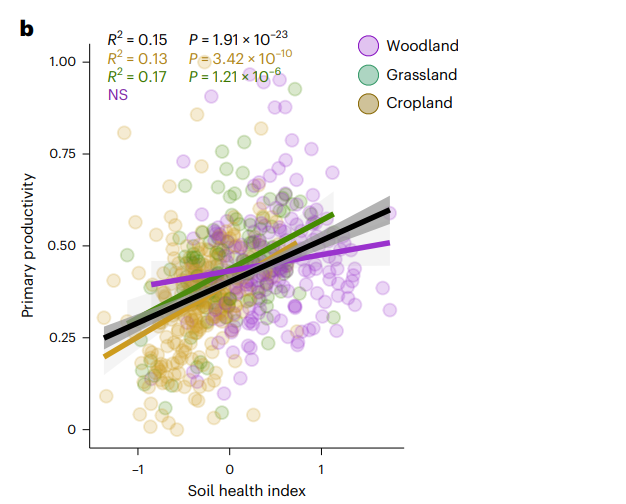
Soil health as a driver of plant productivity. Our new paper in @NatureEcoEvo using data from >500 sites and 27 European countries shows that soil health is associated with higher primary productivity. see:
https://t.co/igW2w7XtWy
Variables of soil fertility including total N content, pH, soil organic carbon and specific soil biodiversity indicators were identified as important drivers of the relationship between soil health and productivity. The relative importance of these variables depended on land-use type.
Lead by @fromeroblanch . Very nice collaboration using the LUCAS data base with @lultimoalbero; @PanosPanagos33; @ManuDelBaq; @PabloGarciaPal ; @EisenhauerLab ; @carlosguerra_pt et al.
The post includes the opportunity to establish independent research topics and to help shape the group's research and teaching together with my team and me.
We are a vibrant and international group @UniOsnabrueck. Please feel free to contact me in case you have any questions.
Jiang gaofei presents Biodiversity restoration based on microbial volatiles at micrope conference. Great work by Waseem Raza and colleagues in nanjing and Utrecht
Do you want to run a microbial GWAS but are put off by installing a dozen different bioinformatic tools, are unsure about best practices, and how to transform the list of threshold passing variants into a neat annotated table?
Then we have just the thing for you!
Want to work on the sweet sites of bacterial life? Then apply for a fully funded PhD-student position in my lab.👇👇👇 (Please spread the word and retweet)
🚨Job Alert🚨 The Chair of Nature Conservation & Landscape Ecology @UniFreiburg is hiring a junior scientist for the EU Horizon project @WildPoshProject 🐝🔬 Research on wild pollinator toxicology, starting 01.10.2024, apply by 24.06.2024. More info: https://t.co/vOH4FbaxL2
Intermittent water stress favors microbial traits that better help wheat under drought
@ISMEComms by @RuthLSchmidt et al from Etienne Yergau lab
https://t.co/Gh9Af52jcB
Widespread horizontal gene transfer between plants and bacteria
@ISMEComms from @AsafLevyHUJI
"75 unique genes that were horizontally transferred between plants (Arabidopsis) and bacteria"
https://t.co/CfD4QqzN8X
We are supporting #MSCA applications to work on host associated and environmental #microbiome. Join our team @LeibnizATB
If you’re interested send your cv and an abstract of your idea to aabdelfattah[@] https://t.co/VpN9d06NbM
New preprint by #BenOyserman on microbiome assembly in tomato. Identified various host QTLs for abundance of microbial taxa, but also microbial SNP alleles in MAGs associated with recruitment by either modern or wild host genotypes. @niooknaw@WURplant https://t.co/dPgDYXr3LU 1/3
Competition for iron is one of the most universal pressure on microorganisms. But predicting siderophore structure used up be a hassle. No longer! https://t.co/Ocr6jCYoI5 @eLife
If you’re interested in rapid in-situ metagenomics with Oxford @nanopore MinION, here’s a great example of how a lab-in-a-suitcase approach can achieve same-day on-site results, allowing “real-time functional and taxonomic monitoring of microbial communities in remote areas”.
The article, by Tamames et al. (2024), features two case studies:
⭐Investigating the microbial communities associated with volcanic rocks on La Palma island, Canary Islands, Spain.
Here the authors investigated bacterial and eukaryotic communities on lava rocks of different ages, producing results within a 24-hour window. To validate the results, the data produced with ONT MinION were later compared with those produced with Illumina NextSeq2000. The taxa and functional genes detected with both sequencing technologies were very similar, confirming the results were accurate.
⭐ Investigating the sulphur metabolism genes in planktonic microbial communities in Ria de Vigo, an estuary in Galicia, Spain.
In this study the aim was to test a results-driven sampling approach over two days. On the first day surface waters were sampled and analysed from three sites, with the results indicating the most interesting site for sulphur metabolism genes to be sampled and analysed in greater detail during the second day.
The authors suggest several advantages of their in-situ approach, such as:
🧬 Rapid monitoring of microbial communities: where rapid results can guide rapid appropriate responses, for example pathogen and antimicrobial resistance gene detection, rapidly evolving microbial blooms, fermentations, and bioreactors.
🧬 Rapid surveys of remote sites: where rapid results can allow researchers to determine whether a site is of interest or not, and whether to sample in more depth or sample elsewhere.
🧬 Rapid discussion of results: the authors' software pipeline allows immediate publishing of the results on a web interface (provided there is an internet connection) allowing collaborators elsewhere in the world to access and interrogate the results as if they were present.
Very cool stuff!
You can read the article here:
Tamames et al. (2024). In situ metagenomics: A platform for rapid sequencing and analysis of metagenomes in less than one day. Molecular Ecology Resources, 24(2), e13909.
https://t.co/KOgpQNPbuM
You can also find a complete experimental protocol to accompany the article here:
https://t.co/cqWRHu1iBY