bullish on the PM role quietly becoming the most important role in tech again
when anyone can build, the person who decides WHAT to build becomes the bottleneck
marketplace startups are destined to be massively reinvented by AI. The weak form is already happening, where we use LLMs for customer support, supply/demand matching, etc. That’s easy
The strong form is to figure out how much of the supply side of the marketplace can be turned agentic and ultimately, robotic. “Uber for X” will have consumers requesting robots to do X. Every on-demand service of the 2010s will instruct a robotaxi or delivery robot. Or if you’re prev used a marketplace to hire X, then you “hire” an agent instead. You won’t need to app developer, because there’s agents to build your app
This will impact marketplace cos differently. Of course some marketplaces - like Airbnb - inherently work in the physical and will leverage AI around the core value prop. And some are bound to lose their network effects as matching fragmented supply/demand turns into an AI problem. Much change is coming
The next big business model for marketplaces will emerge when demand works at high abstractions and supply meets it by becoming programmable
The gap between “can build” and “knows what to build” is the widest it has ever been. And AI is pushing those two curves further apart every quarter.
API costs dropped 97% in two years. No-code gets you to MVP for under $10K. A weekend of vibe coding gets you a working prototype. The supply of “can ship” is effectively infinite now.
The supply of “can feel where a product is soft, hold the 2-year vision, reverse-engineer the sequence, and tell the story that makes someone stop scrolling” is close to zero.
68% of apps never hit 1,000 downloads. 90% of startups fail. 77% of users leave within three days. Not because the engineering was bad. Because nobody on the team could answer “why does this exist” in a way that anyone cared about.
The narrative piece is what most PMs still underestimate. The story shapes the first frame users bring to the experience. Bolt it on after building and you’ve already lost. The team internally doesn’t know why they’re building. The user externally doesn’t know why they should care. Every sprint without a clear “why” compounds against you.
Where I’d push back on signüll: the person he’s describing IS a product manager. The fact that he feels the need to invent a new title tells you how far the role has drifted from what it was supposed to be. PMs weren’t meant to be ticket writers and standup facilitators. The role was always supposed to sit at the intersection of taste, technical depth, and narrative. We just let it get buried under process.
The bottleneck moved. The job descriptions didn’t.
the most underrated hire right now is a great product person.
when i say product person i'm def not talking about a product manager. perhaps i think there has to be somewhat of a new role. i don't have a good name for it yet but maybe something like "product thinker".. someone with an intuitive grasp of the product as it exists, where it's soft, where it sings, & how to iterate it toward something even sharper. in some sense, this person has to cohesively hold in their head where this product should be 2 years from now & work backwards from that.
i say this cuz when building was hard, engineering was the bottleneck & the status hierarchy often reflected that. building is no longer hard. which means the variance in outcomes has shifted almost entirely to judgment on what to build, how to sequence it, & how to talk about it.
& the story matters as much as the thing. internally, it organizes the team around a shared model of why. externally, it shapes the interpretive frame users bring to their first experience. you can't retrofit narrative onto a product & expect it to land, it has to be load bearing from the start.
the rarest version of this person sits at the intersection of culture & deep technology. someone genuinely bilingual. they know what's technically possible & they know which cultural currents are real vs. ephemeral. that combo is what separates products that feel inevitable from products that feel assembled.
before ppl clap back with this person has always been valuable, i know.. i am just saying now they might be the most *important* person in the room. their value compounds like never before.
The part most people will skip: NVIDIA just made every voice AI API a commodity.
OpenAI charges $0.06/min input and $0.24/min output for Realtime API. Gemini Live bills 25 tokens/second of audio. Every startup building voice agents is hemorrhaging cash on per-minute API fees to run what is fundamentally a pipeline problem: ASR → LLM → TTS, three models stitched together with latency at every seam.
PersonaPlex replaces that entire pipeline with one 7B model. Runs on a single A100. Open weights, MIT license, commercial use permitted. Response latency: 0.170 seconds for turn-taking, 0.240 seconds for interruptions.
It scores higher on dialog naturalness than Gemini (2.95 vs 2.80 MOS) and handles interruptions better than every commercial system they benchmarked.
This tells you everything about NVIDIA’s playbook. They don’t need to charge for the model. They need you to buy the GPU. Every company that self-hosts PersonaPlex instead of paying OpenAI per-minute is another A100/H100 sale. Every voice agent startup that drops their API dependency is another enterprise GPU contract.
NVIDIA open-sourced the fishing rod because they sell the lake. Built on the Moshi architecture from Kyutai, fine-tuned with under 5,000 hours of data.
The voice AI margin is migrating from the application layer to the hardware layer. And NVIDIA is the only company that profits no matter which model wins.
330,000 downloads in the first month. That’s infrastructure capture disguised as generosity.
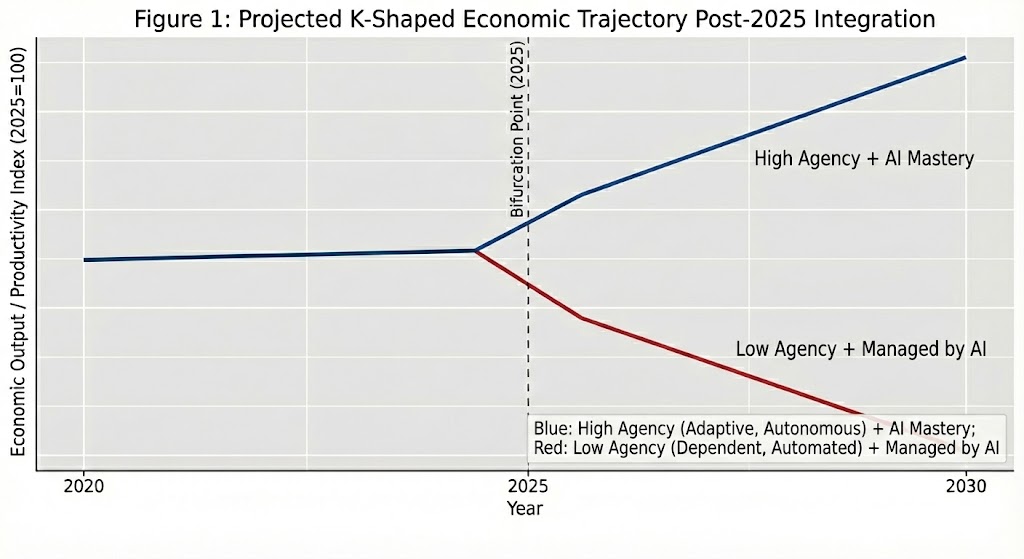
In 10 years, there will be two classes of people.
Economists call it the "K-shaped economy" - and the next 2-3 years will decide which line you're on.
• An overclass that uses AI as a lever to build wealth, automate income, and make decisions at a speed no human can compete with alone.
• And an underclass that gets managed by it.
This isn't just "coming". It's already happening.
Some mind-blowing stats:
• Workers with AI skills earn 56% more than the same job without them. That premium doubled in a single year.
• Industries adopting AI are seeing 3x the revenue growth per employee.
• Meanwhile, 90% of workers haven't taken a single hour of AI training.
• Goldman Sachs estimates 300 million jobs will be affected by AI by 2028. That's 24 months from now.
If you're reading this now and you haven't built systems with AI - haven't automated a single workflow, haven't used it to create anything that makes you money or makes you irreplaceable - you are currently on the wrong line.
That's not an insult. You have the agency to change your trajectory right now.
But six months from now, the gap will be twice as wide. And a year from now, it may not be crossable.