Back home again in Indiana!
Happy to share that I recently joined @IUMedSchool as a Tenure-Track Assistant Professor in the Department of Psychiatry.
In other news, I just received my NOA for my 5-year K01 from @NIAAAnews: https://t.co/MzPAUxyxHZ
A polygenic score calculated using concordant single-nucleotide variants may potentially be used to evaluate people with alcohol use disorder risk. https://t.co/HPcp5ztPpP
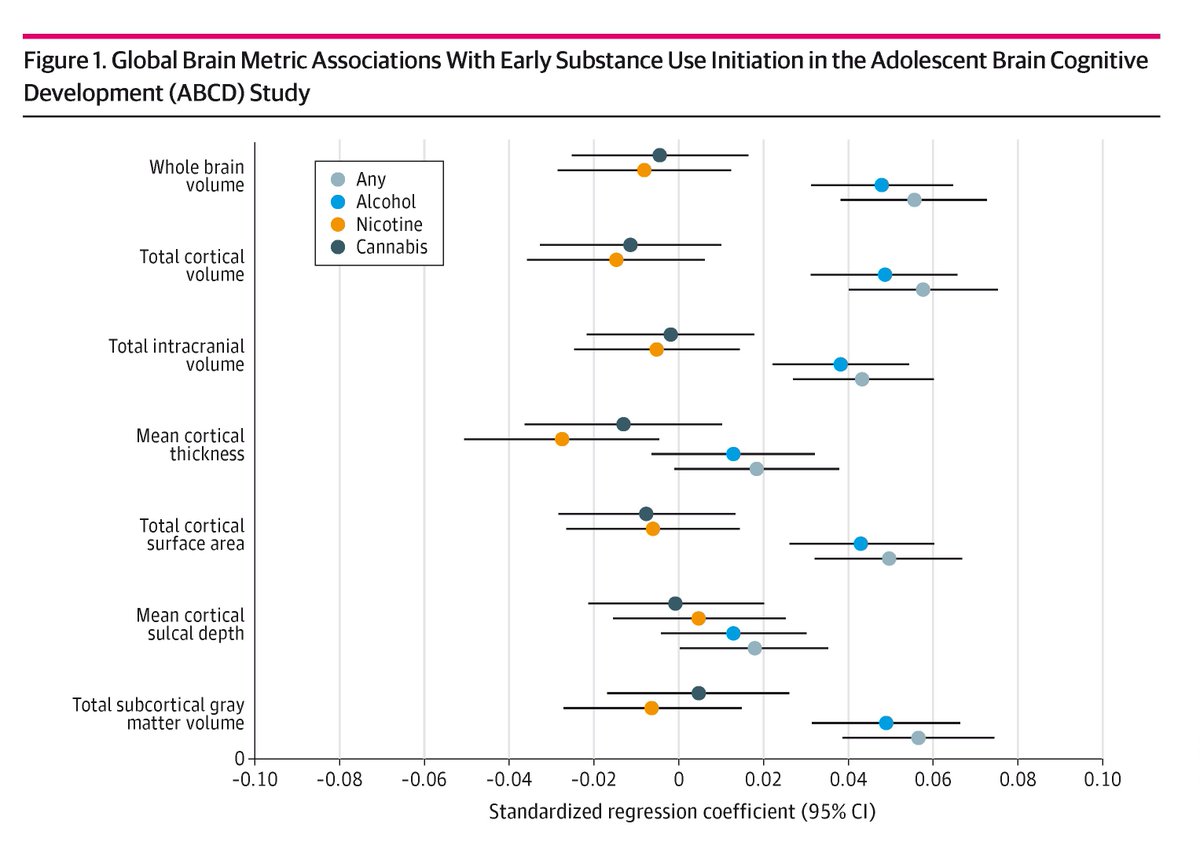
🆕 from #NIDA: Brain structure differences are associated with early use of substances among adolescents. @WUSTL #ABCDStudy https://t.co/r6afD8JtH7 (1/3)
Pre-existing brain structure variability in children, eg, greater whole brain, cortical, and subcortical volumes, and thinner prefrontal cortex, but thicker cortex elsewhere, was linked with earlier substance use. @Alex_PMiller https://t.co/kaQ4fpoyfW
Across all samples, which included @Add_Health, @UTAustin GENES, and @CO90s, sensation seeking PGSs were associated with greater adolescent binge frequency, while alcohol consumption PGSs were associated with steeper increases to peak binge frequency in emerging adulthood.
New preprint examining associations between impulsive personality trait, alcohol consumption, and alcohol use disorder polygenic scores (PGSs) and binge drinking trajectories from adolescence into early adulthood in three independent longitudinal samples. https://t.co/XYJ0KVrIa2
In a new @Nature study, a team of researchers at YSM, @JacksonLab, and @broadinstitute use generative #AI to create #DNA sequences never seen in nature.
The synthetic sequences can selectively turn #genes “on” and “off” in targeted cell types: https://t.co/T48IEsWRmr
Back home again in Indiana!
Happy to share that I recently joined @IUMedSchool as a Tenure-Track Assistant Professor in the Department of Psychiatry.
In other news, I just received my NOA for my 5-year K01 from @NIAAAnews: https://t.co/MzPAUxyxHZ
I feel very fortunate to be able to do this work at @IUMedSchool near family, surrounded by wonderful colleagues, and with the support of my incredible mentorship team.
Our article exploring the neurobiological correlates of prenatal cannabis exposure is now out! "Prenatal cannabis exposure, the brain, and
psychopathology during early adolescence" https://t.co/aEiDj7j9Kj
Excited to share new work (~half of my dissertation!) just out in 𝗣𝘀𝘆𝗰𝗵𝗼𝗹𝗼𝗴𝗶𝗰𝗮𝗹 𝗠𝗲𝗱𝗶𝗰𝗶𝗻𝗲! https://t.co/pS7SmPf6FF Big thanks to my wonderful co-authors, @David_Baranger, @e_covey_johnson, @jackson_josh_, Aaron Gorelik, @Alex_PMiller, @AlexanderHatoum, ...
New preprint online! Using data from the ABCD study, we looked at differences in baseline brain structure among children (ages 9-11) who had and had not initiated substance use by 3-year follow-up (prior to age 15).
https://t.co/eo6LEGJoQC
Follow-up tests controlling for prenatal substance exposure and restricting our analyses to only participants initiating use after baseline suggest many of these structural differences are independent of prenatal exposure and precede substance use involvement.