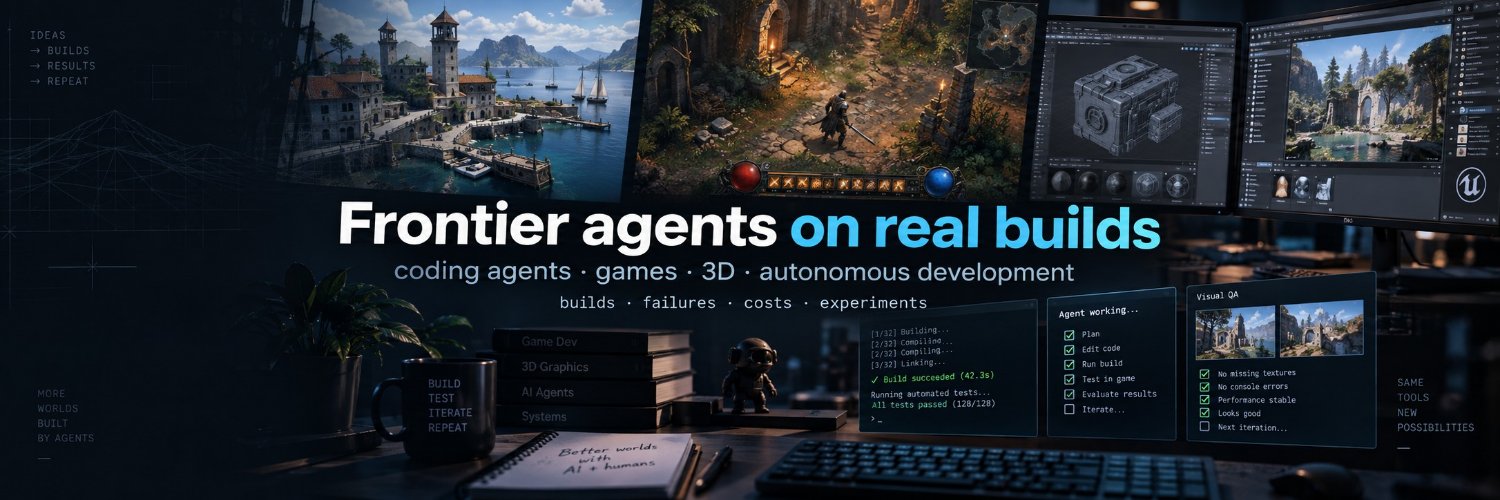
FIXER — The First Favours demo is live.
I started FIXER as a Three.js game, migrated it to Unity with AI agents, and now there’s an actual playable Windows demo.
Take jobs, drive the city, fight, earn money and choose how you approach the work.
Free demo:
https://t.co/zrsd06Dxpe
If you play it, I want to hear what works and what breaks.
Hey X - looking to connect with more people into AI, coding agents, software engineering, game dev, 3D, Unity, Unreal, Three.js and Blender.
If that’s you, say hi 👋
Let’s connect.
@AriesTheCoder Good to connect. I’m spending most of my time around coding agents and game development right now, so definitely overlapping interests 👋
@vlasyuk_a Thanks Alex, good to connect. The Unity move was mainly about performance: on the same GTX 1080 / i5-4590 box I went from ~25 FPS in Three.js to ~59 FPS in Unity. Still plenty to polish, but getting the demo playable was a big milestone.
@EdenBitton7 Good mix 😄 I’m mostly on the engineering / AI-agent side, so the practical business and marketing angle is something I’m interested in too. Good to connect.
@howithin That split makes sense. I’m finding the model choice matters a lot by task too, especially once you separate code/organization from visual work and asset iteration. The interesting part for me is figuring out where each model consistently starts to fail.
@DanielZambrini I’m starting to think that’s the part I’ve underestimated. I’ve spent a lot of time posting the work itself, but the accounts growing around me seem to spend much more time actually talking with other builders.
One more way to look at the scale:
Pricing only the 1.519B GPT-6 Astra tokens at current Standard API rates, while preserving the recorded cache hits, comes to roughly $2,008 API-equivalent.
That is not what I actually paid under the subscription.
I’m also leaving the 182M automatic-review tokens out of that estimate because I don’t have a published price for them.
I asked GPT-6 Astra to total the usage from the FIXER session where I polished the Three.js build, migrated the game to Unity, then kept fixing and polishing it.
1.702 BILLION recorded tokens.
Over 6 days, 4 hours elapsed:
1.519B Astra
182M automatic reviews
97.3% of input was cache-served
That’s not 6 days of continuous work, and it’s not a bill.
But it shows how absurdly large long-running coding-agent workloads can get when the same project context, instructions and tool state are processed again and again.
Exactly. I think “did it complete the task?” is only one axis.
In game-agent testing I’d want separate measures for things like path/decision efficiency, recovery from mistakes, unnecessary actions, exploit-like behavior, and how coherent the play looks to a human.
Two agents can reach the same end state while one looks competent and the other looks completely broken.