The Supreme Court weakened a key piece of the Voting Rights Act, making voting discrimination cases dramatically harder to bring in federal court. Cases citing Section 2 of the Act plummeted 60%, a @BLaw analysis shows. Here's a 🧵on our reporting
https://t.co/tVfMhBmyZx
After Callais I wondered in chats with election law litigators whether SCOTUS would eventually rule that states’ political gerrymanders trump the constitutional rights of voters under the 14th Amendment.
Tonight the court decided just that in Allen v. Milligan. See highlights.
@teafortillerman@brettnolan Also, I’ve greatly enjoyed this chat guys.
I’m really looking forward to watching what groups do with this ruling—and how it could have broader impacts on state law based claims in this realm (Florida constitution especially).
I expect it’ll be cited/used by both parties, BTW
@teafortillerman@brettnolan I don’t see how you and I disagree. SCOTUS makes it so with Callais/this Milligan.
Doesn’t matter whether folks like it —this is the law now.
Show the impossible map or take your ball and go home. That’s what the 14th Amendment/VRA redistricting claims can be reduced to
@teafortillerman@brettnolan Going forward there could be the most explicit discrimination by lawmakers. But if plaintiffs don’t bring forward a map that checks all of the state’s criteria they can’t win.
Protect incumbents. Combine X counties, whatever. Move the goalposts, win the game.
@teafortillerman@brettnolan Think you might be looking past the setup in this case.
Here we have a case where lower court (two Trump appointees) found there was intentional discrimination. Yet, SCOTUS says the lack of map—that lower court says is impossible without discrimination—blocks claim. Circular.
@teafortillerman@brettnolan Put bluntly: meeting criteria that can’t be met without discrimination, to prove a discrimination claim, is the circular problem.
@teafortillerman@brettnolan Sure. SCOTUS says 14A violation can’t be found unless there’s a map that accomplishes all state criteria.
Those criteria are impossible to meet in map that doesn’t discriminate against X voters intentionally.
Thus, now criteria can (and have) trumped intentional discrimination
@brettnolan@teafortillerman Think you misunderstand where I’m coming from. I’m not criticizing the court.
Reading the order it looks like SCOTUS—at least the majority—agree with my reading.
And I personally have no investment in any standard. They can make the bar as high or low as they’d like.
@brettnolan@teafortillerman Not sure where you’re going here.
But I see no issue with this claim, beyond stating that there seems to be an argument that minority voting patterns change marginally, election to election. True, but how that impacts standards seems squishy, no?
@brettnolan@teafortillerman Again, thanks for this thought. But again, we part ways.
This evidence, with local voting pattern data, is exactly what has been used to show racially polarized voting in litigation.
Disentangling in many areas likely ain’t possible. See Tennessee/Memphis.
@brettnolan@teafortillerman Hi Brett. Thanks for these thoughts.
We’re going to part ways because your first point here is circular. If, in order to have valid 14A claim, one must meet state criteria, those criteria now trump 14A claims—you need this to get that (higher in order of operation).
@mattlinla If you're not seeing it that's because my fat thumb didn't highlight the surrounding sentences. (I need a better way of doing this on phone)
Both points--state's reason of incumbent protection; issue of evidence of racially-polarized voting not sufficient--are on that page.
@teafortillerman Hi Joe. I read this ruling and Callais a couple times. Where do you think I’m incorrect?
Sincere question. Would love to hear your thoughts.
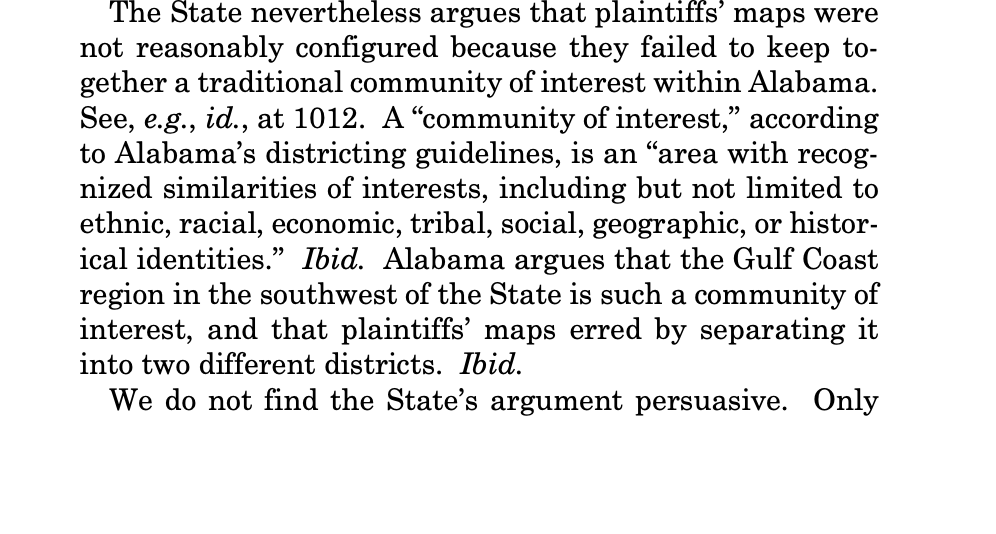
In 2023, chief justice John Roberts & SCOTUS majority said Alabama's argument for a "community of interest" along the gulf coast was BS.
Tonight, SCOTUS takes a reversal and says that a court-ordered map was not legal because it failed to keep Gulf coast comunity together
Callais: We’re not changing the test for discriminatory intent claims.
AL district court: Okay, we find discriminatory intent.
SCOTUS tonight: You misread Callais. We’re reversing you.
I have studied under election law masters and I’ve read thousands of pages of redistricting litigation rulings, briefings, special master reports, and legislative testimony.
Can’t say I’ve ever read anything quite like this.
Now it’s not just the VRA (statute) subject to Callais’ stringent test, but intentional discrimination (vote dilution) against minority voters.
A state’s preference for how incumbents are handled in a map is judged more important than the 14th Amendment.