🚨Today is publication day for my book, "Aligning Election Law"!
The book argues that promoting alignment between governmental outputs and popular preferences should be an overarching goal of election law.
You can buy the book at the link below.
https://t.co/B3fwYkIXBp
Callais: We’re not changing the test for discriminatory intent claims.
AL district court: Okay, we find discriminatory intent.
SCOTUS tonight: You misread Callais. We’re reversing you.
NY has enough seats to impact the national balance of power.
And aiming for national fairness is likely to be more appealing to voters (who have to approve the plan) than authorizing aggressive gerrymandering no matter what.
NY is the perfect place to try the strategy @goldzimer and I outlined a few years ago: redistricting with the goal of NATIONAL partisan fairness.
https://t.co/Fq5lilQW4N
Politico: New York Democrats push redistricting amendment, joining national battle
“Democrats have finalized their plans for a state constitutional amendment to change New York’s redistricting process — joining a national battle over drawing congressional boundaries.”
“The changes would enable Democrats to shift as many as four Republican-held House seats to their column in the 26-member delegation — giving the party a slight edge in a state with several swing districts.”
https://t.co/0Xc0NgK8G3
The WI Supreme Court agreed to hear our case alleging that the congressional map is an anticompetitive gerrymander.
Note that this *isn't* a partisan gerrymandering challenge; our grievance is the map's suppression of competition (not its partisan skew).
https://t.co/awuzOhdx9b
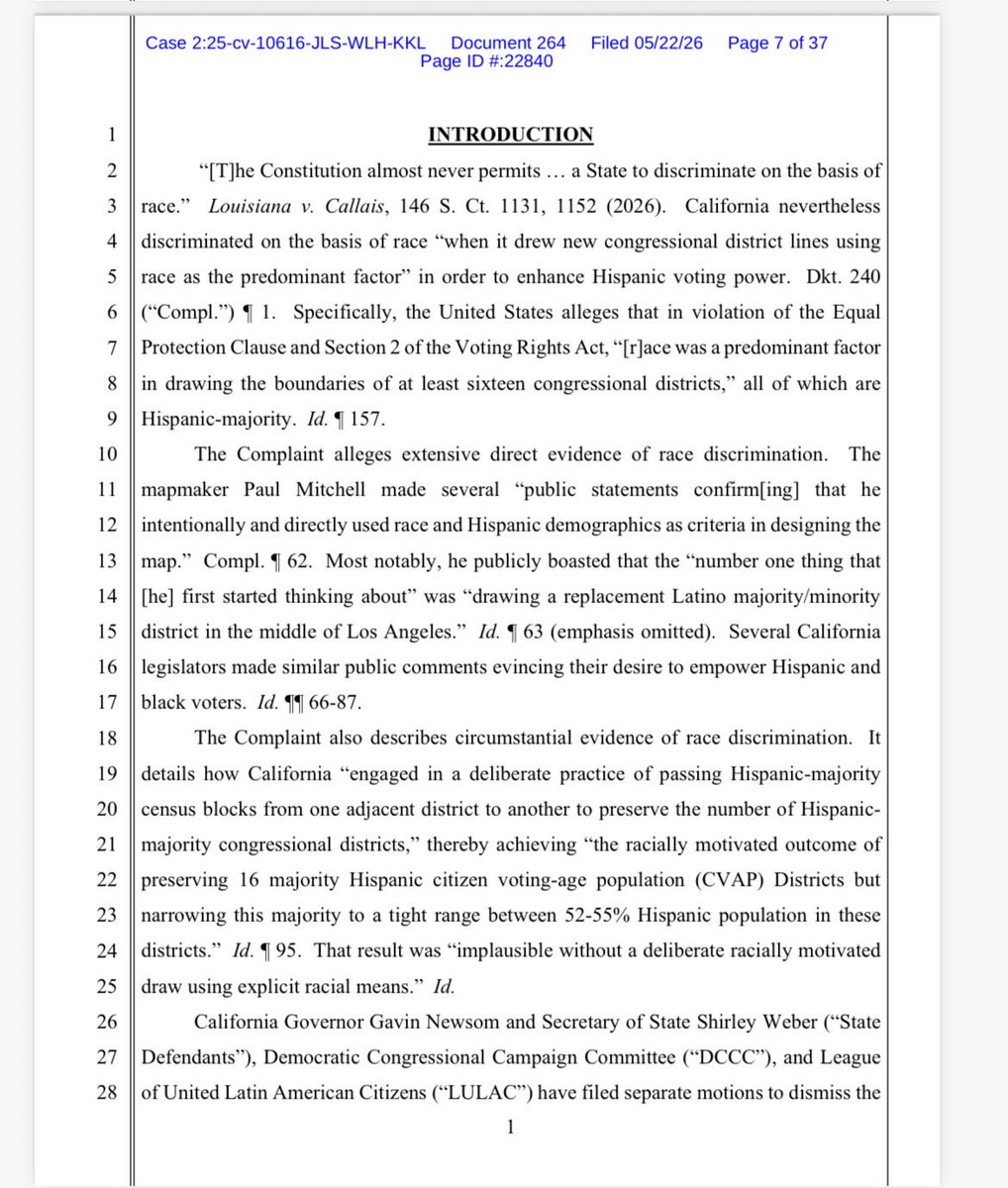
The DOJ literally filed the same claim a few months ago - and lost 9-0 at the Supreme Court.
Again, Callais didn’t change the law of racial gerrymandering. So districts that were valid then (because party, not race, predominated) are still valid now.
@leedrutman I forget if that's the same as the 2022 bill or not. The 2022 bill may have *seemed* to have wiggle room but it really didn't. The EG is the only fairness metric that met its criteria. And the 7%/1 seat presumption was close to irrebuttable (if a compliant map was possible).
These are major problems in theory - except, in practice, Congress can resolve them all.
Congress can pick some criteria and exclude others, and just set a fairness threshold that can't be exceeded.
Redistricting tradeoffs are also often overstated. See https://t.co/o1lyaYGfov.
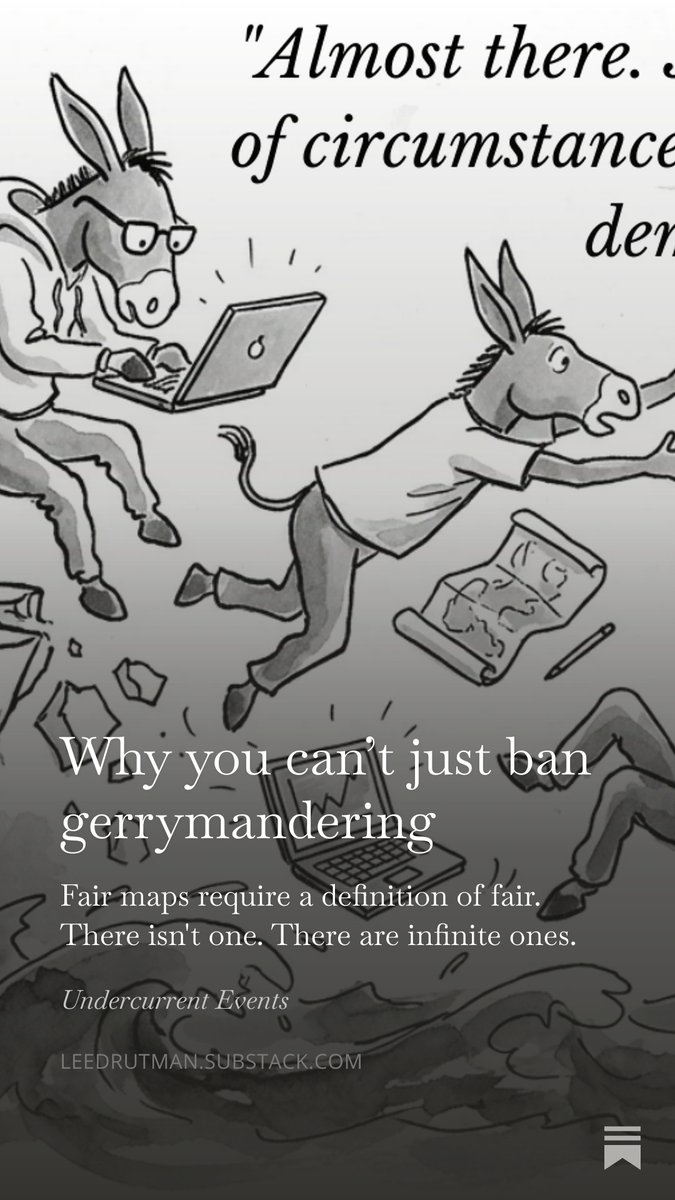
Ban gerrymandering. It sounds so obvious. So simple. Of course we should do it.
Except, there’s just one problem. What is a gerrymander, anyway?
You may think you know it when you see it. But are you so sure? How would you measure it?
@leedrutman The final 2022 bill basically imposed an efficiency gap ceiling of 7% or one seat (depending on state size), calculated using specific elections.
I expect a future bill would be even more determinate.
A nice @ElectionClinic win: Quincy has to count 1000+ voter signatures it rejected due to "illegibility" - even though voters' printed names were next to their messier signatures.
(This was on an initiative petition to rescind a pay raise for the mayor.)
https://t.co/Bvusa42gEP
We can be more judgmental here: Republican mid-decade gerrymandering has eliminated the unbiased House of 2022-2024 and replaced it with a chamber significantly skewed in favor of Republicans.
From a democratic perspective, this is something to condemn, not celebrate.
NEW: Here's a different way of visualizing the House battleground & the impact of redistricting.
Republicans have shifted the tipping point seat 9 points right. Just beyond that, Dems have few opportunities. https://t.co/brTqPMRYQj
I have long argued that we should give more weight in redistricting reform to the importance of competitive districts. You often hear that "the big sort" makes it difficult to create competitive districts.
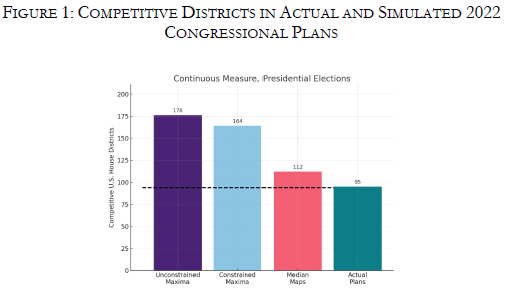
In an article with @ProfNickStephan, "Districting and Competition," we make use of simulated districting to show that we could have twice as many competitive districts without any sacrifice in traditional districting criteria. That would make the House more responsive to shifts in voter preferences and reduce the extremism associated with safe seats.
Link in reply
@GeoffWise3@RickPildes@PennLRev No, I think the story is consistent ; we just focus on competitiveness (not responsiveness), examine it from a bunch of angles, and look at both congressional and state legislative plans.
Here's a new essay by @RickPildes and me, forthcoming in @PennLRev, on districting and competition (link in next tweet).
We compare the competitiveness of enacted U.S. House plans to that of maps generated by a computer algorithm.
Our main finding is that enacted plans are *much* less competitive. Without any sacrifice in terms of traditional criteria, we could roughly *double* the number of competitive districts. This would lead to a much more responsive, more accountable House.
https://t.co/PNSOv0sk8Q
The short answer is that redistricting roughly HALVES the expected number of competitive districts compared to maps created without considering election results.
That is, we could have twice as many competitive districts (without any cost in terms of traditional criteria).
In an article we’ll post soon, @RickPildes and I look into this topic: to what extent redistricting is responsible for diminished competition (as opposed to geographic sorting and other factors).
https://t.co/GfHrYqdFCz
Update: Cohn & Washington say they “reran the simulations without consideration of race.” If so, then they’re not just using the off-rack ALARM ensembles and their maps (unlike the ALARM ones) were actually produced without any race-related parameter.
Update: Cohn & Washington say they “reran the simulations without consideration of race.” If so, then they’re not just using the off-rack ALARM ensembles and their maps (unlike the ALARM ones) were actually produced without any race-related parameter.