@CarinaDelpicco1@LatinXChem then sequentially, amine (0.2 mmol, 1.0 equiv.), the carboxylic acid (0.2 mmol, 1.0 equiv.), and isocyanide (0.2 mmol, 1.0 equiv.), were added. After completion, aqueous NaIO4 was added dropwise to the reaction, and the mixture was stirred at rt until the reaction was finished.
@CarinaDelpicco1@LatinXChem The general procedure:
piperidine (0.01 mmol, 5 mol%) was dissolved in 0.8 mL of 2-MeTHF (0.5 M). then aldehyde (0.2 mmol, 1 equiv.), the solution was stirred for 10 minutes at 25°C. Then N-(Phenylseleno)-phthalimide (0.2 mmol, 60.4 mg, 1 equiv.) was added and stirred y 3h).
@CarinaDelpicco1@LatinXChem Is a good question...in all compounds synthesized we cannot see the other isomer! Firstly, we assume that NMR analysis should be from the E and Z isomers of alkene but the results are from rotamers of tertiary amide bonds.
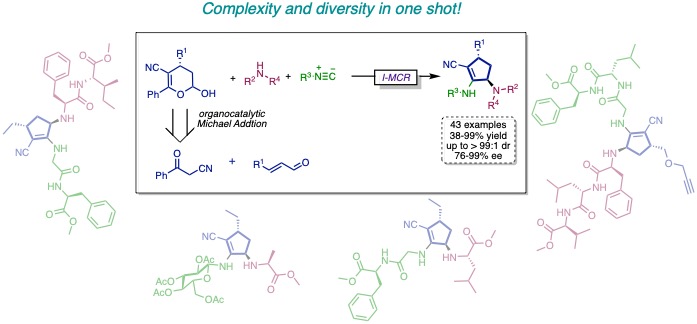
@CarinaDelpicco1@LatinXChem The R1 is from the aldehyde and R4 is from the isocyanide component. As you can see in the scheme there is a mistake with the color of substituent, the blue should be for R1 and red for R4.
Hello everyone @LatinXChem ! Here's my work titled "Multicomponent synthesis of some computational derivative for application as metalloprotease inhibitors" for the #LXChemOrg category, poster number #OC086. #LatinXChem#Ugi4CR#docking
Direct Access to Tetrasubstituted Cyclopentenyl Scaffolds through Diastereoselective Isocyanide-based Multicomponent Reaction - now published in Chemical Science https://t.co/Rh8Ews45kE
Complexity and diversity in one shot! We have just published in @ChemicalScience a new isocyanide-based multicomponent reaction towards the assembly of complex and highly functionalized cyclopentenes !! @FAPESP, @ufscaroficial
@Rossinha4@LatinXChem Hi, @Rossinha4 and @LatinXChem some peptides having phosphonic acid have been employed in the '90s as LasB inhibitor but none was synthesized in a one-pot manner and not as peptoids scaffold.
@Rossinha4@LatinXChem Hi, @Rossinha4 and @LatinXChem I used Boc protected AA in the multicomponent reaction Ugi-4CR. After the product was obtained the boc and ester deprotection is done in a one-pot manner.
@Alexand35535548@LatinXChem Hi @Alexander35535548, that depends on what property do you want to analyze. But in general these reduced models give some hints about the energetics, which can be used as a starting point for condensed-phase calculations
@Alexand35535548@LatinXChem Dear @Alexand35535548, till the date there is no experimental confirmation of aromaticity for these kind of systems. Since, aromaticity it is not a quantum observable there is no a direct physical concept to rationalize (or measure) it.
@Alexand35535548@LatinXChem In this work we found that at least under implicit water, the carboxylation of Propionyl-CoA coupled with Biotin reduced the energy barrier at around 20kcal/mol. Finally the enzyme will help to reduce the other part.. :D
Hi @LatinXChem, this is my work “Mechanism study of Biotin-dependent carboxylation reaction”, #LatinXChem#LatinXChemTheo#THEO047 by which we unravel the most thermodynamically favored path to conducted a carboxylation reaction using Biotin as carboxyl-carrier.
Hi @LatinXChem, this is my work "Revisiting Aromaticity Assessments in Inorganic Clusters", #LatinXChem#LatinXChemTheo#THEO042. This looks into the assignment of aromaticity in inorganic clusters, where the aromaticity measure can be ambiguous by the tool used on the analysis.