@NakfaEnergy Opinion: Energy "commercial diplomacy" is once again central to US engagement in Africa, especially under the Trump administration, and can act as a catalyst for a strategic rationale for Eritrea/US engagement.
Read article here: https://t.co/DL04wHMDaA
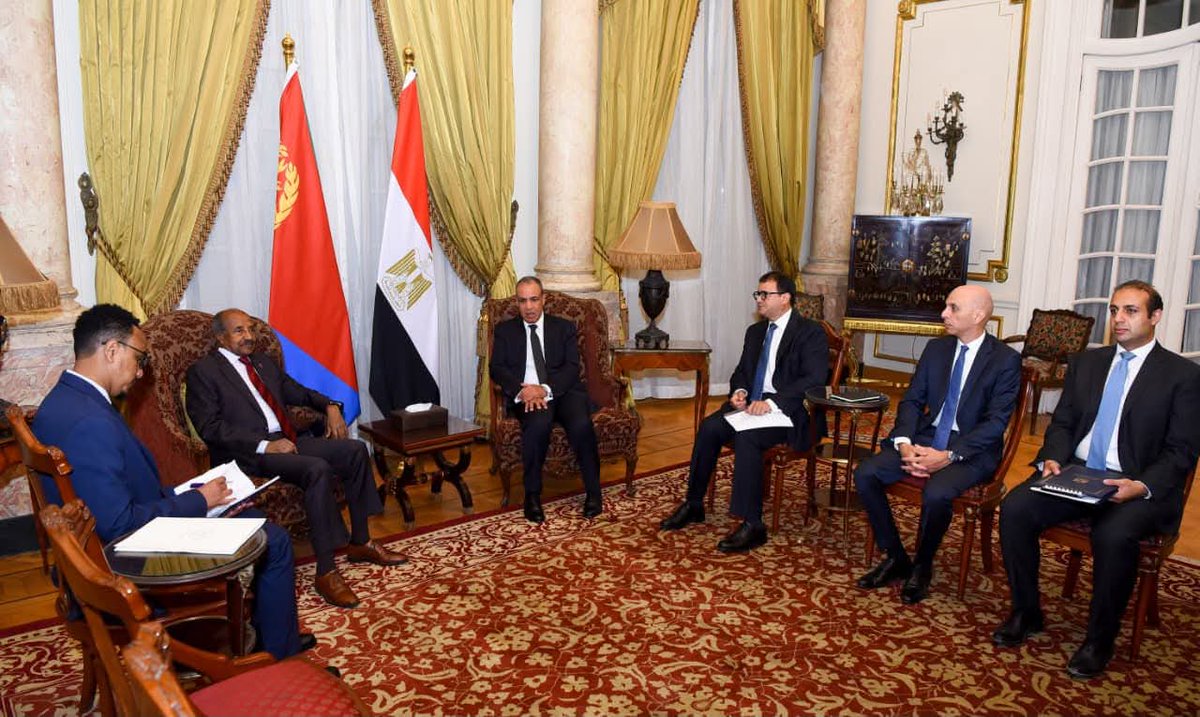
Foreign Minister Osman Saleh met in Cairo today his Egyptian counterpart, FM Dr. Badr Abdelatty, for extensive talks on the consolidation of the strategic and historical ties of partnership that exist between the two countries.
The two Foreign Ministers discussed in greater depth current developments in the Horn of Africa and the coordination of the respective positions of both countries on matters of mutual interest.
The Foreign Ministers recalled the meeting between the two Heads of State held in Cairo last month as well as previous exchanges of Ministerial visits between the two countries.
In this regard, Foreign Minister Osman Saleh and his Egyptian counterpart noted that conducive groundwork has indeed been accomplished to elevate the bilateral ties of friendship and cooperation to a new and higher level and thereby augment the benefits and interests of both peoples.
The two Foreign Ministers also underlined that the security and governance of the Red Sea is, in full consonance with international law, the exclusive and normative responsibility of the littoral States.
Foreign Minister Osman Saleh also met in Cairo Mr. Massad Boulos, President Trump's Senior Advisor for Arab and African Affairs, for extensive talks on the enhancement of Eritrea-US bilateral ties as well as on broader regional matters and developments.
Commodity market guru Jeff Currie on the loss of oil refining capacity:
“We have huge losses of refining capacity all over the world… We estimate 60% of Russian refining capacity is taken out. That is 3 million barrels per day.”
STAY LONG GASOLINE, DIESEL, AND JET FUEL.
🚧🇪🇷 Diesel is the lifeblood of every modern economy. As the primary fuel for transportation, it powers the movement of people, goods, and essential services while serving as the backbone of critical national infrastructure. Diesel fuels commercial trucking, public transportation, mining operations, construction equipment, agricultural machinery, military logistics, maritime transport, and backup power systems. It is also indispensable for electricity generation in many developing and frontier economies where diesel-fired power plants provide reliable baseload and emergency power.
Because diesel underpins virtually every productive sector, any disruption in its supply or a significant increase in its price has cascading effects throughout the economy. Diesel shortages can impede the transportation of food, medicine, fuel, and other essential commodities, disrupt industrial production, reduce agricultural output, increase the cost of electricity, and weaken national security and military readiness. Likewise, rising diesel prices quickly translate into higher transportation and logistics costs, fueling inflation, increasing the cost of living, and reducing economic competitiveness.
For these reasons, ensuring a secure, reliable, and affordable supply of diesel is not merely an energy objective—it is a strategic national priority. Domestic petroleum production and refining capacity provide governments with greater energy security, reduce exposure to external supply shocks and volatile international markets, strengthen economic resilience, and enhance sovereign control over critical energy resources.
🚧Diesel is the backbone of every economy. It powers transportation, electricity, industry, agriculture, mining, and military operations. When diesel is scarce or prices rise, inflation follows, supply chains weaken, and economic activity slows. https://t.co/XWdI0jg20f
#Mozambique’s vast natural gas resources have the potential to transform its economy, but unlocking that potential requires more than world-class reserves. It demands a stable, investor-friendly regulatory framework.
The article highlights how Angola’s gas sector reforms provide a practical roadmap for Mozambique. Through targeted policy measures, including a dedicated natural gas legal framework, gas monetization legislation and fiscal incentives, Angola has successfully attracted investment, accelerated gas commercialization and strengthened energy security.
As #Mozambique advances its own gas ambitions, adopting proven reforms that promote regulatory certainty, competitive fiscal terms and long-term investment could help fast-track project development while maximizing value for its people and economy.
Read the full analysis below. https://t.co/Mab77c4HfU
Read French version here: https://t.co/zTBVK14g8t
Read Portuguese version here: https://t.co/7vbrUF4qpg
🇪🇷⚖️ Eritrea Calls for an End to the Politicization of the UN Human Rights Process
💬 “Justice loses its credibility when it ceases to be impartial.”
At a briefing to the foreign diplomatic community in Eritrea, Foreign Minister Osman Saleh reaffirmed Eritrea's longstanding position regarding the UN Human Rights Council (UNHRC) process.
🔍 Key Messages from the Briefing
🟥 1) End the Politicization
Eritrea argues that, for 14 years, the Special Rapporteur mechanism has evolved into a politicized process rather than a constructive human rights dialogue.
🟦 2) Sovereignty & Mutual Respect
Eritrea reiterated its commitment to international engagement based on:
• 🤝 Sovereign equality
• 🤝 Mutual respect
• 🤝 Non-interference
• 🤝 Genuine cooperation
🟩 3) Economic Consequences
According to Eritrea, the continued mandate has contributed to:
🔹 A negative international perception
🔹 Reduced investor confidence
🔹 A weaker tourism climate
🔹 Obstacles to economic development
🟨 4) Better Use of UN Resources
Eritrea contends that resources devoted to the mandate could instead support:
✅ Capacity building
✅ Development programs
✅ Practical cooperation that directly benefits citizens
🟪 5) Engagement—But Not Selective Targeting
Eritrea emphasized that it remains committed to internationally recognized human rights mechanisms, including:
📌 Universal Periodic Review (UPR)
📌 Treaty body processes
📌 Technical cooperation based on dialogue and consent
🌍 The broader question extends beyond Eritrea:
Should international human rights mechanisms primarily emphasize dialogue, technical cooperation, and capacity-building, or should they continue relying on country-specific mandates that some states view as politically selective?
Constructive engagement is most effective when it is credible, impartial, and applied consistently.
“Lasting solutions are built through trust and cooperation—not perpetual confrontation.”
🇪🇷🕊️ Peace, development, and human dignity are best advanced through principled dialogue, mutual respect, and equal treatment under international law.
#Eritrea 🇪🇷 #UNHRC #UnitedNations #HumanRights #Diplomacy #InternationalLaw #UPR #Africa #Peace #Development #Multilateralism
Angola’s deepwater success story demonstrates that long-term investment thrives where policy, partnership and regulatory certainty align.
By creating a stable investment environment, strengthening collaboration with industry and implementing targeted reforms, Angola has transformed its offshore sector into a model for sustainable energy growth. The country's deepwater developments continue to attract global capital, extend the life of mature assets and unlock new opportunities for exploration and production.
As Africa seeks to maximize the value of its natural resources, Angola offers a compelling blueprint for investment-led energy development that other producing nations can learn from.
Read more: https://t.co/fxxx7OHOnq
Read French version here: https://t.co/kAHzL2Vpuk
Read Portuguese version here: https://t.co/R75vTqYVMe
This guy used Claude to build a Quant Bot and made +$589,139 on Polymarket.
25,388 predictions with a 63% win rate in 77 days.
That comes out to roughly $7,651 in profit per day and almost 14 trades per hour.
With $217K in deposits, he is now up 2.7x.
About +271.5% ROI.
The bot strategy is simple:
It finds markets where the pricing is still off.
Gets in before the odds fully catch up.
Repeats the same setup again and again across many entries.
The edge on each trade is small.
But scale and repetition turn it into a massive result.
Most profitable trades:
$17,839 → $36,318 (+$18,478, +103.58%)
$3,112 → $15,011 (+$11,898, +382.22%)
$10,676 → $22,178 (+$11,502, +107.74%)
What makes it work is not one huge trade.
It is the same small advantage, applied fast, applied often, and repeated until the pricing gap is gone.
I reverse-engineered it. Had Claude rebuild the same logic.
One prompt. 90 minutes. Fully deployed.
You only need: Claude + a device + 1 hour per day.
Giving this free for 24 hours.
To get it:
1. Comment the word PROFIT
2. Like and retweet this
3. Follow me @codewithimanshu so I can DM you
Cameron Hudson’s fixation on Eritrea says more about his clients than Eritrea itself. When paid lobbyists dismiss normal diplomatic engagement as “dramatic,” it usually means the underlying geopolitical shifts are making his sponsors uncomfortable. If Addis Ababa expected serious strategic analysis, they are throwing good money after bad by relying on desperate caricatures instead of confronting geopolitical reality.
It's rarely worth responding to Hudson's posts on topics like the #RedSea or #Eritrea, but here's a textbook example of slick, "motivated" framing that deserves a closer look. He deliberately conflates two separate issues: "exclusive responsibility for security/governance" with "no foreign navies allowed at all."
Keep in mind what Egypt's Foreign Minister actually stated in the report: Red Sea security and governance must be the sole responsibility of littoral (coastal) states, with "no other parties" involved in setting the rules. This has absolutely nothing to do with banning foreign naval presence or activity. The point of the littoral states' council is straightforward: coastal countries should lead on rules, patrols, and overall management, ie not outsiders unilaterally imposing agendas. Naval presence is a completely separate issue.
Why? Because littoral states can legally invite and host foreign navies through bilateral agreements. #Djibouti does exactly this with the massive US base at Camp Lemonnier, plus facilities for France, Japan, China, and others. That's consensual hosting by a sovereign coastal country, not "imposition."
Hudson blurs this distinction deliberately. He's attempting to make the Egyptian FM's statement appear far more extreme and anti-Western than it actually is, a convenient framing when you're trying to shape narratives for new clients.
Guess who's been knocking on his consulting door lately? PP #Ethiopia! 😂
#Eritrea’s foreign policy remains firmly anchored on these core principles, guiding its commitment to independent political path, regional stability, mutual respect, and regional and international cooperation.
🇪🇷
#EritreaShineAt35#Diplomacy#ForeignPolicy