Making FHE accessible @Intel Labs. PhD from @ETH
Trying to make secure computation (FHE, MPC) more accessible to non-experts through new tools & abstractions.
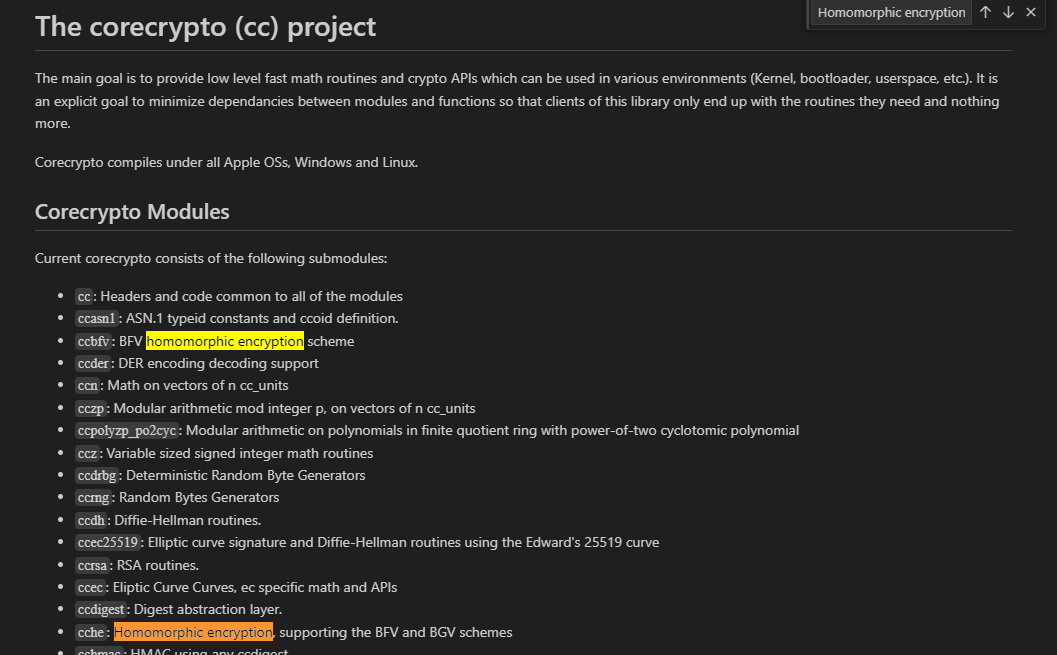
Apple's corecrypto library (scroll way down on https://t.co/x6O83rZmJo) contains both ccbfv (BFV implementation) and cche (BGV/BFV). Does anyone have any idea what these might be used for? (or why there's two different BFV implementations?)
Stick around on Friday for the *very last talk* of #HotPETs🍦where we promise some hot (🌶️🌶️🌶️) takes on PETs design and real-world privacy incidents
(with Lena Csomor, @AlexanderViand, @anwarhit, @bkacsmar)
@attache_travel What are things that one should do/book/reserve ahead of time? E.g., prebooking to skip the queue at <attraction>, following an account announcing pop-up art events, etc
@jeremyjkun In the area of FHE specifically, there's at least @zama, https://t.co/Zo3ojbtg5O, https://t.co/kdwAXohEli and myself using MLIR and defining custom IRs.
@ElaineRShi@IEEESSP@AndrewCMyers This sounds great! I tried to register (i.e., filled out the form) last week but never heard anything back :(
Did I make it in time? Also pinging @AndrewCMyers
Announcement:
PL meets crypto workshop co-located with IEEE S&P organized by @ElaineRShi and @AndrewCMyers will be held on Sunday, May 22 on SRI campus in Menlo Park, CA.
Many amazing speakers: https://t.co/sKtSWSvN5R
RSVP via https://t.co/tHzJ51fWcU
First come, first serve
@zornsllama In "correct" German, it probably should: https://t.co/BF2pbLCstk but it's not a very frequent thing. The "Greetings from the n of us" is probably the only case where it's expected. The Genitiv is pretty uncommon, I'd use "von zwei X" instead of "zweier X"
@zornsllama I don't know what grammar thing is happening there, but there's *something* happening to numbers in some car names: "BMW 1er/3er (einser/dreier)" which are the 1-series and 3-series in English, afaik
If you want to get an idea what the DARPA DPRIVE program on FHE accelerators is all about, this paper is a great introduction to the power (and challenges!) of dedicated HE accelerators: https://t.co/hZiMwgO32c
Together with efficiency improvements, FHE also became much simpler. In Spring 2010 FHE was "hot of the press" but I couldn't help myself and tortured my COS 433 students with 4 dense lectures https://t.co/bCkrJJ7PJE
These days it fits nicely in two https://t.co/IS5RPPzXcU
@TedOnPrivacy@_shruthig Really cool to see this! If you're interested, I'd love to have a chat at some point about the project! For example, XLS seems to be pretty hardware focussed - any thoughts on what it would take to extend it to arithmetic circuits (BFV/BGV/CKKS)?
Big news today! 🚨 We're releasing a first-of-its-kind transpiler to make it radically easier to use 🔐 fully homomorphic encryption🔐!
Put regular C++ code in, get FHE-ready C++ code out. Magic ✨
Check our our code! Or keep reading for more info 😀
https://t.co/bqt1CutsAc
Really excited to talk about the challenges of #FHE development and how the current ecosystem of tools & compilers is addressing/trying to address them :)
Thanks for inviting me @randhindi!
The next @fhe_org meetup will be on May 20th. @AlexanderViand will be talking about #FHE tools and compilers. Join us if you are a developer interested in protecting your user data with #cryptography! https://t.co/vl9UIQG4uf
Finally, we give concrete tool recommendations and outline future directions for FHE compiler development.
Check out our repo with detailed tool descriptions, our example applications, and readmes & ready-to-go docker images for the tools we explored https://t.co/1LI0dQfHTO 5/5
Excited to share our upcoming @IEEESSP SoK paper on Fully Homomorphic Encryption Compilers, i.e. tools that help lower barriers of entry in FHE for non-expert developers. https://t.co/WfkKvJXOB8
Joint work with @pjattke@anwarhit 1/n
We highlight where barriers to entry have been successfully lowered and where they still remain using different case study applications (medical, statistics, ML) representing common aspects of FHE applications.
4/n