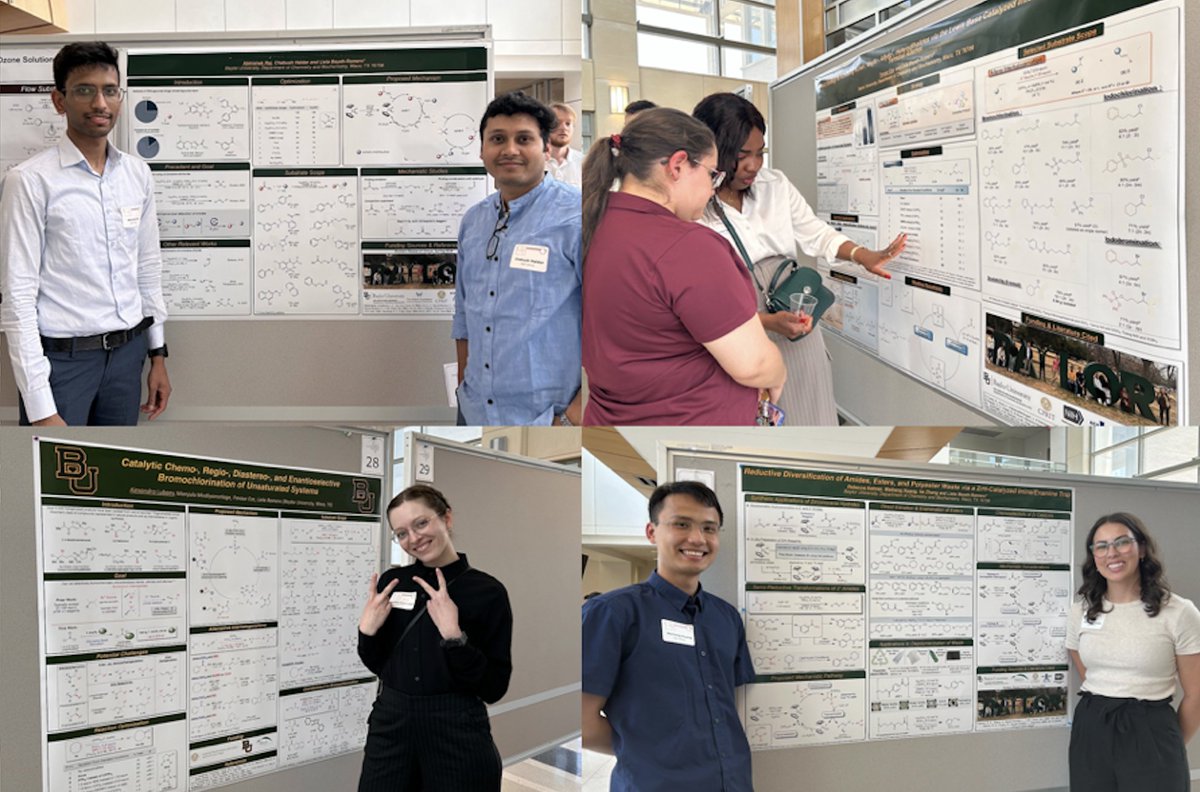
Direct reductive amination of amides with sulfonamides at RT? ✅ Zr-catalysis makes it possible—mild, efficient, and selective for late-stage monoalkylation.
Check out the latest paper from our group @BaylorCBC now available online @ACSCatalysis!
https://t.co/y93e2ODcTA
Continuing the string of recent good news for the group: my NSF CAREER award was funded!
Super excited (and grateful to @NSF) to continue our explorations and take this research to the next level. Big thanks to everyone who’s supported us along the way @BaylorCBC and beyond!
After somewhat of a hiatus, I’m back to post some recent developments for the group:
First up this week, our study on the catalytic dihalogenation of allenes is now online– kudos to the team for all their hard work!
https://t.co/ozNrTYYDWw
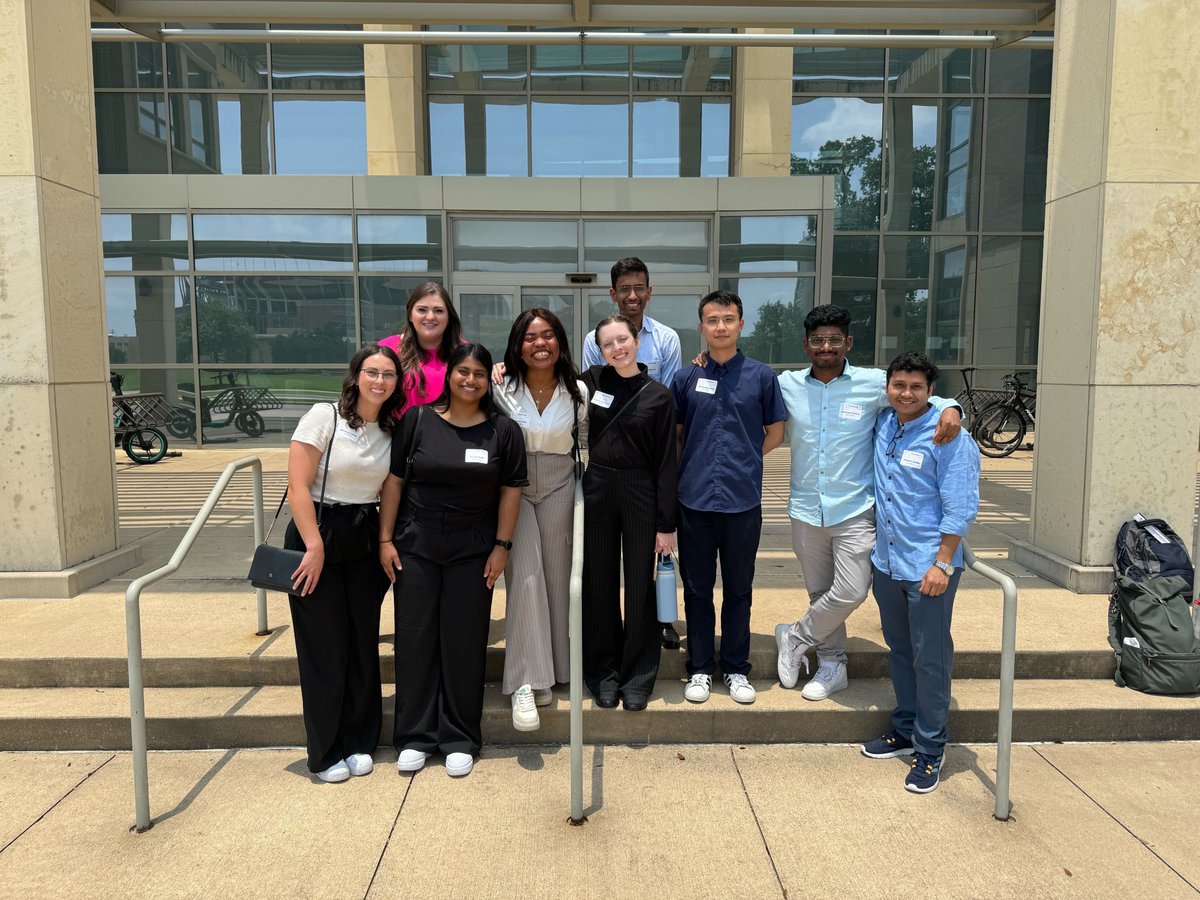
We had another successful 2024 @ACSorganic Graduate Research Symposium (GRS) on July 25-28, 2024 @UVA! We are excited and look forward to seeing everyone again at the #2025ACSGRS on July 17-20, 2025. Save the date and stay tuned for more info! https://t.co/EqIP9Z1LR3
#2024ACSGRS Friday night session student presenters: So Young Lee (left) from MIT; Mark Maust (top right) from Emory University: and Alexandra Lubaev (bottom right) from Baylor University. @ACSorganic
2023-24 Outstanding Graduate Research Productivity Awards. Congratulations Kanika Vashisth, Daniel Devore, Darren Gass, Malisha Welikala, & Alexandra Lubaev!
@baylorgraduate@Trakselis@Liela_Romero@MartinGroupBU
BEARS WIN!!!!!!!!!! 🐻🏀
Down 14 early, No. 11 @BaylorMBB comes all the way back to send UT home with a defeat in their final conference game in Waco! #SicEm
Our next Virtual Symposium (free to all) will be held on October 18 and will feature @OChem_Grenning and @nagiblab. Thank you @chemistrio and @NSFCCHF Beyond CCHF for hosting! https://t.co/jeXn8klJBL
I’ll be at the Gordon Research Conference next week!! Come find me to talk about discovery chemistry at AbbVie and to catch up! Looking forward to it 🤩
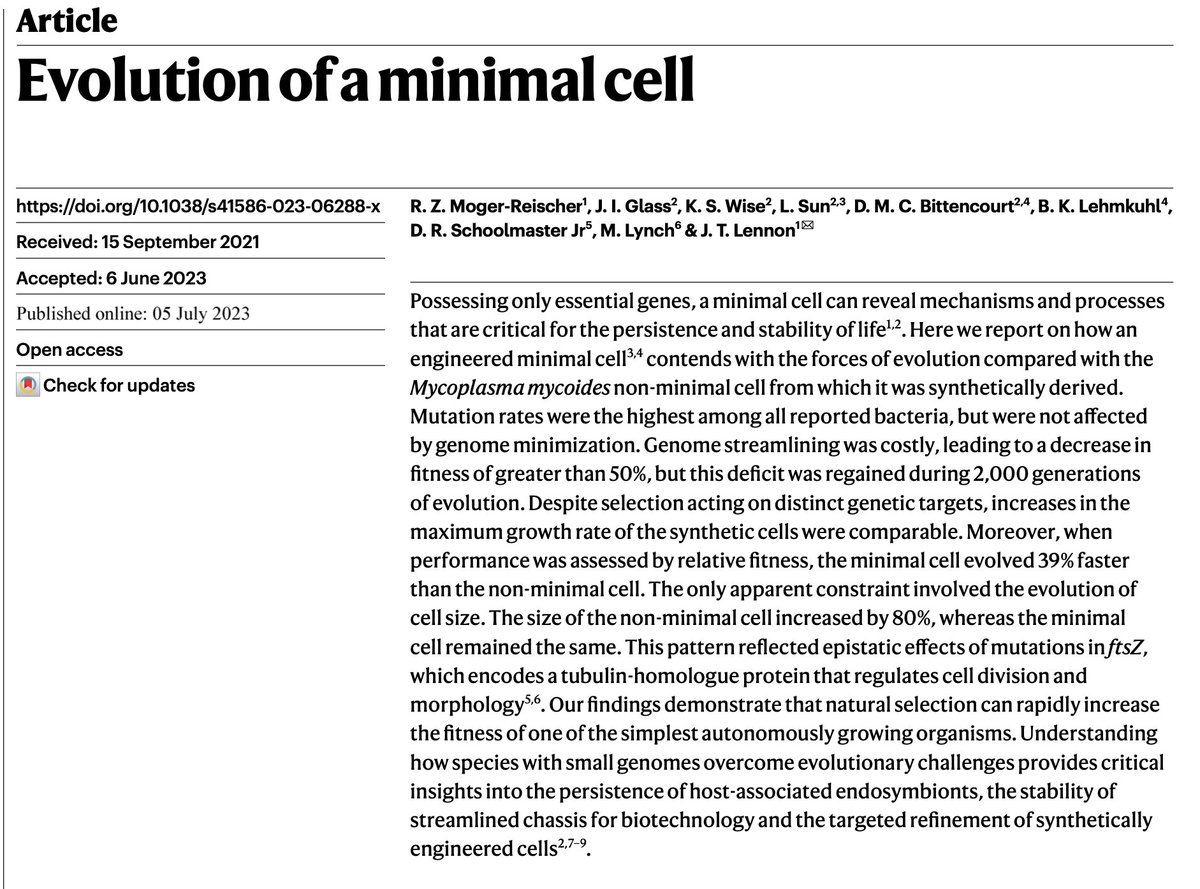
A mind-blowing paper has come out today in @Nature
In 2016, JC Venter Institute scientists trimmed a bacterial genome to its barest minimum required for life to synthesize what they called a "minimal genome" (https://t.co/Rk8oZJ0bUj).
Today, a group of scientists from Indiana University reports how that minimal genome evolved over 2000 generations in comparison to the non-minimal genome.
The authors found that even when you reduce a bacterial genome to its absolute minimum where every nucleotide matters, the genome undergoes mutational events generation after generation as much as the non-minimal genome. One simply cannot stop the evolution.
Just over 300 days of evolution (equivalent to 40,000 years in humans) the minimal cell has gained everything it lacked in fitness on day one in comparison to the non-minimal cell.
When comparing the evolved traits between the minimal and non-minimal cells, the scientists found something striking. The evolutionary process increased the cell size of non-minimal cells but not that of the minimal cell. But that is not the striking part.
The scientists were able to identify the key mutation that resulted in cell size evolution. And it turned out that the mutation that helped the non-minimal cells to grow bigger is the same that helped the minimal cells to stay smaller. Growing bigger had a survival advantage for non-minimal cells and not growing bigger had a survival advantage for minimal cells. So, the mutation had a context-dependent effect. This just demonstrates that the evolutionary effects on traits have no absolute direction. All that matter is what is beneficial for the organism's survival.
The conclusion of the paper is metaphorically a quote from the Jurassic Park movie:
“Listen, if there’s one thing the history of evolution has taught us is that life will not be contained. Life breaks free. It expands to new territories, and it crashes through barriers painfully, maybe even dangerously, but . . . life finds a way". (https://t.co/UlxRlb86CT)
https://t.co/zA9OAqSoAu
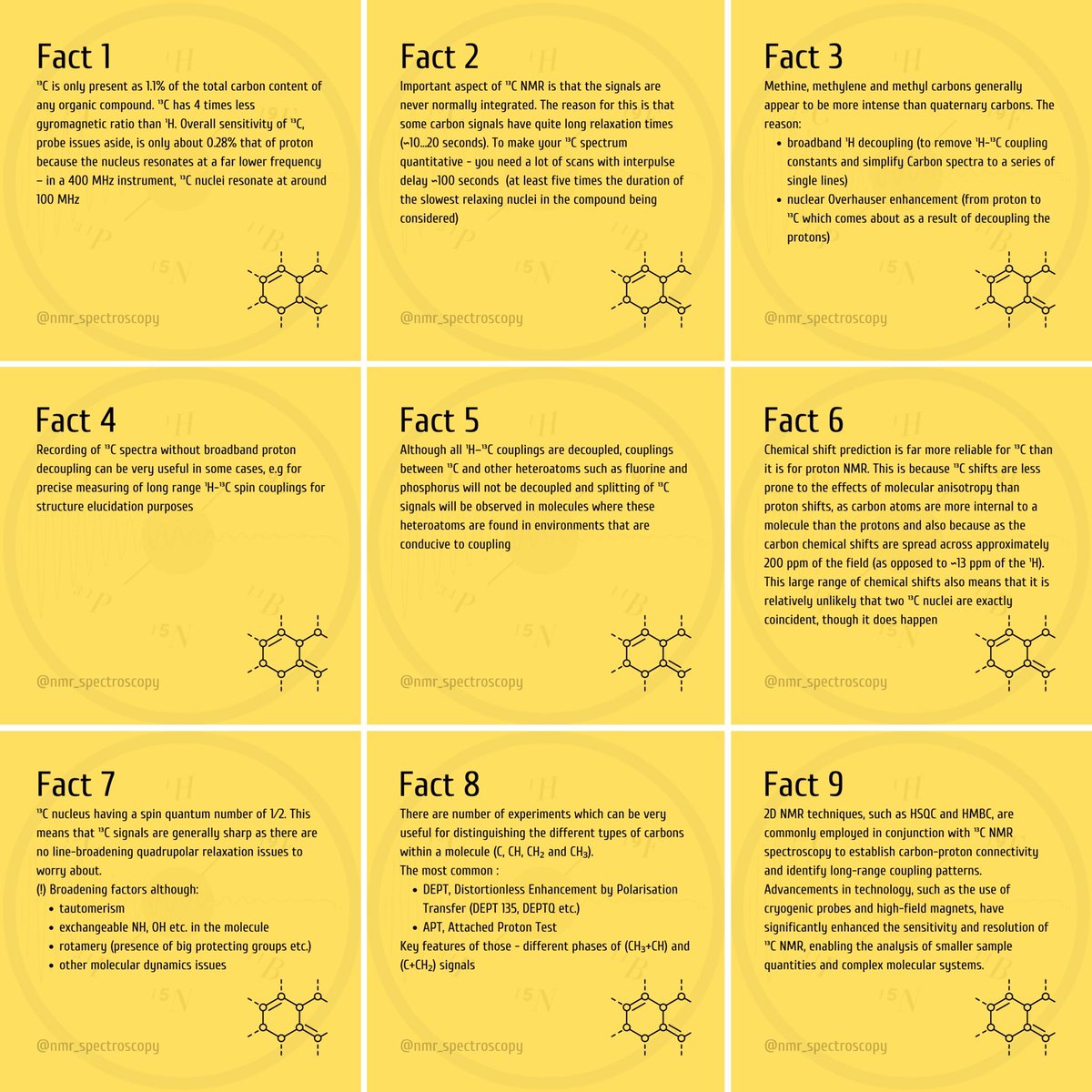
ℹ️🧲 Here are 9 essential facts about ¹³C NMR spectroscopy you have to be aware of before starting the experiment. 📝Source: Essential Practical NMR for Organic Chemistry by S.A.Richards and J.C.Hollerton second edition, Wiley, 2023 and my experience).
#nmrchat#nmr#chemtwitter