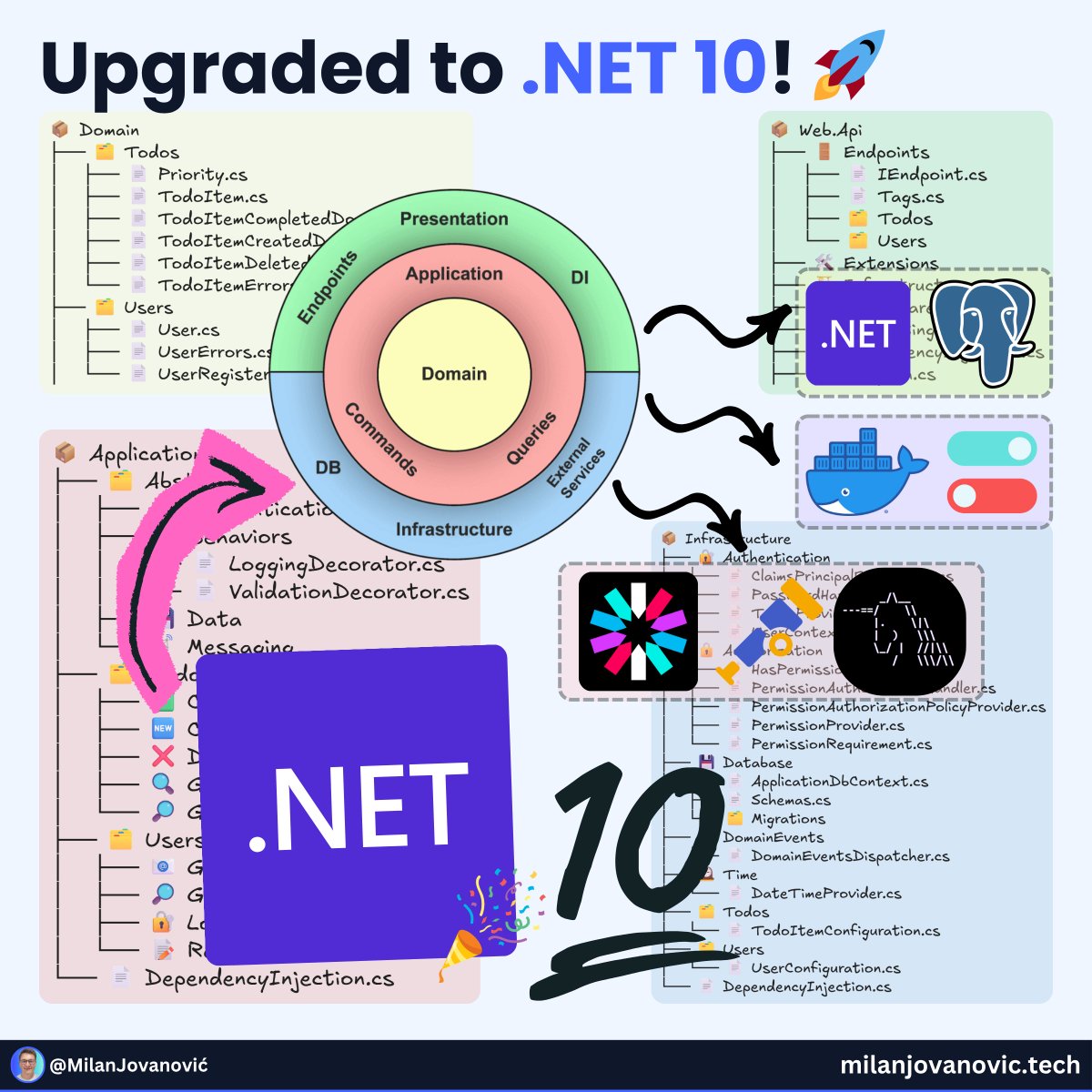
I upgraded my Clean Architecture template to .NET 10.
And it took only a few minutes. Here's how 👇
My .NET version is defined in one place, a Build props file. I updated to net10 and that took care of all the projects in the solution.
The next part was updating the NuGet packages.
This was equally simple with central package management. I updated the version in the Packages props file, and it was picked up by all the projects in the solution.
Here's what's inside:
- Simple domain model with Domain Events pattern
- CQRS (no MediatR) + clean use cases implementation
- Validation and logging cross-cutting concerns
- Authentication with JWT and user context
- Boilerplate for RBAC authorization
- Docker Compose orchestration
- Minimal APIs, health checks
You can get the template here: https://t.co/hriLuopEC4
I recently found out my template is used by a local company, doing $30M+ yearly revenue.
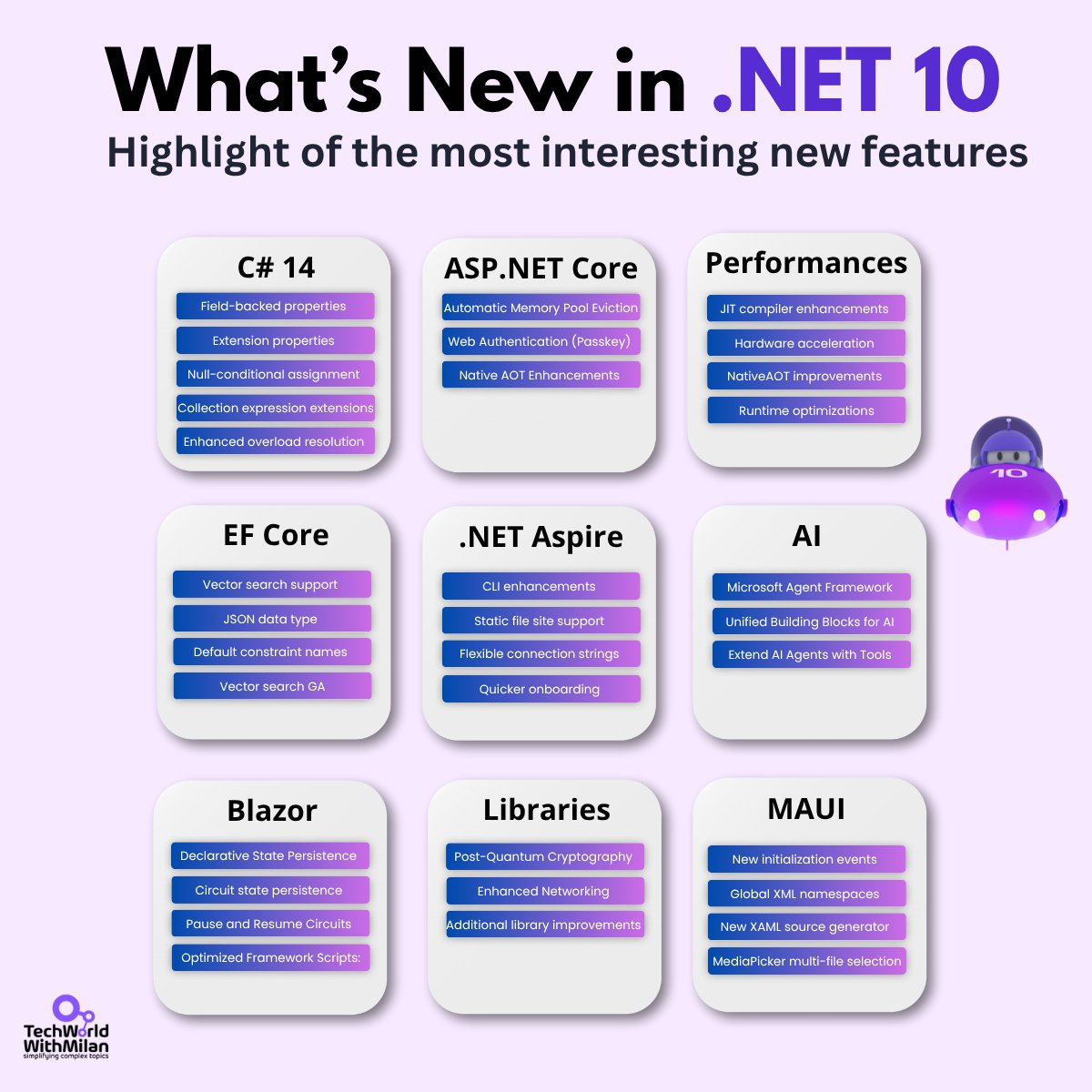
𝗠𝗶𝗰𝗿𝗼𝘀𝗼𝗳𝘁 𝗝𝘂𝘀𝘁 𝗥𝗲𝗹𝗲𝗮𝘀𝗲𝗱 .𝗡𝗘𝗧 𝟭𝟬
This is a Long-Term Support (LTS) release with 3 years of support until November 2028. It's built for AI workloads, production apps, and serious performance gains.
What is new:
𝟭. 𝗖# 𝟭𝟰 & 𝗙# 𝟭𝟬
C# 14 adds field-backed properties that eliminate explicit backing fields, plus extension properties that work on any type, including interfaces and static members. You also get null-conditional assignment (?.=), first-class Span<T> conversions, and ref struct interface implementations.
F# 10 focuses on refinement with scoped warning suppression, ValueOption optional parameters for zero-allocation code, and parallel compilation in preview mode.
𝟮. 𝗔𝗜 𝗙𝗶𝗿𝘀𝘁-𝗖𝗹𝗮𝘀𝘀 𝗦𝘂𝗽𝗽𝗼𝗿𝘁
The new Microsoft Agent Framework combines the Semantic Kernel and AutoGen to build multi-agent systems. https://t.co/e4cl2gXfX2 provides unified abstractions that work with OpenAI, Azure OpenAI, GitHub Models, and Ollama through a single interface.
Model Context Protocol (MCP) support enables agents to access databases, APIs, and tools via a standardized protocol. Microsoft Copilot is built with .NET.
𝟯. 𝗔𝗦𝗣.𝗡𝗘𝗧 𝗖𝗼𝗿𝗲 & 𝗕𝗹𝗮𝘇𝗼𝗿
https://t.co/PLYLs2P2P6 Core adds automatic memory pool eviction to reduce the footprint of long-running apps. Blazor introduces circuit-state persistence, component-state recovery after disconnections, and automated browser testing with WebApplicationFactory.
WebAuthn passkey support is now built into Identity. Minimal APIs automatically validate query, header, and body parameters, plus support server-sent events.
𝟰. 𝗘𝗻𝘁𝗶𝘁𝘆 𝗙𝗿𝗮𝗺𝗲𝘄𝗼𝗿𝗸 𝗖𝗼𝗿𝗲 𝟭𝟬
Vector search support is available in SQL Server 2025 and Azure SQL Database for AI workloads such as semantic search and RAG. Azure Cosmos DB adds full-text search and hybrid search using RRF (Reciprocal Rank Fusion).
Complex types can now be nullable, map to JSON columns with full LINQ support, and use ExecuteUpdate for bulk operations without loading documents.
𝟱. 𝗣𝗼𝘀𝘁-𝗤𝘂𝗮𝗻𝘁𝘂𝗺 𝗖𝗿𝘆𝗽𝘁𝗼𝗴𝗿𝗮𝗽𝗵𝘆
Windows CNG support enables ML-DSA and ML-KEM algorithms to protect against quantum threats. Enhanced ML-DSA variants and composite approaches combine traditional and quantum-resistant algorithms.
𝟲. .𝗡𝗘𝗧 𝗔𝘀𝗽𝗶𝗿𝗲 𝟭𝟯
Aspire ships with single-file AppHost support, built-in static file hosting for frontend apps, and enhanced polyglot development. You can orchestrate Python, JavaScript, and other platforms from your .NET AppHost with unified debugging.
𝟳. .𝗡𝗘𝗧 𝗠𝗔𝗨𝗜
Android 16 and iOS 26.0 bindings bring the latest platform features. The new XAML source generator delivers faster builds and better IntelliSense. Global and implicit XML namespaces eliminate the need for repetitive declarations.
MediaPicker adds multi-file selection with PickMultipleAsync and automatic EXIF handling.
𝟴. 𝗣𝗲𝗿𝗳𝗼𝗿𝗺𝗮𝗻𝗰𝗲
JIT compiler improvements include better inlining and method devirtualization. AVX10.2 support targets cutting-edge Intel silicon. Arm64 SVE and write-barrier optimizations cut GC pause times by 8-20%.
NativeAOT produces smaller, faster binaries. Runtime optimizations enhance loop inversion and stack allocation.
𝟵. 𝗩𝗶𝘀𝘂𝗮𝗹 𝗦𝘁𝘂𝗱𝗶𝗼 𝟮𝟬𝟮𝟲
GitHub Copilot adaptive paste automatically fixes names and formatting, even translating between languages. The Profiler Copilot Agent analyzes CPU usage, suggests optimizations, and generates BenchmarkDotNet benchmarks.
The debugger agent for unit tests automatically debugs failures, forms hypotheses, and validates solutions. Code coverage is now available in the Professional edition.
𝟭𝟬. 𝗦𝗗𝗞 & 𝗡𝘂𝗚𝗲𝘁
The CLI adds native tab-completion, container image generation for console apps, and one-shot tool execution with dnx. SLNX solution format provides human-readable, XML-based solution files.
NuGet audits transitive dependencies by default and integrates with GitHub Advisory Database. The new .NET package update-vulnerable command automatically fixes security issues.
Check the links in the comments.
There are many misconceptions about CQRS.
You don't need to do what big tech is doing.
Here's what CQRS is:
- Logical separation of reads & writes
- Commands change state, return nothing*
- Queries don't change state, return data
*You can return data; the intent is what matters.
Here's what CQRS isn't:
- Separate read/write databases
- Event sourcing
CQRS is simple.
Here's how you can get started: https://t.co/p6ZfnhqrqW
I took the image from the recent Netflix architecture on CQRS.
This might be appropriate for their scale and requirements.
You can start much, much simpler and still get the benefits.
---
Sign up for the .NET Weekly with 74K+ other engineers, and get a free Clean Architecture template: https://t.co/3Y7efUqGS2
The first time I ran the new 𝗖𝗼𝗱𝗲𝗥𝗮𝗯𝗯𝗶𝘁 𝗖𝗟𝗜, it caught a few things I didn’t expect.
- A timing attack vulnerability in my auth flow
- Nested logic that should be pulled into separate functions for testability
- Duplicated profile fetching code that needed cleanup
- Even small things, like replacing logger.Error with logger.Warn for expected failures
All of that was flagged before I even committed my code.
That’s not something a linter would catch. And it happened right in my terminal.
And when I connect it to my AI agent (Claude Code, Augment Code, etc.), the CLI hands off the full review context so the fixes can be auto-applied. No context switching required.
That’s why the CLI feels like the missing piece:
- Review staged & unstaged changes before commit
- Catch subtle bugs and improve maintainability
- Stay in flow: code → review → commit
- Let your AI agent handle the fixes
I’ve used CodeRabbit’s IDE reviews in VS Code for months, but the CLI goes deeper. It feels like having a dedicated reviewer living in my terminal.
Want to try it? The CodeRabbit CLI is free: https://t.co/4dV449ZSQ9
Thanks to @coderabbitai for sponsoring this post.
Por esto rechacé a un candidato que escribió tests en la prueba técnica
Por las diferentes empresas que he pasado me ha tocado hacer entrevistas, preparar pruebas técnicas y revisarlas.
🧵 👇
BREAKING: Apple just proved AI "reasoning" models like Claude, DeepSeek-R1, and o3-mini don't actually reason at all.
They just memorize patterns really well.
Here's what Apple discovered:
(hint: we're not as close to AGI as the hype suggests)
Adding 𝗠𝗖𝗣 to 𝗔𝗴𝗲𝗻𝘁𝗶𝗰 𝗥𝗔𝗚 Systems.
If you are building RAG systems and packing many data sources for retrieval, most likely there is some agency present at least at the data source selection for retrieval stage.
This is how MCP enriches the evolution of your Agentic RAG systems in such case (𝘱𝘰𝘪𝘯𝘵 2.):
𝟭. Analysis of the user query: we pass the original user query to a LLM based Agent for analysis. This is where:
➡️ The original query can be rewritten, sometimes multiple times to create either a single or multiple queries to be passed down the pipeline.
➡️ The agent decides if additional data sources are required to answer the query.
𝟮. If additional data is required, the Retrieval step is triggered. We could tap into variety of data types, few examples:
➡️ Real time user data.
➡️ Internal documents that a user might be interested in.
➡️ Data available on the web.
➡️ …
𝗧𝗵𝗶𝘀 𝗶𝘀 𝘄𝗵𝗲𝗿𝗲 𝗠𝗖𝗣 𝗰𝗼𝗺𝗲𝘀 𝗶𝗻:
✅ Each data domain can manage their own MCP Servers. Exposing specific rules of how the data should be used.
✅ Security and compliance can be ensured on the Servel level for each domain.
✅ New data domains can be easily added to the MCP server pool in a standardised way with no Agent rewrite needed enabling decoupled evolution of the system in terms of 𝗣𝗿𝗼𝗰𝗲𝗱𝘂𝗿𝗮𝗹, 𝗘𝗽𝗶𝘀𝗼𝗱𝗶𝗰 𝗮𝗻𝗱 𝗦𝗲𝗺𝗮𝗻𝘁𝗶𝗰 𝗠𝗲𝗺𝗼𝗿𝘆.
✅ Platform builders can expose their data in a standardised way to external consumers. Enabling easy access to data on the web.
✅ AI Engineers can continue to focus on the topology of the Agent.
𝟯. Retrieved data is consolidated and Reranked by a more powerful model compared to regular embedder. Data points are significantly narrowed down.
𝟰. If there is no need for additional data, we try to compose the answer (or multiple answers or a set of actions) straight via an LLM.
𝟱. The answer gets analyzed, summarized and evaluated for correctness and relevance:
➡️ If the Agent decides that the answer is good enough, it gets returned to the user.
➡️ If the Agent decides that the answer needs improvement, we try to rewrite the user query and repeat the generation loop.
Are you using MCP in your Agentic RAG systems? Let me know about your experience in the comment section 👇
#LLM #AI #MachineLearning
If you are looking to improve your 𝗵𝗮𝗻𝗱𝘀-𝗼𝗻 𝘀𝗸𝗶𝗹𝗹𝘀 𝗮𝗻𝗱 𝗳𝘂𝗻𝗱𝗮𝗺𝗲𝗻𝘁𝗮𝗹 𝘂𝗻𝗱𝗲𝗿𝘀𝘁𝗮𝗻𝗱𝗶𝗻𝗴 𝗼𝗳 𝗵𝗼𝘄 𝗔𝗜 𝗔𝗴𝗲𝗻𝘁𝘀 𝘄𝗼𝗿𝗸, check out my 𝗕𝘂𝗶𝗹𝗱𝗶𝗻𝗴 𝗔𝗜 𝗔𝗴𝗲𝗻𝘁𝘀 𝗙𝗿𝗼𝗺 𝗦𝗰𝗿𝗮𝘁𝗰𝗵 series that I started some time ago.
First article covers the tool use pattern of an Agent.
If you are using any orchestration frameworks for agentic applications, you might be abstracted away from what using a tool really means. I believe that understanding applications from the base building blocks is really important so we are implementing all of the abstractions from scratch.
After finishing the project you will learn:
➡️ What AI Agents are.
➡️ How the Tool usage in AI Agents actually works.
➡️ How to build a decorator wrapper that extracts relevant details from a Python function to be passed to the LLM via system prompt.
➡️ How to think about constructing effective system prompts that can be used for Agents.
➡️ How to build an Agent class that is able to plan and execute actions using provided Tools.
You can find the article here: https://t.co/dQS4CtOnry
You can also find a Jupyter notebook and python scripts that complement the article in a GitHub repo (links in the article).
Youtube videos coming soon!
If you’re looking for something to dig your hands into this weekend, be sure to take a look!
Let me know if there are any issues following the project. Feel free to DM me or leave comments here or under the article 👇
#AI #LLM #MachineLearning
API Redesign is risky without tests, because it could cause regression bugs.
How do we handle structural changes - such as API Redesign? E.g. splitting one field (e.g. “name“) into two fields (“first name“ and “last name“).
Read the full article: https://t.co/SjsBxo1p6h
#tdd
If you're dealing with a long-running API request, consider splitting the work into two parts:
1) Accept the request and return quickly
2) Do the heavy work in the background
Here's how this can help you build better APIs: https://t.co/5Q2vUHTt4e
Make your RAG application 10x smarter!
ColiVara is a unique document retrieval method that does not need chunking or text processing. It still feels like RAG but without OCR, text extraction, broken tables, or missing images.
What you see is what you get. ✨
Here’s why it’s a breakthrough:
🖼️ Vision-based indexing
⚙️ 100+ file format support
⚡ State-of-the-art multimodal retrieval
✨ APIs & SDKs for both Python/TypeScript
⬇️ No vector DB management (pgVector under the hood)
But that’s not all:
📚 Detailed documentation
✅ Seamless local or cloud quickstart
🧠 Late-interaction embeddings for extra accuracy
The best part, it's 100% open-source!
Link to the GitHub repo in next tweet!
_____
Find me → @akshay_pachaar ✔️
For more insights & tutorials on AI and Machine Learning.
If you feel behind on learning about Large Language Models, try these:
– Readers: free 200+ page book covering pre-training, generative models, prompting and alignment
– Programmers: Karpathy’s neural networks zero to hero playlist including implementing GPT-2 from scratch