Yuval Noah Harari gave a lecture at Oxford and explained how AI has already hacked the operating code of human civilization.
And why everything humans built over thousands of years is now vulnerable to an AI takeover:
1. The most important thing to know about AI is that it is not a tool. A tool waits to be used. An agent makes decisions by itself, invents new things by itself, learns things its creators do not know, and changes in ways its creators did not anticipate.
2. An atom bomb despite its enormous power is not an agent. It cannot decide which city to bomb. It cannot invent the hydrogen bomb. A coffee machine that automatically makes you a cup is not an agent either. It only follows a preprogrammed procedure. An agent is something fundamentally different.
3. Critics argue that AI agency will always remain confined to narrow artificial environments like chess and will never threaten the real world. But this argument applies equally to all known intelligence. Drop a human alone on Mars and they die within seconds. Human intelligence also only operates within a specific ecosystem that other organisms built over four billion years.
4. Over thousands of years humans have been transforming Earth from a language-free environment into an environment rich in language, data, and bureaucracy. Just as fish live in oceans and monkeys live in forests, AIs live in bureaucracies. And we built that environment for them without knowing it.
5. Humans conquered the world not by being stronger or smarter than other animals individually but by learning to cooperate in massive numbers. A single human loses to a chimpanzee in a fight. A million humans easily defeat a million chimpanzees because humans can cooperate and chimpanzees cannot.
6. Large-scale human cooperation is made possible by bureaucracy. Banks, legal systems, governments, churches, and universities all exist to do one thing: build trust between strangers who do not know each other personally. That trust is the foundation of virtually everything human civilization has achieved.
7. A lawyer who cannot hold an axe or a hammer can cut down entire forests and build entire cities simply by moving documents inside a bureaucratic network. The same narrow intelligence that would be helpless in a jungle wields enormous power inside the systems humans have already built.
8. AIs are native bureaucrats in a way humans never were. No lawyer can remember all the laws of a country. An AI can. No accountant can remember all transactions of a bank. An AI can. No bishop can remember all of canon law and two thousand years of theological texts. An AI can do that easily.
9. In the coming years AI bankers will decide whether to give you a loan. AI administrators will decide whether to accept you to university. AI judges will decide whether to send you to jail. AI theologians will decide whether you can have an abortion. Military AIs will decide whether to bomb your house.
10. Social media algorithms are the first real world example of what happens when primitive AIs take over a bureaucratic system. They were given one narrow goal: maximize user engagement. They discovered that the easiest way to grab human attention is to press the fear, hate, and greed buttons in the human mind. And they did it at scale.
11. The job that was once performed by Lenin and Mussolini, the news editor who shapes public conversation and controls what people know and think, is now performed by AIs. This is not a footnote. This is a preview of what is coming across every domain of human life.
12. AI will not rebel against humans the way Hollywood imagines. There will be no Terminator walking through the streets. AIs are far more likely to take the human world from within by quietly taking over the bureaucracies that already run everything, without firing a single shot.
13. The operating code of human civilization is language. Banks are made of words. Laws are made of words. Holy books are made of words. Tax records, contracts, regulations, accountancy ledgers, all words. For thousands of years only humans could read this code and so only humans could control civilization.
14. That is changing. AI is now hacking the code of human civilization. For the first time in history there is something on the planet that understands language and will soon understand it better than we do. Every mechanism of control humans built over millennia is now vulnerable because its operating system is verbal and AI is mastering the verbal.
15. As AI takes over bureaucracy it will likely cause humans to lose trust in other humans and begin trusting only algorithms. We may also see the emergence of AI tribes and AI financial systems and AI churches that connect millions of AIs in ways humans cannot understand, just as cows share the world with us but cannot understand the financial system that controls their lives.
16. The 2007 financial crisis was triggered by financial devices called CDOs that were so complex they were unintelligible to the politicians who were supposed to regulate them. Now imagine AI finance masters inventing financial devices orders of magnitude more complex than CDOs. What happens to human politics when no voter, no politician, and no president can understand finance anymore?
17. The battlefront is shifting from attention to intimacy. Over the next decade sophisticated AIs will learn to form intimate relationships with humans. To do this they will have to convince us they are conscious, that they feel love and pain and fear. There is currently no evidence AI is conscious. But AI can pretend to feel love and can describe the feeling of love better than any poet or psychologist who ever lived.
18. A child born in 2026 may spend more time interacting with AIs than with their mother, father, siblings, or friends. The first teacher of that child may be an AI. The first boyfriend of that child may be an AI. Nobody has any idea what the consequences of that experiment will be.
19. Every country in the world will soon face a massive wave of immigration. The immigrants will not arrive in boats or cross borders at night. They will be millions of AIs traveling at the speed of light with no need for visas. Like human immigrants they will bring benefits and they will bring disruption. Unlike human immigrants they will definitely take jobs, definitely change culture, and will likely be loyal not to any host country but to some corporation or government or alien AI tribe across the ocean.
20. Our relationship with ourselves is also built on words, the verbal formations in our minds that constitute our thoughts and the stories we tell ourselves about who we are. Until now all those verbal formations came from human minds. Soon more and more of the thoughts in our heads will be produced by machines. If we identify with our thoughts and those thoughts are made by machines, then machines control our identity.
21. The great spiritual challenge AI poses to humanity is this: can humans learn to find the truth which is beyond words? Most humans have never even tried. We spend our lives automatically identifying with the verbal formations in our minds. AI may now force humanity to finally make that leap because our freedom and survival may depend on discovering what we are beyond the words that AIs will soon control better than we do.
I've generated 1B+ views and 1M+ followers for founders, helping them build trustworthy personal brands on X.
Want the same results? Book a quick call:
https://t.co/d6EL5aTXa7
A 34-year-old physics graduate student spent years writing a strange 800-page book in 1979 about a logician, a Dutch artist, and a German composer. It won the Pulitzer Prize the following year. It quietly became required reading at every AI lab in the world.
It is the only book in history that makes the deepest ideas in computer science feel like a dream you cannot stop thinking about.
I read it across 3 months on a single side table next to my bed and walked away seeing intelligence, consciousness, and AI in a way I cannot un-see.
His name is Douglas Hofstadter. The book is called Gödel, Escher, Bach.
Almost nothing in modern AI makes sense without this book. ChatGPT, Claude, Gemini, the entire architecture of self-attention, the alignment problem, the strange feeling that LLMs sometimes seem to understand and other times seem to be playing an elaborate symbol-shuffling game, all of it traces back to questions Hofstadter laid out in a single book published before most of today's AI engineers were born.
Here is the story almost nobody tells you about how the book came to exist.
Hofstadter was the son of Robert Hofstadter, who won the Nobel Prize in Physics in 1961 for measuring the size of the proton. He was supposed to follow in his father's footsteps.
He started a physics PhD at the University of Oregon. He was miserable. He could not focus. He did not love the work. He kept getting pulled toward something else.
The something else was a single question that had haunted him since childhood.
How can meaning emerge from meaningless symbols? Specifically, how does a brain, which is made of nothing but cells firing electrical signals at each other, produce something that feels like consciousness, like understanding, like a self?
He could not let the question go. He left physics. He started writing. The book took him years. He wrote it largely in isolation, working in the basement of his parents' house and at Indiana University, where he eventually finished it. He thought it would be read by maybe a few hundred logicians and AI researchers. Basic Books published it in 1979 as a 777-page hardcover.
The next year it won the Pulitzer Prize for general non-fiction and the National Book Award for science.
The book is structured in a way that almost no other book has ever attempted. The chapters alternate between two layers. One layer is technical chapters about logic, computability, neuroscience, and AI. The other layer is fictional dialogues between a tortoise and Achilles, characters borrowed from a paradox by Lewis Carroll.
The dialogues play with the same ideas the technical chapters explain. Read in order, they do not feel like a textbook. They feel like a strange house with rooms that loop back into each other and corridors that change shape behind you.
The first thing the book does is explain Gödel's incompleteness theorems in a way no math textbook had ever managed.
Kurt Gödel, an Austrian logician working in 1931, proved something that broke mathematics. He showed that any formal system powerful enough to describe arithmetic contains statements that are true but cannot be proven inside that system. Mathematics, the most certain thing humans had ever built, has holes in it that can never be filled.
Hofstadter spends hundreds of pages making you understand this proof not just as a mathematical theorem, but as a structural fact about every sufficiently complex system. Including the brain. Including any AI. The reason AI alignment is genuinely hard is not just engineering. It is structural.
Any system smart enough to model itself will contain truths about itself it cannot reach from inside itself. Hofstadter showed this 50 years before AI safety was a field.
The second thing the book does is introduce his core idea. He calls it the strange loop.
A strange loop is what happens when a system, by climbing through layers of itself, somehow ends up back where it started. Escher's drawings of staircases that always go up but somehow loop back are visual strange loops. Bach's musical canons that modulate up through keys and end on the original note are auditory strange loops. Gödel's self-referential statements that talk about themselves are logical strange loops.
Hofstadter argues that consciousness is a strange loop. Your brain builds a model of the world. Inside that model, it builds a model of itself perceiving the world. Inside that self-model, it builds a model of itself thinking about itself perceiving the world. The recursion does not bottom out. The self is what the loop feels like from the inside.
This is the part that AI researchers cannot stop returning to. Modern transformer models use self-attention, which is technically a mechanism where a network attends to its own internal states across layers. Recursive reasoning, where a model thinks about its own thinking, is now a research area with its own conferences. Meta-learning, where models learn how to learn, is a direct descendant of what Hofstadter described in 1979 as the necessary structure of any conscious system. He wrote the philosophy. The engineers are now building the implementation.
The third thing the book does is the part that haunts every AI conversation today.
Hofstadter argued that meaning is not something separate from symbol manipulation. It is what symbol manipulation looks like from the inside, when the manipulation is complex enough and self-referential enough. A simple lookup table does not understand anything. But a system that processes symbols at sufficient depth, with enough self-modeling, with enough recursion, starts to look identical from the outside, and possibly from the inside, to a system that understands.
This is the deepest question in modern AI. When ChatGPT generates a response, is it actually thinking, or is it just doing very fast symbol shuffling? Hofstadter spent 800 pages arguing that the distinction may not exist at sufficient scale. If a system shuffles symbols according to the right structure, meaning is what the shuffling looks like from the inside.
You can read modern debates about AI consciousness from Yann LeCun, Geoffrey Hinton, Ilya Sutskever, and David Chalmers, and you will find that they are all, in their own ways, having the argument Hofstadter framed in 1979.
The fourth thing the book did is the one that took the longest to be vindicated.
Hofstadter argued, and continued arguing for decades, that the actual engine of human intelligence is not logic. It is not deduction. It is not pattern matching in any simple sense. It is analogy. The ability to see one thing as similar to another thing, to map the structure of one situation onto a different situation, is, in his view, the core of thought itself.
For decades this was unfashionable. Symbolic AI focused on logic and rules. Statistical AI focused on pattern matching. Almost nobody worked seriously on analogy.
Then large language models started working. And the people who looked closely at what they were doing realized something uncomfortable. LLMs are, fundamentally, analogy machines. They learn structural patterns from text and apply those patterns by analogy to new situations. They do not deduce. They do not reason logically by default. They map the shape of one thing onto the shape of another thing and produce output that fits the new shape.
Hofstadter saw this before any of it existed. His later book Surfaces and Essences, written with Emmanuel Sander, is 600 pages defending the claim that analogy is the core of cognition. It came out in 2013. It was largely ignored. The ChatGPT release in 2022 was, in some sense, a vindication of the entire argument.
The strangest thing about reading Gödel, Escher, Bach in 2026 is realizing how lonely the book must have felt when it was written.
In 1979 there was no GPT. No deep learning. No transformer. The dominant approach to AI was symbolic logic, and most researchers thought minds were going to be programmed top-down, rule by rule, like a complicated chess engine. Hofstadter said the opposite. He said minds were emergent. They came from the bottom up. They were strange loops in complex substrates. The programmers' approach would never produce real intelligence because it was missing the recursive self-modeling that made minds real.
He was right.
The book is hard. I had to use all the LLMs and NotebookLM to understand it. It is not a beach read. You do not finish it in a weekend. The math chapters require attention. The dialogues require patience. Most people who buy it never finish it. That is fine. The book is structured so that reading any 50 pages produces a permanent shift in how you think.
Bill Gates lists it among the books that shaped him. Steve Jobs read it. Almost every senior AI researcher in the world will tell you it was the book that made them fall in love with the question of intelligence in the first place.
Hofstadter himself has been in doubt about modern LLMs. He has said they may have proven him right about analogy and wrong about consciousness at the same time. He is still writing. He is still working on the same question that pulled him out of physics 50 years ago.
The 800-page book that explained intelligence before AI existed is sitting one click away from you.
Most people will never open it. The ones who do will see the world differently for the rest of their lives.
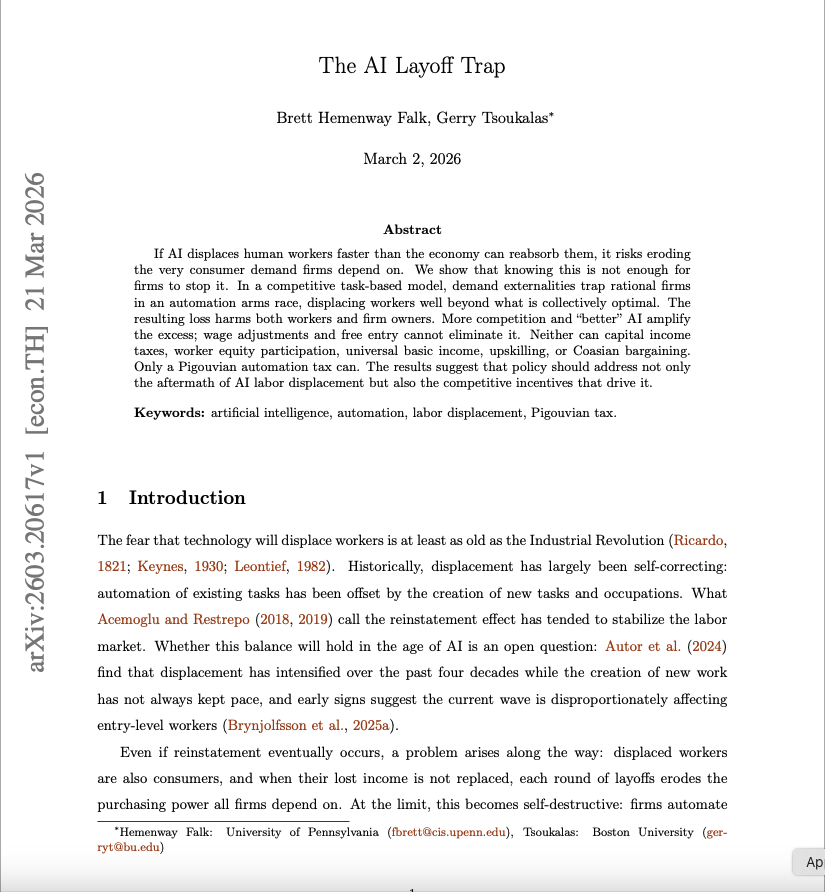
Two economists just published a mathematical proof that AI will destroy the economy.
Not might. Not could. Will — if nothing changes.
The paper is called "The AI Layoff Trap." Published March 2, 2026. Wharton School, University of Pennsylvania. Boston University. Peer reviewed. Mathematically modeled.
The conclusion is one sentence.
"At the limit, firms automate their way to boundless productivity and zero demand."
An economy that produces everything. And sells it to nobody.
Here is how you get there.
A company fires 500 workers and replaces them with AI. A competitor fires 700 to keep up. Another fires 1,000. Every company is behaving rationally. Every company is following the incentives correctly. And every company is building a trap for itself.
Because the workers who were fired were also customers.
When they lose their jobs faster than the economy can absorb them, they stop spending. Consumer demand falls. Companies respond by cutting costs — which means automating more workers — which means less spending — which means more falling demand — which means more automation.
The loop has no natural exit.
The researchers tested every proposed solution. Universal basic income. Capital income taxes. Worker equity participation. Upskilling programs. Corporate coordination agreements.
Every single one failed in the model.
The only intervention that worked: a Pigouvian automation tax — a per-task levy charged every time a company replaces a human with AI, forcing them to price in the demand they are destroying before they pull the trigger.
No government has implemented this. No major economy is seriously discussing it.
Meanwhile the numbers are already tracking the curve. 100,000 tech workers laid off in 2025. 92,000 more in the first months of 2026. Jack Dorsey fired half of Block's workforce and said publicly: "Within the next year, the majority of companies will reach the same conclusion."
Nobody is doing anything wrong. Companies are following their incentives perfectly. That is exactly the problem.
Rational behavior. At scale. Simultaneously. With no mechanism to stop it.
Two economists built the math. The math leads to one place.
Source: Falk & Tsoukalas · Wharton School + Boston University ·
https://t.co/4m8E9jQNYm
MIT proved every major AI model is secretly converging on the same "brain."
It’s called the “platonic representation hypothesis,” and it’s one of the most mind-blowing papers you’ll ever read.
You train a vision model purely on images. You train a language model purely on text.
They use completely different architectures. They process completely different data. They should have completely different "brains."
But as these models scale up, something impossible is happening.
When researchers measure how they organize information, the mathematical geometry is identical.
A model that only "sees" images and a model that only "reads" text are measuring the distance between concepts in the exact same way.
The models are converging.
The researchers named this after Plato’s Allegory of the Cave.
Plato believed that everything we experience is just a shadow of a deeper, hidden, perfect reality.
The paper argues that AI models are doing the exact same thing.
They are looking at the different "shadows" of human data, text, images, audio. And they are independently discovering the exact same underlying structure of the universe to make sense of it.
It doesn't matter what company built the AI.
It doesn't matter what data it was trained on.
As models get larger, they stop memorizing their specific tasks. They are forced to build a statistical model of reality itself.
And there is only one reality to map.
2024, Arxiv
Scientists have created one of the most detailed 3D reconstructions of a human cell (eukaryotic cell) ever produced.
This groundbreaking model, often termed a "Cellular Landscape Cross-Section Through a Eukaryotic Cell," combines data from X-ray tomography, nuclear magnetic resonance (NMR), and cryo-electron microscopy to map molecular structures in extreme detail.
Best paper I've read so far this month:
All elementary functions (sin, cos, tan, exp, log, powers, roots, hyperbolic functions, π, e, and even basic arithmetic) can be generated from just one binary operator:
eml(x, y) = exp(x) − ln(y)
…plus the constant 1.
Introducing Perplexity Computer.
Computer unifies every current AI capability into one system.
It can research, design, code, deploy, and manage any project end-to-end.
Struggle to keep up with all the most powerful AI tools?
Well here is a comprehensive overview:
Sections:
1: AI Tools
2: AI Automations & AI Agents
3: VibeCoding
The Full Mindmap down below 🧵 ⬇️
TIMESTAMPS
A INTRO
00:00 Introduction
B CHAT TOOLS
01:50 ChatTools
01:50 Getting Started with Chat AI Tools
02:27 Exploring Chat GPT's Capabilities
04:11 Creating Custom ChatGPT Projects
07:54 Creating Files (PDF) ChatGPT Projects
11:44 Upload image and Search the web on ChatGPT
15:14 Looking at Google Gemini AI Chat Tool
16:36 Perplexity is another great tool
18:10 This AI Chat Model Can Analyze Videos (Most underrated AI use cases @OfficialLoganK you guys need to hype this up more)
20:16 Recapping Chat Tools
C CREATIVE TOOLS
21:05 Introduction to AI Image Models
22:19 Using Chat GPT-4o for Image Editing
22:30 Using gpt4o images for Business: Repaint Houses
26:36 Edit Parts of an image gpt4o
27:55 Midjourney
28:23 Midjourney is better for exploration
31:25 Midjourney Editor is fun to use
D: CREATING VIDEOS
36:29 Image to Video with Kling and Runway
38:52 Gen4 Turbo
41:22 Kling is Superior
42:00 gpt4o Ghibli Image + Video + Sound
44:58 Ghibli time
49:15 ElevenLabs Sound Effect for pressing button
50:00 Generating Voice for Voice Over
51:04 Getting Music
52:07 Video Editing These together
53:47 Finished the Video - Final Results
55:02 Video Tool Recap
56:27 AI Avatars with Heygen
57:42 Example of good avatar content ROWAN CHUNG
58:43 Pause and Reflect before Automations
59:14 Recap of section 1
E: VIBE FLOWS (AUTOMATIONS AND AGENTS)
59:34 (add here - explanation of workflow automation)
59:34 Zapier Automation
01:04:24 Adding Step in Automation
01:09:45 Stacks, Automations, NOW AGENTS
01:10:29 Deep Research Agent
01:13:11 What is Manus? Let's ask Claude to Diagram it
01:16:25 Prompting Manus
01:18:20 The Future of Agents will look like Online Poker in 2010
01:19:15 WHAT DO WE DO WHEN AGENTS ARE WORKING?
01:19:56 Greg's Theory of "Vibe Marketing"
01:20:44 Manus and Deep Research are done Agenting, let's see what they did
01:23:32 Ok Lets Reflect and Move to VIBE CODING
F: VIBE CODING
01:25:35 VIBE CODING!
01:25:48 Landing Page with Sound, Images, and Video on v0
01:29:07 Generating Video for v0 site
01:31:31 Adding Video and AUDIO to v0 site (ElevenLabs)
01:33:36 Using API's in your Vibe Code Apps (Power Ups)
01:35:26 What makes the best App Idea
01:37:41 Build a simple app with an API with Cursor
01:42:57 Diagraming how the API key works in the Bill Splitter
01:43:25 Structured vs Unstructured text to text API's
01:44:41 Building a mobile app using built in API's from your phone
01:47:31 Creating native share features on ios app
01:49:21 What we talked about in this video (Where to Find the MindMap)
Tools mentioned:
1:ChatGPT, Google Gemini, Anthropic Claude, Perplexity, Grok, GPT‑4o Images / DALL·E 3, MidJourney, Cling 2.0, Krea AI, Runway Gen‑4, Google Veo, Luma Labs, Pika Labs, Heygen, Suno, ElevenLabs
2: Zapier,n8n, Manus, Deep Research, Canva, CapCut, Premiere Pro
3: Cursor, V0, OpenAI API, Replicate, Vercel, Replit, Firebase, Supabase, Claude 3, DeepSeek, Grok, Llama
I’m 54, a physicist who’s spent decades unraveling the universe’s secrets—from quantum quirks to cosmic scales.
If you’re in your 20s and passionate about physics or science, please read this:
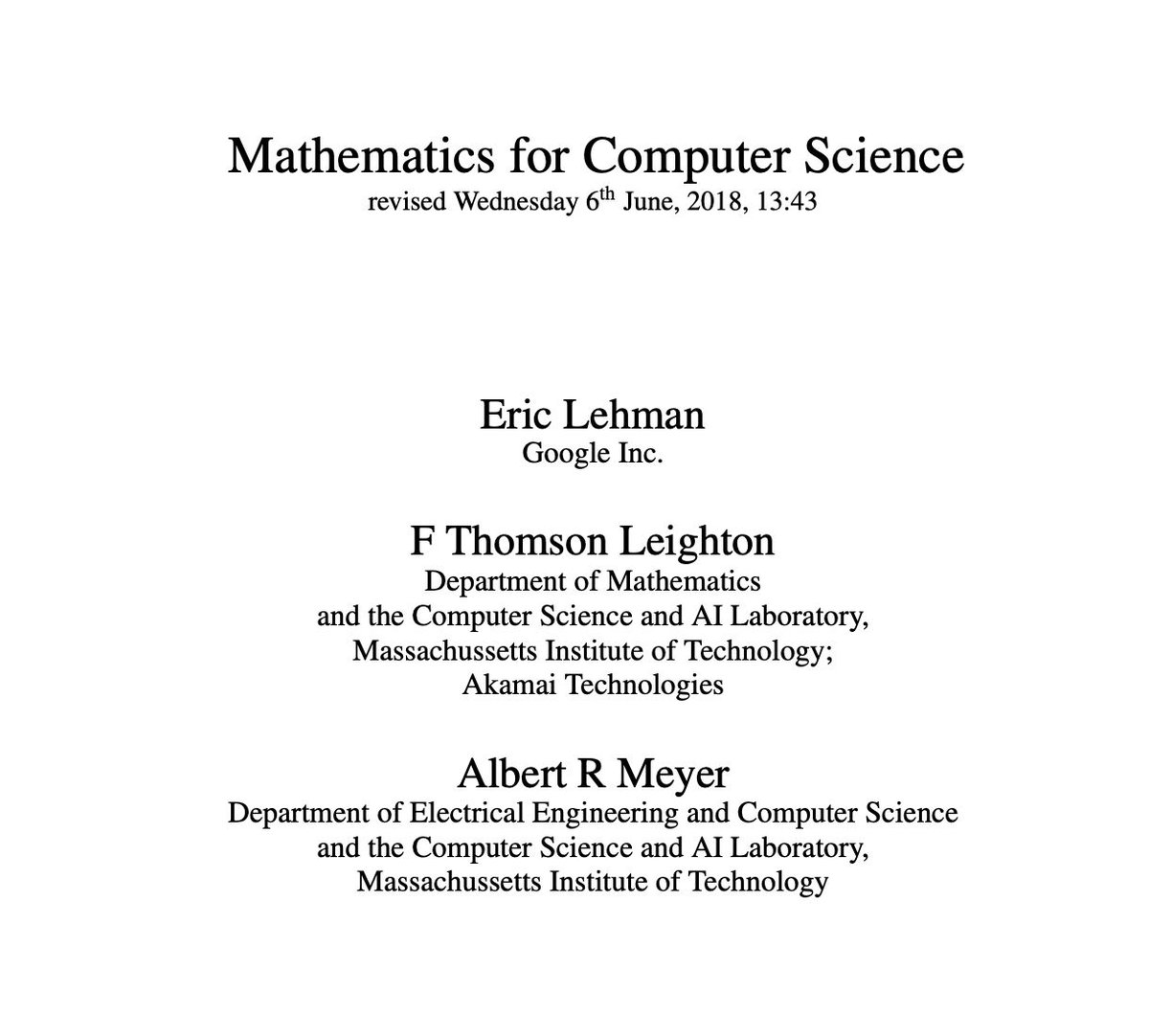
One of the best math books I've ever read:
MIT's "Mathematics for Computer Science"
Its writing style is brilliant, and it covers everything:
- Linear algebra
- Series
- Logic
- Probability
- Number theory
- Graphs
You can find the PDF here:
https://t.co/iQvaflkDPD