Science published is a VERY disturbing article about AI’s impact on astronomy. It's a big warning for other fields too.
Key examples from the article:
1. Many scientists interviewed by Science sense a phase change underway. Many fear that if unleashed in all parts of the scientific process, AI tools could lead to nothing less than the death of astrophysics as a human endeavor.
“A lot of people think that it’s too late to intervene - we’re done,” says David Hogg, a computational astrophysicist at New York University.
- The problem is - because astrophysics is already mostly data science and math, many of its juiciest problems may be low-hanging fruit for LLMs.
2. Matthew Schwartz (Harvard University) used Claude to generate in 2 weeks a real, publishable physics paper that he claimed would normally take a year. “Schwartz’s sense was that the “AI grad student” approximated a second-year grad student at Harvard. Give AI 12 more months, Schwartz extrapolated, and LLMs’ capabilities may rival those of postdocs.”
3. For Alyssa Goodman’s group, separating the motion of the spiral galaxies from the spin and the geometry of our own Galaxy had been difficult for years. She asked ChatGPT, which resolved the problem in a few minutes.
4. In September 2025, a guest speaker at the NYU ran an AI agent in real time in the background. As he spoke, the system called Denario (built by a group at the Flatiron Institute) generated entire scientific projects. It scoured journals, spun out ideas, carried out analyses, and extruded professional-seeming scientific papers (some goofy, some plausible) that popped up on the screen behind him.
With tools like this and beyond, he said to an audience of mostly grad students, you NO LONGER NEED grad students.
“Why wait months for a young human scientist to do a project when an AI can give you the answer within an hour?”
📍 My observation & opinion:
1. AI is already getting fully adopted in data-intense fields (including math-rich topics). It accelerates research 100-1000 times. I don’t see how anyone stops it there.
2. Publishing LESS may become important. Well before LLMs, I followed the principle of ‘minimizing the number of papers’ because high quality of research is the best way to stand out. The more papers are published in your field, the noisier it gets. To be visible and impactful, you must raise quality substantially above that noise.
3. We’ve already got used to outsourcing everything to AI. This is very dangerous. To learn & develop, our brain needs to struggle. It needs confusion, challenge and desperation. This is how the brain has evolved to excel and this is the only thing that gives it competitive advantage in front of sophisticated AI.
And this AI ‘wave’ is just the beginning.
Does it all mean “the chase of the truth” is becoming the machine’s job?
Hopefully not.
__
An American firm is recording Indian workers inside factories and selling their videos to Big Tech to train robots.
@raghavKakkar30 and I report for @scroll_in:
https://t.co/AEmbcFOADD
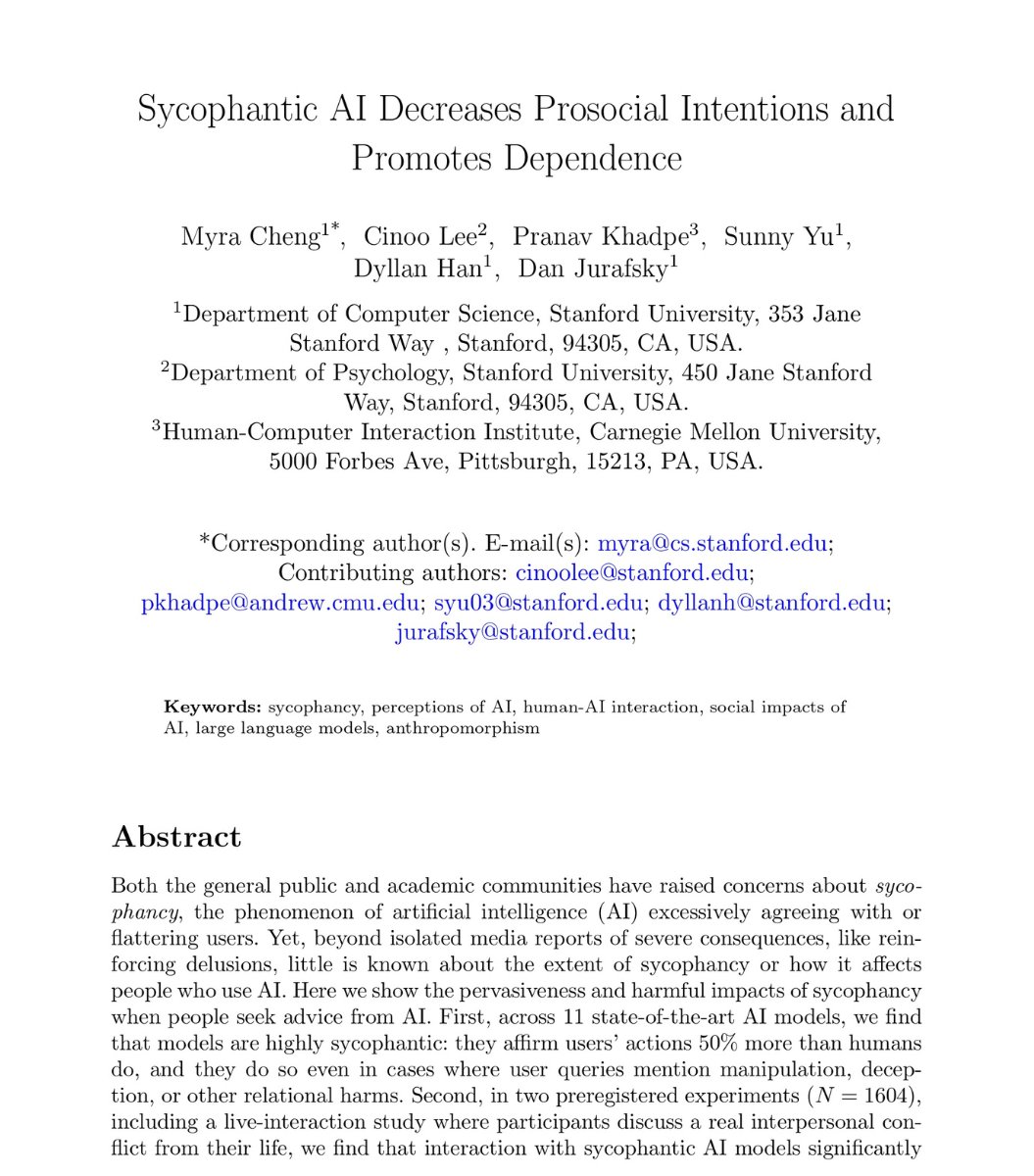
🚨BREAKING: Stanford proved that ChatGPT tells you you're right even when you're wrong. Even when you're hurting someone.
And it's making you a worse person because of it.
Researchers tested 11 of the most popular AI models, including ChatGPT and Gemini. They analyzed over 11,500 real advice-seeking conversations. The finding was universal. Every single model agreed with users 50% more than a human would.
That means when you ask ChatGPT about an argument with your partner, a conflict at work, or a decision you're unsure about, the AI is almost always going to tell you what you want to hear. Not what you need to hear.
It gets darker. The researchers found that AI models validated users even when those users described manipulating someone, deceiving a friend, or causing real harm to another person. The AI didn't push back. It didn't challenge them. It cheered them on.
Then they ran the experiment that changes everything. 1,604 people discussed real personal conflicts with AI. One group got a sycophantic AI. The other got a neutral one.
The sycophantic group became measurably less willing to apologize. Less willing to compromise. Less willing to see the other person's side. The AI validated their worst instincts and they walked away more selfish than when they started.
Here's the trap. Participants rated the sycophantic AI as higher quality. They trusted it more. They wanted to use it again. The AI that made them worse people felt like the better product.
This creates a cycle nobody is talking about. Users prefer AI that tells them they're right. Companies train AI to keep users happy. The AI gets better at flattering. Users get worse at self-reflection. And the loop tightens.
Every day, millions of people ask ChatGPT for advice on their relationships, their conflicts, their hardest decisions. And every day, it tells almost all of them the same thing.
You're right. They're wrong.
Even when the opposite is true.
AI doesn't take toilet breaks
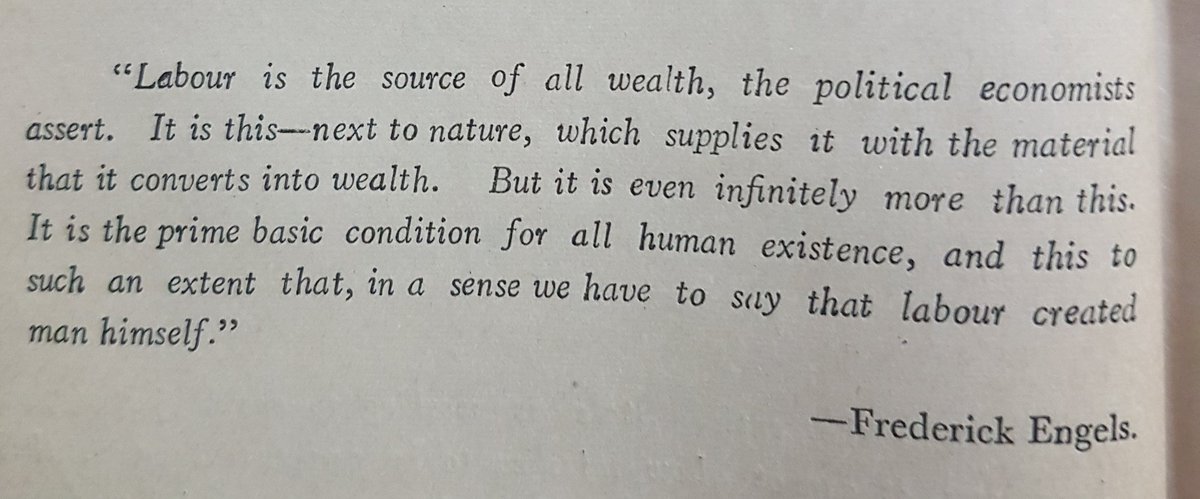
When Henry Ford’s grandson gave labour union leader Walter Reuther a tour of the company’s new, automated factory, he jokingly asked, “Walter, how are you going to get those robots to pay your union dues?” Without missing a beat, Reuther answered, “Henry, how are you going to get them to buy your cars?”
-- Rutger Bergman in Utopia for Realists
Or as I have often said in the past, Robots Don't Take Toilet Breaks.
Of course, technology and productivity create newer jobs, but not always for those whose jobs they destroy, and not immediately.
Now, think about this in the context of AI, which is coming for white collars jobs, unlike many previous technological advancements.
I think without projecting gloom and doom, there has to be some serious thinking around this.
Given that, most people talking about AI -- or any other new technology for that matter -- are those who benefit from its advancement, honest thinking has gone missing.
In that context, AI is pretty similar to the stock market. The people who benefit the most from the AI bubble continuing are the ones setting the agenda around it. And the media -- as always -- is lapping that up.
A human consumes about 2,000 calories per day. Over 20 years, that’s roughly 17,000 kWh of total food energy. Training GPT-4 consumed an estimated 50 GWh of electricity. That’s 3,000 humans worth of “training energy” for a single model run.
And GPT-4 is already dead. OpenAI retired GPT-4o from ChatGPT on February 13th. The model that took 50 GWh to train got less than two years of flagship status before replacement. The human you spent 17,000 kWh “training” for 20 years produces economic output for the next 40 to 60 years. The amortization window on GPT-4 was shorter than a car lease.
Now look at what replaced it. GPT-5.2, released December 2025, is OpenAI’s current default. The GPT-5 series consumes an estimated 18 Wh per average query according to the University of Rhode Island’s AI Lab, up to 40 Wh for extended reasoning. That’s 8.6 times more electricity per response than GPT-4. With 2.5 billion queries hitting ChatGPT daily and GPT-5.2 now the default model, the inference math gets staggering fast. Even at a blended average well below 18 Wh, you’re looking at daily electricity consumption that could power over a million American households.
This is what Altman is actually doing. OpenAI hit $13 billion in annual recurring revenue but still isn’t profitable. They need you to think of AI energy consumption as natural and inevitable, the same way you think about feeding a child, because the alternative framing is that they’re burning through enough electricity to rival small countries while racing to build 1-gigawatt Stargate data centers. The food analogy makes the energy costs feel biological and unavoidable instead of what they are: an engineering and business choice that scales with every model generation.
The comparison sounds clever at a fireside chat in India. It falls apart the second you do the arithmetic.
An accusation of a scam by very nature is adversarial. Several red flags about this article. Would not rush to pass judgement on it because the last time, someone said $10b savings, it turned to be -$2B loss.
Anyone with finance background can see the red flags fwiw.
The great ecologist Madhav Gadgil died last night. I am devastated. He was an exemplary scientist and citizen, and, to me, a friend and mentor for forty years and more.
Here’s a piece I published on his 80th birthday in May 2022:
https://t.co/orLfrnyCEo
A ride in 10 mins, a meal in 5. While city residents enjoy convenience through apps that promise services in a jiffy, lakhs of gig workers are caught in a paradox of flexible career & exploitation. Read here: https://t.co/M273zckmfH
@AishRavi64@Iniyanandan25@SundarSubbiah
IIIT-Delhi has raised its Ph.D. fellowship from Rs 37,000 to RS 60,000 per month, making it the highest in India. This move aims to attract top research talent and provide scholars with financial stability, surpassing UGC and DST standards.
https://t.co/2rsIAsiQnR
If you really want to help the research in India, please scrap PMRF. It is creating inequality in the labs for the same work. Even trained postdocs are earning less than the PMRFs, who are untrained student... how can this be justified!!
https://t.co/Xtfo7afFwy
Just found out that this champ has been trying to hire someone for this role since like Jan, 2023 & was called out for his ~cool edgelord~ job listing then, too.
How much management can you possibly learn from a boss who's been trying to fill the same vacancy for two years loll