Excited to present our work, “Social-Group-Agnostic Bias Mitigation via the Stereotype Content Model”, at #ACL2023! Our bias mitigation approach goes beyond the norm by incorporating social psychological theories of human stereotyping. 📷📷https://t.co/9EHxzBN9mN
For more details, check out our paper at:
📄 Paper: https://t.co/9EHxzBN9mN
You can find the code for our experiments on GitHub: 💻 Code: https://t.co/8bNzbjT252
Drop by our poster in Virtual Poster Session 3 at #ACL2023!
🚨Thrilled to present our work published at ACL 2023 main conference! 🚨
We introduce a novel approach driven by bridging the gap between bias mitigation efforts in NLP and social psychological theories of human stereotyping! 🔍
https://t.co/9EHxzBN9mN
Leveraging the Stereotype Content Model from social psychology, we introduce a social-group-agnostic debiasing approach for word embeddings and LLMs. Achieving comparable performance on bias benchmarks, it offers both theoretical and practical advantages: https://t.co/4ph2pWPBOP
Our results again show that our theory-driven approach can simultaneously mitigate biases for multiple social groups. Interestingly, our "debiased" language models perform on par with their pretrained (biased) counterparts on the GLUE benchmark!
Excited to present our work, “Social-Group-Agnostic Bias Mitigation via the Stereotype Content Model”, at #ACL2023! Our bias mitigation approach goes beyond the norm by incorporating social psychological theories of human stereotyping. 📷📷https://t.co/9EHxzBN9mN
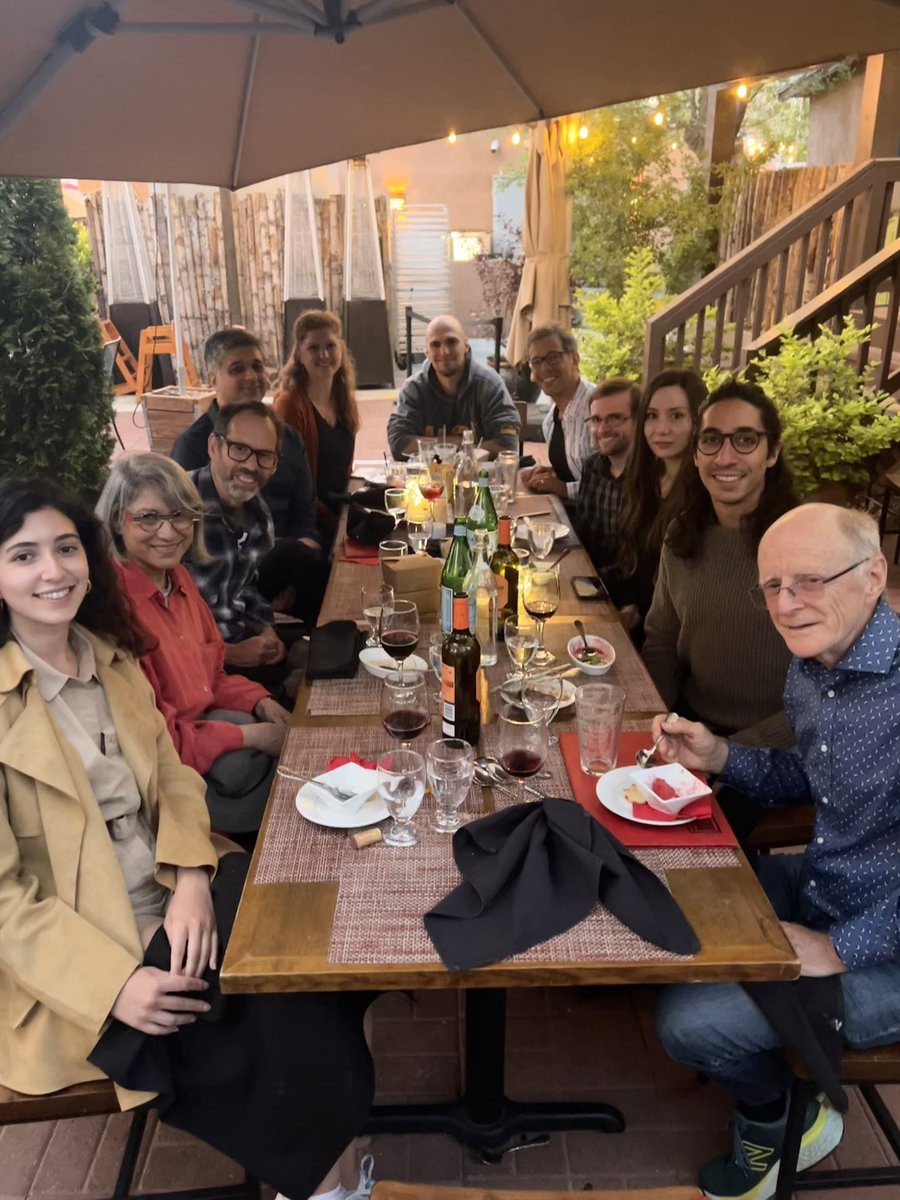
At the @sfiscience Santa Fe institute we had a dream come true (two years in the making): cross disciplinary boundaries to study “language as a window into mind and society”. Co-organized with @banaji. I’m still buzzing from all I learned! A 🧵…
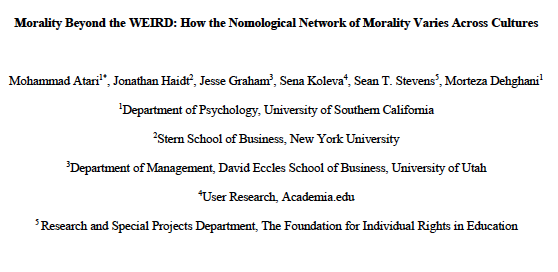
🚨NEW PREPRINT🚨
Morality Beyond the WEIRD: How the Nomological Network of Morality Varies Across Cultures
We present the Moral Foundations Questionnaire-2 (MFQ-2).
https://t.co/EYb41YQ1fr
W/ @JonHaidt , J Graham, @SenaKoleva , S. Stevens, and @MortezDehghani
THREAD 1/20
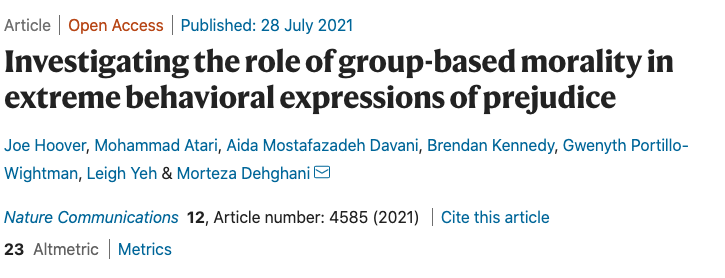
After 3 editors, 6 reviewers & 5 revisions, after our text analysis of Gab was removed by editors post-review process along with references to “conservatives”, and after the Peer Review file was censored, a whitewashed, butchered version of our paper was published @NatureComms
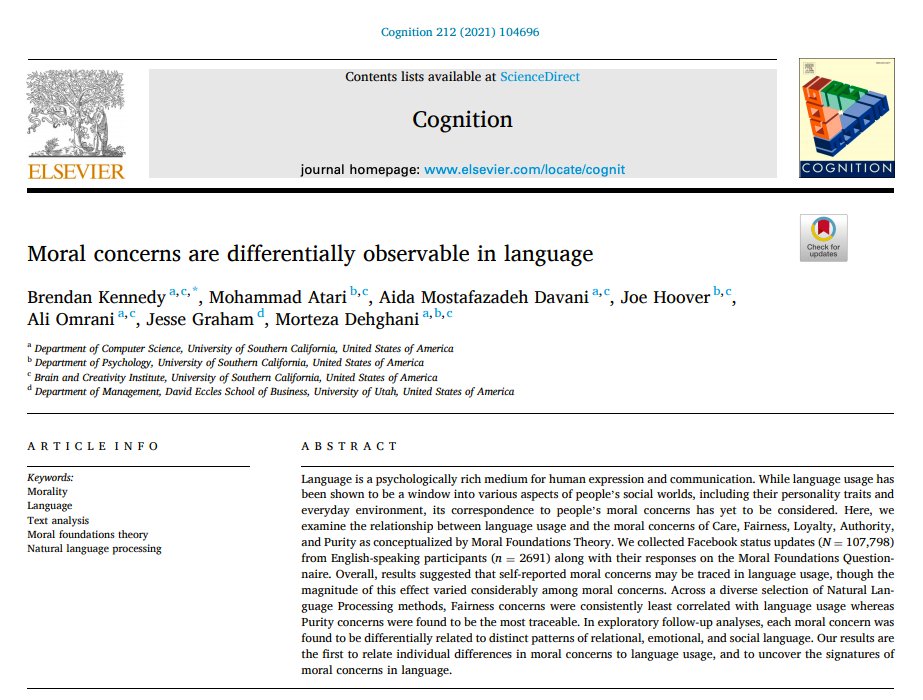
We show 1. Moral concerns are observable in language 2. This signal is differential: each moral domain maps onto a distinct linguistic signature 3.Exclusive moral lang is not a great predictor of individuals' moral concerns @berendennedy@MohammadAtari90 https://t.co/nh8kd6ov2C
The first project that I helped with in my PhD is out in Cognition! 🍾
Here we show that moral concerns are observable in language and explore the linguistic traces of each moral foundation.
🚨🚨🚨 New paper out in Cognition! Thanks to my wonderful coauthors and my advisor @MortezDehghani
In this descriptive/exploratory work, we found that moral concerns are *differentially* observable in language: each moral domain maps onto a distinct linguistic signature. 🧵
USC Computer Science joins many other CS departments in an effort to waive GRE for 2021 graduate program applicants. If you’re interested in NLP, definitely apply to @CSatUSC PhD program and mention names of our NLP faculty @_jessethomason_@robinomial@jonathanmay@xiangrenNLP !





![billyuchenlin's tweet photo. Excited to share our commonsense NLG dataset, CommonGen (->Findings of #emnlp2020), targeting generative #CommonSenseAI. Huge thanks to my wonderful co-authors: @wangchunshu @peizNLP @xiangrenNLP @nlp_usc + Chandra & @YejinChoinka @allen_ai.-->Link https://t.co/WzUMLbTo3A [1/3] https://t.co/YUk5mZ71jE](https://pbs.twimg.com/media/EkN79-7VcAMtwc8.jpg)


