⚡ Latency hack for Polymarket bot builders:
If you’re a halfway decent Polymarket bot maker, you already know the basics:
don’t sign orders in the hot path.
When it’s execution time, your orders should already be signed and ready to fire.
But the harder problem is how you pre-sign.
Because once you start covering a lot of markets, outcomes, price levels, sizes, and retry depths…
the number of orders you need to prepare can explode.
50 markets
× 2 outcomes
× 100 price levels
× 50 possible sizes
× multiple retry levels
Suddenly your bot is trying to keep hundreds of thousands, or even millions, of signed orders ready.
That sounds good in theory.
In practice, it can quietly become the bottleneck.
Your pre-sign refresh takes too long.
Your cache goes stale.
Your bot stalls while rebuilding.
The trade arrives while you’re busy preparing for the trade.
And in copy trading, that’s brutal.
A few hundred milliseconds can be the difference between:
- getting the same fill as the source
- chasing a worse price
- or not executing at all
A better pattern is to keep full price coverage, but compress the sizing dimension.
Instead of pre-signing every exact dollar size:
$1, $2, $3, $4, $5 … $70
you pre-sign composable chunks:
$1, $2, $4, $8, $16, $32, $64
Then when you need $37, you use:
$32 + $4 + $1
Need $50?
$32 + $16 + $2
So your bot still has flexible sizing, but it doesn’t need to pre-sign every possible size at every possible price.
The hot path becomes simple:
1. source trade detected
2. choose the already-signed chunks
3. submit them as a batch
No signing.
No grid rebuild.
No expensive work when the opportunity appears.
One important caveat:
each child order still has to be valid on its own.
If a tiny chunk creates an order below the market’s minimum size, the whole batch can fail.
So the chunking logic needs to be minimum-order-aware.
But if you do it right, you get the best of both worlds:
wide price coverage, flexible sizing, and a much smaller pre-sign workload.
That means faster refreshes, less stalling, fewer stale orders, and a better chance of copying before the book moves.
If you want more execution tips like this, and you’re building Polymarket copy bots, join the Polysocket community below.
We’re putting together traders/builders who care about faster wallet detection, cleaner copy execution, and fewer missed fills.
https://t.co/Z4KJ5L7OXm
@Abomination81@0xd1namit So essentially you swap the feeds from live data to your recorder data and then let it backtest the exact same engine of your live bot right?
How long does it take you to backtest a moderately complex Strat through a month of windows?
@Abomination81@0xd1namit How do you run different strategies on your backtester efficiently - for example, ones that use tape velocity, vs ones that use underlying momentum, vs just imbalance etc
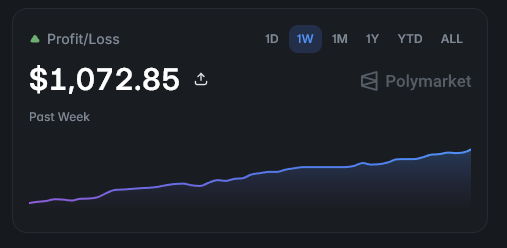
Custom low-latency Rust bot + ultra-low-latency wallet feeds = profitable copy trades on Polymarket.
Started with $100. 5 min crypto markets only.
Now sitting at nearly $1k in gains.
Speed is the only edge that matters.
@nerlfield@Abomination81@Polymarket I’ve been getting much highest latency consistently with the exact same infrastructure setup since v2 - do you know if the time in the window you’re firing makes a big difference on the latency?
🚀 3-Day Live Polymarket Copybot Results Are In
Custom Rust bot running on a dedicated server with @PolySocketDev wallet feed.
Seed: $50
Max $25 per asset per direction
5min Crypto markets only
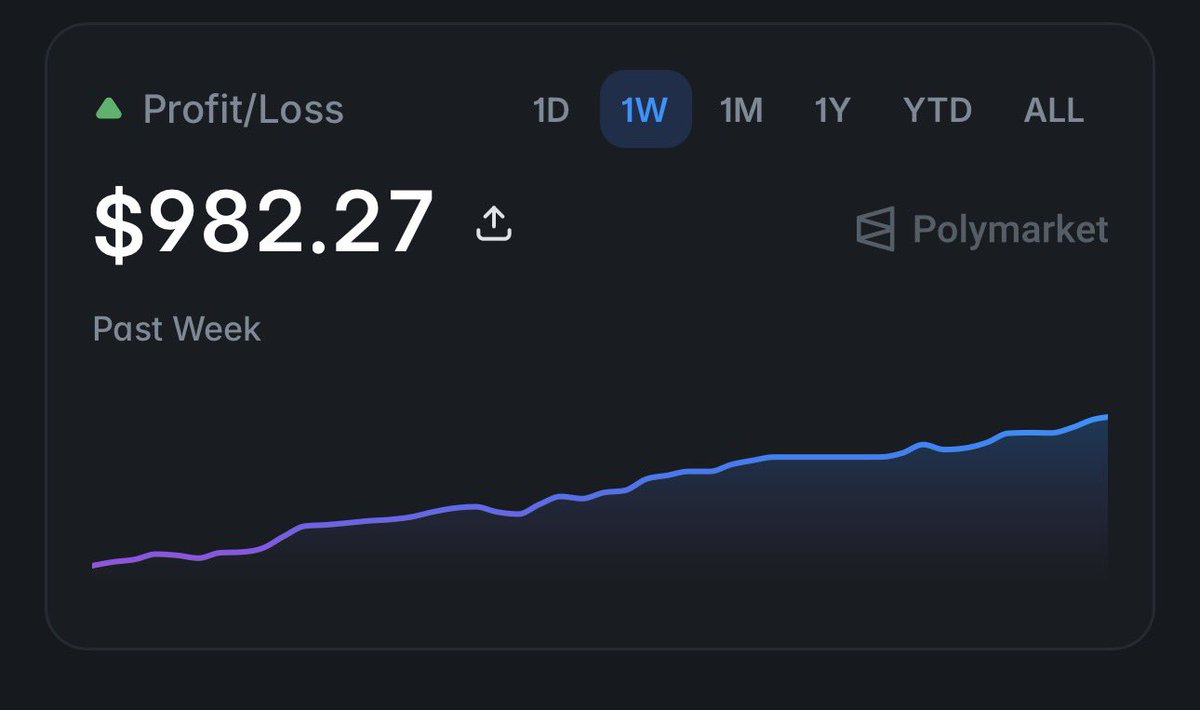
Current PNL: +$700 ✅
Low-latency wallet data = real edge.
Who else is building?
No liquidity. Dozens of good strategies die because you cannot sell/buy the shares. If you make enough bots it happens to everyone.
There are a few ways around this. This is my strategy to manufacture more shares.
1. Naked Sells.
You do not need to own the share to sell it. Usually liquidity is paired (the buy shares are actually the sell shares too) but not always.
How you use this is pretty simple... Buying one side is the same as selling the other.
2. Split Shares.
This is more complicated, but arguably more useful.
You can split $1 from your wallet into 1 up, and 1 down share. The shares themselves have no value.
This means if you split and do nothing, when the window ends it resolves as one as winner, and you haven't sold either side, you get your 1$ back.
So the example is, you want to buy a share at 62c but there is no liquidity there.. or not enough.
You know this is an issue so when the window opened you pre-split 10 shares... now they are sitting in your account.
You can then list them for sale, gtc or fak at 38c. If they sell, you are left with the opposing share, at 62c. Therefore manufacturing 62c shares.