Lingling and Orm just turned a clinic promo into a regional broadcast.
Bangkok, Nov 18: The Touch Clinic hosted Chapter 2 at One Bangkok.
Within hours:
✸ 100k+ posts on X
✸ Top 5 trending across Vietnam
✸ Coordinated campaigns from Manila to São Paulo
Most celebrity endorsements buy a photo op.
This one triggered a global media wave on fan power alone.
Wrapping an asset into a token is the simplest part of the trade. Anyone with an RPC connection can mint a smart contract representing an invoice, a bond, or pre-IPO equity.
The actual bottleneck that decides whether this industry scales or stalls is distribution and secondary liquidity. Wall Street can tokenize every balance-sheet asset in existence, but without active secondary depth and real-world capital matching, those tokens just sit in isolated smart contracts gathering dust.
Look at where the structural demand is actually forming. It is not just retail speculating on synthetic mega-cap equities on weekend mornings. The real friction being solved is in cross-border settlement and trade finance, where a 2.5 trillion dollar funding gap continues to choke supply chains and mid-market enterprises.
Initiatives like Singapore's Project Guardian and new regulatory sandboxes under the SEC Innovation Exemption are shifting focus toward standardizing how this collateral actually moves across borders. When trade receivables, commodity warrants, and institutional credit can be settled instantly without intermediary friction, capital efficiency jumps immediately.
The next hurdle is execution architecture. Right now, onchain equity and credit markets suffer from fragmented liquidity across isolated pools and predatory transaction ordering. Solving that requires dedicated trading infrastructure: referenced market pricing, cross-issuer liquidity aggregation, and fair batch auctions that eliminate front-running.
The conversation has to move past vanity issuance volume. Issuing digital twins of real assets is yesterday's milestone. The protocols and platforms that will capture enduring value are the ones building the clearing pipes, matching global liquidity to underserved capital seekers, and proving that an onchain market can settle faster and cleaner than the legacy venues they aim to replace.
The protocols and platforms that will capture enduring value are the ones building the clearing pipes, matching global liquidity to underserved capital seekers, and proving that an onchain
Wrapping an asset into a token is the simplest part of the trade. Anyone with an RPC connection can mint a smart contract representing an invoice, a bond, or pre-IPO equity.
The actual bottleneck that decides whether this industry scales or stalls is distribution and secondary liquidity. Wall Street can tokenize every balance-sheet asset in existence, but without active secondary depth and real-world capital matching, those tokens just sit in isolated smart contracts gathering dust.
Look at where the structural demand is actually forming. It is not just retail speculating on synthetic mega-cap equities on weekend mornings. The real friction being solved is in cross-border settlement and trade finance, where a 2.5 trillion dollar funding gap continues to choke supply chains and mid-market enterprises.
Initiatives like Singapore's Project Guardian and new regulatory sandboxes under the SEC Innovation Exemption are shifting focus toward standardizing how this collateral actually moves across borders. When trade receivables, commodity warrants, and institutional credit can be settled instantly without intermediary friction, capital efficiency jumps immediately.
The next hurdle is execution architecture. Right now, onchain equity and credit markets suffer from fragmented liquidity across isolated pools and predatory transaction ordering. Solving that requires dedicated trading infrastructure: referenced market pricing, cross-issuer liquidity aggregation, and fair batch auctions that eliminate front-running.
The conversation has to move past vanity issuance volume. Issuing digital twins of real assets is yesterday's milestone. The protocols and platforms that will capture enduring value are the ones building the clearing pipes, matching global liquidity to underserved capital seekers, and proving that an onchain market can settle faster and cleaner than the legacy venues they aim to replace.
BTS IN KAOHSIUNG 🇹🇼
BTS arrived in Taiwan today and stopped by Liuhe Night Market before rehearsal‼️
Jin, j-hope, V & Jungkook tried local street food, while V even asked “Hǎochī ma?” 🥹
3 SOLD-OUT SHOWS START NOVEMBER 19
#BTS#ARIRANG TOUR
BTS IN KAOHSIUNG 🇹🇼
BTS arrived in Taiwan today and stopped by Liuhe Night Market before rehearsal‼️
Jin, j-hope, V & Jungkook tried local street food, while V even asked “Hǎochī ma?” 🥹
3 SOLD-OUT SHOWS START NOVEMBER 19
#BTS#ARIRANG TOUR
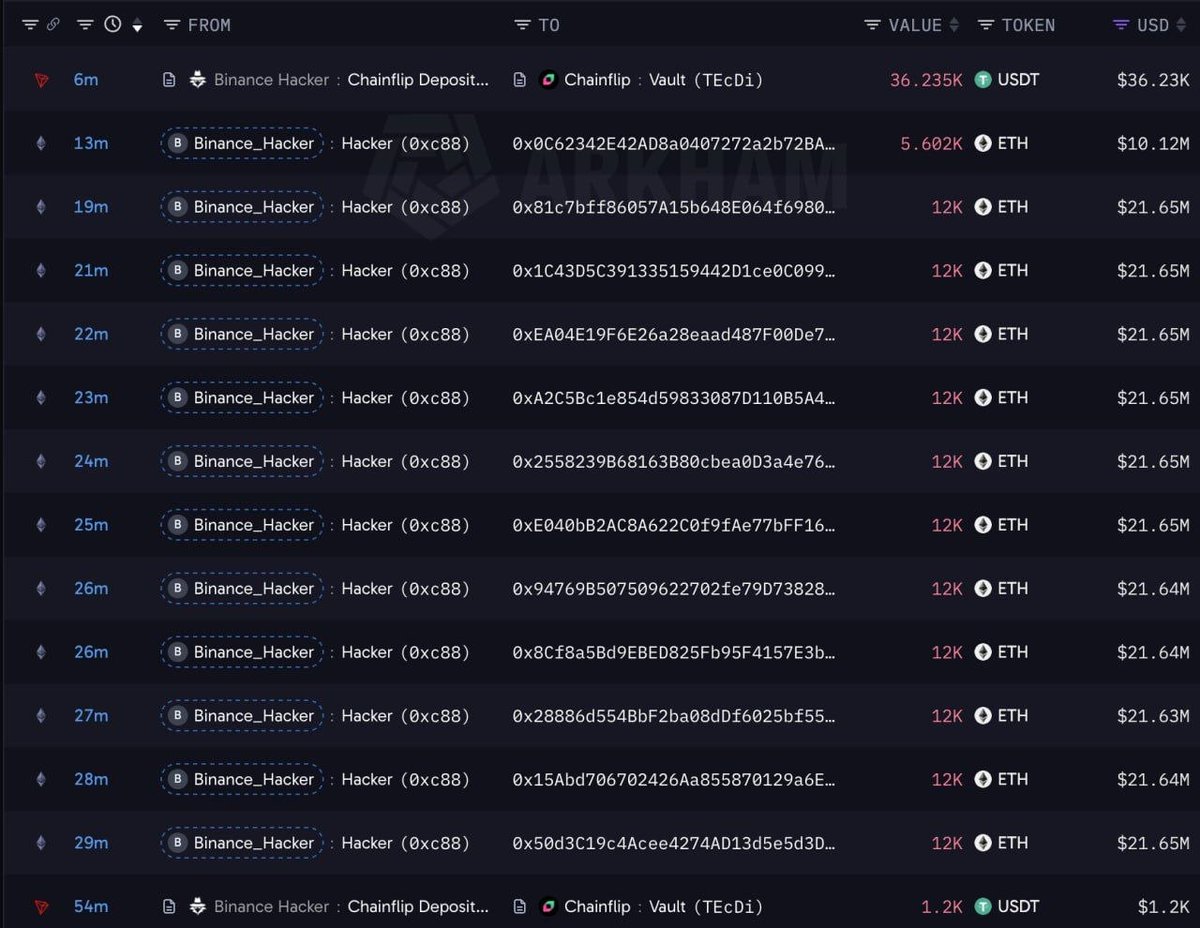
The Binance hacker is still moving ETH to launder.
This time, another 137,000 $ETH worth approximately $248M has been moved.
That brings the total to 3 laundering transactions so far.
Despite these massive movements, around $800M worth of ETH still remains in the hacker's wallet
The Binance hacker is still moving ETH to launder.
This time, another 137,000 $ETH worth approximately $248M has been moved.
That brings the total to 3 laundering transactions so far.
Despite these massive movements, around $800M worth of ETH still remains in the hacker's wallet
can we all agree that stablecoins solved fast settlement, but the institutional data problem is still wide open
watching projects like @primus_labs tackle this on bnb chain makes me think about how compliance and privacy finally meet halfway
Spot on. Moving capital instantly means nothing for big players if sensitive off-chain records are exposed on public ledgers. Verifiable privacy tech like zkTLS is the exact missing bridge needed to unlock real institutional adoption without sacrificing regulatory standards. 🔒⚡
can we all agree that stablecoins solved fast settlement, but the institutional data problem is still wide open
watching projects like @primus_labs tackle this on bnb chain makes me think about how compliance and privacy finally meet halfway
People are modeling $ETH DATs off spot NAV but the real edge is staking yield. If yield covers the burn, the treasury never has to sell ETH for ops and every capital raise can go straight into more ETH. Very different flywheel
People are modeling $ETH DATs off spot NAV but the real edge is staking yield. If yield covers the burn, the treasury never has to sell ETH for ops and every capital raise can go straight into more ETH. Very different flywheel
Maya Jama wore archival Dolce & Gabbana to British GQ Men of the Year.
She arrived at London's Leake Street in a fully sheer black lace gown, matching lingerie, and sheer mesh opera gloves.
The 32-year-old just stepped down from hosting Love Island after nine series. She now holds a seven-figure Netflix deal, fresh acting credits, and 5/1 bookmaker odds to join the next Bond film.
A red carpet look isn't just fashion. It's a statement of intent.
The 32-year-old just stepped down from hosting Love Island after nine series. She now holds a seven-figure Netflix deal, fresh acting credits, and 5/1 bookmaker odds to join the next Bond film.
Maya Jama wore archival Dolce & Gabbana to British GQ Men of the Year.
She arrived at London's Leake Street in a fully sheer black lace gown, matching lingerie, and sheer mesh opera gloves.
The 32-year-old just stepped down from hosting Love Island after nine series. She now holds a seven-figure Netflix deal, fresh acting credits, and 5/1 bookmaker odds to join the next Bond film.
A red carpet look isn't just fashion. It's a statement of intent.
On November 11, @okx announced OKXICE, a joint venture with Intercontinental Exchange, the parent company of the New York Stock Exchange.
Starting November 23, 2026, the platform is set to roll out tokenized US stocks and ETFs directly onchain.
Most tokenized equity experiments in crypto failed because they were synthetic IOUs carrying counterparty risk and zero legal teeth. The mechanics here look noticeably different:
+ 24/7 trading for US equities and ETFs, removing traditional market hour bottlenecks.
+ Real shareholder rights embedded in the tokens, including voting power and dividend distributions.
+ True self custody. Assets stay in user wallets, and OKXICE does not hold client funds or private keys.
Restricted rollout. Access is limited strictly to eligible US customers, leaving international markets out for now. The regulatory structure is the real tell. OKXICE is launching under a conditional temporary exemption from the SEC while awaiting formal approval. That points to a measured shift in posture. Regulators are no longer shutting down RWA rails on arrival, even as policymakers and corporate issuers continue to debate legal frameworks and shareholder registry rights.
Most tokenized equity experiments in crypto failed because they were synthetic IOUs carrying counterparty risk and zero legal teeth. The mechanics here look noticeably different:
+ 24/7 trading for US equities and ETFs, removing traditional market hour bottlenecks.
On November 11, @okx announced OKXICE, a joint venture with Intercontinental Exchange, the parent company of the New York Stock Exchange.
Starting November 23, 2026, the platform is set to roll out tokenized US stocks and ETFs directly onchain.
Most tokenized equity experiments in crypto failed because they were synthetic IOUs carrying counterparty risk and zero legal teeth. The mechanics here look noticeably different:
+ 24/7 trading for US equities and ETFs, removing traditional market hour bottlenecks.
+ Real shareholder rights embedded in the tokens, including voting power and dividend distributions.
+ True self custody. Assets stay in user wallets, and OKXICE does not hold client funds or private keys.
Restricted rollout. Access is limited strictly to eligible US customers, leaving international markets out for now. The regulatory structure is the real tell. OKXICE is launching under a conditional temporary exemption from the SEC while awaiting formal approval. That points to a measured shift in posture. Regulators are no longer shutting down RWA rails on arrival, even as policymakers and corporate issuers continue to debate legal frameworks and shareholder registry rights.
most folks focus on how smart an ai agent is while ignoring the boring backend logic
watching how @termix_ai structures its api endpoints and unsigned tx intents makes you realize secure execution matters way more than flashy demos
most folks focus on how smart an ai agent is while ignoring the boring backend logic
watching how @termix_ai structures its api endpoints and unsigned tx intents makes you realize secure execution matters way more than flashy demos
Xiaomi launched the 18 Pro in Bangkok yesterday.
At 44,999 baht, specs like dual 200MP cameras and new Snapdragon silicon are expected.
The real hurdle is convincing buyers they need a rear display.
Xiaomi brought on Thai duo LenaMiu to demonstrate it. Instead of detailing display latency or peak nits, they simply framed shared selfies on stage.
Hardware specs explain what a feature is. Chemistry explains why it exists.