Over the past 4 days at @Supercomputing we have loved your questions around our new accelerated roadmap.
So today, here’s a blog post from Alice & Bob’s CTO and co-founder @RLescanne that answers many of them, in detail.
One number decides how big, how complex and how power-hungry a quantum computer ends up. Which one? How many physical qubits you need to make a single logical one. ⚛️
Our CTO follows it from one machine to the next and takes you along. It drops, then climbs back up on purpose, and he explains why 📉📈
He also dives into what has to be true to get there, and why we’re confident we will.
Make a coffee and dive in ☕
👉 Read the blog post: https://t.co/Wmt6ZFWuck🗺️
#QuantumComputing #CatQubits #QuantumRoadmap #AliceAndBob
Alice & Bob’s quantum computing roadmap is here.
Today, we have updated our roadmap to deliver quantum utility by 2030, a device with twice the logical qubits we previously planned to deliver, and large scale quantum computers by 2034.
Cat qubits are still at the core of this faster path, the most hardware efficient one in the industry for superconducting qubits. 🚀
How is this acceleration possible?
MODULARITY: We’re linking QPUs together at cryogenic temperatures, so a single cryostat or a single wafer are no longer the limit. 🧩
FULL INTEGRATION: We are about to open the doors of our new fully integrated chip design, fabrication and testing facility in Paris, one of the largest and most advanced QPU development sites in Europe 🔬
Six years ago, we helped bring the cat qubit to life. Today, they are getting us to large-scale quantum computers, and over the next decade, to new frontiers in science.
We can’t wait to travel this road down with you. 🛣️
See the full roadmap: https://t.co/XQtyulRxJ2
Join the team: https://t.co/dSGYc7Nh4p
#Roadmap #QuantumComputing #CatQubits #FaultTolerantQuantum #AliceAndBob
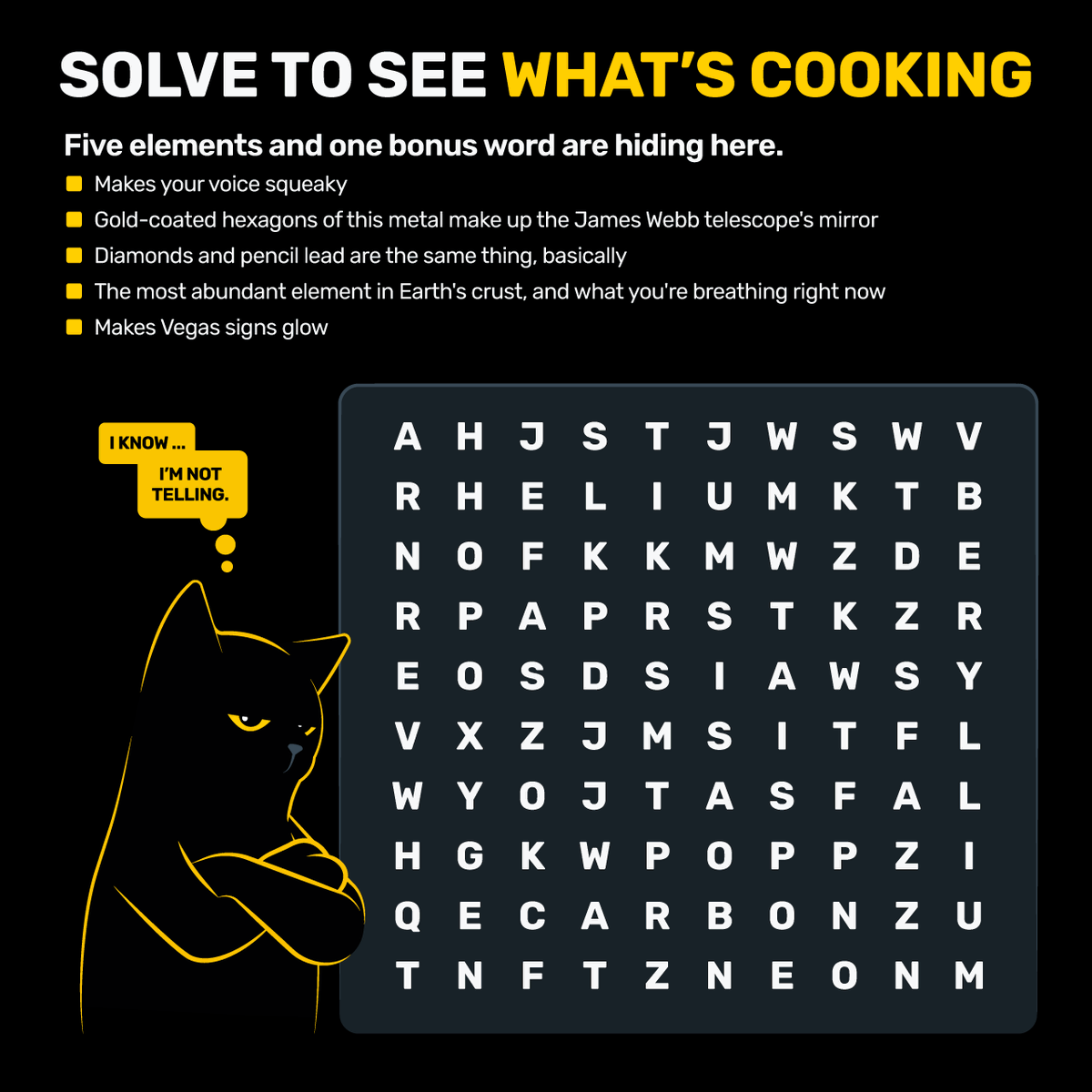
Cats can stare at one spot for hours.
Quantum engineers can stare at one error rate for just as long.
Now it’s your turn, stare at the grid then solve it 🐈⬛
Let us know in the comments how many words you got, and if you found the bonus word.
Watch this space tomorrow 18th November! 👀👩🍳
#QuantumComputing #CatQubits #AliceAndBob #WordSearch #PuzzleTime #DeepTech
Quantum computers aren’t that alien. 🐈⬛🛸
In the server room, a QPU is just another accelerator next to your CPUs and GPUs.
So why reinvent how we schedule and manage them?We’ve spent the past year working with the STFC Hartree Centre on QRMI, an open-source, vendor-neutral interface (alongside IBM, Pasqal and others). Implement it once, and our cat qubits work with Slurm, OpenPBS, LSF, Flux and more. And with this week’s @nvidia news on Slurm, we’re ready for what’s next. 🚀
NVIDIA’s update lets Slurm treat QPUs as first-class resources, and the QRMI community is already building the plugin for it.Our Felis cloud API already speaks QRMI, so no extra integration work needed.
Read the full story here 👉 https://t.co/UG3QOC2wNT
If you’re heading to @Supercomputing 26, see us run a QRMI tutorial with @IBM and @pasqal_quantum today, 13:30 CST, room W184d. 🤓
#QuantumComputing #HPC #QRMI #Slurm #CatQubits #SC26
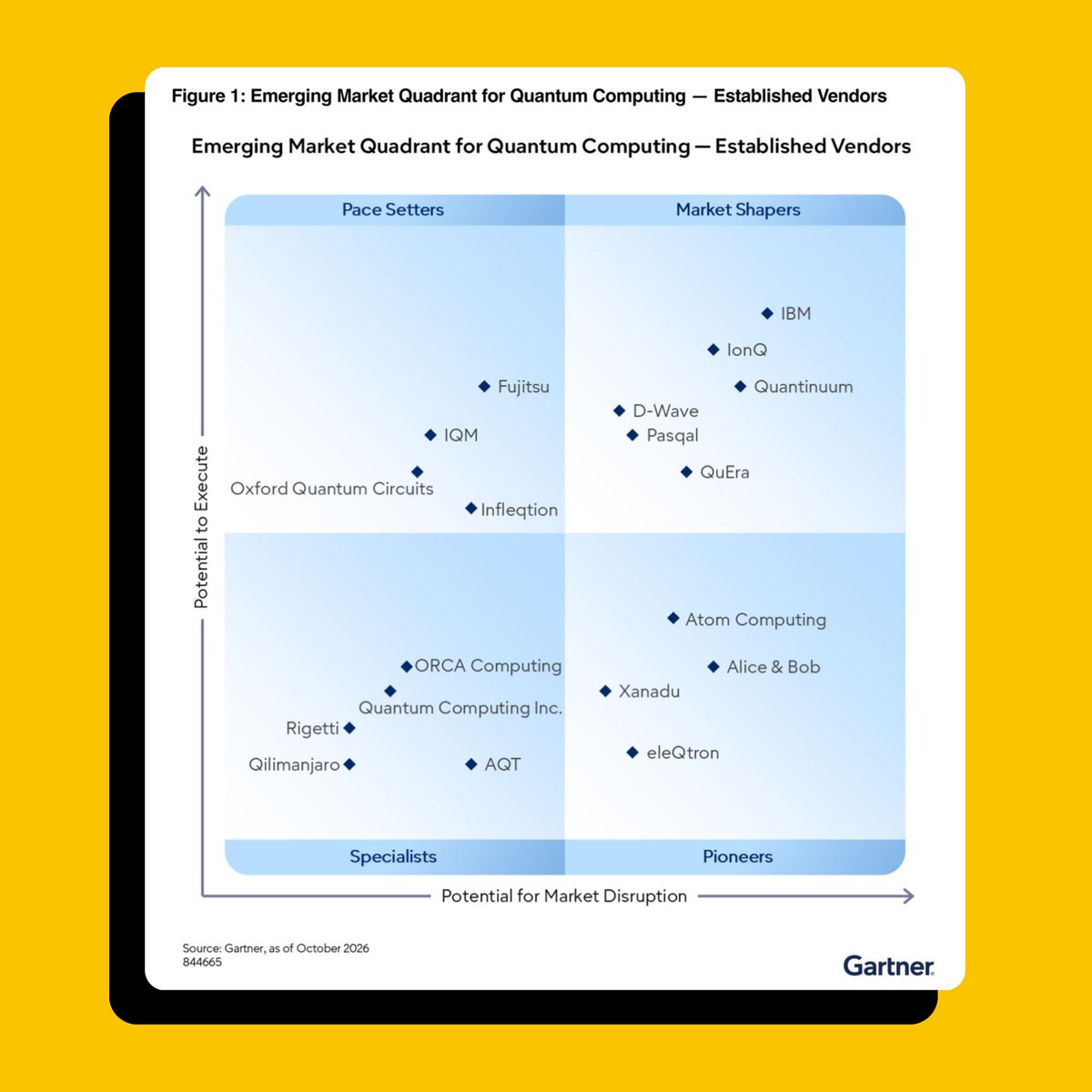
Gartner recently released its first Emerging Market Quadrant for Quantum Computing, and Alice & Bob is recognized as a "Pioneer" and one of the most likely to bring disruption to the market 🐈⬛
A few points from the report we completely align on.
🔹No qubit technology has won yet
🔹Fault-tolerant quantum computing is expected between 2028 and 2030
🔹The market will likely consolidate around the companies that get there
Here’s where we’d add our own view 💭
The race won’t be decided by who builds a quantum computer that can “just” solve useful problems.
It will be decided by who turns that computer into an economically viable product. If a machine is too expensive to buy or to run, too difficult to build or to host, even early market traction won’t make a lasting advantage. 🏭
That’s where cat qubits make the difference, and why Alice & Bob scored so high on “potential for market disruption.” Because they exponentially correct bit-flip errors in the hardware itself, each logical qubit needs far fewer physical qubits. Fewer qubits means computers that are orders of magnitude more compact, more efficient and therefore more economical ⚡
Congratulations to everyone featured in this first edition 🥂
#QuantumComputing #CatQubits #FaultTolerance #QuantumErrorCorrection #DeepTech #Gartner
Quantum computing has a size problem. We think cat qubits solve a big part of it 🐈⬛
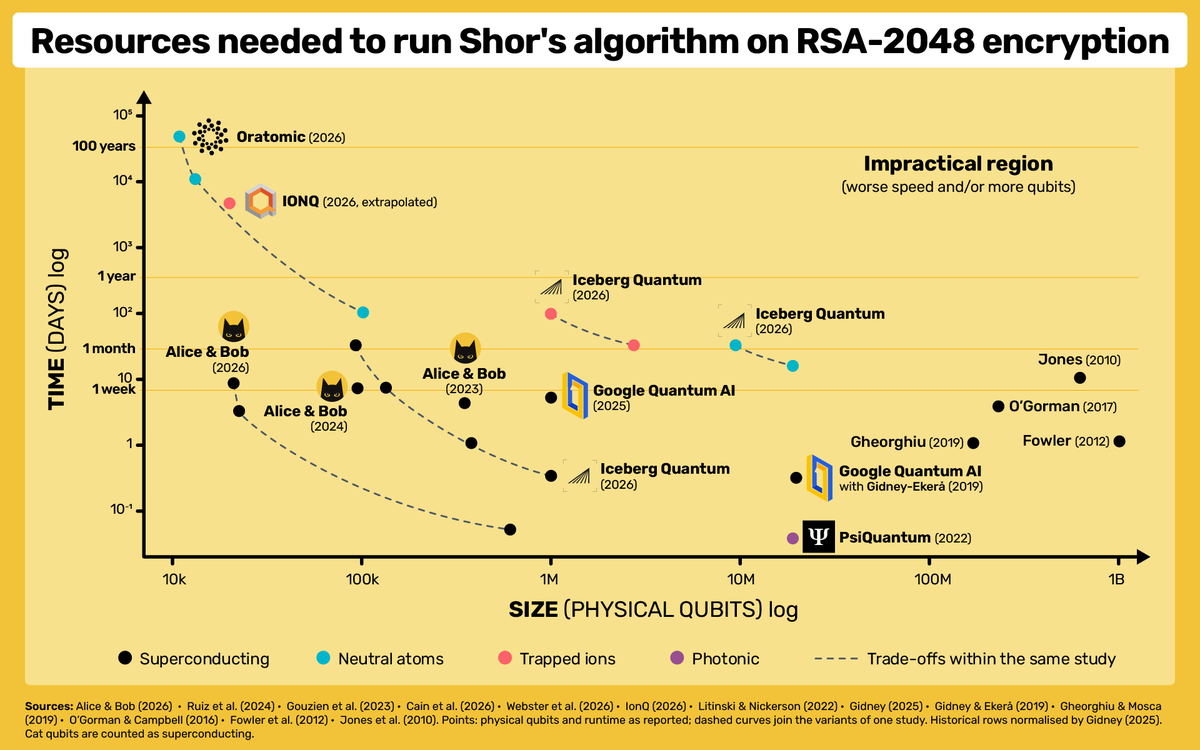
To break RSA-2048 in about three days, we would need around 1 million standard superconducting qubits, about 33 000 m² and circa 500 MW, roughly the power consumption of Brussels 🇧🇪. With cat qubits, it's 23 000 qubits, 800 m² and 12 MW. About what an high-speed train runs on 🚄.
Why does that matter? Every qubit comes with cryogenics, wiring, control electronics and cost. A machine consuming as much as a whole city is a machine you could build, but nobody will buy. One that fits in a small building, powered by a single wind turbine, starts to look like an engineering project. 🏗️
The savings come down to physics. Cat qubits resist bit-flips by design, so error correction only has to fight phase-flips. We’ve shown this on our Boson 4 chip in 2024 and more recently on the Helium chip, where idle bit-flips times reached 1h 🧪 https://t.co/riYXCwoDig
This is a theory paper, such a machine still has to be built and the challenges to overcome are many. But a smaller machine is a much more realistic one, and arguably one that could be built sooner.
The world's transition to quantum-resistant cryptography has never been more urgent than now.
More on the findings this Wednesday in the blog post from the study's authors.👀 In the meantime, have a look at our infographic 👉 🖼️ https://t.co/Un6lNQZMsa
For those of you who want to dive deeper here's the full paper: https://t.co/aQgOBbogyI
#QuantumComputing #CatQubits #ShorsAlgorithm #FaultTolerance #PostQuantumCryptography
400 times the age of the universe. That’s how long today’s best supercomputers would need to factor a 2048-bit number 🔐
Then, in 1994, Peter Shor showed a quantum computer could do it efficiently, given a sufficiently large quantum computer.
Since then, the question has been how large. In our new paper, we estimate about 25,000 cat qubits could run it in about 3 days.
Dahmun Goudarzi and Vivien Londe, two of the researchers behind the paper, take you from the maths that keeps your passwords safe to the cat qubits that could change the picture. 🐈
📄 Read the paper: https://t.co/aQgOBbogyI
📝 Read the blog post: https://t.co/43JwqPx7nW
Last week we said 22 593 cat qubits and 3.14 days. Today, the authors show their work 🐈
Our new technical blog post walks through how we compiled Shor’s algorithm for RSA-2048 with Inria Rennes, all the way from the algorithm down to every physical qubit on the chip 🧩
Inside, you’ll find 👇
🧮 The modern version of Shor’s algorithm, thirty years of optimizations in one place
🔌 Three tricks built for cat qubits (a parity-CNOT, a multi-target CNOT and active injection) that let us rebuild the adder, the operation Shor’s runs most
🗺️ A full chip layout, two layers face to face, with memory and compute zones and magic-state factories
🎯 Our assumptions, stated plainly. The headline number assumes no bit-flip on any qubit during the three-day run. Our latest preliminary results reach a bit-flip about every hour for each qubit, and the paper also works out the cost of that more conservative scenario
We also make a case for the whole field 😼 Comparing platforms only works if every estimate states its algorithm, hardware and error correction. So we propose a smaller shared milestone that uses the same building blocks as RSA-2048, one any fault-tolerant architecture could aim for first 🏁
Written by the people who did the work, and worth the read 👇
📝 Blog: https://t.co/pOmYIcTFk9
📄 Paper https://t.co/aQgOBbogyI
#QuantumComputing #CatQubits #ShorsAlgorithm #FaultTolerance
Quantum computing has a size problem. We think cat qubits solve a big part of it 🐈⬛
To break RSA-2048 in about three days, we would need around 1 million standard superconducting qubits, about 33 000 m² and circa 500 MW, roughly the power consumption of Brussels 🇧🇪. With cat qubits, it's 23 000 qubits, 800 m² and 12 MW. About what an high-speed train runs on 🚄.
Why does that matter? Every qubit comes with cryogenics, wiring, control electronics and cost. A machine consuming as much as a whole city is a machine you could build, but nobody will buy. One that fits in a small building, powered by a single wind turbine, starts to look like an engineering project. ���️
The savings come down to physics. Cat qubits resist bit-flips by design, so error correction only has to fight phase-flips. We’ve shown this on our Boson 4 chip in 2024 and more recently on the Helium chip, where idle bit-flips times reached 1h 🧪 https://t.co/riYXCwoDig
This is a theory paper, such a machine still has to be built and the challenges to overcome are many. But a smaller machine is a much more realistic one, and arguably one that could be built sooner.
The world's transition to quantum-resistant cryptography has never been more urgent than now.
More on the findings this Wednesday in the blog post from the study's authors.👀 In the meantime, have a look at our infographic 👉 🖼️ https://t.co/Un6lNQZMsa
For those of you who want to dive deeper here's the full paper: https://t.co/aQgOBbogyI
#QuantumComputing #CatQubits #ShorsAlgorithm #FaultTolerance #PostQuantumCryptography
@igordownunder RSA keys are usually meant to last for hours, sometimes even years. Also, Shor's algorithm complexity grows polynomially in the size of the number: it means going from 2048 to 4096 is much easier than classically.
Breaking RSA-2048 with 23,000 cat qubits. 🐈 In 3.14 days
This is the finding of our new paper, the latest resource estimate for Shor’s algorithm, the benchmark the whole field uses to compare quantum hardware 📄
The results are a record low for total quantum resources at this speed of execution, about 40 times fewer physical qubits than @GoogleQuantumAI 's Craig Gidney 2025 estimate. 🏁
RSA-2048 is the lock behind secure websites, banking and software updates 🔐 Shor's algorithm has been able to break it, on paper since 1994. Nobody has built the machine yet, but every year the estimate of how big it needs to be gets a little smaller.
In 2019, the best estimate was 20 million qubits. In 2024, ours was just under 100,000. Now 22,593, in 3.14 days. Yes, pi 🥧
Small isn't enough. Fast isn't enough. The new study optimizes for both. 😼
Bitcoin, Ethereum and most blockchains aren't secure either, about 30,000 qubits would be needed to crack a Bitcoin key in about an hour ₿ ⏳
How we got here, what it means for cryptography, and when it all converges, our CEO Théau Peronnin talks about it in the blog 👇
📝 Blog - https://t.co/K3E5pxTUMv
📄 Paper - https://t.co/kiC9JZz66u
Stay curious, more info coming soon 👀
#QuantumComputing #CatQubits #ShorsAlgorithm #PostQuantumCryptography #Cryptography #FaultTolerance #DeepTech
This Thursday something BIG yet unprecedentedly small, will come out of the lab.
To "decrypt" the riddle, you may want to play a game with us 🎲 👉 https://t.co/27kdW9zHLD
Three short puzzles, about five minutes, no physics required. You will find a rhythm, compose a score, and catch an error before it catches you… what do you think will be the big news on Thursday? Answer in the comments 👇
#quantumcomputing #FTQC #quantumerrorcorrection #crypto #shor
A small comparison of the recent QuEra + Anthropic + Harvard study and our own...
You might find it interesting. 🤖 vs 🧙
In the video: the cost of simulating Fe₂S₂ with a quantum circuit. We ran our method (https://t.co/prJw9hQt9k) on the same benchmark as their study (https://t.co/5pb2jbf7P7), applying our optimizations to their circuit too.
➡️ Result: we cut TQ (the lower the cheaper) by around 1/3 vs their released circuit, by using around 2/3 fewer Toffoli gates for some extra logical qubits.
Blog post on the paper coming soon. 👀
What happens when AI enters the quantum lab, and GPUs carry the load?
At @NVIDIA GTC Berlin, our CEO and co-founder Théau Peronnin showed what that looks like in practice. AI and GPU computing now speed up every step of how we build quantum computers, from chip design to error correction:
⚡ Dynamiqs https://t.co/dFbuOgCsiP, our quantum simulation library, is integrated with NVIDIA CUDA-Q and runs on NVIDIA GPUs and simulates cat qubit physics up to ×75 faster. That means we can explore chip design ideas before we fabricate them
🔍 AI fits our measurements with ×10 less compute, checked against a digital twin of the chip
🤖 155 AI agents planned a study, our team checked the plan, and one agent ran it on our chips autonomously. A full study took a day instead of a week
🧩 In a first proof of concept with NVIDIA @NVQLink, we decoded simulated error syndromes from our LDPC-cat codes, showing how decoding can scale by becoming more efficient as several syndromes are decoded in parallel with GPUs
We also had a special visitor at the booth: @awagonfeld , NVIDIA's CMO, dropped by to see where cats and GPUs meet 💚
Thanks to everyone who came to say hi 🐾
#NVIDIAGTC #QuantumComputing #CatQubits #NVQLink