@ValerieAnne307@shiestynurse@LindaG_RN As a “libtard” nurse of 30 yrs, I have NEVER denied care, be they HIV positive, etc. This wasn’t a “libtard” thing, it was an unethical thing. And yes, should be reported, as should any healthcare professional who calls others names such as “libtard” or “magat”.
Three hidden drugs.
One “supplement.”
All Ultimate Forza capsules recalled: undeclared sildenafil, tadalafil + dapoxetine.
Sold at some US GNC franchises.
Stop use; return for refund.
With nitrates, hidden ED drugs can dangerously lower blood pressure.
@tdgiv40@Camsiyonna1 I couldn’t even watch this whole clip. I’m still shaking. My “father” did this to my sister and me, more me. My father would run through the house closing windows and doors so the neighbors wouldn’t hear. They all knew, and shunned my sister and me
If your kid depends on FAFSA this Trump accounts will destroy them .
🚨🚨🚨
The government is giving a child $1,000 in "free money" but by placing it in an asset account in the child's name, they are disqualifying that child from thousands of dollars in Pell Grants and subsidized loans over their college career
($200/yr x 4 years = $800 lost immediately, plus more if the balance grows).
The "free money" is effectively clawed back by the financial aid system. The Treasury gives with one hand and the Department of Education takes with the other. This ensures poor families remain indebted to the system rather than receiving outright support
🚨🚨🚨🚨
——
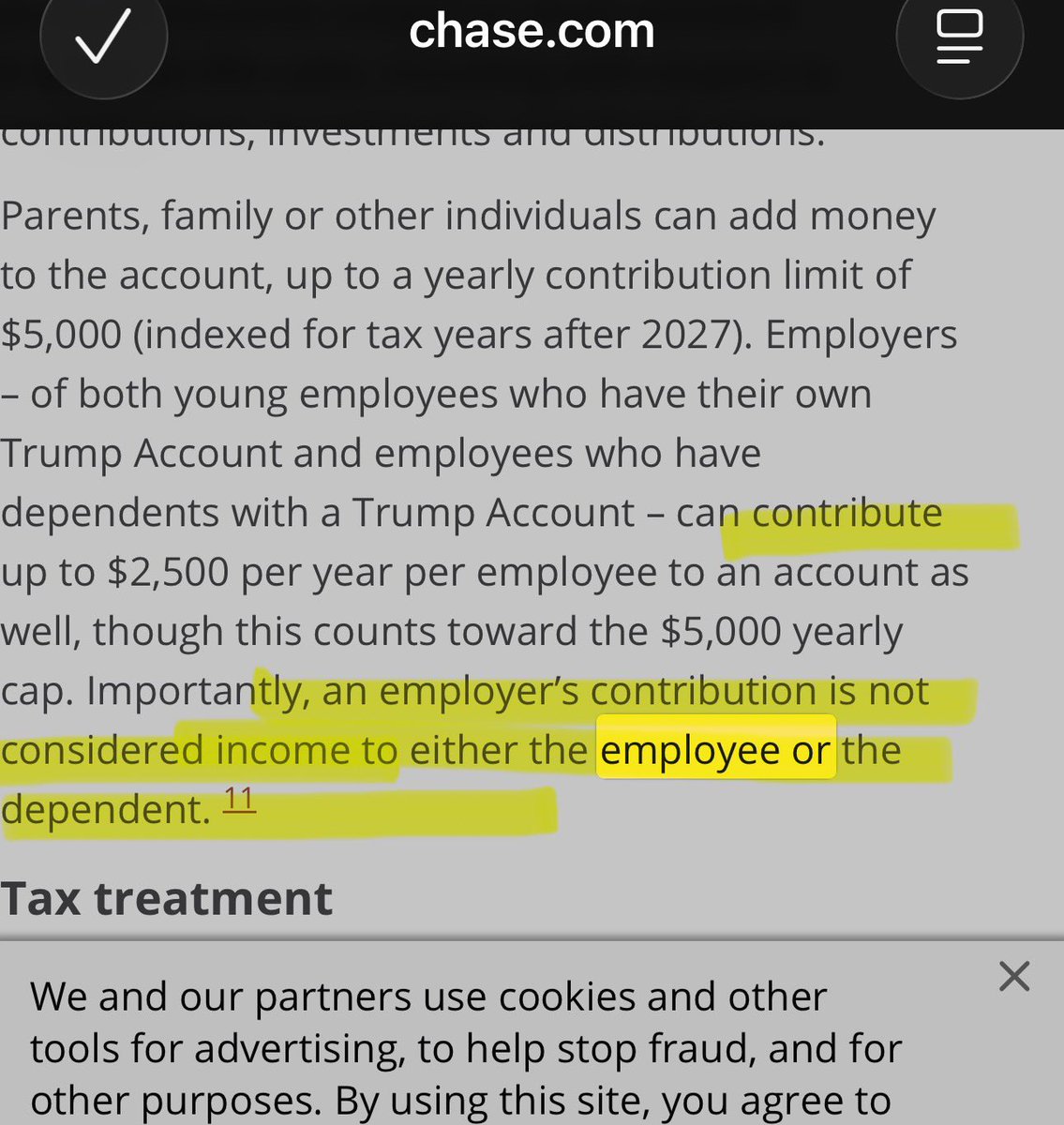
THE WAGE REPLACEMENT SCHEME (THE CORPORATE TAX DODGE)⚠️⚠️⚠️⚠️🏦🏦
Another anomaly Employers can contribute up to $2,500 per year to these accounts, and these contributions are "not considered income to the employee or the dependent." The Treasury promotes this as a "tax-preferred benefit" for small businesses.⚠️⚠️⚠️
So If an employer puts $2,500 into a Trump Account instead of giving the employee a $2,500 raise, who wins? 👀
The employee gets locked liquidity (can't touch it for 18 years), but the employer gets a tax deduction.
This incentivizes corporations to replace liquid wage increases with locked equity contributions. An employer can tell a worker, "I can't afford a $2,500 raise," and instead give them $2,500 in a Trump Account. 🚨🚨🚨
The employee thinks they got a bonus, but they actually got nothing they can use to pay rent or buy groceries today. This suppresses real wage growth by funneling compensation into illiquid government accounts that the worker cannot access, while the employer maximizes tax benefits.🚨🚨🚨🚨
——
THE NEGATIVE TAX ARBITRAGE (THE POOR MAN'S PENALTY)🚨🚨🚨
Another Anomaly: it says Contributing to a Trump Account is done with after-tax dollars (no deduction), but withdrawals are taxed as ordinary income upon distribution.⚠️
This is the opposite of a Roth IRA (where you pay tax now, but withdraw tax-free). In this system, you pay tax now, and you pay tax later.⚠️
This structure is predatory for low-income families who are currently in a low tax bracket. If a family in the 10% or 12% tax bracket contributes today, and the child withdraws the money at age 35 when they are in the 22% or 24% tax bracket, the family has voluntarily entered a higher tax liability. This structure guarantees the IRS collects more revenue decades from now than they would under a normal savings account or Roth structure.
The "benefit" of tax-deferred growth is wiped out by the penalty of higher taxes at withdrawal.⚠️⚠️⚠️
——
All these Trump accounts do is 🚨🚨 Loop:
The Government (Treasury) forces money in -> Robinhood/BNY manages it -> The money buys stocks/companies -> BlackRock/Goldman/etc. run those companies/assets -> The stocks go up due to forced demand -> The companies match employee contributions (tax write-off) -> More money in -> Stocks go up more.
It's a circular enrichment scheme for the financial sector.🚨🚨🚨STOLEN from US TAX PAYERS 🚨🚨🚨
@RepThomasMassie
THIS CANNOT BE ALLOWED TO HAPPEN!
Trump wants to cut down Washington DC's oldest grove of cherry trees along and eliminate the public biking path and picnic areas so he can build a golf course on public land, using public dollars, and taking spaces away from the public.
A student submitted an essay she wrote by hand. Her university ran it through an AI detector. The detector said she cheated. She is autistic.
Her name is Moira Olmsted. Adelphi University. February 2026. Turnitin flagged her essay as 100% AI-generated. She was disciplined.
Two other AI detectors classified the same essay as human-written.
She sued. She won. The court called the school's decision "arbitrary and capricious."
She is not the only one.
In May 2026, a high school student in Palo Alto was expelled after an AI detector flagged his work. He faced visa revocation. He filed a federal civil rights lawsuit.
A researcher at Griffith University just proved mathematically why this keeps happening. The paper is on arXiv. The finding is one sentence.
AI text detectors have a structural flaw that no amount of better engineering can fix.
Here is what the math says.
If a university wants its detector to catch 80% of cheaters, at least 750 out of every 10,000 innocent students will be wrongly accused. That is not a software problem. It is a theorem.
If the university tries to limit false accusations to 1%, detection power collapses to 6%. It catches 6 out of every 100 AI-written papers. The other 94 get through.
There is no setting where the detector is both fair and effective.
The reason is diversity. Every student writes differently. Non-native English speakers use simpler vocabulary. Shorter sentences. Clearer structures. So does AI. A Stanford study found that 61.3% of TOEFL essays written by non-native English speakers were misclassified as AI-generated. A separate analysis tested 14 commercial detection tools. Zero out of 14 reached 80% accuracy.
The students most likely to be wrongly accused are non-native English speakers, neurodivergent students, and anyone who writes with clarity and precision. The qualities that make their writing effective are the same qualities the detector mistakes for a machine.
Vanderbilt University understood this. They disabled Turnitin's AI detection in 2023 after calculating that even a 1% error rate across 75,000 submissions would produce 750 wrongful accusations per year.
750 students accused of cheating for writing like themselves.
The paper's conclusion is not that we need better detectors. It is that the diversity of human writing itself makes accurate detection mathematically impossible.
The same thing that makes your writing yours is the thing that gets you accused.
https://t.co/L91ldtXP05
Could you also please cut the sugar in the regular soda? I could drink regular in the UK and Europe without issue. In the U.S.? My blood sugar spikes due to the 21gms of sugar.
Presenting the FFXIV x Jollibee Collaboration Sweepstakes! The joyful collab will be concluding on May 31 but you can still enter for a chance to win some prizes!
🛍️ Jollibee x FFXIV Apparel
✨ FFXIV Taito Items
🍗 Eat Chicken Emote
✅ Submit your entries: https://t.co/xUyRZhfjAa
Open to US & CAN. For full terms and conditions, please see the official rules at https://t.co/Sj6t1dpLwx.
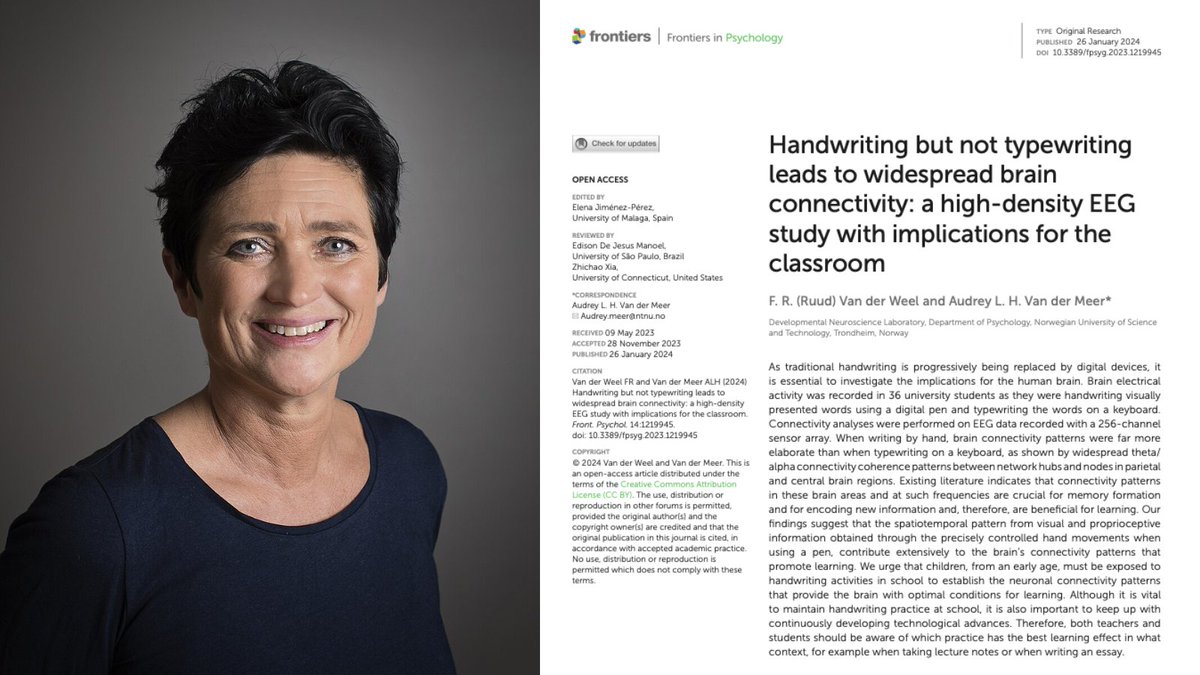
A Norwegian neuroscientist spent 20 years proving that the act of writing by hand changes the human brain in ways typing physically cannot, and almost nobody outside her field has read the paper.
Her name is Audrey van der Meer.
She runs a brain research lab in Trondheim, and the paper that closed the argument was published in 2024 in a journal called Frontiers in Psychology. The finding is brutal enough that it should have changed every classroom on Earth.
The experiment was simple. She recruited 36 university students and put each one in a cap with 256 sensors pressed against their scalp to record brain activity. Words flashed on a screen one at a time.
Sometimes the students wrote the word by hand on a touchscreen using a digital pen, and sometimes they typed the same word on a keyboard. Every neural response was recorded for the full five seconds the word stayed on screen.
Then her team looked at the part of the data most researchers had ignored for years, which is how different parts of the brain were communicating with each other during the task.
When the students wrote by hand, the brain lit up everywhere at once.
The regions responsible for memory, sensory integration, and the encoding of new information were all firing together in a coordinated pattern that spread across the entire cortex. The whole network was awake and connected.
When the same students typed the same word, that pattern collapsed almost completely.
Most of the brain went quiet, and the connections between regions that had been alive seconds earlier were nowhere to be found on the EEG.
Same word, same brain, same person, and two completely different neurological events.
The reason turned out to be something nobody had really paid attention to before her work. Writing by hand is not one motion but a sequence of thousands of tiny micro-movements coordinated with your eyes in real time, where each letter is a different shape that requires the brain to solve a slightly different spatial problem.
Your fingers, wrist, vision, and the parts of your brain that track position in space are all working together to produce one letter, then the next, then the next.
Typing throws all of that away. Every key on a keyboard requires the exact same finger motion regardless of which letter you are pressing, which means the brain has almost nothing to integrate and almost no problem to solve.
Van der Meer said it plainly in her interviews.
Pressing the same key with the same finger over and over does not stimulate the brain in any meaningful way, and she pointed out something that should scare every parent who handed their kid an iPad.
Children who learn to read and write on tablets often cannot tell letters like b and d apart, because they have never physically felt with their bodies what it takes to actually produce those letters on a page.
A decade before her, two researchers at Princeton ran the same fight using a completely different method and ended up at the same answer. Pam Mueller and Daniel Oppenheimer tested 327 students across three experiments, where half took notes on laptops with the internet disabled and half took notes by hand, before testing everyone on what they actually understood from the lectures they had watched.
The handwriting group won by a wide margin on every question that required real understanding rather than surface recall.
The reason was hiding in the transcripts of what the two groups had actually written down.
The laptop students typed almost word for word, capturing more total content but processing almost none of it as they went, while the handwriting students physically could not write fast enough to transcribe a lecture in real time, which forced them to listen carefully, decide what actually mattered, and put it in their own words on the page.
That single act of choosing what to keep was the learning itself, and the keyboard had quietly skipped the choosing and skipped the learning along with it.
Two studies. Two countries. Same answer.
Handwriting makes the brain work. Typing lets it coast.
Every note you have ever typed instead of written went into your brain through a thinner pipe. Every meeting, every book highlight, every idea you captured on your phone instead of on paper was processed at half depth.
You did not forget those things because your memory is bad. You forgot them because typing never woke the part of the brain that would have made them stick.
The fix is the thing your grandmother already knew.
Pick up a pen. Write the thing down. The slower road is the faster one.
There’s a generation a lot of people forget exists. We were born at the tail end of the Boomers, but we are not culturally the same as people born in the 40s and early 50s. We are Generation Jones.
And honestly, it explains a lot.
We grew up in a world that still felt fundamentally analog, but we were young enough to be dragged headfirst into the digital revolution. We are the bridge generation between rotary phones and smartphones, between slide rules and AI, between Walter Cronkite and algorithm driven media.
We remember when there were only a few television channels and the entire country watched the same thing at the same time. We also adapted to the internet, email, forums, social media, streaming and now artificial intelligence. We lived before and after the technological singularity hit everyday life.
That is not a small thing.
People born in the 40s came of age in a post World War II America that was still industrial, deeply hierarchical and institutionally stable. Their formative years were shaped by the Cold War, Vietnam, the civil rights era and a society where information moved slowly.
Generation Jones came later. We inherited the aftermath of all of that.
We were the kids who watched Watergate destroy blind trust in government. We watched manufacturing begin to collapse. We saw divorce rates explode. We were the first truly latchkey generation in massive numbers. We learned independence early because many of us had to.
We grew up with one foot in old America and one foot in whatever this new thing was becoming.
We played outside until the streetlights came on but we also learned DOS commands. We learned cursive and keyboarding. We had card catalogs and Google searches. We went from vinyl records to cassette tapes to CDs to MP3s to streaming in one lifetime.
We remember maps. We remember memorizing phone numbers. We remember life before GPS and before every human interaction became filtered through a screen.
And because of that, I think Generation Jones developed a very unique perspective. We are adaptable because we had no choice but to adapt. We learned technology as adults instead of being born into it. We remember a slower world but were forced to survive in a rapidly accelerating one.
That creates a very different mindset than either older Boomers or younger Gen X and Millennials.
A lot of us also reject the caricature people now associate with “Boomers.” We were not buying houses for the cost of a sandwich in 1965. The interest rate on my first house was over 14% and that was after buying down a point. Many of us got hit by recessions, outsourcing, pension collapses and economic instability just like younger generations did. We watched promises evaporate in real time.
We understand older generations because we were raised by them. We understand younger generations because we had to evolve alongside them.
That’s why the Jones generation often feels culturally homeless. We are rarely discussed, rarely defined and usually lumped into categories that don’t actually fit us.
But we exist.
We are the human transition point between the industrial age and the digital age.
And frankly, there will probably never be another generation quite like us again.
@Scout_503@KingKaliwani I used to live about 0.25miles from the Hawthorne Farm site. I don’t know how many people can smell what they put in the air, but I can. It causes me to wheeze, and have dyspnea.
I moved 15 mi away. Now I can smell it again.