Japan will panic.
What is the carry trade?
How does the reversal of it create a global margin call?
A credit event?
A monster video.
Follow @leadlaglive for daily market analysis and commentary.
Today's Morning Few.
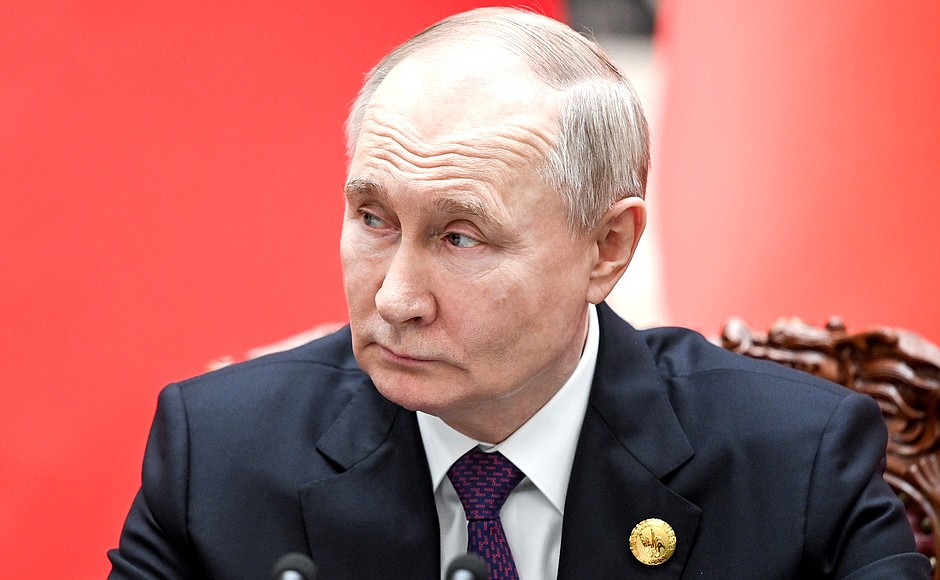
🇷🇺 President Vladimir #Putin:
When our troops stood near Kiev, our Western partners told us: it is impossible to sign documents when the other side puts a gun to your temple. “What should be done?” we asked. “It is necessary to withdraw troops from Kiev.” We did this. On the following day, they threw all our agreements into the dustbin and said: “Now we will fight to the end.” Their Western curators occupied the position that is now known to the whole world – to defeat Russia on the battlefield, to inflict a strategic defeat on it.
Imagine if they walked down prices to liquidate the longs just so they could Dalai us to new highs on some “NEWS”
We simply ignore the FUD.
1 $FTM = 1 DUBAI PHANTOM SOON
$BTC
Whether you like it or not, today's ATH was a liquidity sweep.
Liquidity sweeps, even if an ATH breaks, are not reasons to think we will rocket higher immediately.
I say this as a bulltard.
I've done transactions in fiat and bitcoin. I haven't done transactions in gold, Apple stock, or anything else.
I can send bitcoin to anyone with an internet connection globally, within the hour on-chain, or within seconds via Lightning, with no centralized party capable of blocking it. Meanwhile, my international fiat wire transfers take days and often get blocked by centralized parties and then I have to sort through layers of bank customer service to figure out which side the blockage occurred on and why. Happens all the time.
And recipients of international dollar transfers that don't have access to eurodollar accounts often get forcibly converted into local currency at fake exchange rates, whereas sending bitcoin can reach them directly, around their local banking system.
Bitcoin can be brought across borders in unlimited size, whereas fiat and gold are very limited at ports of entry. That doesn't matter much to most Americans but it can matter a lot for people in the 160+ other currency monopolies in the world that often want to leave one country for another with their savings intact. It's not theoretical- I personally know people that have done this and have fled hyperinflationary jurisdictions thanks to it. That's a monetary use case.
I've spoken with plenty of human rights advocates in authoritarian countries who turned to bitcoin when their bank accounts were frozen. It helps them keep receiving donations, keep their funds from getting arbitrarily taken, etc. That's another monetary use case. It's the fallback for financial de-platforming, confiscation, censorship, etc.
When I travel globally, which I do many times per year, I can't access any of my physical gold in the United States, and all of my modes of payment (other than a small wad of physical cash) are reliant entirely on an international chain of credit- I have to trust my U.S. banking institutions and their various counterparties to keep my cards working. But I can customize some of my bitcoin setup so that I can access self-custodial bitcoin anywhere, which could be helpful in a pinch. In some countries I can spend it directly on merchants, while for others there are peer-to-peer marketplaces to convert it to local currency, which greatly increases my options if need be rather than making me entirely reliant on my institutions back in the US.
So, what someone gets by holding bitcoin is optionality and global availability that their other monies can't provide them, and in a package that has less ongoing supply dilution than fiat or gold (and ultimately with zero dilution).
And then on top of that, there is an investment thesis that this money will continue to catch on due to having the above-mentioned characteristics, and thus reach closer to its total addressable market (which is basically anyone who wants to hold some nonzero percentage of their net worth in self-custodial and globally portable money that can't be diluted). Even if one is in a jurisdiction where they don't feel those attributes are helpful to them and thus doesn't directly hold it for its monetary properties, they might instead hold it within an investment vehicle because they view those attributes as being attractive to others and thus likely to continue gaining adoption.
The majority of bitcoin doesn't move very often, because it's held for savings or a long-term investment outlook. But the fraction that does move, can move with very high velocity due to how efficient it is. Due to the fact that modern monies get rapidly diluted, we tend to treat money and investments as separate, whereas with bitcoin, some portion of it can be locked away as savings/investment, while another portion can be used for spending or working capital.
Change happens fast. Solana now rivals or surpasses Ethereum across:
- DEX Volumes
- NFT Volumes
- Active Addresses
- Transaction Count
- Stablecoin Transfers
“But Solana isn’t decentralized 😤”
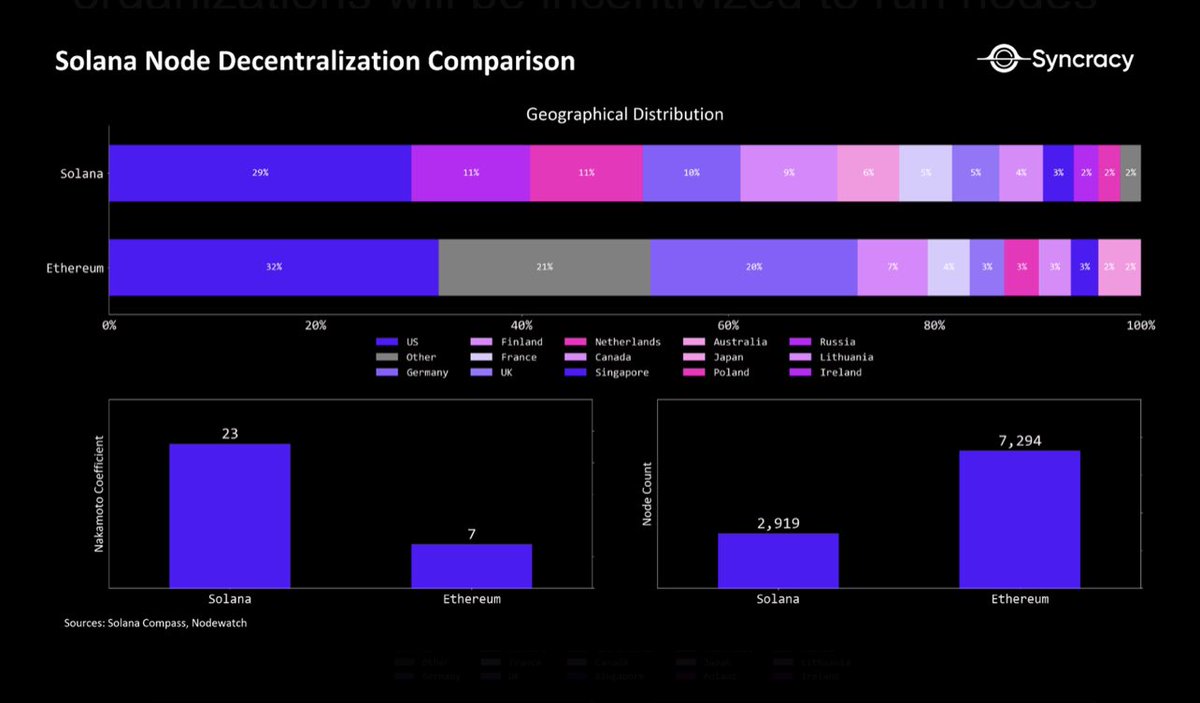
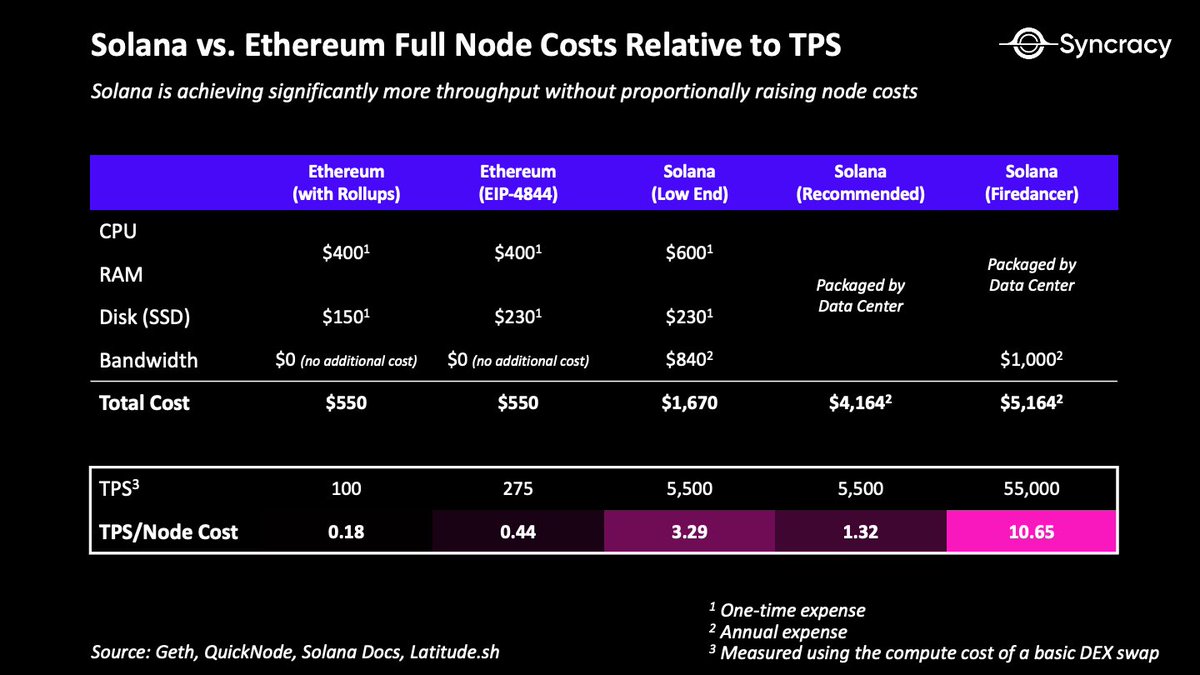
Reality: Solana has ~40% the amount of nodes as Ethereum, they’re only ~5x more expensive to run, and provide orders of magnitude more throughput…
Seems like its worth the trade-off?
Of course there’s more to decentralization than node count and geographic distribution, and Solana needs to continue decentralizing its developer ecosystem among other things. But it’s important to remember decentralization isn’t just a static attribute, it changes through time.
As Solana continues to grow, so too will it’s developer ecosystem. So too will it’s node count. So too will it’s efforts to implement light clients and DAS — features that all blockchains will have in the long-run to ensure cheap end user verification. So too will it’s applications and users and integrations… I think you get the point.
And when it’s all said and done will it matter so much that Solana wasn’t perfect from the beginning? I’ve personally learned to get over it.