Apollo & Artemis (a thread for Earth Day)
I spent years poring over all 18,000 photos taken by the Apollo program, finding the very best photos of Earth from space and restoring them.
So how do the Artemis photos compare?
🧵
Liftoff.
The Artemis II mission launched from @NASAKennedy at 6:35pm ET (2235 UTC), propelling four astronauts on a journey around the Moon.
Artemis II will pave the way for future Moon landings, as well as the next giant leap — astronauts on Mars.
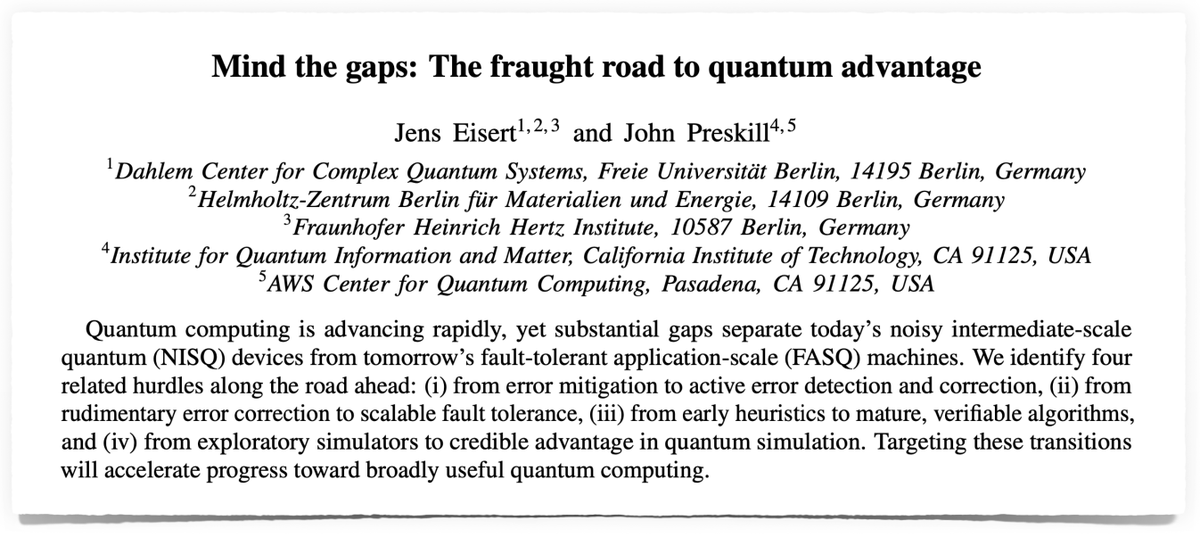
Over the recent weeks and months, @preskill and I sat down to think about where we are in quantum computing. While the noisy intermediate-scale quantum (#NISQ) era — a term coined by John in 2018 — is just unfolding as we speak, the time seems right to look ahead to the next steps to come.
https://t.co/aSWIa4Z6CA
In this perspectives article, we try to sketch the fraught road to quantum advantage — the path toward fault-tolerant, application-scale quantum (#FASQ) computers. There are several gaps ahead of us, and we try to faithfully and honestly hint at how one may be able to "mind those gaps", and suggest a few important intermediate steps along the way.
I have been impressed by the ease and efficiency with which we have been able to put this together. Warm thanks to John for the great collaboration and wonderful team work.
BREAKING NEWS
The Royal Swedish Academy of Sciences has decided to award the 2025 #NobelPrize in Physics to John Clarke, Michel H. Devoret and John M. Martinis “for the discovery of macroscopic quantum mechanical tunnelling and energy quantisation in an electric circuit.”
The first taste of “Somni,” the upcoming album with Snarky Puppy and Metropole Orkest (conducted by Jules Buckley), is here. “Waves Upon Waves” is the opening track on the 70-minute work, and its debut single.
Listen now: https://t.co/t4nGzMp3M2
It was great to take part in the second edition of the Seeking Quantum Advantage conference in Oxford last week!
There were talks spanning the latest developments in applications, quantum error correction, hardware and co-designing between different elements of the stack on the path to quantum advantage.
I was also pleased to once more moderate the unique SEEQA debate (pictures below!), alongside the organisers Bálint Koczor and Simon Benjamin. It took place in the Oxford Union — a location famous for high-profile debates.
The motion was "This house believes that quantum computers will have a greater impact on our lives than conventional ones". Arguing for the motion were @ElhamKashefi, Terry Rudolph and Nathan Wiebe, and against the motion were @quantum_graeme, @victorvalbert and Jens Eisert.
At the end of the debate, participants "voted with their feet" by walking through the "Aye" or "No" door, resulting in 72 ayes and 94 noes, so the motion was defeated! It provided lots of food for thought during the conference, and creative arguments from the panelists.
The conference also featured the @OQC_Tech poster prize of £500 for early career researchers, which was awarded to @AlikiCapatos for her poster "Practical blueprint for low-depth photonic quantum computing with quantum dots". An honourable mention went to Ryan Tiew for his poster "Low-Overhead Entangling Gates from Generalised Dehn Twists." Congrats!
A big thank you to Ming-Lai at @sparrow_quantum for the huge effort he put into this paper, as well as the other authors at The Niels Bohr Institute for all their input – I am very lucky to work with such exceptional people.
What’s cool is that we’ve already successfully demonstrated the resource state generation and fusion gates in the lab. As a result, our blueprint is able to focus on feasibility and practicality, with components we know how to implement and improve towards real fault-tolerance.