"Fluency illusion" is a cognitive bias where the brain mistakes familiarity for actual mastery. To break the illusion, you must force your brain to perform the hard work of retrieving information (active recall) rather than passively consuming it.
Attention @arxiv authors: Our Code of Conduct states that by signing your name as an author of a paper, each author takes full responsibility for all its contents, irrespective of how the contents were generated. 1/
Today we’re excited to unveil a new generation of Segment Anything Models:
1️⃣ SAM 3 enables detecting, segmenting and tracking of objects across images and videos, now with short text phrases and exemplar prompts.
🔗 Learn more about SAM 3: https://t.co/CjMnf7fspz
2️⃣ SAM 3D brings the model collection into the 3rd dimension to enable precise reconstruction of 3D objects and people from a single 2D image.
🔗 Learn more about SAM 3D: https://t.co/yXcvts8Ogc
These models offer innovative capabilities and unique tools for developers and researchers to create, experiment and uplevel media workflows.
"AI isn't replacing radiologists" good article
Expectation: rapid progress in image recognition AI will delete radiology jobs (e.g. as famously predicted by Geoff Hinton now almost a decade ago). Reality: radiology is doing great and is growing.
There are a lot of imo naive predictions out there on the imminent impact of AI on the job market. E.g. a ~year ago, I was asked by someone who should know better if I think there will be any software engineers still today. (Spoiler: I think we're going to make it). This is happening too broadly.
The post goes into detail on why it's not that simple, using the example of radiology:
- the benchmarks are nowhere near broad enough to reflect actual, real scenarios.
- the job is a lot more multifaceted than just image recognition.
- deployment realities: regulatory, insurance and liability, diffusion and institutional inertia.
- Jevons paradox: if radiologists are sped up via AI as a tool, a lot more demand shows up.
I will say that radiology was imo not among the best examples to pick on in 2016 - it's too multi-faceted, too high risk, too regulated. When looking for jobs that will change a lot due to AI on shorter time scales, I'd look in other places - jobs that look like repetition of one rote task, each task being relatively independent, closed (not requiring too much context), short (in time), forgiving (the cost of mistake is low), and of course automatable giving current (and digital) capability. Even then, I'd expect to see AI adopted as a tool at first, where jobs change and refactor (e.g. more monitoring or supervising than manual doing, etc). Maybe coming up, we'll find better and broader set of examples of how this is all playing out across the industry.
About 6 months ago, I was also asked to vote if we will have less or more software engineers in 5 years. Exercise left for the reader.
Full post (the whole The Works in Progress Newsletter is quite good):
https://t.co/ON3GwlI3mi
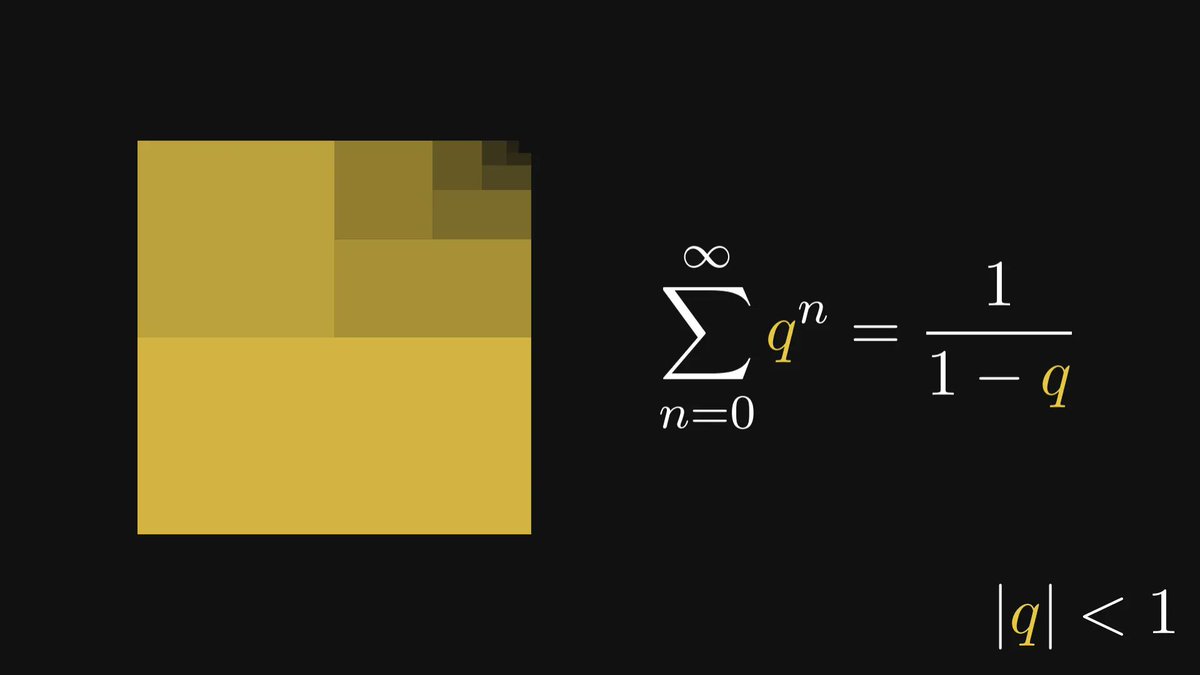
One of my favorite formulas is the closed-form of the geometric series.
I am amazed by its ubiquity: whether we are solving basic problems or pushing the boundaries of science, the geometric series often makes an appearance.
Here is how to derive it from first principles:
In 15 years as a prof, I've been to 30+ PhD defences.
But only 5 questions determine your success.
The questions seem random, but they're testing skills.
Master these areas and you'll walk out more confident.
Here's the question framework that actually works:
1. Contribution Significance
They want proof your work matters.
This tests your ability to position research impact.
• Start with the broader problem you're solving
• Connect your findings to existing problems
• Quantify the advancement you've made
Move from general significance to specific innovation.
2. Methodological Differentiation
They're probing your research choices.
This shows your understanding of alternatives.
• Acknowledge existing approaches openly
• Highlight your unique methodological angle
• Explain why your approach yields better results
Confidence here shows mastery of your field.
3. Criticism Response
They want to see intellectual resilience.
This tests your ability to defend without defensiveness.
• Acknowledge any valid concerns immediately
• Separate limitations from fundamental flaws
• Redirect to your research's core strengths
Grace under pressure demonstrates research maturity.
4. Future Research Directions
They're evaluating your research vision.
This shows whether you think like a researcher.
• Consider both incremental and breakthrough possibilities
• Connect future work to current limitations
• Identify 2-3 logical next steps
Vision separates PhD students from PhD researchers.
5. Real-World Impact
They want practical relevance demonstrated.
This tests your ability to translate research value.
• Discuss implementation challenges honestly
• Identify specific stakeholders who benefit
• Connect findings to industry applications
Practical thinking proves research influence.
Don't treat these questions as interrogation.
Treat them as your chance to demonstrate expertise.
So:
What question from your defence surprised you most?
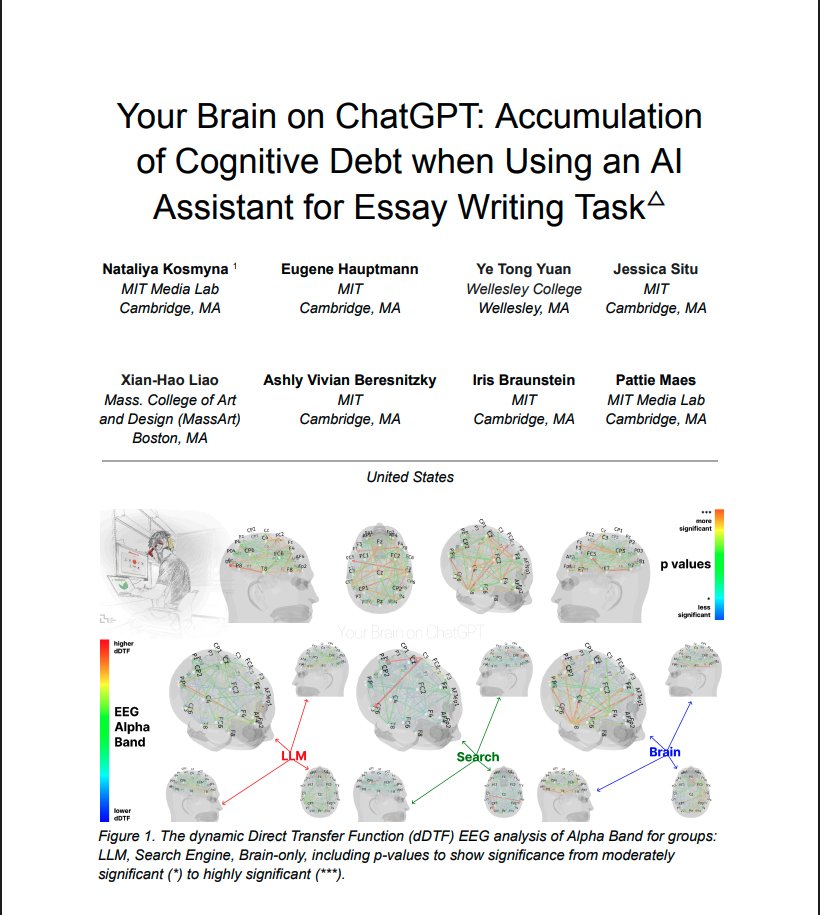
BREAKING: MIT just completed the first brain scan study of ChatGPT users & the results are terrifying.
Turns out, AI isn't making us more productive. It's making us cognitively bankrupt.
Here's what 4 months of data revealed:
(hint: we've been measuring productivity all wrong)
The UQ AI PhD Showcase is running 26- 27 June 2025. The event features keynotes from Peter Bailey (Canva) & Lawrence Kusz (ChatStat), lighting talks and posters, and a panel discussion on "AI in the real-world" with recent UQ graduates. More info here: https://t.co/wze6uEK8t2
We’re hiring! @UQSchoolEECS is recruiting a Lecturer/Senior Lecturer (Asst. Prof.) in Applied AI for a continuing teaching & research role. Join us to help build a new Centre of Excellence in AI & Data Science between UQ (Brisbane, Australia) & Thapar Institute (India).
Comet rises above the horizon just before orbital sunrise amongst aurora and swirling satellites.
Timelapse composed from 1/4s, 50mm, f1.2, ISP 6400 images played at 30fps.
@tweethue my Philips Hue automations have all switched forward by 1 hour even though my location does not have daylight savings. I’m in AEST not AEDT and my location is correctly set in the app. How can I fix this bug?
💡I am recruiting a PhD student in Deep learning for Electromagnetic Solvers w/ Prof Amin Abbosh
Develop physics-guided deep learning models, domain adaptation & data augmentation techniques to overcome the disparity between theoretical models & reality: https://t.co/S49K8z9jCo