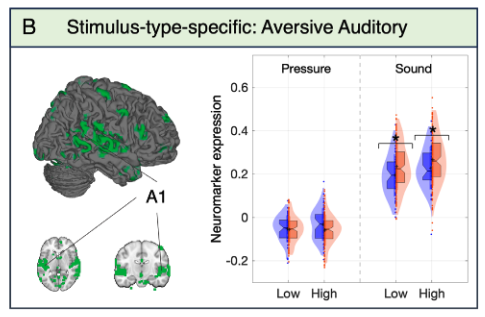
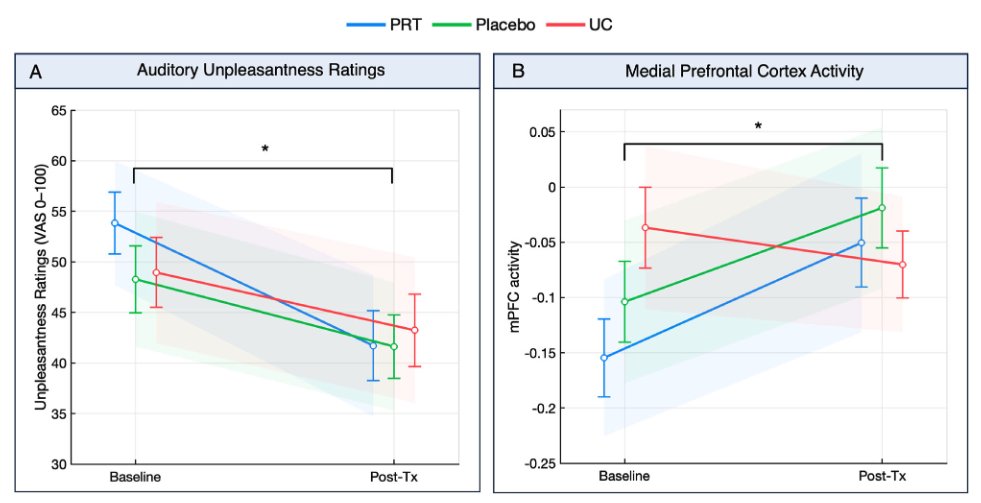
We know that chronic back pain is driven by brain amplification of sensory input -- but we haven't known how far this amplification extends
In new work just published in Annals of Neurology, we show that people with chronic back pain also have substantial (d ~ 1.0) amplification of aversive auditory processing, and that this is
- driven by hyper-responsivitiy in auditory cortex and insula
- has overlapping mechanisms with fibromyalgia
- partially reversible with treatment (pain reprocessing therapy), including stronger mPFC responses to aversive sounds
https://t.co/2x4errOj3r
Is this multi-sensory sensitization cause of consequence of chronic pain?
collaboration with @torwager@AlinaPanzel@C_Buchel
The new application cycle for our fully funded international graduate program has just started. You can now apply via our website, sign up for a Q&A, or participate in the Applicant Support Program https://t.co/7EURS8HiDC ! 👍🏻🧠👏🏾#passionforscience, #maxplanckschools
Get ready for the next application round of our excellent PhD program starting in September 1st 2024! Our application portal will open via our webpage on that day! #maxplackschools#passionforscience 🧠🍀💪🏻👌
The countdown of this year‘s application cycle has started today! Our application portal is now open for both, the Cognition Track and the Clinician Scientist Track. More information can be found here: https://t.co/bC6lOvgHFJ! Looking forward to hearing from you! 💪🏻🧠🥰
🧠Neuroimaging peeps🧠 our field is blessed with beautiful visualizations. Our preprint provides 3 tools to help move toward code-based & replicable visualization:
📗practical guide (why should I?)
📦package selector (which one?)
🏗️code template generator (how do I start?)
👇🧵
(1/7) After submitting my dissertation, I am happy that my main project is finally published with the great support of @C_Buchel, @BjornHoring and M. Rose @SysNeuroHamburg . We investigated agency and placebo/nocebo in the context of a Bayesian pain model. https://t.co/BXo0ONHo8D
1/Large language models like Galactica and ChatGPT can spout nonsense in a confident, authoritative tone. This overconfidence - which reflects the data they’re trained on - makes them more likely to mislead.
We are going on the final week of our application phase! Hurry if you would like to become part of our excellent fully funded program! #passionforscience 🫵🏻🧠🫀🎈 https://t.co/bC6lOvhfvh
On Monday I was lucky enough to present my PhD project at this year's Max Planck School Day - and boy was I nervous! Even so, I had the most wonderful time - so here's a tiny thread summarizing my highlights from the day 🧵 1/3
PS: & an even bigger thank you to @MPS_cog & the School Day organization team for giving me the opportunity to present & for the wonderful support I've had throughout this very special day!
My favorite part of the day, however, was all the conversations I had with wonderful students I’ve met across all cohorts. So a big thank you to everyone who came up to me - you’ve really made my day! ☀️🌻 (3/3)