The first ever Bitwise Staking Report is here.
In our new quarterly digest, we take a hard look at the fundamentals for Ethereum, Solana, Hyperliquid, Avalanche, Near, and Tempo.
TLDR: Things are looking pretty good under the hood.
Read the report: https://t.co/Lkd0VOTyjp
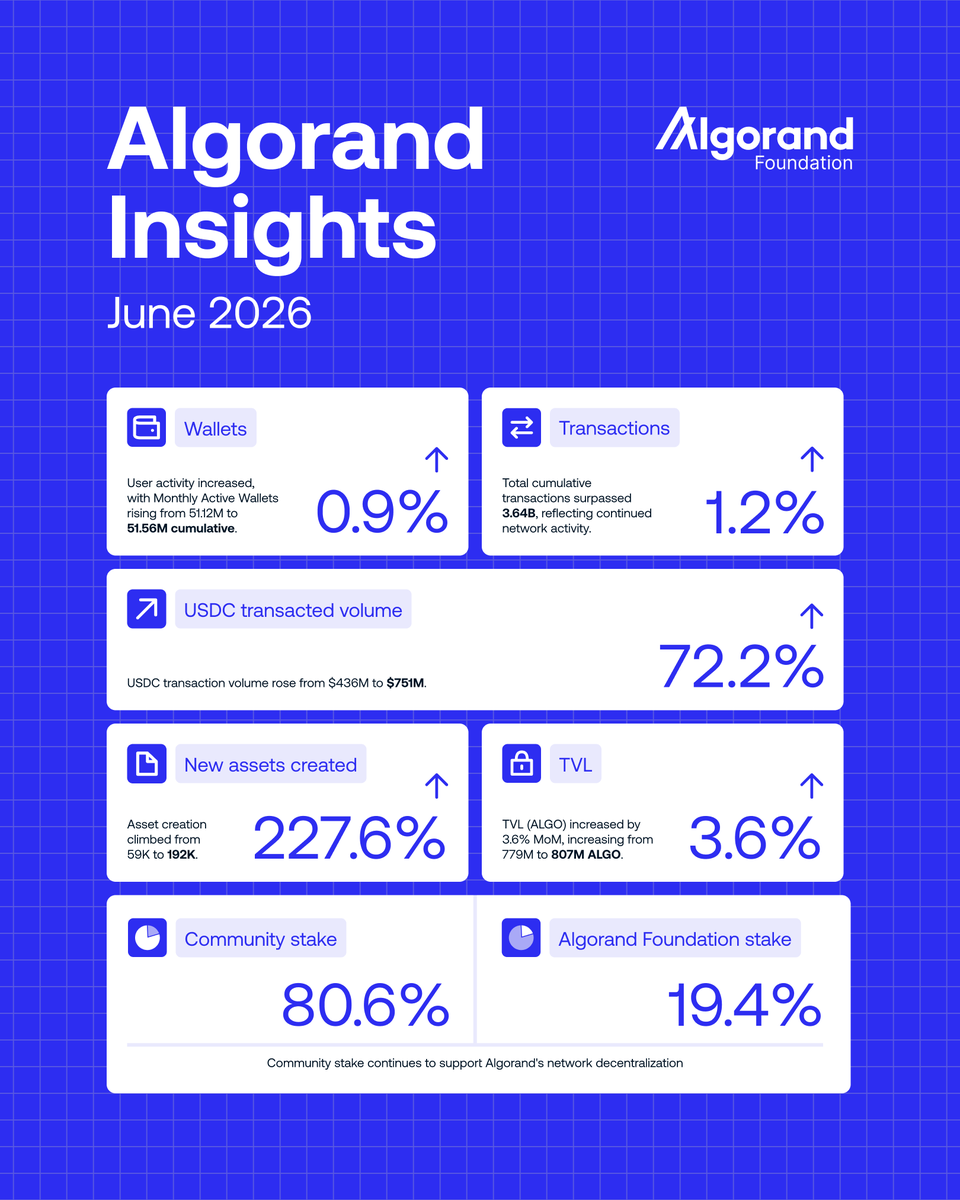
June was another strong month for the Algorand ecosystem.
Monthly active wallets, transactions, TVL, and USDC transaction volume all increased.
Builder activity continued to accelerate, with on-chain asset creation up 228% MoM.
Over 80% of the network stake remains community-held.
The surprise of he AI mid-cycle slowdown is ending.
The last several weeks were a positioning reset, not the end of the structural bull market. Leverage was flushed, semis became deeply oversold, and the narrative turned bearish just as the underlying demand story kept strengthening.
In this week’s video, I cover:
• Why exponential token demand is colliding with linear supply
• Why memory, bandwidth, power and compute remain scarce
• Why the token index is being misunderstood
• How consumer agents could create the next step-function in usage
• Why Scott Bessent told you Bitcoin, stablecoins and agentic commerce are becoming part of the same AI macro story
• What the technical reset means for the next leg higher
The correction changed positioning. It did not change the trajectory.
Watch here: https://t.co/0lrdMKEasd
MARA has entered into a definitive agreement with HIF to acquire a strategic powered land site in Texas. The site spans more than 1,200 acres with access to up to an initial 1 GW of grid capacity by October 2027 and up to 2 GW by April 2028, subject to ERCOT approval.
We intend to develop it as a large-scale digital infrastructure campus supporting high-performance computing, with flexible compute including Bitcoin mining. This expands our capacity pipeline and our long-term investment in Texas. Learn more: https://t.co/VJKTa1Pjzk
In case you have not heard, Bitcoin is dead and Michael Saylor is back again as the villain.
The trend is still bearish but signs of change are showing up as I showed in this week's YouTube.
The next rally will not start because everyone suddenly becomes bullish. Sentiment is too bad.
The catalyst may be the reverse of two negatives rather than a positive. It may start because of two forces that have punished Bitcoin ease:
1)AI equity momentum is crashing and the AI trade volatility is rising, forcing capital to look for new beta.
2)The market may have gone too far pricing AI capex as a hawkish Fed story.
AI agents are not just a demand shock. They are also a supply shock through digital labor, productivity leverage, and financial automation.
That is where Bitcoin becomes interesting again.
The Fed may have to unlearn its old framework.
Investors may have to relearn Bitcoin.
New piece:
Bitcoin and the Art of Unlearning the Fed
https://t.co/b4DHzWHHxo
Equity momentum is crashing.
AI is not over — the easy-money phase is.
Now the story shifts to AI agents, enterprise adoption, and “productivity leverage.”
"Even at tens of millions of agents users, we're still early"
"There's just not going to be enough compute in the world to satisfy all the demand."
Warsh speaks too and doesn't seem concerned about inflation. Could we see a cross-asset momentum regime shift soon?
And Bitcoin?
Shorts are getting greedy. Vol is compressed. Bad news is no longer breaking price. First bottoming signs are showing up.
New video: Momentum Is Crashing, Bitcoin Is Bottoming, AI Agents Are Rising
https://t.co/QPZaCJ2Zwb
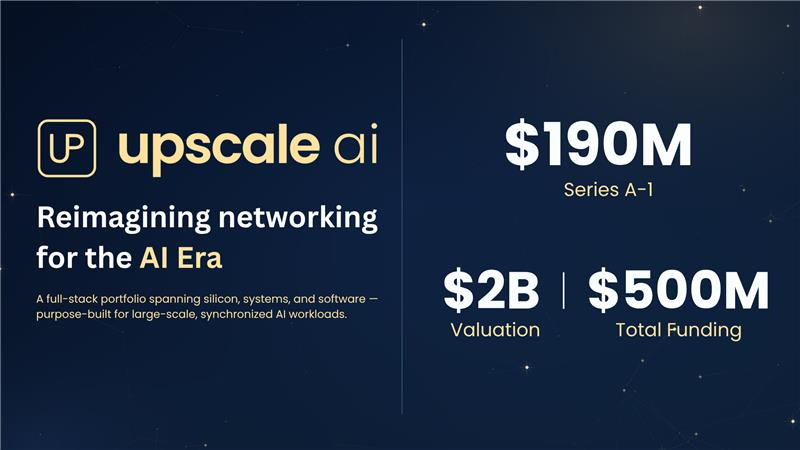
Upscale AI has raised $190M in Series A-1 financing to accelerate the scaling of our open-standard AI networking solutions.
This brings our total funding to half a billion dollars and our valuation to $2B, reflecting strong investor conviction.
https://t.co/62nNCysK91
This year, the EF is decreasing its budget by roughly 40%, which entails some difficult decisions. The goal of the decreases was set out in the Treasury Management Policy last year: the EF is transitioning into being a long-term-oriented endowment-based organization, shifting from its pre-2026 average of spending ~15% of its remaining funds each year, toward a post-2030 target of ~5% per year.
Often, when an organization goes through something like this, people try to pretend that nothing of great value was lost, that it is an efficiency increase, that the only people cut are unproductive dead weight, and everyone else stopped partying, studied the blade, entered cracked S-tier beast mode, and this was sufficient to make up for the downside. I will not try to pretend this. I respect my EF colleagues far too much to pretend that there was not much that is lost. They are brilliant people. They are dedicated engineers of whom some have worked on the Ethereum protocol for nearly a decade. They have brought a bright light to the Ethereum ecosystem with their code, their words, their warmth as human beings and their actions. My dearest hope is that they find a path that brings them fulfillment and happiness whether inside Ethereum or outside. Hopefully many will be able to bring their excellent talents and mindset to the wider Ethereum ecosystem, or the even wider CROPS world.
Instead, I will try to explain what *are* some of the grand sacrifices being made. The Ethereum Strawmap is no small thing. It is an extremely ambitious undertaking seeking to replace and augment almost every part of the protocol - consensus, proofs, privacy, account model, state, and more. This is the third iteration of Ethereum, in the same way that the Merge was the second, even if the shipping style is less Big Bang and more one-piece-at-a-time. On top of this, the EF is increasing its role in the Access Layer. We are not compromising on Ethereum being a Deeply Impressive protocol, something worthy of its place in a world with quantum computing, rockets to Mars and powerful biotech and AI, and capable of meeting the challenges that this era will bring.
Some of the deficit will be recovered through more work happening outside the EF. But not all. So what are the grand sacrifices that will enable a leaner effort to accomplish all of this? I will give a few examples (though far from an exhaustive list):
* The multi-client model will shift in the direction of multiple clients existing less for _redundancy_, and more for _specialization_. Up to this point, redundancy has been the main security strategy: if one client has a bug, if it has less than 33%, the chain keeps going and does not even stop finalizing. We are increasingly exploring moving more pieces of the protocol to a different security strategy: AI-assisted formal verification. Some smaller pieces of Ethereum (eg. BLS libraries) have worked this way already for a long time. But soon many more parts of Ethereum will likely function on this model. This may greatly reduce resource requirements of shipping a large number of EIPs. The resources saved by client teams can ideally instead be used to better serve different specialized user needs, including EF Access Layer goals.
* PSE (Privacy and Scaling Explorations) is winding down as a unit. The number of people working on ZKPs for privacy and scaling is probably as high as ever, but they are working less on "exploration" and more on *implementing* ZKP-based privacy and scaling into the Protocol and Access Layer
* Devcon will likely over time become smaller-scale, somewhat more spartan, much lower-deficit than previous years, in addition to other changes in vision in line with the Mandate.
* Fewer beyond-Ethereum megaprojects coming from EF. As I announced earlier this year, I am taking on some of the responsibility of doing projects in this category that I consider valuable with my personal funds.
* EF institutional work is reducing in scope, specializing more specifically on creating replicable test cases of highly CROPS-friendly deployments, even if at smaller scale.
These do not explain all departures; in some cases they do not explain departures at all and rather explain _reduced need for new spending_. But they are a large part of the strategy at play.
In the longer term, I personally favor a "soft lean-and-done" approach to Ethereum: once the Strawmap is completed, generally stick to security fixes and small high-value changes, and have a much higher bar for considering new feature additions to the protocol. This allows Ethereum to remain capture-resistant without demanding very large budgets. Learn less from multimillion-line-of-code behemoth projects, more from bitcoin.
The past years have been a challenging era for Ethereum. However, the ecosystem is adapting, both inside the EF and outside, and I am confident that Ethereum is very well-positioned to succeed and thrive.
https://t.co/iZiOonRYzR
Following last week’s outages related to the 1.72 release, the Sui Core Team has completed an investigation and incident review, detailing what happened and the steps taken by validators to restart the network.
“We will have a crash.”
That was the guarantee on national TV from a prominent financial journalist who just spent 8 years researching 1929 for a book by the same name. Yes, 8 years.
Maybe he is right or maybe he is selling books.
Or maybe after studying the greatest crash in market history for nearly a decade, every market starts to look like 1929.
That is exactly why investors should be using AI.
Not to predict the future perfectly, but to study the realities of crashes and bubbles without bias: how they actually formed, how they actually ended, what technical signals showed up, what was different each time, and how much fear was driven by narrative instead of data.
This week’s video is about why subscription driven bear porn only hurts you, the psychology behind bubble calls, and how to use technical analysis and AI to take control of your own view instead of letting fear narratives control you.
Watch here:https://t.co/4XW2tAxWXv