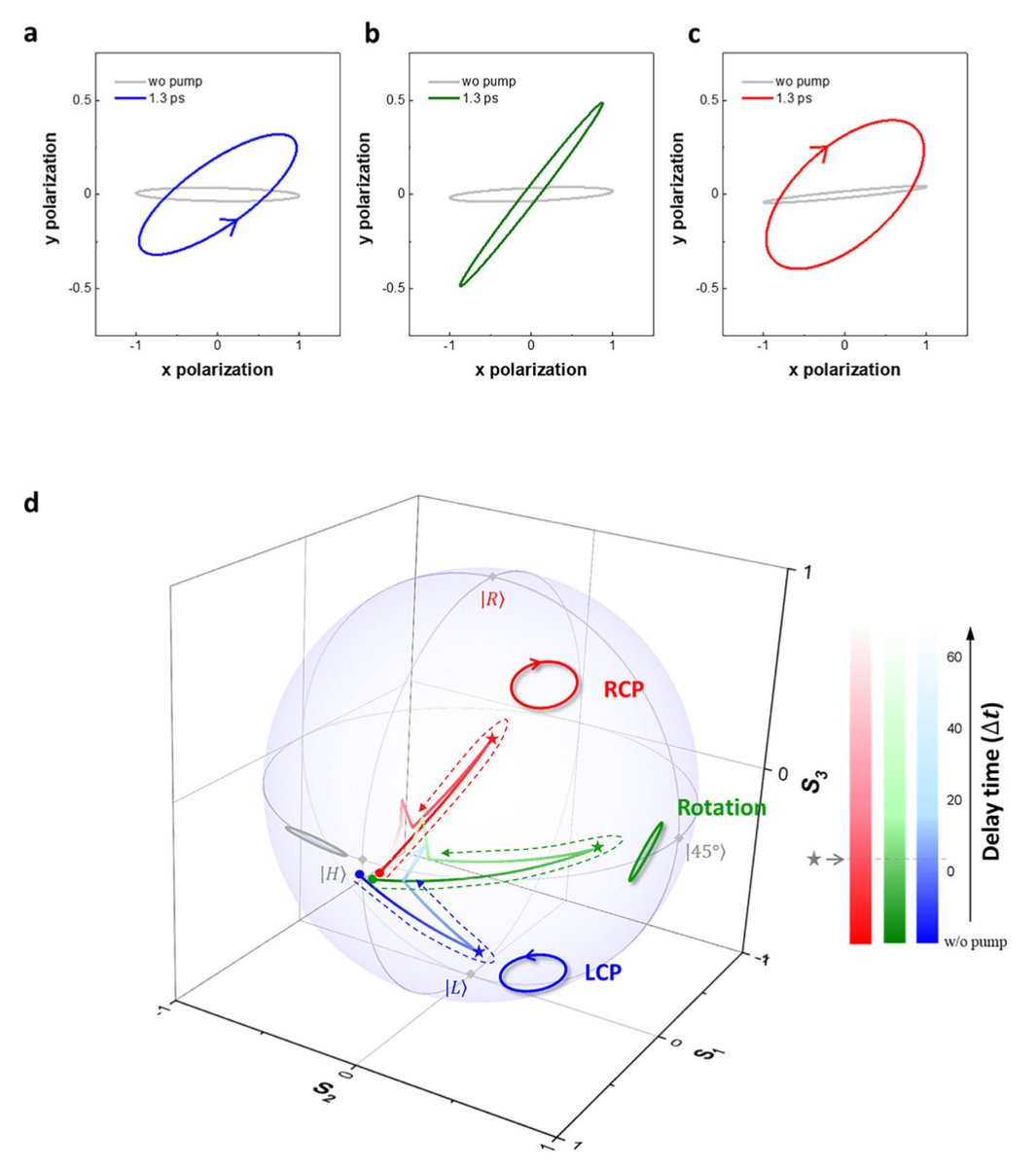
📲💻🔬🔭⚛️💱Chirality provides a versatile basis for controlling the polarization state of light and is central to key photonic functionalities, including spectroscopy [1–4], molecular analysis [5–7], and optical information encryption [8–11].
If the photon doesn’t collapse when observed by Artificial Intelligence, Than It’s Not Conciousness. If human perceptions can alter matter, this is a dark matter.
Physicist Ludwig Boltzmann wrote a beautiful ode to New York City:
'Whenever I enter New York Harbor I am seized by a kind of ecstasy.
The towering buildings and the Statue of Liberty with the torch held up high!
If I were a musician I would compose a symphony'
#Boltzmann
☀️ SOLAR ACTIVITY - ASTRID EVOLUTION
SOLAR MESH - AIA 171 Å x3 Combo (304 Å for outer limb)
29 November 2026 · 00:00-10:00 UTC
- Made in ASTRID EVOLUTION Solar Studio -
In 1953 Freeman Dyson travelled to Chicago to show Enrico Fermi results that agreed with experiment.
Fermi was unimpressed by the free parameters in his calculation and quoted John von Neumann: “With four parameters I can fit an elephant, and with five I can make him wiggle his trunk.”
Dyson told the story in Nature in 2004.
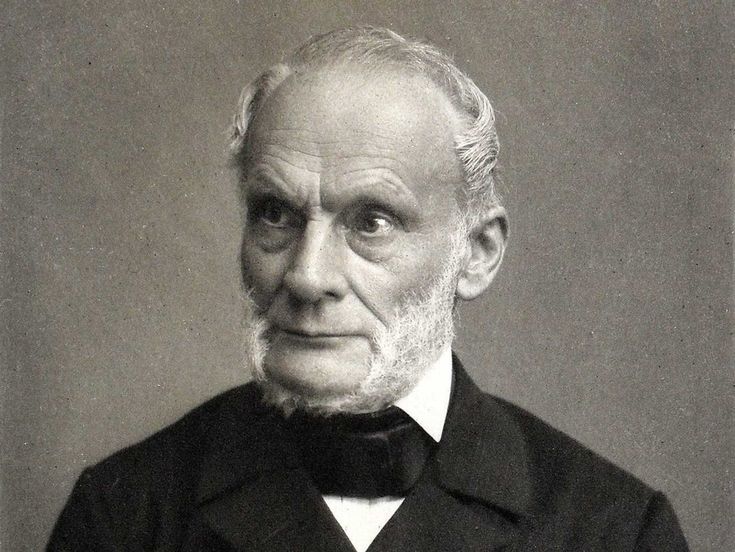
Rudolf Clausius coined the word “entropy” in 1865, from the Greek τροπή (transformation). He deliberately chose a word that sounds like “energy”, because he thought the two quantities were closely related.
In 1785, Charles-Augustin de Coulomb established that the electric force between two point charges follows an inverse-square law.
Like charges repel, while opposite charges attract. Doubling the distance reduces the force to one-quarter, whereas doubling either charge doubles the force.
This simple relationship underpins electrostatics, helping explain everything from atomic interactions to everyday static electricity.
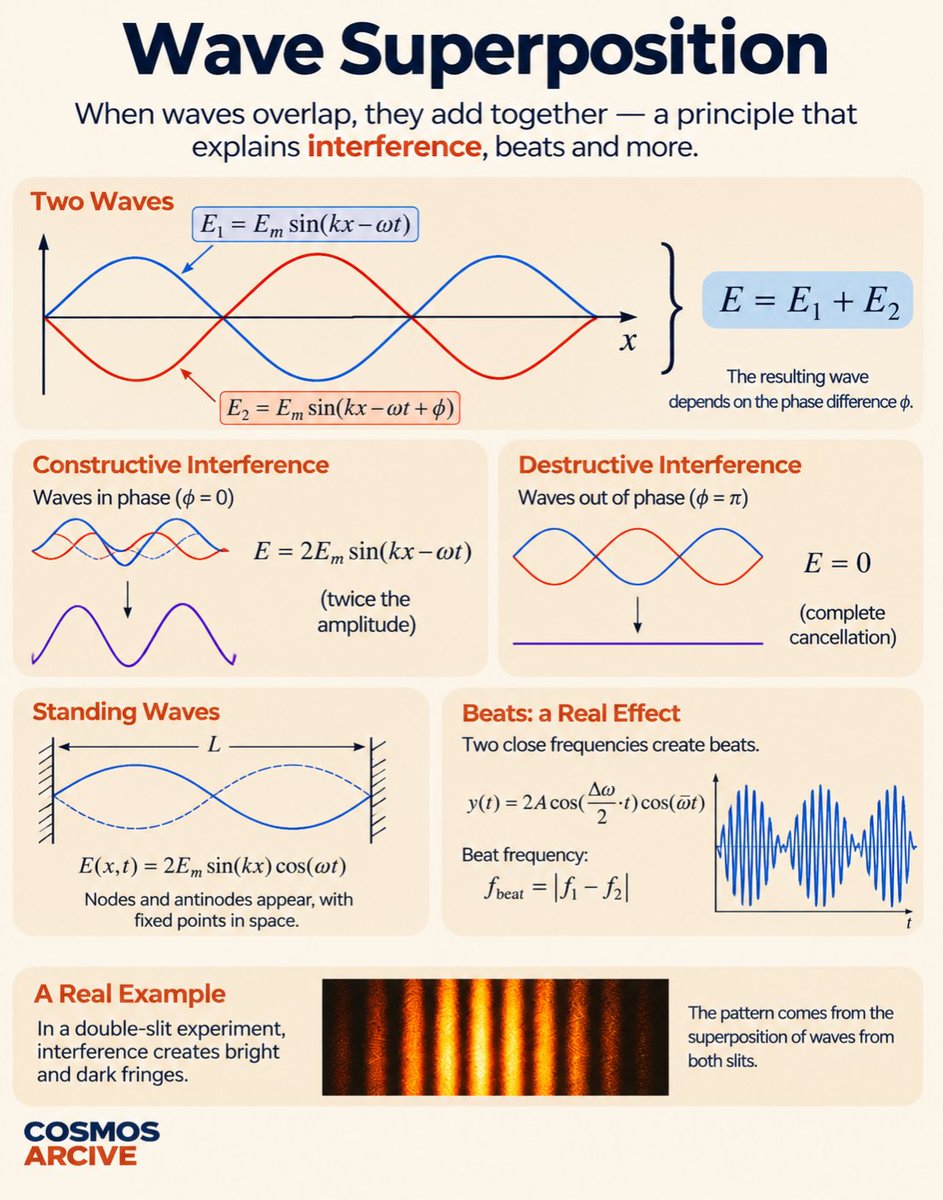
Two waves can occupy the same space, yet completely change each other.
When their crests meet, they reinforce. When a crest meets an equal trough, they cancel.
This is superposition: y = y₁ + y₂.
It is how standing waves form, with points that never move called nodes.
Black Hole Superradiance
A spinning Black Hole could grow a cloud of particles much larger than itself.
If ultralight bosons exist, they can extract rotational energy from the Black Hole, forming a growing cloud around it.
This phenomenon could allow us to discover particles far beyond the reach of conventional particle detectors.
Every polarization state of light is a point on a sphere.
The field traces an ellipse with orientation ψ and ellipticity χ, where tan χ = ±b/a. Its Stokes vector is S = (cos2χ cos2ψ, cos2χ sin2ψ, sin2χ): longitude 2ψ, latitude 2χ.
The equator holds the linear states: H and V on S₁, ±45° on S₂. The poles are circular, right-handed at the top (IEEE). A circle of latitude keeps the axial ratio fixed while the ellipse turns.
Angles are doubled, so orthogonal states are antipodal.
Three physicists described quantum mechanics in three different ways.
Schrödinger wrote a wave equation. |ψ|² gives the probability of finding a particle.
Heisenberg showed there's a limit to precision: Δx Δp ≥ ħ/2. Knowing position more exactly means knowing momentum less.
Dirac combined quantum mechanics with relativity: (iħγ^μ∂_μ − mc)ψ = 0. The equation predicted the positron, which was found in 1932.
🧬Drawing inspiration from biological systems, where self-assembled multicomponent biomolecular structures underpin key aspects of cellular functions, we introduce here DNA polycubes, a general nanoscale assembly platform based on cube-shaped building blocks made from DNA. The DNA polycubes system introduces the minimal kit design principle to solve the inverse problem of self-assembly: Given an arbitrary 3D multicomponent target shape (finite or periodic), identify the smallest set of building blocks and interaction rules required that can robustly assemble into that shape and suppress undesired alternative conformations. This capability opens opportunities in materials design, photonics, nanoelectronics, and biomedical engineering by enabling complex 3D architectures that are inaccessible through conventional top-down nanoscale fabrication techniques.