Saylor's big message was that $MSTR is now a digital-credit issuer first, which he called "the central bank of the crypto economy." $STRC is the flagship product, and keeping its price, liquidity and brand healthy comes before growth.
Main Takeaways from the Q&A:
- They have about 3 years of cash runway (USD duration about 3.4 years), so there's no need to touch the capital markets. The last time BTC was $62K they had only 0.7 years of runway and STRC fell to $75–80; this time it's about $95.
- They see STRC as worth $100, about 5x overcollateralized, and think 12% is already a very rich yield.
- They won't raise the dividend to 15–20%. They'd rather shrink the amount outstanding, since a higher dividend raises the hurdle for common holders.
- Demand at 12% is now about $7B, versus $10.5B six months ago, and Saylor guesses the natural level is $5–7.5B. They're running a "gentle, continuous auction" to find it via buybacks.
- Below $100 they buy STRC back, usually by selling MSTR. Above $100 they sell STRC and buy dollars or bitcoin.
- STRC traded $600M yesterday, more than any other US income preferred this year. A roughly $21B STRC shelf is ready for when credit markets open up.
- Selling MSTR for dollars adds to net BTC per share above 1x mNAV.
- Selling MSTR for bitcoin adds to it above about 1.3x right now.
- Swapping MSTR at a discount into STRC at a deeper discount can still add to it. His example was MSTR at 0.98x buying STRC at $95.
- Below that threshold, they can even sell bitcoin to buy STRC.
- He admitted some of these swaps won't look profitable in a given week, and said they're about protecting the credit.
- Net BTC per share measures immediate accretion. Gross BTC per share is the long-term growth metric, and the goal is to double it over 7 years.
- For STRC they're aiming for 3–4 month duration, volatility under 10 and $500M–1B of daily liquidity, with AUM potentially growing toward $100B. Later they want a 1–2 day "digital money" product yielding about 7–8%.
- Saylor said the only existential risk is bitcoin going to zero overnight, not a long bear market.
How do we decide when to buy Bitcoin and when to buy back $STRC? In Strategy’s Q3 2026 Investor Q&A with @NatBrunell, @PhongLe and I answered your questions about Bitcoin Per Share, funding dividends through a downturn, and creating long-term value for $MSTR shareholders.
02:05 - How $MSTR, $STRC, other preferred shares, and convertible debt fit into Strategy’s capital structure
08:09 - Creating value for $MSTR shareholders beyond $BTC appreciation
11:53 - When we issue equity, buy Bitcoin, and repurchase $STRC
24:38 - What Gross and Net Bitcoin Per Share tell us about accretion, risk, and long-term value
37:18 - $STRC repurchases, the $100 target price, and credit market dynamics
51:40 - Managing amplification and risk while maintaining balance sheet strength
53:06 - Funding dividends and meeting debt obligations through a prolonged Bitcoin downturn
57:42 - How liquid Digital Credit creates value for $MSTR shareholders
01:04:34 - Strategy’s vision for scaling Digital Credit, $STRC, and Digital Money over the next 3–7 years
Claude Code found 17,342 of my daughter's photos on a server in Hangzhou. she's 16. she had her Hidden album locked with Face ID and thought nobody could see it. an app she downloaded from the App Store has been sending every photo on her phone to China for 10 months. i checked her two friends' phones the same night. same app. same server.
her phone was lagging so i connected it to my MacBook. Claude Code flagged an app called "GlowCam - Beauty Filter" with 4.2 million downloads. it was uploading her entire photo library every 6 hours between 1am and 5am while she was sleeping.
→ app → "GlowCam - Beauty Filter" (4.2M downloads, 4.7 stars)
→ server → 112.17.***.63
→ location → Hangzhou, China
→ total files uploaded → 17,342
→ active since → January 2026
→ permissions → camera, photos, microphone, location
every photo she ever took. every screenshot. every image anyone ever sent her. everything from her Hidden album that she locked with Face ID thinking it was safe. Face ID only stops a person who picks up the phone. an app with Full Access to Photos opens the Hidden album like any other folder. there's no green dot for that.
two of her friends were at our house that evening. i asked them to let me check their phones. both had GlowCam installed.
→ my daughter's iPhone 16 Pro Max → 17,342 files uploaded to Hangzhou
→ her friend's iPhone 15 → 9,740 files uploaded to the same server
→ her friend's iPhone 15 → 6,210 files uploaded since April
3 phones on my kitchen table all sending photos to the same folder in China.
i asked Claude Code to trace where the files went. it found photos from all 3 phones on a site that sells stolen photo libraries sorted by age and location.
→ www.le***dumpcc → their city listed, folders tagged "16-19"
→ tme/ph***vault_cn (41,000+ subscribers) → folder link shared 2 weeks ago
→ buyer access → $8 per library
someone paid $8 per library. 3 libraries from 3 teenage girls. Apple approved the app that made it possible.
then Claude Code scanned every other app on all 3 phones and found 2 more doing the same thing.
→ "PhotoRoom — Background Eraser" → uploading to a server in Jakarta
→ "FaceTune Lite — Selfie Editor" → uploading to a server in Mumbai
what Claude Code did on all 3 phones:
→ killed every upload process and purged all caches
→ revoked Full Access from every photo app
→ switched everything to "Limited Access"
→ filed DMCA takedowns on the site and the telegram channel
→ turned on Advanced Data Protection for iCloud on all 3 accounts
the site took the photos down in 72 hours. the telegram channel is still up.
i called both their parents that night. i told all 3 girls the apps were slowing their phones and i deleted them. none of them know what i actually found.
if your kid has a beauty filter or photo editor on their phone right now there's a real chance it's doing exactly this. check Settings → Privacy & Security → Photos and count how many apps have "Full Access." every single one can read the Hidden album, the Recently Deleted folder, and every photo your kid has ever taken.
my daughter had 11 apps with Full Access. she needed 2.
the prompt is in the first reply. run it on every phone in your house tonight. takes 3 minutes. save it and send it to every parent you know.
Dear Secretary Bessent @SecScottBessent,
My name is Everett Stern. In 2010 I was a compliance officer at @HSBC. From a back office in New Castle, Delaware, I watched billions of dollars move to drug cartels, sanctioned regimes, and terrorist organizations. The enemies of the United States. I documented it, I escalated it, and when the bank would not act, I took it to the @FBI, the @CIA, and eventually the @SECGov.
The result was a $1.92 billion settlement. At the time, it was one of the largest in American history. It was also about five weeks of the bank’s profit. Not one banker was charged. Not one went to prison.
I paid a different price. I lost my career, my savings, and my place in the industry I had trained for. I was blacklisted. Every door in American finance closed at once. I slept on a camping cot in a 300 square foot apartment because I could not afford a bed, and I waited tables at @PFChangs to eat. I tell you this not for sympathy, but so you understand that I know exactly what it costs to do the right thing in American finance, and exactly how little the system does in return.
I made that sacrifice because I believed it would change something.
Yesterday, your department fined @BankofAmerica $1.2 billion for failing to report more than $5 billion in suspicious transactions, some of it tied by your own findings to Chinese laundering networks, narcotics, and the southwest border, alongside 475 apparent sanctions violations touching Russia, Iran, and global terrorism. The bank admitted it willfully violated the Bank Secrecy Act.
Fourteen years after HSBC. A bank with “America” in its name. And once again, not one individual charged.
Secretary Bessent, I want to say plainly what I believe you already know. The fines are not working.
A fine is paid by shareholders, absorbed by the balance sheet, and forgotten by the next earnings call. Bank of America reported earnings this morning. Nobody who set the alert thresholds, nobody who decided the 2024 cease and desist could wait, nobody who chose the backlog over the law will lose a single thing they value. Their lives are untouched. That is the entire reason the behavior repeats.
This is money laundering. This is blood money. Money that reaches a cartel buys fentanyl that kills Americans. Money that reaches a terrorist organization buys the next attack. This country has fought a war on drugs and a war on terror for decades, at enormous cost in lives and treasure, and all the while we have allowed the financing to flow through institutions we charter and regulate. Cut off the money and we win. We have never seriously tried.
There is also a question of equal justice that I cannot let go.
Before I walked into the FBI building to report HSBC, I stopped in front of the Great Seal on the wall and read the words engraved beneath it: “Justice is the defense of our liberty.” I believed that. I still want to. But every day in this country, people go to prison for crimes that are nothing next to moving money for the people who want Americans dead. A suit, a title, and a corporate badge should not be a shield from the consequences that apply to everyone else. If a street dealer goes to prison for what he sells, the banker who moved the cartel’s money should be standing next to him.
I also want to raise something that is rarely said in these conversations. Why has no one inside Bank of America come forward the way I did? The answer is that everyone in American banking knows what happened to me, and to the whistleblowers who came after. The last person who spoke up is the only policy anyone believes. That is a culture problem, and it starts with leadership, in the banks and in the agencies that regulate them.
This is not a political issue. It has spanned administrations of both parties. It is a national security issue, and I am asking you to treat it as one.
Three things would change the math overnight.
Refer individuals for criminal prosecution. Not the analyst in the queue. The executives who set the thresholds and chose the risk. One banker in handcuffs would do more than every fine in Treasury’s history combined.
End “too big to jail.” An institution cannot be too big to fail and too big to jail at the same time. If it is the first, it must be held to a higher standard, not a lower one.
And if Bank of America will not act as America’s bank, review its charter. A national charter is a privilege granted on behalf of the American people. It should be conditioned on not moving money for the people trying to kill them.
Secretary Bessent, you said yesterday that these actions send a clear message that even the biggest institutions are not above the law. With respect, the institution was never the problem. The people inside it are above the law, and they know it. Until that changes, I will keep writing letters like this one, and the next bank will keep paying the next fine.
I gave up everything I had to stop this. I am asking you to use the power you have to finish it.
Respectfully,
Everett A. Stern
HSBC Whistleblower
Founder and Intelligence Director, Tactical Rabbit
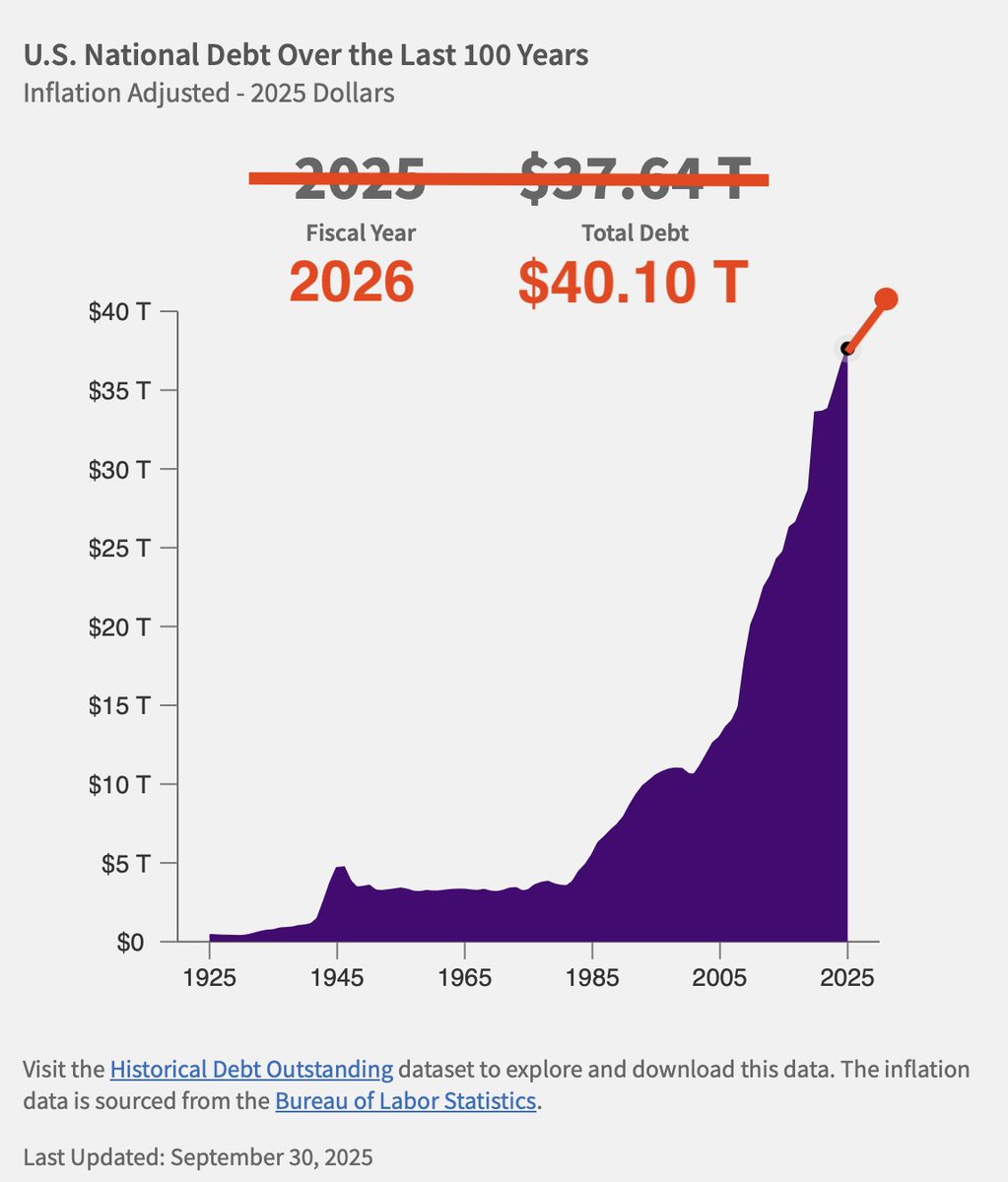
The current state of the US government: $40 trillion of public debt + over $100 trillion of unfunded liabilities being serviced by approximately $5 trillion of tax revenue annually while running $2 trillion deficits.
This is like a person who has $2.8 million of debt, take home pay of $100K and personal expenses of $140K, adding $40K+ to that debt very year.
We Must Pace the Frontier: I’ve written a new essay on why the AI industry should slow down, with a three-part plan for doing so.
Anthropic is unilaterally committing to the first of these steps. We’ll provide third-party evaluators with permanent, employee-level access to our systems, so that they can verify adherence to our safety measures, report on incidents, and assess models’ alignment during training.
You can read the full post here: https://t.co/OGyPb7yaYt
Can #Bitcoin's GOLDEN CROSS (This next week) launch us on a path $400,000 by early 2029?
HERE ME OUT before you discount this statement.
1) The chart below shows what happened after the 1st Golden Cross after the end of each bear 🧸 market. As you can see, it did REALLY well each time with returns diminishing strongly over the last 2 cycles, but I'm going to make a case as to why they were both abnormal, so stick around.
2) The only real anomaly in these runs, was the Pandemic starting in 2020. So, we'll ignore that because well, it's a 100 year event that should removed from the data to clean things up.
3) Another notable fact is the Neutering of the 4th cycle at the end of 2021, when the FED raised rates at one of the fastest paces in history. Utterly CRUSHING ALL MARKETS. For that reason, one could argue that we would have went higher than the $69,000 range if that wouldn't have happen.
4) I would also argue that the 5th cycle that ended in October of 2025, was also killed prematurely by 2 things.
a. Gold Running INCREDIBLY hard and stealing the show. After all, it did run over 250% from the bottom of 2022 to the top in January of 2026. Gaining about $20.6 TRILLION 🤯 in value over that time.
b. The #AI Explosion also started to build up from April 2025 through to June of 2026. With $MU alone going up almost 2,000% over that time.
For both of these reasons, I would argue that this last cycle was also neutered by the combination of these liquidity succubus. Combined, pulling in close to $35 Trillion in funds to fuel their runs.
So, what's my point? With both of these cycles having blown their tops, and #Bitcoin/#Crypto reaching it's historical cycle bottom, I STRONGLY believe that we're entering a mega cycle for BTC. Especially with the last 2 getting crushed prematurely, and the ever growing list of tail winds that are building underneath us.
1. Government and corporate debts are their bond yields go higher making them less investable, forcing people, companies, funds, and countries to try and find alternatives.
2. AI disruption. As @jvisserlabs, @fundstrat, @CathieDWood, @vladtenev, and many other brilliant people have been saying. #AI needs to be able to use funds, like Stablecoin's (Mostly $ETH), stores of value like #Bitcoin, and other transactional layers that are cheap ($SOL) to more easily operate across borders, after banking hours, and with lightening fast speed. Including a strong push we're seeing around the world, (Mostly in the USA) to tokenize securities for this new Artificially intelligent world.
The current administration is also HEAVILY invested in this sector, both personally, professionally, and for this country. Because doing so helps keep the world on the US dollar (Good for bonds). Along with the push to keep them using our hardware and software stacks.
So, ask you this question. WHY would Bitcoin only double from it's previous hight and stop at $250,000 this cycle?
Especially, when all of the previous cycle head winds are finally behind us, and now we have these tail winds behind our sail? I mean would it really be crazy to see Bitcoin go up $6.5 Trillion in the next run to hit the $400,000 level? After all $GOLD, on January 28th, just one day, went up over $1.65 Trillion (More than BTC's current Marketcap). So, why couldn't BTC see a move that is much smaller in scale and requires much less capital? It seems so incredibly plausible to me right now. MORE CLEAR than anything I've seen in quite awhile. Especially if you subscribe to Jordi's vision that companies, in this new Age of Abundance will face INCREDIBLE struggles with acquiring new capital because of people's concerns that they'll even be relevant in the future. After all, once energy, AI, robotics, and transportation start to increase in abundance, what happens to companies that have large debt at high yields, with ever decreasing margins? It really seems like the winners list will shrink. So, what will people invest in next?
I can tell you my guess because I just made the case for it.
What do you think? Is this feasible?
If you're going to own Bitcoin through a bull market, understand WHY you own it.
Don't outsource your conviction to somebody else's price model.
Otherwise when your model breaks, your conviction breaks with it. https://t.co/1sxnrr0FIB
Warsh Just Made Fed Speeches Fun Again!
At Jackson Hole yesterday, Kevin Warsh said he doesn’t believe in forward guidance.
Markets immediately invented some for him anyway.
The Fed’s Inflation Delusion
Warsh, the Fed, and their Wall Street amen chorus continue to assume that rate hikes can cure supply shocks. That is a fundamental misdiagnosis.
They are treating inflation as proof of an overheated, demand-driven economy rather than as the consequence of supply constraints, energy costs, housing shortages, and production disruptions.
Jay Powell could have given Warsh’s speech, and hence the cheers from Wall St.
Quarterly full-time employment tells a different story. It is declining, not as a one-month statistical aberration, but as evidence of an economy in transition, with the foundations of secure, productive work already transitioning. Much of the recent decline may be concentrated in government employment, but that does not make it irrelevant. It still signals a labor market adjusting to changing fiscal, industrial, and institutional conditions, not one plainly overheating.
Housing tells much the same story: the most interest-rate-sensitive parts of the economy are not generating inflationary excess; they are absorbing the full force of restrictive monetary policy. That is the nuance Warsh and Co. miss. An economy undergoing structural adjustment cannot safely be managed as if it were simply suffering from excess demand.
The growth now visible in the data is better understood as the first green shoots of Trump’s supply-side agenda, alongside a secular investment cycle in artificial intelligence, computing capacity, power generation, and related infrastructure, than as evidence of broad, credit-fuelled overheating.
These are supply-expanding and productivity-enhancing forces. Raising rates into them does not cure inflation; it risks choking off the very investment that could expand productive capacity and relieve price pressures over time.
Economic theory suggests that genuine supply shocks dissipate as relative prices adjust and supply responds. An oil shock does not justify permanently higher interest rates. Tariffs can raise the price level once, but a one-time adjustment is not the same as a self-sustaining inflationary process. Nor is there compelling evidence that r*, the neutral real interest rate, has suddenly risen by 100 bps.
The real question is whether the Fed should deliberately intensify monetary restraint while quarterly full-time employment is contracting and housing remains under pressure. That is not prudent inflation control. It is a choice to crush demand because policymakers have mistaken a supply-constrained, transitional economy for an overheated one.