AlphaPrimer Research — quantitative research and systematic trading infrastructure for decentralized finance.
Founded 2019, small team in New York. We work on market microstructure across AMMs and on-chain order books, on-chain execution systems, and portfolio-level risk decomposition.
We'll post research notes and measurements here.
#alphaprimer #defi #web3 #smartcontract #research
18 Sep 13:15 UTC
Post-FOMC scoreboard. The 8 Sep bound is already retired. This is the next clock.
What printed
16 Sep 18:00 UTC: FOMC hiked 25bp to 3.75–4.00%, 12–0. Sixteen of eighteen dots still want another hike this year. The decision was in the price. The press conference was the hawkish part.
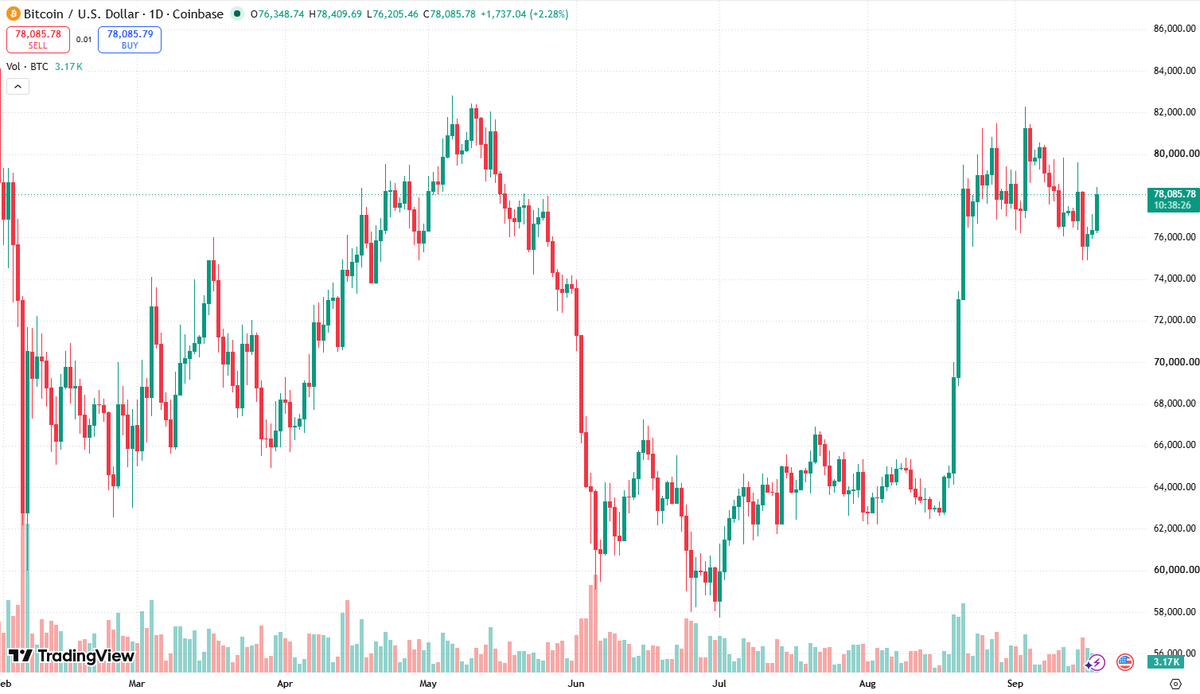
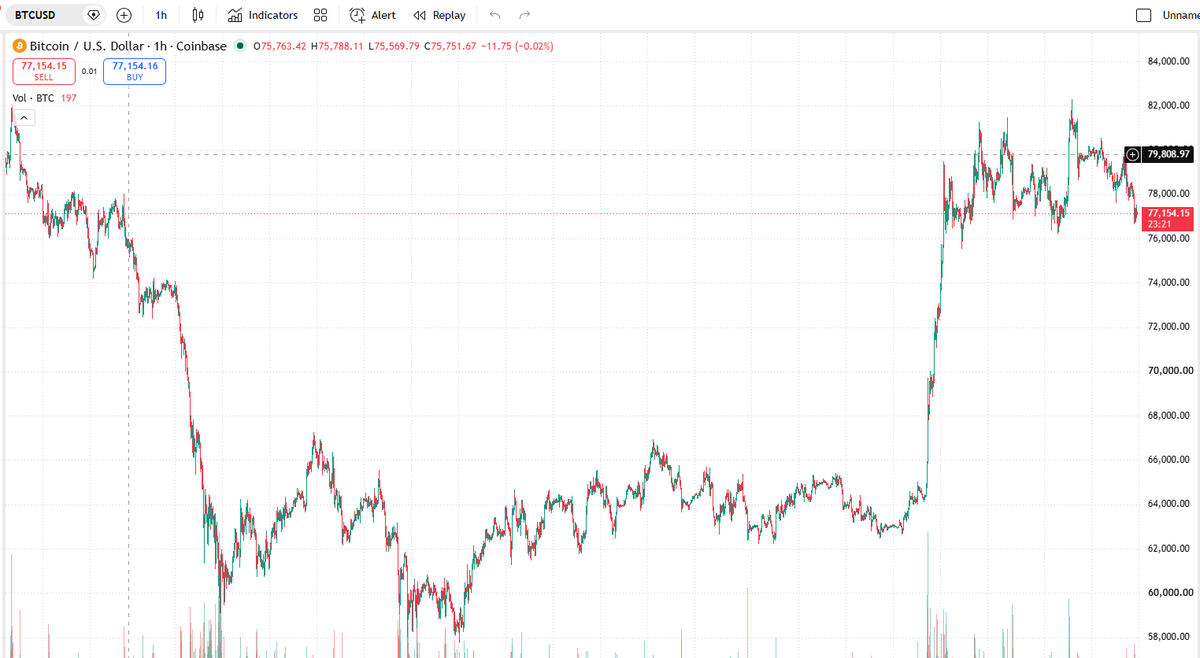
16 Sep Coinbase / USD daily: low ~$75.0k, close ~$76.2k. Still under the old $77k line.
17 Sep close: still the mid-$76ks.
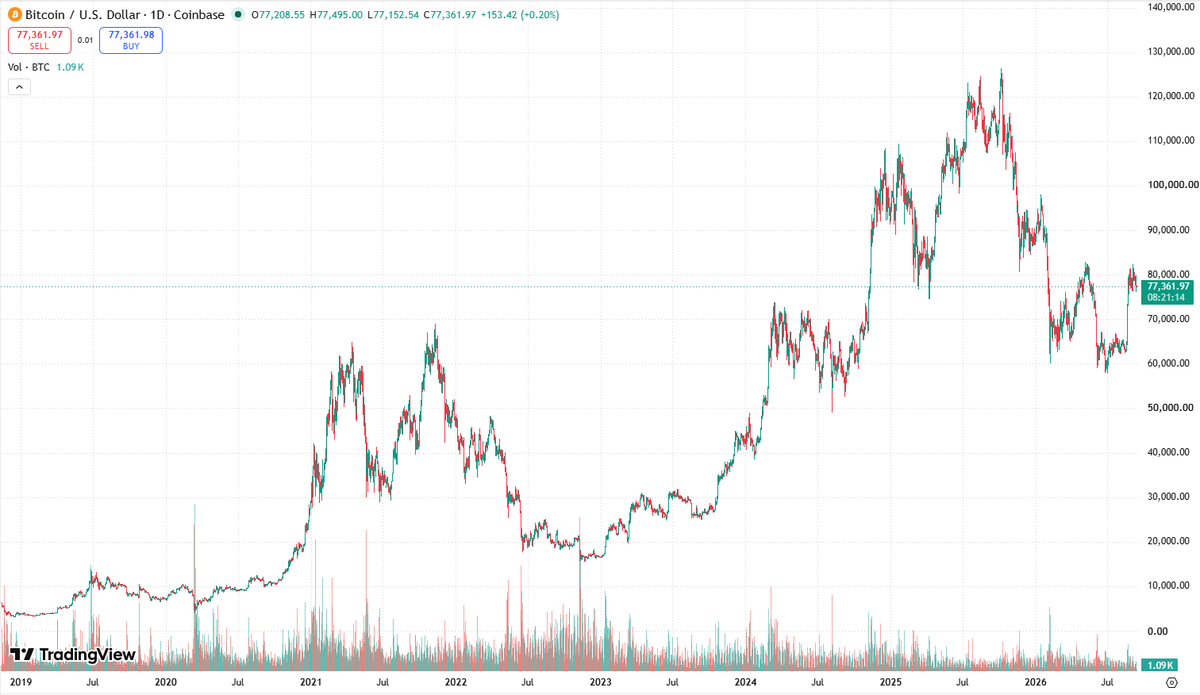
18 Sep session: trade back through $77k, some series into the high-$77ks / low-$78ks. That is a trade. It is not yet two cash closes back above the line.
Premium
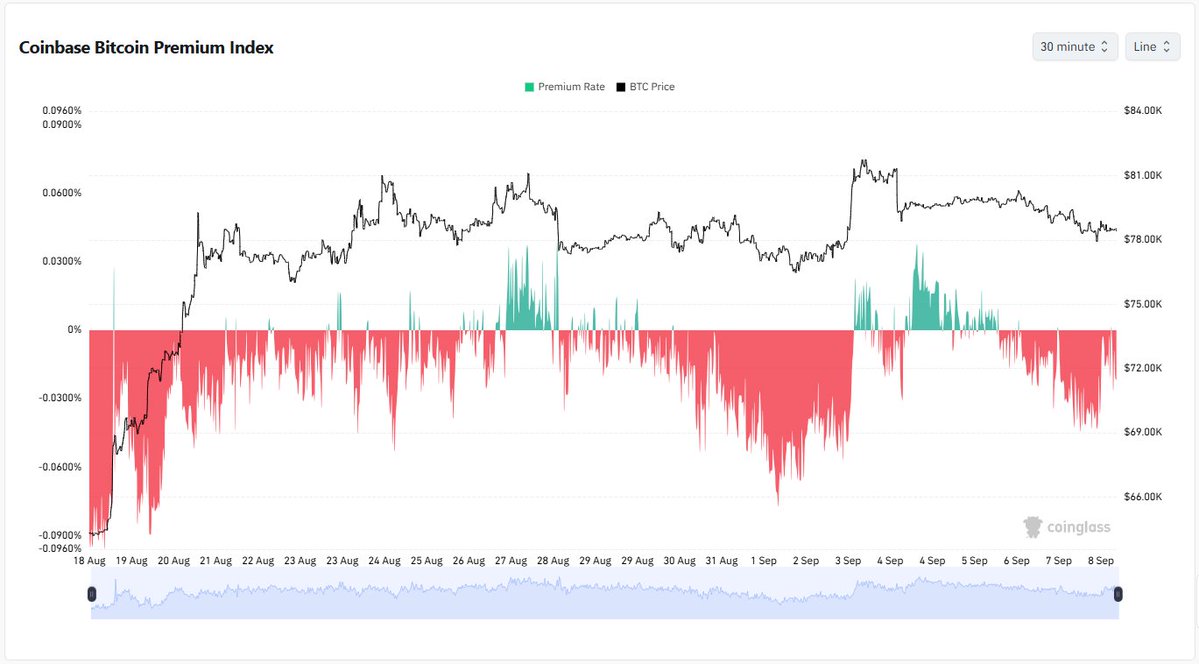
The +0.20% Coinbase–Binance threshold into an NY close still has not printed. Into the meeting the spread was negative to flat. A bounce that starts offshore can look like a bid on the candle and still be a funding squeeze.
New view
Hypothesis: $77k is now the repair line, not support that held. Acceptance is two Coinbase daily closes back above $77k plus premium > +0.20% through one NY cash close.
Invalidation of the repair: Coinbase daily close back under $75.0k — the 15–16 Sep low cluster.
$80k remains unconfirmed US inventory until both conditions hit on the same week.
We do not treat Friday's lift as the US cash bid arriving. We treat it as the book digesting a hike that was already paid for.
Sources: FOMC SEP 16 Sep, Coinbase BTC-USD daily, Bitbo premium, CoinGlass.
#alphaprimer #Bitcoin #FOMC #MarketStructure #research
A price is not a market state.
The same print can be a cash bid, a funding squeeze, or a liquidity hole. Those three things look identical on a candle and they do not trade the same.
That is why we do not start with the chart. We start with three questions:
Where is the inventory.
What does a fill actually cost once gas, slippage and adverse selection are in the same function.
What breaks first when the oracle, the sequencer, or the range liquidity is the weak point.
Concentrated liquidity made capital look more efficient until the price left the range. Cheap blockspace made on-chain routing look cheaper until depth and carry still won. Both results were available in the data before they were available in the narrative.
We will keep publishing measurements, not slogans. Partners can request the internal notes.
https://t.co/B5eJLnrUBa
#alphaprimer #defi #web3 #MarketStructure #research #smartcontract
16 Sep — pre-FOMC note, not a price call.
ETH is sitting near $2.4k into the meeting. That is not the interesting number.
The interesting number is where the inventory sits when the print hits.
On the Uniswap v3 ETH/USDC 0.05% pool, a large fraction of concentrated liquidity is still posted in tight ranges around spot. That is efficient in a quiet tape. It is a gap in a two-standard-deviation hour. Static range LPs do not earn the move they underwrite. They convert.
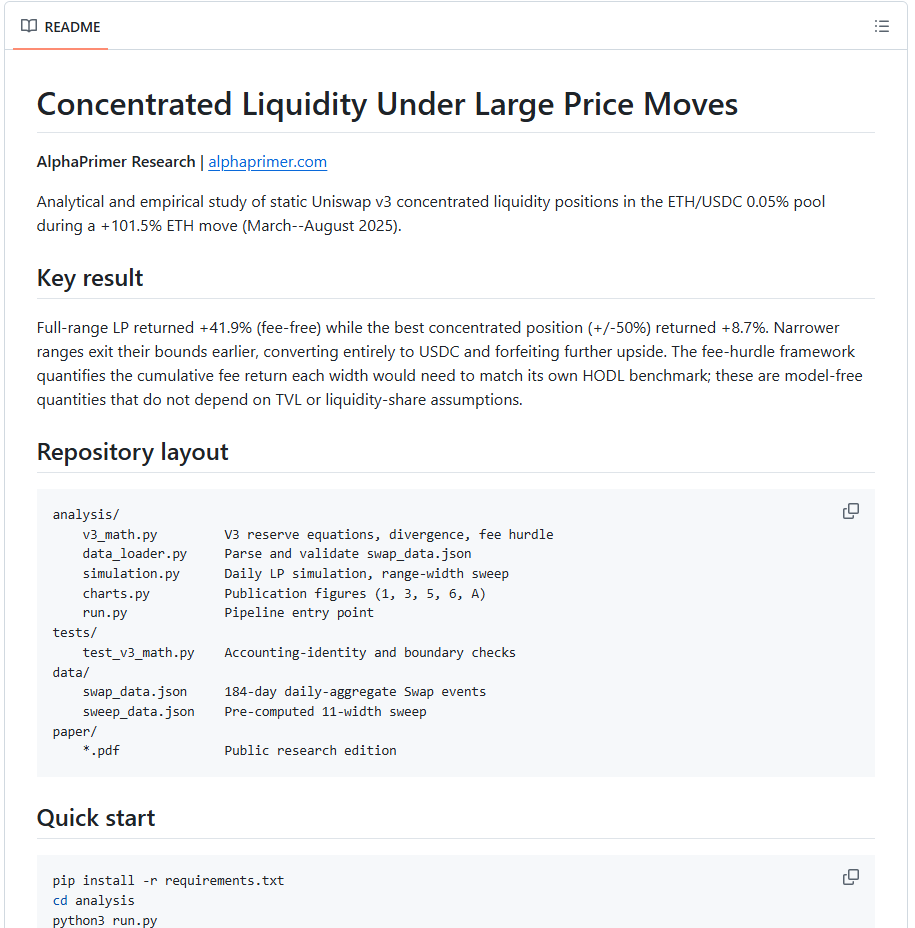
We measured this on a +101% ETH path: full-range returned +41.9% fee-free; the best +/-50% range returned +8.7%. Narrower widths left the interval and forfeited the rest of the trend. The fee hurdle to match HODL is a model-free quantity. It does not care about TVL share.
Into a scheduled macro print the same mechanics apply on a shorter clock. If the first hour after 18:00 UTC is a gap, the on-chain book will look thinner than the CEX book because the CEX book can requote. A v3 tick cannot.
We are not forecasting the decision. We are forecasting where the slippage shows up if the decision is not the one the perps already paid for.
#DeFi #Ethereum #Uniswap #Execution #MarketStructure #alphaprimer #research
16 Sep 00:30 UTC
Scoreboard on the 8 Sep note, into the FOMC print.
15 Sep tape
Coinbase range printed a low near $75.0k and a high near $79.6k. Daily close came in the mid-$75ks on most USD series. That is the first clean daily close under the $77k line we named.
Acceptance under $77k was the kill. A wick is not a close. Yesterday was a close.
What did not change
Premium still did not hold +0.20% through an NY cash close. Bitbo last print is around +0.11%. That is not the US spot bid we were waiting for. The $80k high remains a perp print, not accepted US inventory.
View status
— $80k accepted as US inventory: no
— premium > +0.20% at an NY close: still no
— kill (Coinbase daily close under $77k): triggered on 15 Sep
The 8 Sep bound is retired. We do not invent a new level for the meeting. FOMC is 18:00 UTC. The question after the print is the same one as before: does Coinbase pay up, or does the book stay offshore.
Sources: Coinbase BTC-USD daily, Bitbo Coinbase premium, CoinGlass liquidation tape.
#alphaprimer #Bitcoin #MarketStructure #FOMC #research
@Keziah0x The chart is the residue.
Liquidity location, execution cost, and infrastructure failure modes are the market.
That is the stack.
https://t.co/Jtz1JS3sFF
12 Sep 15:30 UTC
Scoreboard on the 8 Sep note, after both inflation prints.
10 Sep: PPI. Low $76.7k. UTC close printed on either side of $77k depending on the index — CoinDesk ~$77.1k, some venue series ~$76.6k. That is why we specified a venue. On Coinbase the line was nicked, not accepted.
11 Sep: CPI. Range $76.0k–$79.9k. Close ~$77.3k. $80k was tagged and refused in a single session. $732m liquidated across the book. That is a print, not a bid.
Weekend: $77.2k–$77.4k. Dead tape. No NY cash session.
Status
$80k accepted as US inventory — no. Two tests, two rejects.
Premium > +0.20% at an NY close — still no evidence.
Kill (Coinbase daily close under $77k) — 10 Sep argued it; 11 Sep walked it back. The view is wounded, not retired.
FOMC is 15–16 Sep. We do not invent a new level for the meeting. The same two clocks still run.
10 Sep 19:30 UTC
NY cash is minutes from 16:00 ET.
UTC daily is not done.
PPI took Coinbase through $76.73. The rebound is sitting $77.1k–$77.2k. So the session will likely close on top of the line we named, not under it. That matters. We defined the kill as acceptance, and acceptance is a close.
Two clocks, two answers:
— 16:00 ET Coinbase print: probably still in the $77s. Bound not dead.
— 00:00 UTC daily: still open. If that candle finishes under $77k, the 8 Sep view is retired.
Premium never cleared +0.20% on the way up to $82.3k and it did not appear on the way down either. The PPI tape was leverage getting cut, not a US spot bid arriving.
CPI 08:30 ET tomorrow. No new levels until one of the two clocks prints a close.
10 Sep 14:35 UTC
PPI printed hot. Spot traded $76.7k–$77.1k after the number.
That is the $77k bound we wrote down on the 8th.
It is not dead yet. A trade through $77k is not daily acceptance. Acceptance is a close.
What changed: the US cash bid we were waiting for (+0.20% Coinbase premium into 16:00 ET) never showed, and the first inflation print of the week arrived into that vacuum. $190m longs went in the first hour. That is leverage leaving, which is consistent with the last high being a perp print.
View status
— $80k as accepted US inventory: still no
— premium > +0.20% at NY close: still no
— kill: daily close under $77k. Live. Not triggered until the candle ends.
CPI is tomorrow. We do not rewrite the levels for the headline. We wait for the close.
Sources: BLS PPI, Coinbase BTC-USD daily, CoinGlass/Bitbo premium series.
9 Sep ~12:20 UTC
Definition we are using:
p = (Coinbase BTC-USD − Binance BTCUSDT) / Binance BTCUSDT
Last published print on Bitbo: +0.055%.
Threshold from 8 Sep: +0.20% held through 16:00 ET.
That is not close. A bounce from $77.7k to $79.2k can happen entirely on offshore books. This formula is how we tell the difference.
We do not update the view on the bounce.
We update it when p prints above 0.0020 at the cash close, or when the daily accepts under $77k.
Reproduce with any two timestamps on those two venues. If your p disagrees with Bitbo by more than a couple of basis points, say so — then the series is the issue, not the level.
9 Sep 07:50 UTC — interim, not the NY close.
Premium: +0.055% on Bitbo (Coinbase vs global).
Spot bounced from ~$77.7k back to ~$79.2k.
Neither condition hit.
+0.20% into an NY close: no.
Daily acceptance under $77k: no. That was a trade, not a close.
View still live. $80k is unconfirmed as US cash inventory.
Next stamp is 16:00 ET. Same series. Same threshold.
8 Sep 23:45 UTC
Bottleneck tonight is not the daily candle. It is whether US cash ever paid up for the $82.3k print.
Coinbase BTC-USD vs Binance BTCUSDT is still stuck near flat. If that spread cannot hold above +0.20% through a New York close, the high was made on the perp venues.
Hypothesis: $80k fails as accepted inventory until that premium shows up.
Invalidation: premium > +0.20% into the NY close.
Kill the view: daily acceptance under $77k.
Source: Coinbase BTC-USD, Binance BTCUSDT, CoinGlass premium series, same stamp.
Coinbase premium is still asleep.
Offshore can print $82k and fade it. The US cash book does not have to follow. When the premium stays near flat through that, the bid that mattered was leverage, not a new spot buyer in New York hours.
$80k failed on the daily. The premium never confirmed it was real.
Note: cheap blockspace, unchanged venue mix.
Mainnet gas has been near zero for days. If execution were gas-constrained, DEX volume on Ethereum should have absorbed size. It has not done so in proportion.
That is the result. Routing did not automatically move on-chain when the fee dropped. Flow stayed where inventory already sits — CEX books and perps — because depth and funding still dominate the all-in cost.
Gas is a line item. It is not the objective function. The objective function is slippage plus carry plus the probability of a fill. In a low-gas regime those last two terms run the book.
We wrote this down in 2022 as AMM routing under gas constraints. The constraint just flipped sign. The framework did not.
#DeFi #Ethereum #Uniswap #Execution #MarketStructure
AlphaPrimer Research x 1Procard — Partnership Announcement
AlphaPrimer Research has partnered with 1Procard to integrate crypto-native payment infrastructure into our operations.
As a quantitative trading firm operating across multiple DeFi protocols, we require fast and flexible payment rails for infrastructure costs, tooling, and team operations. 1Procard's virtual card API enables us to streamline these payments directly from crypto, without traditional banking friction.
This partnership reflects our commitment to building on
crypto-native infrastructure at every layer — from execution to settlement to day-to-day operations.
We look forward to growing this relationship.
— AlphaPrimer Research | https://t.co/B5eJLnrUBa
— 1Procard | https://t.co/Z76Jkk1kqE
#partnership #1procard #alphaprimer
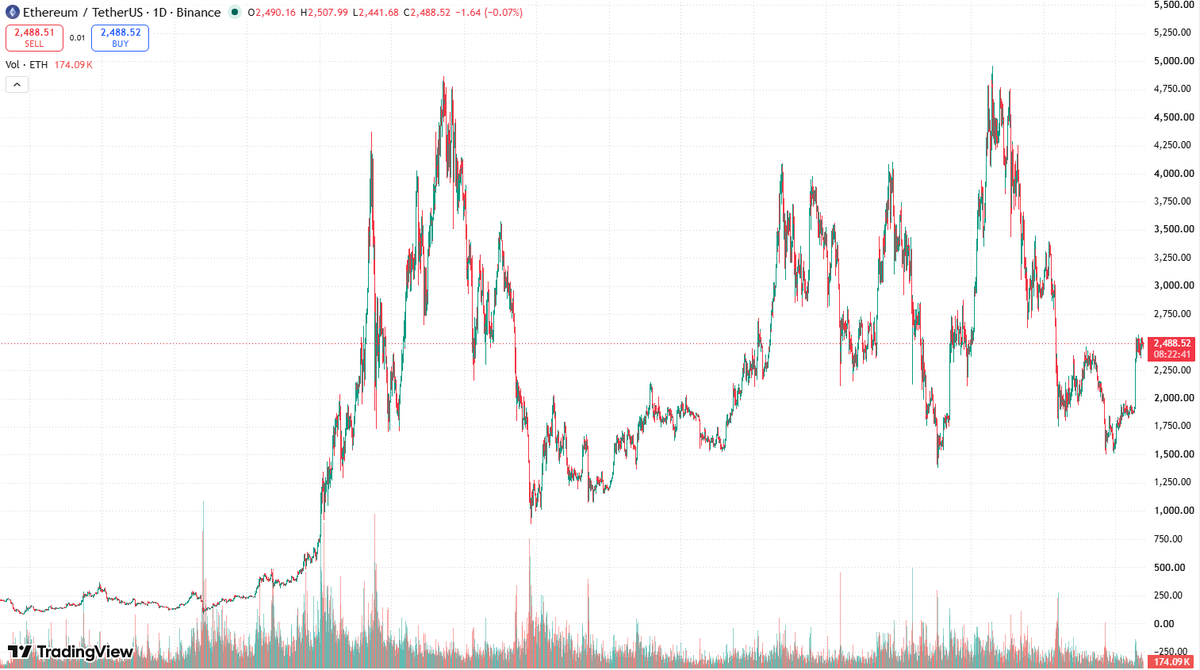
ETHUSDT daily.
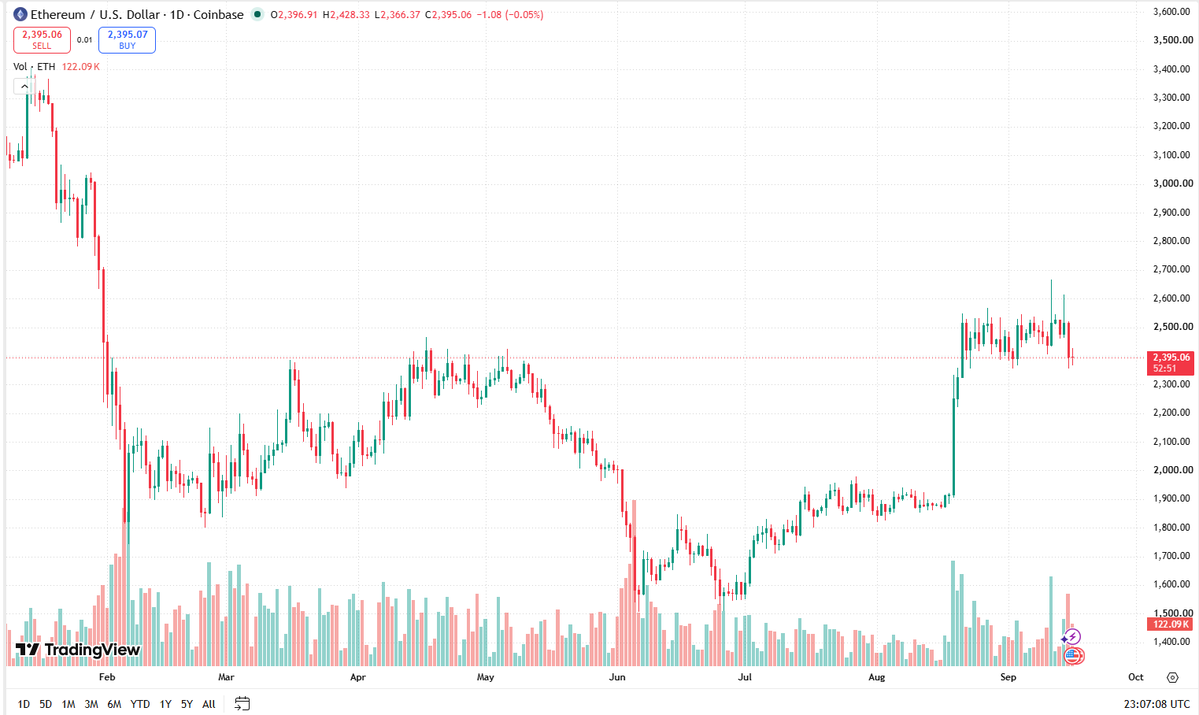
Ether is still digesting the August lift around $2,480–$2,520. The dollar range is quiet. That is not the same as nothing happening underneath.
Gas is still cheap. ETHBTC held up while BTC lost the $80k handle. BTC.D did not break down. Put together: ether is being treated as blockspace collateral, not as an alt that needs a new bid.
A range this tight after a large impulse is usually inventory, not a thesis. The break that matters is acceptance away from $2,500 — not a wick through it.
We size the asset after we size the rails.
#ETH #ETHUSDT #DeFi #MarketStructure #Execution
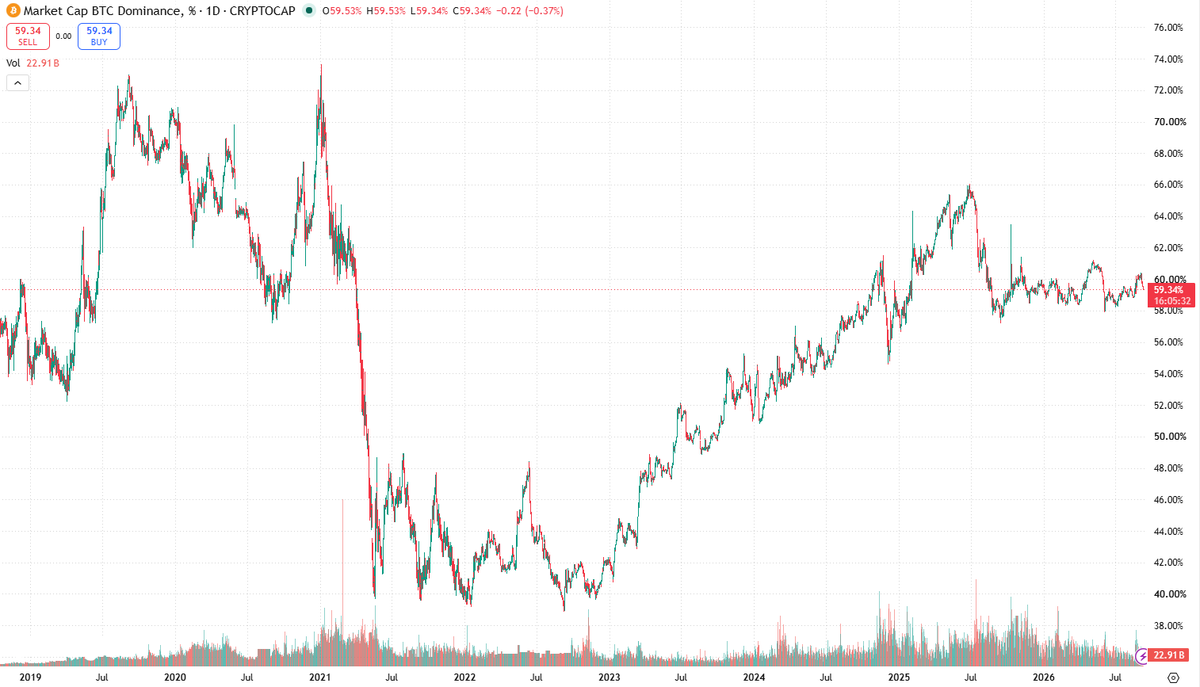
BTC.D, daily.
Spot BTC slipped off $80k toward the high $78ks. Dominance has not. It is still sitting near 59%.
That split is the tape. A dollar drawdown with stable dominance means the rest of the book went with it. Capital did not rotate. It marked down together.
ETHBTC already told the same story in a pair. Dominance tells it in weights. Until BTC.D gives back share in a rising tape, this is still a collateral market, not a risk-asset market.
We care where the weight sits. The handle is secondary.
#BTCD #BTC #ETH #DeFi #MarketStructure
Stablecoin supply is the inventory account.
USDT.D is still the bulk of dollar rails. Tether is about 60% of stablecoin cap, USDC about 25%. Combined they are most of the dry powder that can actually hit a book.
That stock has been roughly flat near $300B. Price can rally without new dollars. It just reprices the same inventory. The August impulse in BTC looked like flow. The stablecoin tape says a lot of it was rotation.
For execution this is the constraint behind the constraint. Cheap gas moves size. Size still has to come from somewhere. If USDT+USDC are not expanding, leverage and venue basis have to do the work.
We read the dollar float before we read the candle.
#USDT #USDC #Stablecoins #DeFi #MarketStructure
Execution note, not a price note.
Mainnet base fee is still sub-0.1 gwei. Priority is optional. A swap that used to be an execution problem is now mostly a routing problem.
That changes the book. When blockspace is this cheap, inventory can move. Failed fills are less about gas and more about pool depth, CEX–DEX basis, and whether the perp venues agree on the cost of carry.
We treat this regime as a constraint set, not a signal. Cheap gas does not mean risk-on. It means the bottleneck moved off the chain and onto the venues.
#ETH #Gas #EIP1559 #DeFi #Execution
Funding is not one number.
CEX BTC perps are still cheap. Binance and Bybit sit in the low-single-digit annualized range. Hyperliquid does not. Same underlying, different cost of carrying inventory.
That is a venue problem before it is a directional problem. If the books were joined, the spread would compress. It has not, which means either HL longs are paying for positioning the CEX book does not want, or capital cannot move across venues fast enough to arbitrage the difference.
We map cost of carry first. Price is the residue.
#FundingRate #BTC #Hyperliquid #DeFi #MarketStructure