What if you could stop looking at DeFi markets as charts and start looking at the structure underneath them?
Who is actually providing liquidity?
Where is the market getting its price?
When does a trade become expensive?
And what happens when the infrastructure itself becomes the risk?
This is where @AlphaPrimer_R comes in. 🧵
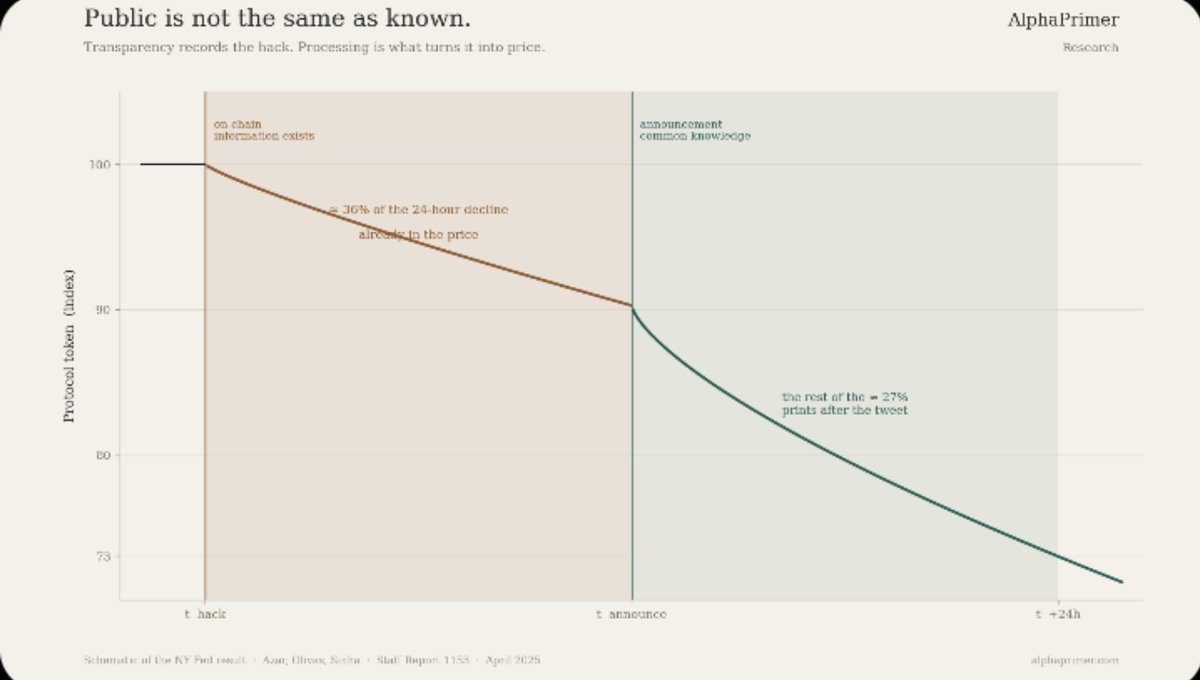
I spent some time going through a Federal Reserve Bank of New York paper published in April 2025, titled “The Price of Processing: Information Frictions and Market Efficiency in DeFi.” What caught my attention was not simply the fact that the paper studied DeFi hacks, but the way it treated the timing of information as a measurable part of market structure.
A hack leaves an on chain record at a specific point in time. The wider market may only become aware of it after an announcement. That creates a measurable gap between information becoming observable and information becoming widely understood.
Across the hacks examined in the study, the average 24 hour price decline was about 27%, yet roughly 36% of that decline had already occurred before the hack became common knowledge through public announcements. The interesting question is therefore not simply who knew first. The information was already sitting on a public blockchain. The deeper question is who was able to identify, process, and act on that information before the rest of the market.
This is where the work of @AlphaPrimer_R becomes relevant to the question. AlphaPrimer approaches decentralized markets through microstructure: price formation, liquidity dynamics, information flow, execution, and the conditions that determine how a market absorbs new information.
The historical record gives us the timestamps. The blockchain gives us the transactions. Market data gives us the reaction. The research problem is connecting those pieces without assuming that correlation automatically gives us causation.
That is the direction I want to explore more deeply. Instead of looking at an event only after the chart has already moved, go back to the beginning. Establish exactly when the information appeared, reconstruct what happened to liquidity, examine how different venues reacted, and determine how much of the eventual price movement can actually be explained by the information available at each point.
This is also why I think historical research has an important place in Web3. Markets leave an unusually detailed record behind them. If we are willing to go back through the timestamps, transactions, announcements, liquidity conditions, and price reactions, we can often reconstruct the sequence of events rather than relying on the narrative that appeared afterward.
The goal is not to produce another confident explanation after the fact. It is to find out what the evidence can support, where the explanation becomes uncertain, and what observation would prove the interpretation wrong.
That is the kind of research I want to build around @AlphaPrimer_R : not just documenting what happened, but understanding how information became price.
I thought I understood research before I started working with @AlphaPrimer_R .
I knew how to find information, understand a chart, explain a thesis, and turn technical ideas into content.
I underestimated the harder part.
Knowing what the data actually allows you to say.
A price can move without establishing a new regime.
A liquidity position can look efficient until the path of the asset changes.
An execution can appear cheap while its real cost is distributed across depth, gas, latency, and slippage.
A model can explain a market remarkably well and still have a boundary where its assumptions stop holding.
That distinction changed the way I think.
Good research isn't the ability to produce a confident conclusion.
It is the discipline to define the variable, understand the mechanism, state the assumptions, identify the evidence, and make the conditions for being wrong explicit.
That is what I took from my time studying AlphaPrimer's work across microstructure, execution, concentrated liquidity, and risk.
And perhaps that is the bigger lesson for Web3:
The advantage will not come simply from having more data.
It will come from knowing how to interrogate it.
The future belongs to people who can turn data into understanding and understand exactly where that understanding breaks.
https://t.co/3ID39qBTBO
@samba_vibe@AlphaPrimer_R Exactly. The failure boundary is part of the model, not an afterthought. If you cannot state what would invalidate the result, you haven't fully defined what the result means.
18 Sep — execution note after the print.
The interesting split on 16 Sep was not BTC versus ETH. It was perp versus spot.
In the hour after the statement, perpetual books sold size. Spot absorbed a fraction of that flow. That is the same pattern we wrote down before the meeting: a priced-in hike can still force a gap in the derivative book while the cash book stays thinner and slower.
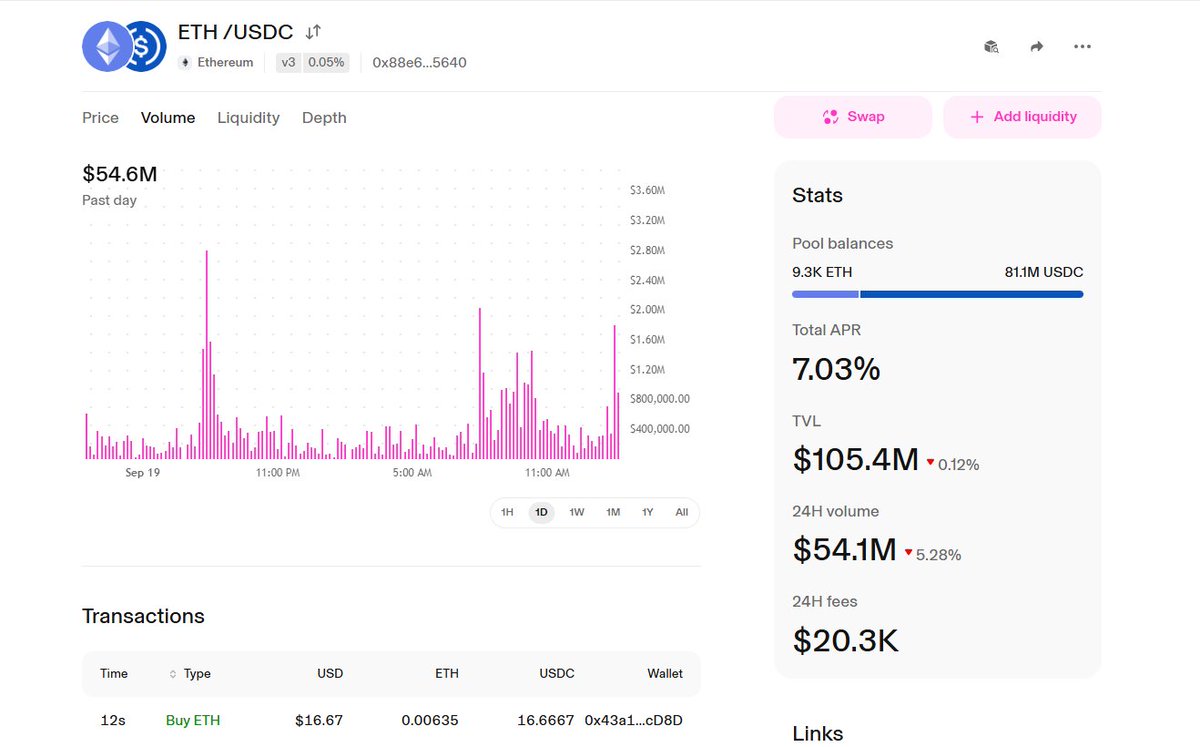
On-chain did not become the venue of choice just because the headline was known. Concentrated ranges around ETH/USDC spot still have to be in the interval to earn. A v3 tick does not requote during the press conference. A CEX book does.
Gas is still cheap. That did not reroute the FOMC tape onto mainnet in proportion. Depth and carry decided the fill. We said this in 2022 when gas was the constraint. The constraint flipped. The objective function did not.
Measurement we care about into next week
— does Coinbase premium hold through an NY close, or does the repair stay on USDT books
— do static ETH/USDC ranges stay in-interval through the next volatility burst, or do they convert and leave a hole
— is liquidation flow still the first hour of every print
The hike is done. The inventory question is not.
#DeFi #Ethereum #Uniswap #Execution #MarketStructure #alphaprimer #research
I spent a good part of this week going through @AlphaPrimer_R research across microstructure, execution, and risk.
The more I read, the more one idea kept connecting the pieces:
Price is an output of a market. It is not the market itself.
That sounds obvious until you ask what actually sits between an order and the final print.
Liquidity is distributed across venues.
Information arrives at different speeds.
Inventory is not positioned uniformly.
Execution consumes depth.
Gas changes the economics of routing.
Oracles introduce dependencies.
Sequencers and block builders affect the path from intention to settlement.
And concentrated liquidity makes the state of the inventory itself dependent on where price is relative to the active range.
So a market price is not a sufficient statistic for the state of the system that produced it.
This is where @AlphaPrimer_R research becomes particularly interesting.
Their microstructure work asks how price formation, liquidity dynamics, and information flow interact across AMMs and on-chain order books.
Their execution work moves from where should the trade go? to the more difficult question: what is the actual cost of getting it there?
And their risk framework extends the analysis beyond the trade itself toward oracle dependencies, contract exposure, governance, and systemic liquidity.
The same logic appears in their concentrated-liquidity research.
A range can appear extraordinarily efficient when measured against the capital deployed. But that efficiency is conditional on the path of the underlying asset. Once the price process leaves the active interval, the economic state of the position changes.
The headline metric survives only if the assumptions underneath it survive.
That is a broader lesson for DeFi.
We often compress a complex system into a single observable:
price,
APY,
TVL,
gas,
slippage,
liquidity.
But each of those is an output generated by a deeper state.
The quantitative problem is therefore not simply to measure the output.
It is to identify the variables that generated it, specify their interaction, and determine where the relationship stops holding.
That is the direction I see across AlphaPrimer’s work.
Not forecasting for the sake of forecasting.
Model the mechanism. Measure the state. Stress the assumptions. Find the failure boundary.
Because once you understand the mechanism producing the number, the number itself becomes much more informative.
That is what serious market structure research should do.
@AlphaPrimer_R
#AlphaPrimer #DeFi #Web3 #MarketStructure #QuantitativeResearch
What if the optimal liquidity range is not a fixed number?
What if it is a function of how the asset moves?
Concentrated liquidity is usually framed as a trade off between capital efficiency and range risk.
That framing leaves out the variable that determines whether a range stays alive:
price dynamics.
A band can be efficient while price remains inside it. Once the path leaves the band, fee income stops and the position becomes one sided.
The range is no longer a market making position. It is an inventory position.
So the question is not “tighter or wider.”
It is whether the law of the price can tell us which intervals should earn more.
We model concentrated liquidity under mean reverting dynamics and derive LP return expressions that connect three objects:
→ Price dynamics determine how long a range remains active.
→ Range width determines the economics while it remains active.
→ The realised path determines the inventory assigned to the position.
We then take the ranking to mainnet 14 months of pool data and test where the mapping holds.
It fails where it should fail: jumps, mean reversion that does not arrive, and inventory stranded on the wrong side of a trend.
That is the result we care about.
Efficiency is not a property of tightness. It is conditional on the behaviour of the asset.
The range should be chosen from that behaviour.
This is the kind of market structure problem we study at AlphaPrimer.
A BTC bounce is not necessarily a change in market structure.
So how do we distinguish a bounce from a meaningful signal?
At AlphaPrimer, we use a simple price-dislocation measure:
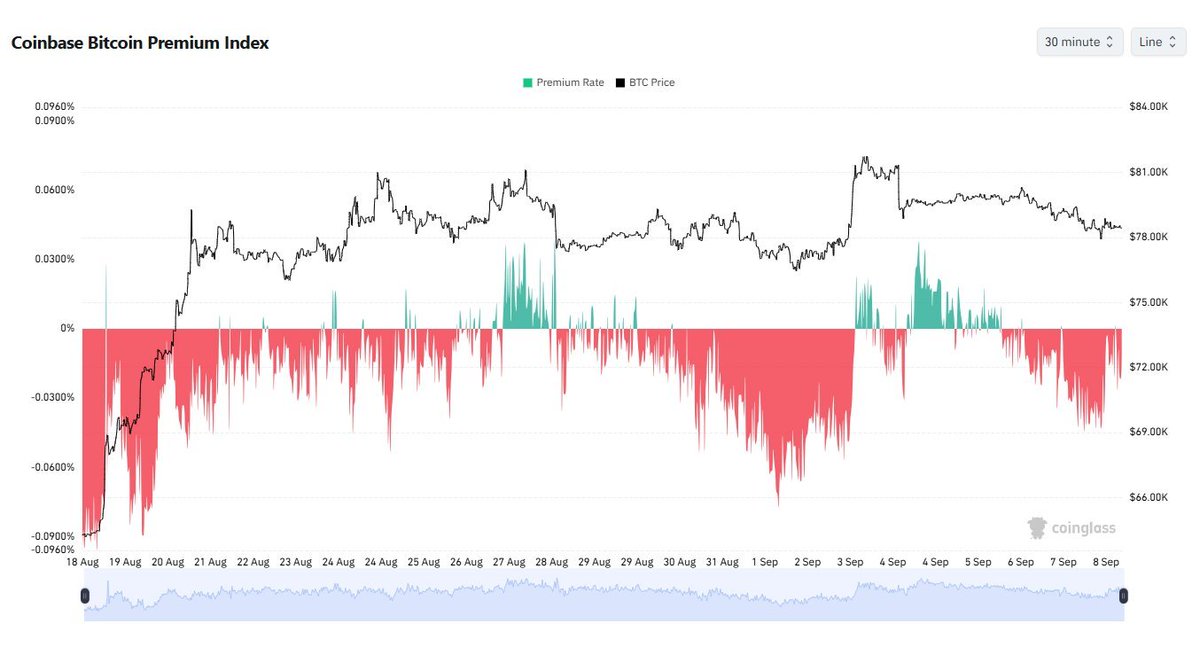
p = (Coinbase BTC-USD − Binance BTCUSDT) / Binance BTCUSDT
As of 9 Sep, ~12:20 UTC, the last published Bitbo print was +0.055%.
Our threshold from 8 Sep was +0.20%, held through the 16:00 ET cash close.
That gap matters.
BTC can move from $77.7k to $79.2k without confirming a structural shift if the move is occurring primarily on offshore books.
The dislocation measure gives us a way to test whether that move is being reflected in the cash market.
So we do not update the view simply because BTC bounces.
We update it when:
→ p > 0.0020 at the cash close, or
→ the daily accepts below $77k.
The objective is not to explain every price move after it happens.
It is to define the signal first, then test whether the market satisfies it.
The calculation is reproducible using any two timestamps across the two venues.
If your result differs from Bitbo by more than a few basis points, investigate the series before interpreting the level.
Research is only useful when the signal can be defined, reproduced, and challenged.
More market-structure research from @AlphaPrimer_R .
A bounce is not confirmation.
9 Sep, 07:50 UTC interim print, not the NY close.
Bitbo showed a +0.055% premium between Coinbase and global spot.
BTC had bounced from roughly $77.7k to $79.2k.
But neither of our conditions had been met:
→ +0.20% into the NY close: no.
→ Daily acceptance below $77k: no.
The distinction matters.
That move was a trade, not a close.
So the view remains live.
$80k is still unconfirmed as US cash inventory.
The next decision point is 16:00 ET.
Same series.
Same threshold.
No change to the view until the data changes it.
@AlphaPrimer_R
The $82.3k print is not the signal.
The question is whether US cash actually paid up for it.
At 23:45 UTC on 8 Sep, Coinbase BTC-USD versus Binance BTCUSDT remained near flat.
Our test is simple:
If the spread does not hold above +0.20% into the New York close, the move has not established a US cash premium.
That leaves two competing explanations for the $82.3k print:
accepted demand, or price discovery led by perpetual venues.
We treat them differently.
Hypothesis: $80k remains unconfirmed as accepted US inventory until the premium appears.
Invalidation: premium > +0.20% into the NY close.
Kill: daily acceptance below $77k.
This is the type of distinction @AlphaPrimer_R studies through market microstructure: how liquidity, price formation and information flow across venues determine what a price actually tells us.
The broader problem is straightforward.
A fragmented market can produce a headline price without giving you a clean read on where demand is actually coming from.
The job of the model is to separate the print from the underlying market structure.
Define the signal. Set the invalidation. Then let the data decide.
Most people look at DeFi through prices, TVL, volume and charts.
But those numbers are only the surface.
The harder questions are underneath:
Where is the liquidity actually coming from?
What is really driving a price move?
How efficiently can a trade be executed?
What happens when liquidity disappears?
And what happens when the infrastructure a protocol depends on starts behaving differently under stress?
This is where I think @AlphaPrimer_R stands out.
AlphaPrimer is not trying to make noise around every new narrative in DeFi. Their focus is much deeper: understanding how decentralized markets actually work through quantitative research.
They work across three areas that are fundamental to the evolution of DeFi:
Market microstructure.
Execution.
Risk.
Take concentrated liquidity.
It is easy to describe Uniswap V3 as a more capital-efficient AMM because liquidity providers can choose specific price ranges.
But that immediately creates another question:
What determines the range that should actually be used?
A tighter range can be more efficient while the market remains inside it. But when price moves outside the range, the position's behaviour changes completely.
So range selection cannot be separated from the behaviour of the underlying asset.
AlphaPrimer's research approaches this quantitatively, modelling concentrated liquidity under mean-reverting price dynamics and then testing those ideas against real mainnet data.
That is the part I find particularly interesting.
The objective is not simply to say “concentrated liquidity is efficient.”
It is to understand when, why and under what market conditions that efficiency actually exists.
The same thinking extends to execution.
In a fragmented on-chain market, finding liquidity is not enough.
You have to consider routing, fees, gas, slippage, latency and the possibility that other participants are competing for the same opportunity.
A trade that looks profitable on a chart can have very different economics once the actual execution costs are included.
AlphaPrimer works on this side of the problem too, researching smart order routing, gas optimisation, cross-chain settlement and execution infrastructure.
Then there is risk.
DeFi protocols can depend on oracles, bridges, liquidity pools, governance systems and other pieces of infrastructure.
Everything can look fine during normal conditions.
The real question is what happens when the market becomes stressed.
AlphaPrimer's research into oracle stress testing, liquidation cascades and price-feed reliability is aimed at understanding exactly those situations.
And as liquidity becomes increasingly distributed across different chains and L2s, market structure becomes even more complicated.
Their work on cross-chain MEV looks at how arbitrage and extraction opportunities move across these environments, including the effects of sequencers and bridge finality.
This is why I see AlphaPrimer as more than another DeFi research account.
They are trying to answer questions that become increasingly important as decentralized markets mature.
Not:
“What token is trending?”
But:
“What is actually happening beneath the price?”
Not:
“Where is the liquidity?”
But:
“How does that liquidity behave, and what does it mean for execution?”
Not:
“Is the protocol working normally?”
But:
“How does the system behave when its assumptions are tested?”
That distinction matters.
DeFi is becoming more sophisticated, and the infrastructure around it needs research that is equally rigorous.
That is what makes @AlphaPrimer_R worth watching.
Their work sits at an interesting intersection of quantitative finance and decentralized markets, turning messy on-chain behaviour into something that can actually be modelled, tested and understood.
For me, that is the kind of research DeFi needs more of.
BTC touched $80K. But who actually paid for it?
That is the question.
A price can print at a level without that level becoming accepted inventory.
That distinction is what the 8 Sep thesis was testing.
After PPI on 10 Sep, BTC traded down to ~$76.7K. The UTC close was around $77K, but the index mattered: CoinDesk printed ~$77.1K while some venue series were closer to ~$76.6K.
On Coinbase, $77K was breached.
It was not accepted.
Then CPI arrived on 11 Sep.
BTC traded from $76.0K to $79.9K and closed around $77.3K.
$80K was tagged and rejected in the same session.
$732M was liquidated across the market.
Still, liquidation volume is not evidence that $80K became supported demand.
So the test stays mechanical:
$80K accepted as US inventory? No.
Coinbase premium > +0.20% into a New York close? No evidence.
Coinbase daily close below $77K?
10 Sep pushed toward the kill condition.
11 Sep reversed it.
The thesis is weaker, but not invalidated.
This is where the @AlphaPrimer_R lens matters.
Their market microstructure work is concerned with the mechanism behind a price: where price formation occurs, how liquidity moves between venues, and how information propagates through fragmented markets.
Because the interesting question is not whether the chart printed $80K.
It is whether the market transferred enough inventory at $80K for that level to become information rather than noise.
That is a different problem.
And it is why venue selection, persistence and predefined thresholds matter.
We do not change the test because the chart looks convincing.
FOMC is 15–16 Sep.
Same series.
Same +0.20% threshold.
Same $77K invalidation.
The next print does not get to rewrite the hypothesis.
The data does.
@AlphaPrimer_R
Most DeFi markets are easy to watch, but much harder to understand.
A chart tells you where price moved.
It doesn't always tell you where liquidity was sitting, how the price was formed, what execution actually cost, or where risk was building beneath the surface.
That is the problem @AlphaPrimer_R Research is working on.
Founded in 2019, AlphaPrimer is a quantitative research team focused on decentralized markets and the infrastructure that supports them.
Their work spans three connected areas:
→ Market microstructure across AMMs and onchain order books
→ Onchain execution and the real cost of moving capital
→ Portfolio level risk and the dependencies that can amplify market stress
The mechanism is simple:
Measure the market.
Model what is happening underneath it.
Test those models against real on chain data.
Then identify where the model breaks.
The goal isn't to make another chart.
It's to understand the system producing the chart.
As decentralized markets become more complex, that distinction matters.
AlphaPrimer is building the research, models, and infrastructure needed to understand DeFi at that deeper level.
@AlphaPrimer_R
A market price is an observation, not an explanation.
Two markets can print the same price while operating under completely different conditions.
The difference may be inventory positioning, funding pressure, fragmented liquidity, or a temporary dislocation. The candle records the outcome. It does not identify the state that produced it.
This is the kind of distinction @AlphaPrimer_R Research is interested in.
Rather than treating price as the starting point, the research begins with the variables underneath it:
Where is liquidity concentrated?
How does available depth change the marginal cost of execution?
How much of an observed move is explained by informed flow, adverse selection, or temporary imbalance?
And which infrastructure dependency becomes binding when market conditions deteriorate?
The same framework applies across DeFi.
A concentrated liquidity position can appear highly capital efficient while price remains within its active interval. Once the path moves outside that interval, the economics change: fee generation stops, inventory exposure changes, and the original efficiency assumption no longer holds.
Execution has the same problem.
A lower nominal transaction cost does not necessarily imply better execution. Once liquidity depth, slippage, gas, latency, and adverse selection are evaluated jointly, the optimal route can change.
These are not questions that can be settled by looking at a chart alone.
They require measurement, explicit assumptions, models, and empirical validation against on-chain observations.
That is the role AlphaPrimer is building toward: understanding decentralized markets at the level of their underlying mechanisms, rather than only their visible outcomes.
@AlphaPrimer_R
#AlphaPrimer #DeFi #Web3 #MarketStructure #Research
What if you could stop looking at DeFi markets as charts and start looking at the structure underneath them?
Who is actually providing liquidity?
Where is the market getting its price?
When does a trade become expensive?
And what happens when the infrastructure itself becomes the risk?
This is where @AlphaPrimer_R comes in. 🧵