DTCC going live on @CantonNetwork feels bigger than another RWA headline.
real securities can keep their rights, move onchain and settle privately in one flow.
this is the kind of infra i want exposure to early.
@CantonFdn, #CantonResearchNov26
👇👇
► Where Is The Demand For Ethereum?
Ethereum might have one of the largest financial ecosystems in crypto, yet I'm still struggling to find where the actual buying demand for $ETH is supposed to come from.
The clearest demand comes from people moving dollars, borrowing against assets, earning yield, and settling financial products.
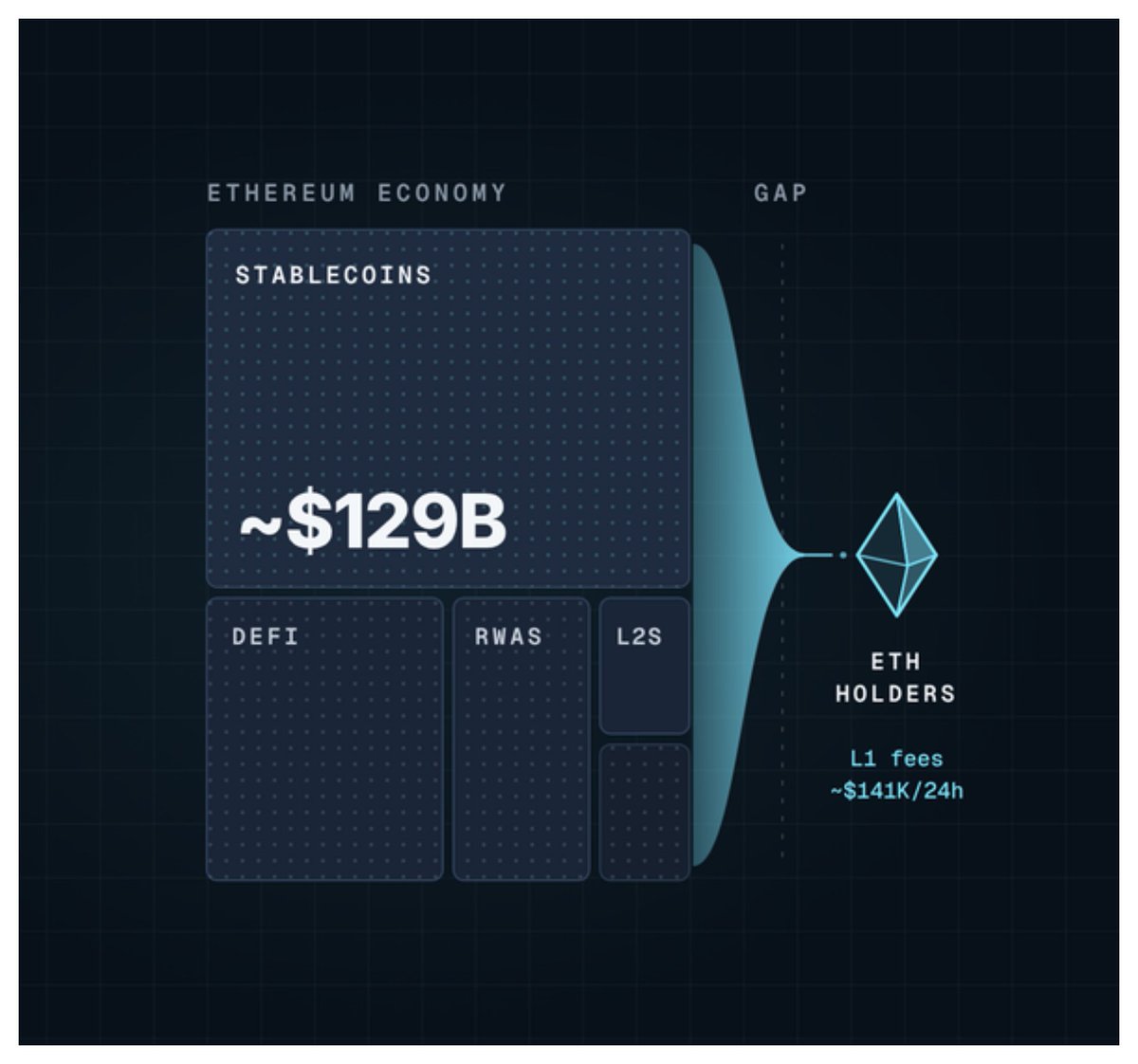
– ~$129B in stablecoins, nearly 46% of the entire market
– ~$36.4B in DeFi TVL
– ~$14.3B in tokenized RWAs
– 44M+ ETH staked, around 36.5% of total supply
Institutions are tokenizing assets on it. Stablecoins are moving billions around. DeFi protocols are still facilitating lending, trading, and collateralized borrowing.
But demand for Ethereum and demand for ETH are two different things.
> Ethereum has a lot of economic activity. Just not much of it reaches ETH holders.
Ethereum L1 generated only ~$141K in chain fees over the latest 24h period. Meanwhile, applications built on Ethereum are generating millions in fees.
But Aave making money doesn't mean ETH holders automatically get paid.
Same with L2s. Base generated $3M in fees and sequencer profit over 30d, while paying Ethereum only $15K in settlement costs.
Across L2s, Ethereum collected ~$75K in settlement and blob fees over 30d.
Ethereum spent years scaling its infra so rollups could process millions of transactions without paying expensive L1 fees.
→ The problem is that Ethereum successfully made the product it sells much cheaper.
I don't think that's necessarily a failure of Ethereum's roadmap. It's just a very different economic model from what ETH holders were originally betting on.
Who's actually buying ETH?
– US spot ETH ETFs have attracted $11.3B in cumulative net inflows since launch, but recent flows have turned negative.
– BitMine now holds 6.08M ETH, ~5% of total supply, and remains one of the largest identifiable corporate buyers.
– Staking: 44M ETH is staked, with yields around ~2.5%.
ETH deposited into staking + DeFi is useful. But a lot of what we call ETH demand is actually existing ETH being put to work. Not necessarily new buyers entering the market.
> The old ETH value capture thesis has changed quite a lot.
Remember when the ultrasound money narrative was everywhere?
Recent daily issuance is ~3K ETH. But daily burns have been running at only ~20–30 ETH.
Ethereum is issuing far more ETH than it burns.
The whole scaling roadmap made txs cheaper, and naturally reduced the amount of ETH consumed through fees.
Maybe we've spent too much time valuing ETH like a commodity whose price should rise whenever more people consume blockspace.
Ethereum is increasingly behaving like financial infra where the underlying asset provides security, collateral, liquidity, and monetary neutrality.
The demand isn't necessarily coming from paying $20 to execute a swap anymore.
It's potentially coming from institutions wanting ETH as collateral, investors holding it as a productive reserve asset, and financial markets choosing it as neutral capital.
But those are different demand mechanisms, and they need different evidence.
Rn, the infrastructure story looks much stronger than the token demand story.
The Ethereum's biggest problem today is turning all that economic activity into a reason for someone to buy and hold more ETH.
Until that happens at scale, Ethereum can keep becoming more important to global finance while ETH holders capture surprisingly little of that growth.
That's the gap I think the next real ETH bull thesis needs to close.
Anthropic ($ANT), the company behind Claude, is now available through Bybit Stocks.
You can now access Anthropic shares through @Bybit_Official.
#Anthropic is the company behind Claude, an AI assistant used for writing, research, and coding, with a strong focus on AI safety.
Here’s what Bybit Stocks offers:
- Buy real shares using USDC in your Bybit UTA.
- Zero trading commissions.
- Fractional shares starting from 5 USDC.
- Trade stocks and crypto from one account.
And there’s more: Bybit is running an ANT trading campaign with a 50,000USDT prize pool trade ANT to earn rewards, but it ends in just 3 days, so don’t miss it.
If you use Claude and want to explore the company behind it, check out $ANT through Bybit Stocks.
👉 https://t.co/uhdmXElwxT
Crypto is entering its revenue-first era
I expect sustained upside to become much more selective.
I’m getting stricter about what makes a token worth owning:
- paying users, repeatable revenue.
- and a clear mechanism that sends value back to holders.
1kx’s 2026 revenue report gives that view some support:
> Blockchain revenue fell 28% YoY.
> Its backtested dividend-token index returned 82% from January through September.
> The top 20 protocols captured 60% of onchain user-paid fees.
That’s a selective market. The index result is encouraging, though nine months doesn’t establish a permanent investing rule.
There’s similar concentration among companies with 6 firms account for 59% of public-company revenue and 52% of private-company revenue in their respective groups.
4 tokens stand out to me through this lens:
[1] $HYPE
1kx reports roughly $939M in trailing-12-month fees. Hyperliquid’s Assistance Fund automatically converts its allocated trading fees into HYPE, which is burned.
I see a strong connection between product usage and token demand. I’m watching whether fee growth can keep pace with valuation and circulating supply growth.
[2] $PENDLE
80% of eligible V2 protocol fees fund PENDLE buybacks, with rewards distributed to active sPENDLE holders.
I’m interested in the recurring demand for fixing yields and trading yield exposure. My main check is whether fees remain healthy as points campaigns and yields change.
[3]. $SKY
Sky’s September update reported $9.7B in stablecoin supply and $5.08M allocated to SKY buybacks and USDS rewards for SKY stakers.
This is a business I can assess through revenue, funding costs, credit exposure and capital reserves. I’m watching the surplus available to holders after those obligations.
[4] $UNI
Active protocol fees now fund UNI burns, giving usage a measurable connection to token supply.
I’m tracking actual protocol fees and recurring burns. Total trading volume alone tells me too little about what UNI captures.
Revenue is my starting point. Valuation still decides the investment.
I want to compare sustainable holder distributions with the token’s valuation, then account for unlocks, emissions and treasury spending.
I also want to see what happens under weaker trading volumes, lower yields or credit losses.
Annualising one exceptional month can make a cyclical business look cheap.
These four deserve closer research. My conviction would increase when revenue per token grows consistently and the price leaves room for weaker conditions.
DYOR.
Leverage is getting wiped but crypto usage is still here.
BTC is now around $65K, nearly 50% below its ATH.
BTC futures OI has dropped to around $41 -42B. Funding has also turned negative. Leverage is clearly being pulled out of the market.
But onchain activity is still quite large:
>> DeFi TVL: ~$71.7B
>> Stablecoin supply: ~$285B
>> DEX volume 7D: ~$52B
>> Perps volume 7D: ~$187B
maybe people are looking at this market like "everything is dying." Price is falling faster than usage.
no one can buy the exact bottom but at these levels i think it makes sense to start accumulating.
then there’s $SOL, $AAVE, $UNI, $HYPE, $ZAMA, $ASTER, $CAKE, $AVAX, $STX, NOCK and protocols that still have volume, users and fees even when the market is bad.
👇👇
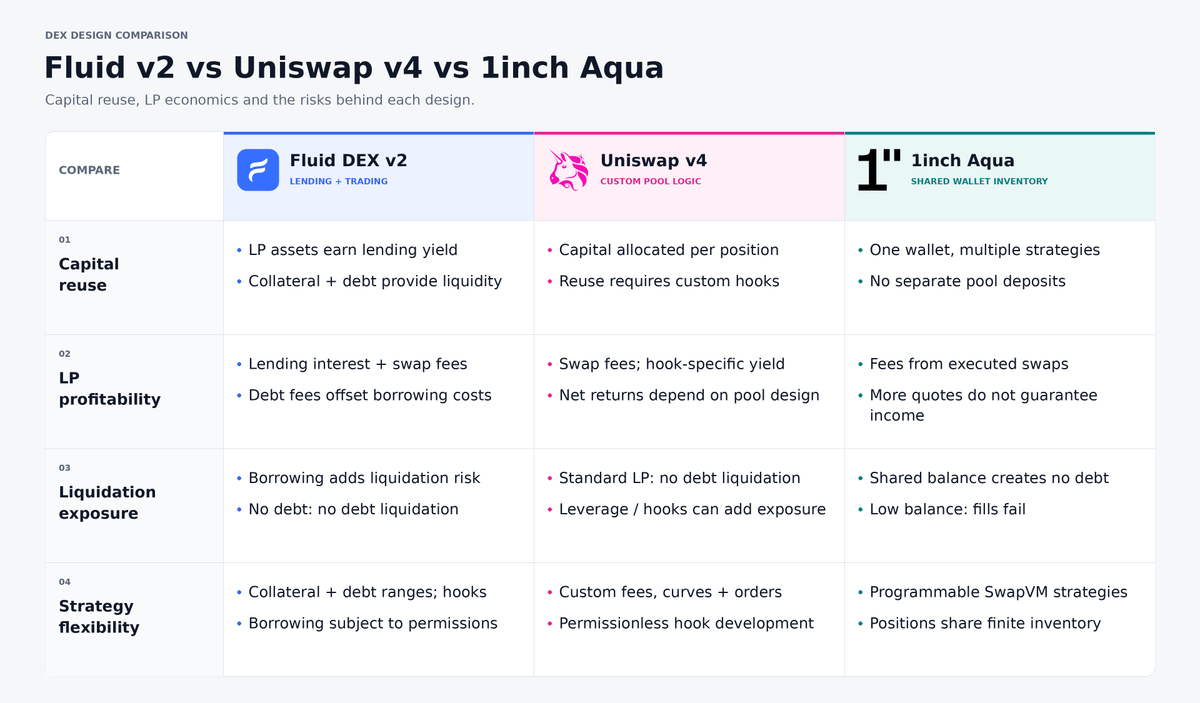
I’ve been comparing Fluid DEX v2, Uniswap v4 and 1inch Aqua.
My first impression is that capital reuse needs a more precise definition.
Earning lending yield, borrowing against an LP position and quoting several strategies against one wallet balance create very different exposures.
These differences follow the protocols’ documented designs.
[1] @0xfluid - for financed LP strategy.
Earning lending interest while providing liquidity improves the income side.
Earning fees on Smart Debt can reduce funding costs.
Cross-collateralization improves borrowing capacity, but it also connects positions through a shared liquidation constraint.
[2] @Uniswap v4, - specific hook for profitability.
Dynamic fees and lending integrations can improve a strategy.
They also introduce implementation-specific costs and dependencies.
Two v4 pools can have very different economics.
I see v4 as a flexible framework for developers.
[3] @1inch Aqua - for capital reuse without borrowing.
The same wallet inventory can support several strategies.
That gives me more opportunities to earn fees without splitting capital into separate deposits.
But those strategies still depend on one finite balance.
a fill changes the inventory available to the others.
Check fills, net fees and inventory performance before treating a high shared-liquidity ratio as an economic improvement.
My preference depends on the objective:
> #Fluid for integrated lending and financed liquidity strategies.
> #Uniswap v4 for custom pool mechanics.
> #Aqua for multiple strategies using shared wallet inventory.
DYOR
I think the reason ppl are dumping is they realize there's no truly safe place left to store crypto rn
> CEXs: hacked (Binance, Bitget) or banned (Mexc)
> DeFi lending: hacked (Aave, Kelp, Drift)
> Cold wallet: hacked (Coldcard, Ledger)
> Self custody wallet: seed phrase / keys leaked
So where do you actually keep your bags?
just minted my first market on @ultramint_xyz
will $HYPE outperform $BTC over the next 7 days?
took me like a minute to set up. you mint the market and earn a cut of it.
yes or no?