➥ Why are so many spot DEXs moving into Perps?
this morning, i read that @PancakeSwap has officially rebranded to Pancake.
the move reflects a bigger shift: from a spot DEX to an all-in-one trading platform offering Perps, tokenized stocks and ETFs 24/7.
i think we're watching DeFi protocols compete for a much bigger market than crypto.
and clearly, no major DEX wants to miss this trend.
just look at the numbers from @coingecko:
– Perp DEX monthly volume grew 8x, from $81.7B in Jan 2024 to $739.5B in Jan 2026.
– RWA Perps volume hit $347B in May 2026, up 1,472x from Jan 2025.
– TradFi Perps generated over 8x the volume of spot RWAs in the first 5 months of 2026.
– Tokenized equity Perps reached $34B in monthly volume in May 2026.
these numbers explain why DEXs are expanding beyond spot trading.
and Pancake isn't the first.
several well-known DeFi protocols started with a completely different business model:
[1] @JupiterExchange (solana:JUPyiwrYJFskUPiHa7hkeR8VUtAeFoSYbKedZNsDvCN): started as a Solana swap aggregator, then launched Jupiter Perps and expanded into a broader DeFi ecosystem.
[2] @Raydium ($RAY): started as an AMM DEX, then introduced Perps through Orderly Network.
[3] @QuickswapDEX ($QUICK): started with spot swaps on Polygon, then expanded into QuickPerps and derivatives trading.
[4] @synthetix ($SNX): started with synthetic assets, then shifted much of its focus toward Perps.
[5] @PancakeFi ($CAKE): started as an AMM on BNB Chain, and now offers Perps alongside tokenized stocks and ETFs.
there's also @HyperliquidX ($HYPE), which started with crypto Perps and has expanded into stocks, commodities and other TradFi markets.
looking at this list, i can see why the old boundaries between DEXs, Perp platforms and traditional brokers are starting to disappear.
a crypto trader can now access BTC, ETH, stocks, gold and ETFs from the same trading interface.
a few years ago, most DEXs were competing over who could offer the best token swaps. now they're trying to capture trading activity across entire financial markets.
i think this is where DeFi is heading, although regulation and liquidity will still determine how far these products can scale.
Pancake dropping "Swap" from its name feels like a pretty accurate reflection of that shift.
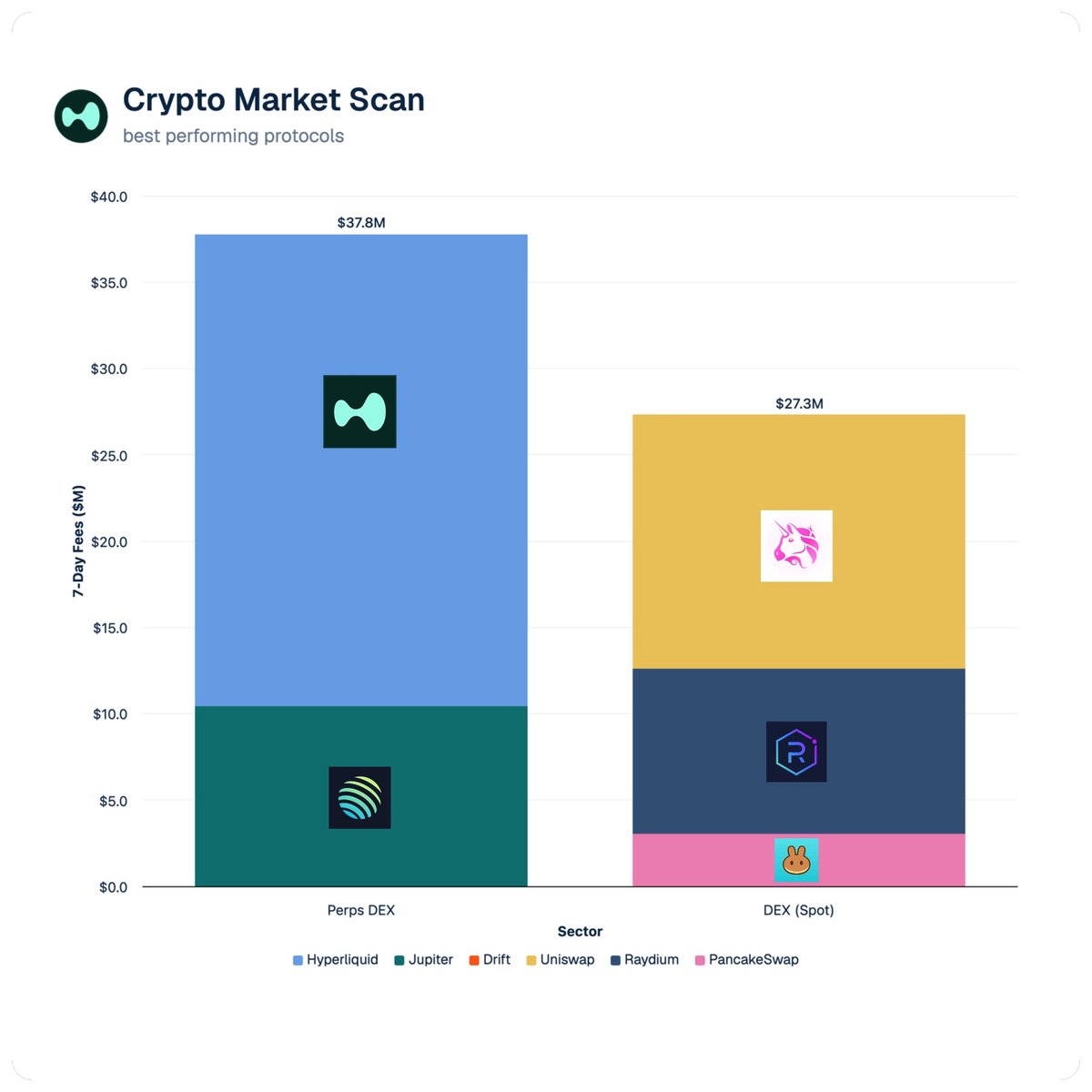
Top-performing sectors and their representative projects.
I reviewed this market snapshot by comparing fees, TVL, valuation, and price performance.
I think capital is moving toward protocols with real usage, but fees alone do not guarantee token value accrual.
[1] Perps DEX: @HyperliquidX, @JupiterExchange, @DriftFDN
This is the strongest sector in the sample, generating $30.9M in 7D fees.
$HYPE remains the clear leader with $22.4M in weekly fees and $58.3B in 7D volume.
I still think it offers the strongest combination of product quality, usage, and direct token value capture.
solana:JUPyiwrYJFskUPiHa7hkeR8VUtAeFoSYbKedZNsDvCN looks cheaper relative to its activity. It also benefits from multiple products across swaps, perps, DCA, and limit orders.
solana:DriFtupJYLTosbwoN8koMbEYSx54aFAVLddWsbksjwg7 gained 49.5% in seven days, but without reliable fee data, I see it as a momentum trade rather than a confirmed fundamental play.
[2] Spot DEX: @Uniswap, @Raydium, @pancakefi, @aeroxyz
Spot DEXs generated $23.5M in 7D fees, making this the broadest performing sector.
$UNI is the most important repricing here. Uniswap v4 turns pools into programmable products through Hooks.
The missing piece is still direct value capture for UNI holders.
solana:4k3Dyjzvzp8eMZWUXbBCjEvwSkkk59S5iCNLY3QrkX6R gained 147.1% in 30 days while producing $7.8M in weekly fees.
Its performance confirms that Solana spot and memecoin activity remains strong.
$AERO is also benefiting from renewed Base activity, while PancakeSwap continues to generate consistent fees across several chains.
[3] Lending: @aave, @Morpho, @sparkfinance
Lending produced $15.8M in weekly fees with the strongest TVL base.
$AAVE remains my preferred blue-chip lending exposure.
It combines $18.8B in TVL with proven risk management and consistent revenue.
$MORPHO is the higher-growth option. Its curated vault model is attracting professional risk managers and more structured onchain credit products.
ethereum:0xc20059e0317de91738d13af027dfc4a50781b066 is the valuation outlier. Based on this snapshot, it has a $70M market cap, $5.6B TVL, and $4.1M in weekly fees.
I find that gap interesting, but I would verify where the fees flow before treating it as undervalued.
[4] Stablecoins: @ethena
$ENA is the strongest 7D performer at +55.4%.
Ethena benefits when perp funding rates rise because that improves the economics behind USDe.
However, $4.2M in weekly protocol fees does not currently mean equivalent value for ENA holders.
[5] Yield trading: @pendle_fi
$PENDLE gained 53.7% in 30 days despite generating only $30K in weekly fees.
The market is pricing future demand for trading fixed and variable yield, not current fee generation.
I like the product, but its valuation still requires meaningful growth in on-chain yield markets.
[6] Liquid staking: @LidoFinance
Lido controls $24.5B in TVL but produces only $1.2M in weekly fees.
This shows why TVL should never be analyzed alone.
ethereum:0x5a98fcbea516cf06857215779fd812ca3bef1b32 offers exposure to Ethereum staking growth, but the connection between protocol scale and tokenholder value remains limited.
[7] Restaking: @eigencloud
$EIGEN gained 20% in seven days, but the protocol currently shows no fee revenue in this dataset.
I still see restaking as an option on future AVS demand.
Until AVSs generate sustainable revenue, the thesis remains more forward-looking than fundamental.
I am most interested in $HYPE, $UNI, solana:4k3Dyjzvzp8eMZWUXbBCjEvwSkkk59S5iCNLY3QrkX6R, $AAVE, $MORPHO, and $ENA.
They represent the clearest areas where price momentum is being supported by actual usage.
The next step is identifying which tokens can capture that economic activity, because protocol growth and token value are not always the same trade.
GBP/USD has been traded for over 100 years!
Q: Why do people still call it "Cable"?
A: Old nickname – the GBP/USD rate used to be relayed over the transatlantic telegraph cable between London and New York. The name stuck long after the tech didn't.
Q: What moves it these days?
A: Mostly Bank of England and Fed policy – rate decisions, UK and US inflation surprises, and general risk sentiment.
Q: What's new here?
A: Bybit listed GBPUSDUSDT as a TradFi Perpetual – USDT-settled, no expiration, tradable 24/7 through your existing Unified Trading Account.
Q: How do I actually use it?
A: If you expect sterling to strengthen, you go long. If you expect the dollar to win out, you go short.
Q: Am I buying actual pounds?
A: No. It's a derivative tracking the exchange rate – you never hold GBP or USD directly.
Q: What's the risk?
A: Leverage – up to 100x is listed on this contract, subject to applicable parameters. It cuts both ways, so margin and liquidation awareness come before position size, not after.
Learn more: https://t.co/IHUbwYk2xb
Register & trade: https://t.co/i483vPGKOS
#Bybit #TradFi #GBPUSD #Forex #Trading
i like this bounce, but i’m not going to FOMO right before a major macro event
BTC has recovered to $85K, and momentum is clearly improving.
but there are still too many variables over the next few days to ignore:
- On Sep 24, Trump and Xi Jinping will meet in Washington, with the trade truce, AI, and US-China relations among the main topics.
- The Fed just hiked rates by 25 bps to 3.75% -4.00%, and 16/18 policymakers still expect at least one more hike this year.
- BTC ETF flows have only just started recovering after two large outflow sessions earlier this week.
- The market has just gone through a large wave of liquidations, so leverage is still playing a meaningful role in price volatility.
i’m not bearish. on the contrary, BTC reclaiming $80K is a positive signal.
but the closer the market gets to peak excitement, the more important it is to check the risk before thinking about the reward.
🟡 Enjoy the rally, keep your positioning reasonable, limit leverage, and don’t let FOMO make decisions for you.
when the market gets a pullback, i’ll still focus on the projects I’ve mentioned many times on my X: projects with real revenue, reasonable tokenomics and allocation mechanisms, and infrastructure that institutions may have to use in the future.
DYOR.
About to disappear into Plonk for the next 6 hours
762,672 $GOLD already in circulation.
1 $GOLD ≈ 8.01 $PLONK on the 7-day trade average.
And the economy is being generated by players actually playing the game.
+ there are bosses and SOL rewards waiting further down the rabbit hole…
You can literally treat this like a side hustle.
The game comes first.
The economy follows.
https://t.co/W8HShyW3Ni
If you only look at the RWA perp chart, the obvious take is just numbers go up bc ppl wanna trade stocks, indices, metals, FX etc on crypto rails.
But not many ppl know onchain RWA trading just hit its second real phase.
First we tokenized the asset. Then crypto did what crypto does and wrapped the price into perps.
Now venues are realizing neither is enough if you actually want TradFi-sized flow to live onchain.
– $0.8B monthly volume in Oct 2025 to $147B at the July peak
– share of all onchain perp volume went from 0.06% to 12–15% now
– $4.9B of RWA perp OI
– TradeXYZ + Variational controlling almost 90%
Most of that growth is still what I’d call phase 1: take the crypto perp machine and point it at stocks, gold, oil, indices, FX and pre-IPO names.
24/7 CLOB + oracle + leverage + premium-based funding, with crypto MMs carrying inventory and hedging somewhere else.
Works insanely well for bootstrapping markets, but problem is the underlying assets aren’t BTC lol.
Stocks sleep, exchanges close on weekends, dividends exist, financing has a real cost and a $5M gold position probably shouldn’t depend on whether CT apes are overcrowded long that hour.
So how does onchain RWA perp trading evolve?
– @trade_xyz / HIP-3 proved that permissionless markets + a fast CLOB + unified margin can create new markets faster than TradFi ever will.
HIP-3 became the RWA liquidity gravity well onchain and today TradeXYZ still sits at $3.9B OI, $1.7B daily RWA volume, ~73% of tracked DEX RWA OI.
– @variational_io’s new swaps are designed to bring a TradFi-style financing relationship into an onchain wrapper.
OLP becomes the counterparty through RFQ, prices the trade, then hedges the risk through CEXs, DEXs, OTC and TradFi liquidity.
The first 5 swap markets were US100, US500, XAU, XAG and USOIL and they already did ~$3.8B volume with a $245M OI peak.
– @qfex takes the CLOB route but simply turns funding off when the underlying cash market isn’t giving it a reliable reference.
It still offers 24/7 trading, but doesn’t pretend a Saturday equity position needs to play the same crypto-style financing game all weekend. Already has $212M RWA OI across 171 markets.
– @Lighter_xyz’s main RWA book is $101M OI across 76 markets, but its Robinhood instance did ~$5B volume in August, crossed $200M OI with 21k+ accounts and >70% of that OI was RWAs.
Tells me brokerage distribution can bootstrap an RWA venue in a way a standalone DEX probably can’t.
– @OndoPerps is trying to turn the RWA itself into the balance sheet by letting tokenized stocks be posted as collateral for equity/commodity perps.
Still small at $78M OI / 45 RWA markets, so the numbers haven’t caught the thesis yet.
Phase 1 was about proving ppl want the exposure. Phase 2 is about fixing everything underneath it like liquidity, funding, collateral, market hours, hedging and distribution.
Making the whole market around it work onchain is the actual game now.
after the memecoin craze, where is capital showing signs of moving next?
i’ve stopped treating memecoin volume as noise. in a thin market, nobody funds a launchpad that prints seven figures a day.
When that starts happening again and when the new meta is pairing memes with tokenized stocks,
this is the sign of liquidity coming back with a new meta.
The last cycle taught me that memes usually wake up first. What I’m watching now is where that capital goes after it gets bored of the casino.
[1] Strong revenue projects
The first stop is always the businesses that already collect fees and buy their own token. Speculative capital likes a flywheel it can actually see.
– $HYPE: still one of crypto’s largest real fee engines, and most of that revenue goes straight into buybacks.
– $PUMP: the launchpad cooled, but the business did not. Annualized fees are still huge and a large cut keeps burning supply.
– $PONS: RH launchpad turned meme issuance into a fee machine and routes most of that back into the token.
– $STONK: the new Solana version of the same idea, pairing launches with stocks and majors, and already competing with Pons on daily revenue.
[2] Essential infra once volume picks up
Once that flow exists, it has to travel through venues. These names don’t need a fresh story cuz they just need onchain activity
– $UNI: still the default spot rail, and the fee switch finally turns volume into protocol revenue and buybacks.
– $JUP: Solana’s routing and perps layer. If Pump, Stonk and stock pairs keep printing, Jupiter sits in the middle of it.
– $RAY: the AMM that catches Solana launchpad flow on the way out. When graduation volume spikes, Raydium fees follow.
– $AERO: Base’s liquidity hub. If agent and inference tokens keep trading there, Aerodrome is the pool they have to use.
[3] AI and AI inference
I still believe AI will be the next catalyst for years since the nonstop shipping from major AI company.
– $TAO: the base asset for subnets that sell real inference and compute instead of just emitting points.
– $NEAR: the rail I want if agents need private execution, payments and cross-chain intents in one place.
– $VVV: Venice turned private inference into a real business, crossed $100M annualized revenue, and buys back the token from API spend.
– $Surplus: an orderbook for leftover inference capacity. If models keep getting cheaper, unused seats become a market.
[4] DeFi and yield farming
The quiet bid is still yield. People who are not flipping are parking stables where borrow demand is real.
– $AAVE: still the deepest lending book. When risk-on returns, leverage and stablecoin utilization show up here first.
– Morpho: vaults and curated markets where I can actually see who is borrowing and why the rate exists.
– $ENA: sUSDe is still one of the few large onchain yields that comes from funding, not from printing points.
If this is the early part of a bull, those four sleeves are where I want size before the rest of the timeline notices.
DYOR.
Tokenized stocks just crossed the point where calling this a niche RWA category is outdated.
– spot stock wrappers are now around $3B onchain ATH, ~4x YTD
– $13.14B monthly transfer volume
– 2.86M holders and 760K monthly active addresses
– 4–5x monthly turnover
Money is moving and the market is extremely concentrated.
– @Ondo: $860M
– @xStocksFi: $631M
– @bstocksfinance: $627M
those three alone are almost 73.4% of the market. Similar thing is happening at the chain layer.
BNB Chain is the #1 tokenized stock chain now with $945M / 32.7%, ahead of Ethereum at $678M / 23.5% and Solana at $509M / 17.6%.
BNB + ETH + SOL control ~73.8% of the book.
BNB won Binance distribution + bStocks launching a $600M+ book almost overnight.
Sol still feels like the retail rail through xStocks/Backpack, while ETH is where the composability and institutional liquidity stack makes more sense.
Robinhood only owns 4.6% market share but grew 400% in total value in 30d. But the chain is winning distribution with 1.1M holders.
All of this tokenized stock growth can't be mentioned without the first real PMF, which is using stocks as the quote asset for another token/meme.
On RH, $HIMS had 53.1% of its onchain float sitting inside stock-paired pools. While $MSTR was at 33%, $RBLX 31.7%, $NVDA 24.9%, $TSLA 21.5%, $GME 19.8%.
The $AI/$NVDA pool alone held ~16.2% of every tokenized Nvidia share.
This is really different from what I imagined at first when thinking about the RWA season.
We came for tokenized stocks and somehow ended up using stocks as the denominator of the casino.
Let’s see what the market finds as the next primitive.
I mapped the major asset-issuer combinations across the RWA market.
After removing the duplicated $1.46B reported under both Centrifuge and Janus Henderson, the issuers in this dataset represent roughly $19.9B in tokenized assets.
The market is much more concentrated than the number of available products suggests.
4 asset families currently account for almost everything.
[1] Treasuries, T-bills, and money market funds: ~$9.8B
This is still the largest RWA category, representing around 49% of the mapped value.
The main issuers are:
– @Hashnote_Labs: $2.98B
– @BlackRock: $2.73B
– @Ondo treasury products: $1.48B
– Janus Henderson/@centrifuge JTRSY: $786M
– @Spiko_finance: $783M
– @SuperstateInc: $775M
– @FTDA_US: $222M
– @OpenEden_X: $21M
I think the attraction is straightforward.
These products give onchain investors access to short-duration government debt, dollar yield, and institutional fund structures without leaving crypto rails.
Spiko is especially interesting because it is the only issuer in this group with meaningful euro-denominated exposure.
EUTBL alone has reached approximately $452M.
[2] Gold: ~$5B
Tokenized gold represents around 25% of the mapped market, but the category is effectively a duopoly:
– Tether XAUT: $3.07B
– Paxos PAXG: $1.90B
Both are single products deployed on Ethereum.
I find this significant because tokenized gold already has real scale, yet no third issuer has built a comparable position.
The product is simple, globally understood, and closely aligned with the macro demand for assets outside the traditional banking system.
[3] Equities and ETFs: ~$3.6B
This is the broadest category by product count, but its capital remains highly concentrated.
– @Ondo: around $2.27B in tokenized stocks and $660M in ETFs
– @BackedFi: $610M across 68 products
– @RobinhoodCrypto: $24M across 1,456 priced tokens
– @DinariGlobal, Remora, and Swarm make up the remaining long tail
Ondo is currently the clear leader in both value and product coverage.
Robinhood shows the opposite model.
It offers the largest number of assets, including equities, ETFs, commodities, and private companies, but its average priced value is only around $17K per token.
That does not make the model unimportant. It shows that distribution can develop much faster than liquidity.
Robinhood is building the product surface first. The next test is whether capital, secondary-market liquidity, and DeFi utility follow.
[4] Structured credit and multi-asset funds: ~$1.5B
This remains a small and concentrated segment.
JAAA, the Janus Henderson AAA CLO fund, accounts for approximately $669M and is the only structured-credit product with meaningful scale in this dataset.
WisdomTree adds another $809M across 15 multi-asset fund share classes.
I see this category as strategically important because it expands tokenization beyond cash-equivalent assets.
However, its current depth is still limited compared with treasuries and gold.
The strongest pattern from this map is the inverse relationship between product breadth and capital depth.
Tether, Hashnote, BlackRock, and Paxos each operate one major product, yet together they hold more than $10B.
Robinhood offers 1,456 priced tokens but holds only $24M across them.
Capital is currently rewarding a small number of simple, liquid, easily understood assets.
A large product catalogue alone does not create demand.
The second pattern is distribution across chains.
XAUT, PAXG, and USTB are concentrated on Ethereum.
BUIDL spans seven chains, while Ondo’s equity products typically operate across three or four.
I think this will become a more important competitive variable.
Single-chain deployment can concentrate liquidity, but multichain distribution gives issuers access to more wallets, exchanges, collateral markets, and settlement environments.
My main conclusion is that the RWA market is developing through 2 different models:
→ Capital concentration: a few products absorb billions because the underlying asset already has clear demand.
→ Asset distribution: issuers tokenize hundreds or thousands of products first, then work to build liquidity and utility around them.
Right now, ~74% of the mapped value is still held in treasuries and gold.
The product universe is expanding quickly, but capital remains conservative.
The next stage will not be measured only by how many assets become tokenized.
ICYMI, @Vozdexai just showed private trading live on Robinhood Chain.
I'm talking about a real $VAI buy going through their private execution engine end to end.
This is the first time I’ve seen this flow actually demonstrated on this chain.
Here's all you need to know thread 🧵
$MARSCOIN is heating up again
after a period of consolidation, the chart just broke out pretty hard and volume is clearly coming back.
another catalyst: $MARSCOIN just got listed on Binance Futures.
the SpaceX/tokenized stock narrative was already easy to get attention around, and now it’s getting more liquidity and CEX exposure too.
i’ve been watching this one for a while, and it’s getting a lot more interesting now.
Mars season might not be over yet 🚀
NFA.