Another tokenized stock product is probably the last thing @Mantle_Official needs rn.
It already has xStocks, hundreds of tickers available onchain, and the infra to trade them. Yet only ~$4M of xStocks value sits on Mantle.
So why mStocks?
Bc this time, there's a chance to build something more tightly integrated with Bybit's trading ecosystem and its 90M+ registered users.
The stocks themselves aren't the moat anymore. The ability to bring users, capital, and liquidity to those stocks might be.
Mantle already has 1,500+ tokenized assets, $500M in stablecoins, and RWA trading infra through protocols like Fluxion.
What it lacks is a large organic user base actively trading those assets onchain.
@Bybit_Official has shown it can move capital into Mantle products before. Mantle Vault reached $200M+ AUM while distributed through Bybit.
Now imagine applying a similar distribution path to tokenized equities.
The planned mStocks setup goes further than just buying and holding:
– Halo Prime issues mStocks referencing real equities
– Bybit provides the trading interface, with planned stock-to-token conversion and potential collateral use inside its Unified Trading Account
– Mantle provides onchain infra, with AMM liquidity and DeFi integrations planned
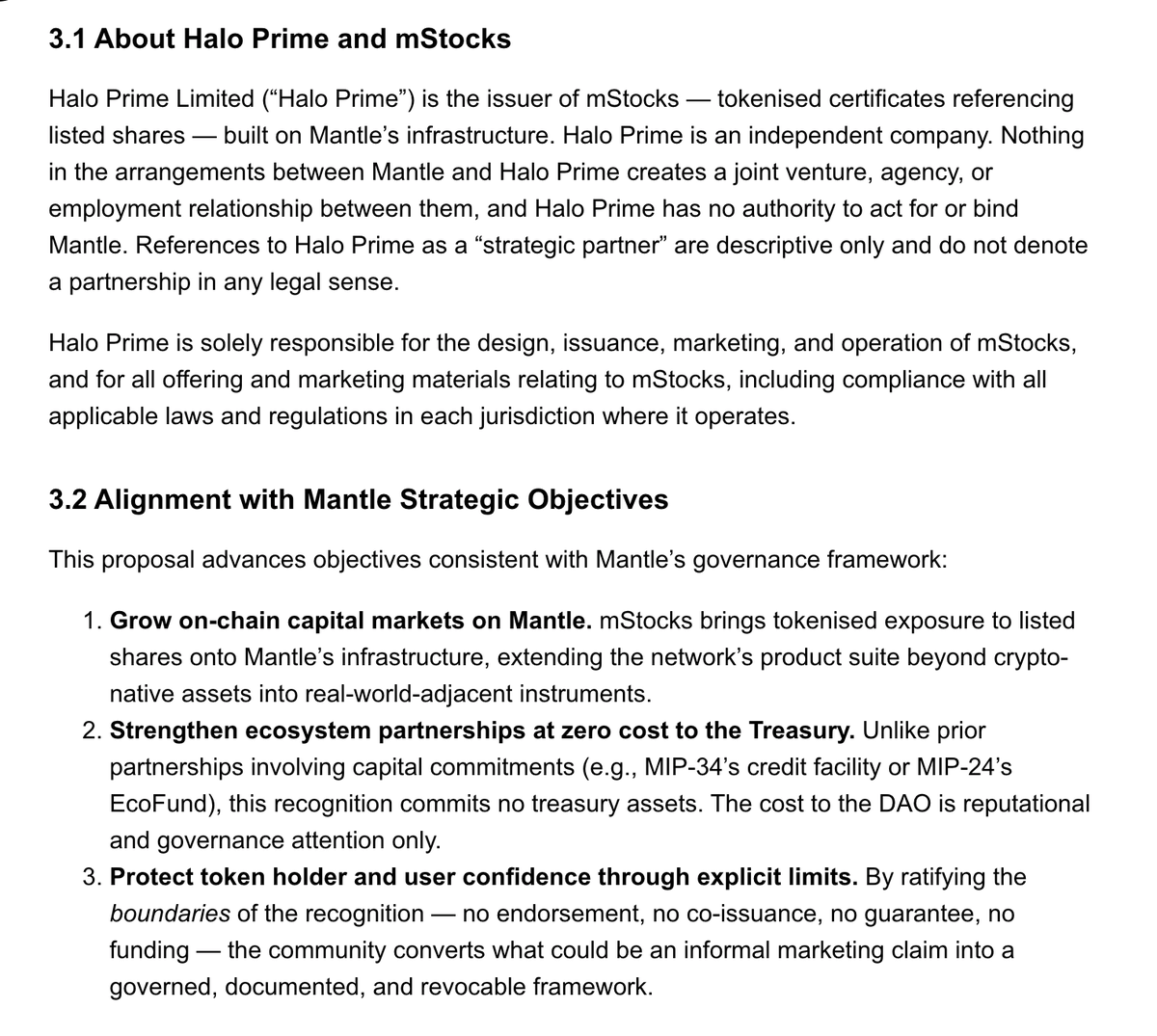
MIP-36 is the governance step to recognize Halo Prime as a strategic partner.
xStocks has already proven there's demand for tokenized equities. Mantle doesn't need to prove that again.
What it needs is a way to turn Bybit's distribution into actual onchain capital, liquidity, and repeat usage.
If mStocks can pull that off, Mantle could finally have an RWA product where the amount of capital using it matters more than the number of assets listed.
MIP-36 voting runs through Nov 26. worth reading the revised proposal and casting your vote if you're an $MNT delegate.
someone at @_gnoland clearly had fun making this teaser, and i'm here for it lmao
$20k prize pool and zero other details, my curiosity is fully activated. builders, keep an eye on this one.
Beyond the Chart #7!
$BTC is back around $61–62K, while the Nasdaq dropped 2.25% and the S&P 500 lost 2% yesterday.
Even the biggest IPO in history from Anthropic couldn't save the market.
I took another look around to see what's happening beyond the charts 👇
- The Fed is getting increasingly hawkish.
October FOMC minutes suggest nearly all members see a need for further rate hikes. Markets are now pricing in roughly a 94% chance of a 25bps hike in December.
→ Higher-for-longer keeps putting pressure on liquidity and risk assets.
- Brent crude fell to around $91/barrel, as US oil inventories rose by 3.4M barrels, well above expectations.
→ Lower oil prices could ease inflation, but if the drop reflects weaker economic demand, it's not necessarily bullish for markets.
- Spot BTC ETFs continue to see heavy outflows.
On Nov 19 alone, net outflows reached $582.3M, with BlackRock's IBIT accounting for $541.1M. Total November outflows are now around $3.47B.
→ ETF flows still show no clear reversal. Selling pressure isn't just coming from retail.
- Bitcoin miners are selling BTC to pivot toward AI.
MARA has sold 13,597 BTC (~$1.1B) since late September, using $750M to repay BTC-backed loans while continuing to expand its AI infrastructure.
→ Another source of selling pressure worth watching. Miners aren't just selling BTC to cover operating costs anymore, but also to fund a new business.
- But not all institutional capital is leaving.
Q3 filings show Mubadala and the Abu Dhabi Investment Council holding a combined ~$1.09B in BlackRock's IBIT.
→ These were holdings as of Sep 30, not fresh inflows. Still, some major funds are maintaining BTC exposure despite short-term volatility.
- Nvidia reported record Q3 revenue of $115.8B (+103% YoY), with EPS of $2.68, beating expectations.
Yet NVDA still fell 3.3% on Nov 19.
→ AI demand remains strong, but good earnings no longer guarantee a stock pump. Wall Street is paying more attention to valuations and ROI.
- Anthropic officially went public on Nasdaq under $ANT, raising a record $81.3B.
Shares were priced at $83, opened at $111.50, and closed their first session at $97.17 (+17% from the IPO price).
→ A massive fundraising success, but anyone who FOMO'd in at the open is already underwater. AI hype and entry price are two different things.
- TSMC is tightening advanced chip orders from China under new US export restrictions.
Some orders that were previously allowed now face additional reviews or delays.
→ Geopolitics is becoming an even bigger factor in the AI supply chain, beyond just market demand.
- Coinbase expanded crypto-backed lending to all 50 US states, powered by Morpho on Base.
Eligible users can borrow USDC against BTC, ETH, or SOL, with over $1.7B in outstanding loans.
→ A clear example of DeFi moving into the mainstream. But borrowing still comes with interest costs and liquidation risk.
- The World Bank is working with Citi and Circle to explore stablecoin payments.
The goal is to make international disbursements faster, cheaper, and easier to track.
→ It's still exploratory, but stablecoins are increasingly being considered as financial infrastructure, not just crypto trading tools.
- The Solana Foundation reportedly acquired a controlling stake in CoinGecko.
The plan is to expand data services and bring Solana-powered trading to CoinGecko, GeckoTerminal, and its mobile app.
→ If realized, this could become a major distribution channel for Solana. But product adoption doesn't automatically translate into value accrual for $SOL.
- Ledger confirmed more cases of tampered hardware wallets in Berlin and Dubai.
Attackers modified genuine devices to steal recovery phrases during setup. Ledger says this was a supply-chain attack, not a secure chip vulnerability.
→ Self-custody still has risks. Buying from official sources and verifying the setup process matter just as much as protecting your seed phrase.
Overall, I'm seeing a pretty clear divergence:
AI is still growing fast, and crypto infrastructure keeps expanding, but capital is becoming much more selective.
The long-term narratives may still hold, but that doesn't mean every asset is fairly valued today.
Anything else worth watching, fam?
The next evolution of DeFi LPing is already happening.
We went from passive liquidity on Uniswap v2, to concentrated liquidity on v3, and now oracle-guided liquidity with Metric.
Same goal of making capital work harder, but a completely different approach to how liquidity should be priced.
1/ @Uniswap v3 fixed one problem, but left another pretty expensive one behind.
Back in v2, LPs deposited liquidity across the entire price curve. Simple, passive, but a huge chunk of that capital sat at prices nobody was trading.
v3 addressed the idle-capital problem. LPs could concentrate liquidity inside a chosen range and offer much more depth with the same capital.
That was a huge improvement, but it also made LPing a more demanding job. Tighter ranges make capital work harder while active. They also make staying active harder.
There's also a less obvious cost called LVR (loss versus rebalancing).
When ETH moves on Binance before Uniswap catches up, arbitrageurs trade against the stale pool price. They capture the difference while LPs effectively sell ETH too cheap or buy it too expensive.
Across 62 major Uniswap v3 pools showing:
– $119.8M in trading fees earned
– $153.9M lost to realized LVR
– $35.6M net losses after costs
So earning a fat fee APR doesn't necessarily mean you're making money.
2/ @metricxyz approaches LPing from a different direction.
Its active pools use a Price Provider supplying an external reference and bid/ask quotes. Liquidity sits in percentage-based bins around that reference.
When the reference changes, the bins’ absolute prices change with it.
A bin sitting 1–2% above a $100 reference sits at $101–102. If the reference rises to $110, that same bin moves to $111.10–112.20. No tokens need to change hands for that repricing.
I think that distinction does most of the work here. The pool can acknowledge a new market price before an arbitrageur has to trade against LP inventory to get it there.
With a fresh, reliable reference, that can reduce a major source of stale-price losses while removing the manual range updates needed just to follow the market.
Now look at what this means for capital efficiency. As of Nov 18:
Metric:
– $28.1M TVL
– $284.5M daily volume
– $8.47B volume over 30d
– $31.1B cumulative volume
– ~10.1x daily volume/TVL
Uniswap v3:
– $1.30B TVL
– $866.8M daily volume
– $34B volume over 30d
– ~0.67x daily volume/TVL
→ 15x higher daily turnover per dollar of TVL for Metric. They are doing about 1/3 of Uni v3's daily volume with ~2% of its TVL.
The bigger shift here is how DeFi thinks about liquidity itself.
We started with pools that needed arbitrageurs to move prices around. then Uni v3 came along and made liquidity way more efficient, but the underlying problem never really went away.
LPs still depend on arbitrageurs to keep their pools in sync with the actual market.
Now Metric is asking a different question: Why should LPs pay arbitrageurs to discover a price that already exists somewhere else?
Especially for stablecoins, major crypto pairs and tokenized stocks where reliable reference prices are available.
Uniswap v4 hooks can already address parts of this problem through dynamic fees, oracle integration and automated liquidity management.
So I don't see Metric as some universal Uniswap replacement.
But I do think separating price discovery from liquidity provision is a meaningful direction for AMM design.
I like what @tradeparagon is building. Options-like convexity in a perp, without strikes or expiries.
A simpler way to trade a curved payoff, with liquidity concentrated into continuous orderbooks.
Power Perps track an underlying price raised to a power. Squared and cubed exposure make the difference pretty clear.
Before funding, fees and additional leverage:
– Underlying +20% → linear +20%, squared +44%, cubed +72.8%
– Underlying -20% → linear -20%, squared -36%, cubed -48.8%
Higher powers amplify directional exposure and add convexity. The downside is softer than a linear position matched for initial sensitivity, but the losses can still be much larger than spot.
HYPE² is Paragon’s initial product. HYPE³ appears in its product interface, but that alone doesn’t establish a live, liquid cubed market.
Vanilla options spread trading interest across strikes and expiries. Power Perps concentrate demand into one continuous book per underlying and power.
That reduces fragmentation, but doesn’t guarantee depth.
@DeriveXYZ accounted for ~89.6% of 30d onchain options premium volume. That points to two different forms of concentration.
Options liquidity is split across contracts, while trading activity is heavily concentrated on Derive.
Power Perps reduce the number of contracts by standardizing the exposure, which also means less room to tailor the hedge.
There’s a reason traders still want strikes and expiries.
> A fully paid call caps the buyer's loss at the upfront premium, while options let traders choose specific strikes and expiries to define their exposure.
> Power Perps simplify that choice, but introduce ongoing funding and margin risk instead.
Funding is the major omission in the simple payoff pitch.
Paragon bases funding on recent underlying variance, funding on the underlying perp and the chosen power. The contract’s premium or discount to its index then adjusts the final rate, settled hourly.
Longs usually pay shorts, although a sufficiently large discount can reverse that. Shorts carry negative convexity, and funding helps compensate for hedging costs.
Leverage adds another difference. HYPE² has roughly 2x underlying sensitivity relative to notional.
At 3x position leverage, initial sensitivity is roughly 6x committed margin, assuming the contract tracks its index.
Paragon's illustrative scenario puts liquidation around a 10.6% HYPE decline for that 3x long, excluding funding, additional collateral and other positions.
Unlike a fully paid long call, a leveraged Power Perp can be liquidated before the expected move arrives. No expiry doesn't guarantee unlimited holding time.
– $185.02M in rolling 30d volume across 34 Paragon markets.
That's deployer-wide activity, not Power Perps volume, so it doesn't establish demand for HYPE².
I’m positive on making convexity accessible inside a familiar perp interface. But removing strikes and expiries also gives up useful controls.
Funding and executable liquidity will decide that, and those are still the numbers I want to see.
everyone asks what the apr is but the better one is who's paying it.
that's the first thing i check, and it's why @Oly_Dao is on my radar. it earns from real activity on ethereum and robinhood chain:
> eth staking
> uniswap liquidity
> pools trading OLY against tokenised stocks
every trade in those pools pays a tax into a payout contract that holders can see and claim. so if no activity = no emission.
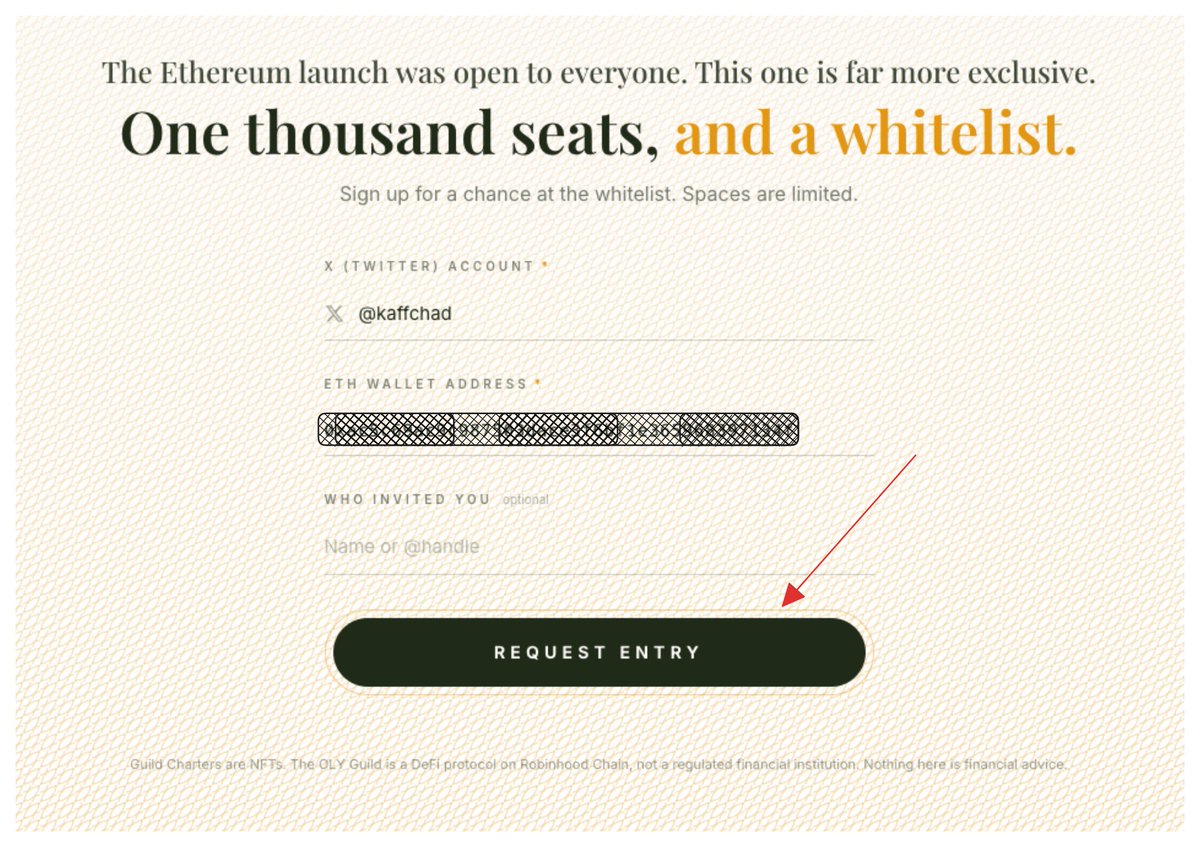
next up is the guild (changed from the bank of oly) w/ same model, new name for regulatory reasons. tbh i'd rather a team tidy that up before launch than after.
1,000 founding guild nfts, each able to open up to 10 branches. whitelist is open rn, mint details drop soon.
i just applied for it, if you are interested in, just follow @Oly_Dao and apply here: https://t.co/FlByKIy15H
how to farm $20k yield from @metricxyz
> start with ~$3k
> join via my ref: https://t.co/ItWLshQIDw
> add LP WETH/USDC (or USDT) on metric, currently ~140% apr
> lose ~$2/day to IL. basically one sad gas station coffee
> claim a one-time ~$20k from the metric airdrop
worst case there's no airdrop!
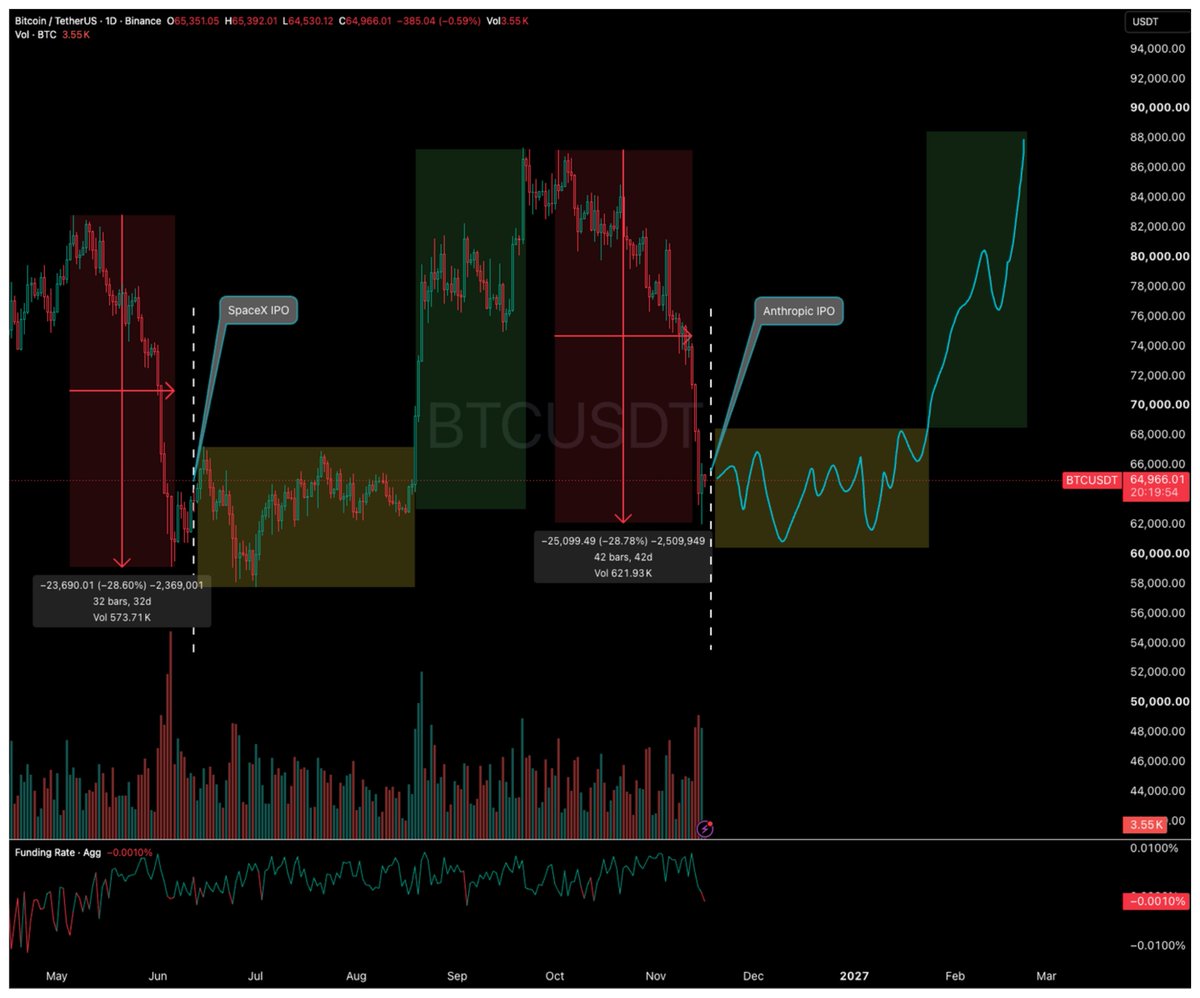
if the thesis is right and capital is leaving crypto to wait for the anthropic ipo this wednesday, btc might play out like this (based on what happened around the spacex ipo):
– chop sideways here for at least a few weeks
– then pump to 90k zone
I think once btc going sideways, altcoins with strong fundamentals and real catalysts get room to run much higher.
the ones i'm watching rn: $HYPE, $UNI, $ZK and $MEGA
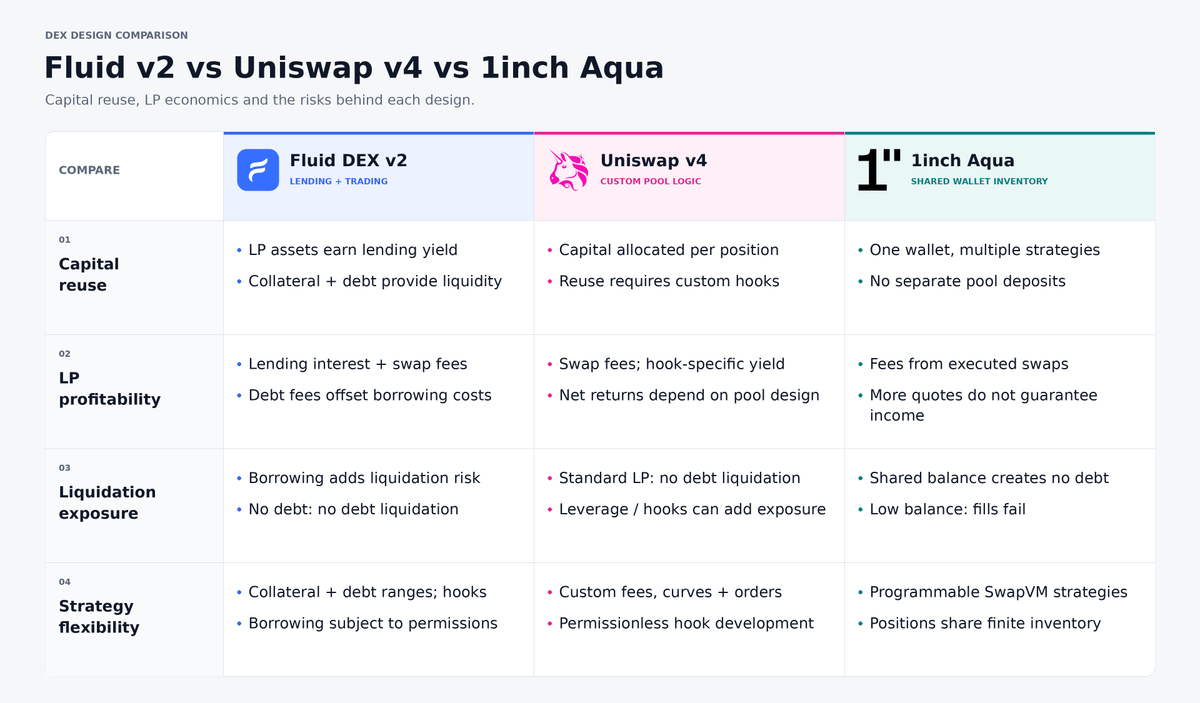
I’ve been comparing Fluid DEX v2, Uniswap v4 and 1inch Aqua.
My first impression is that capital reuse needs a more precise definition.
Earning lending yield, borrowing against an LP position and quoting several strategies against one wallet balance create very different exposures.
These differences follow the protocols’ documented designs.
[1] @0xfluid - for financed LP strategy.
Earning lending interest while providing liquidity improves the income side.
Earning fees on Smart Debt can reduce funding costs.
Cross-collateralization improves borrowing capacity, but it also connects positions through a shared liquidation constraint.
[2] @Uniswap v4, - specific hook for profitability.
Dynamic fees and lending integrations can improve a strategy.
They also introduce implementation-specific costs and dependencies.
Two v4 pools can have very different economics.
I see v4 as a flexible framework for developers.
[3] @1inch Aqua - for capital reuse without borrowing.
The same wallet inventory can support several strategies.
That gives me more opportunities to earn fees without splitting capital into separate deposits.
But those strategies still depend on one finite balance.
a fill changes the inventory available to the others.
Check fills, net fees and inventory performance before treating a high shared-liquidity ratio as an economic improvement.
My preference depends on the objective:
> #Fluid for integrated lending and financed liquidity strategies.
> #Uniswap v4 for custom pool mechanics.
> #Aqua for multiple strategies using shared wallet inventory.
DYOR