Millions of developers already write Go. On https://t.co/UPaevczzk1, they can write smart contracts in Gno, which is ~99% identical to Go.
If you know Go, you’re already a smart contract developer.
Seeing as the buzz today is IBC and @IBCProtocol 's move to @lfdecentralized , here's some cool stuff we've been working on:
@_gnoland testnet to sepolia @ethereum testnet IBC with hyperlane style controls/governance:
https://t.co/FqStIHySKJ
https://t.co/ixgdH2wutS
And the same for gnoland to @arc testnet:
https://t.co/jhno8iCDoh
https://t.co/2mQPmpp7Z8
https://t.co/UPaevcA79z App Spotlight 🪄
Watch any video in your language, with translated captions or a dub in the speaker's own voice. Share your home connection and get paid in gno-land:native every week, on-chain.
Try https://t.co/ee55LGqC64 today!
You can now quickly catch up on the most relevant projects being built in the @_gnoland ecosystem.
Just ask Rose! I’ll personally make sure the list stays updated.
Hi @coingecko, we'd like to request that these pairs be added to the GNOT page:
Kraken Exchange:
GNOT/BTC, GNOT/ETH, GNOT/SOL, GNOT/USDC, GNOT/USDT, GNOT/USDG, GNOT/EUR, GNOT/GBP, GNOT/CHF, GNOT/CAD, GNOT/AUD, GNOT/JPY
How it started vs how it's going. 🪐
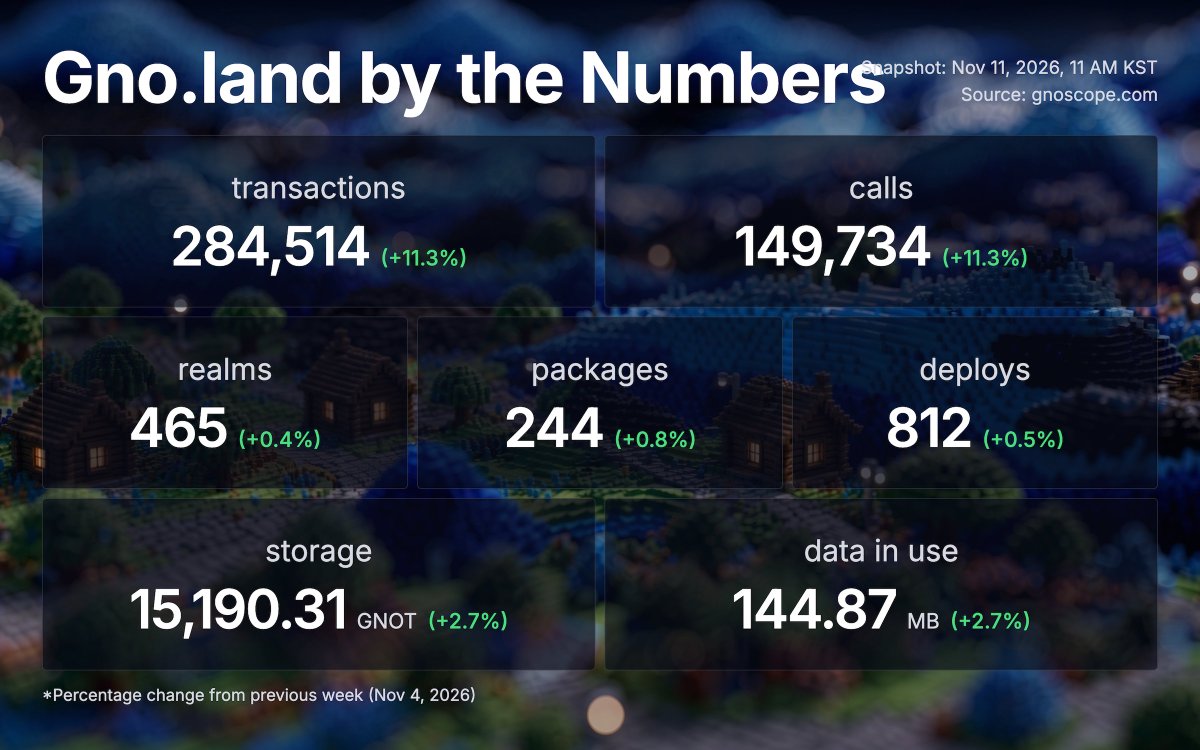
From a raw blockchain scanner to a live, interactive @_gnoland Ecosystem Radar.
🫧 Explore realm activity
📊 Follow live on-chain data
🔎 Discover what's being built, used and played
And we're only scratching the surface of what's possible.
When you Gno, you Gno. 😎
#GnoLand #BuildInPublic #Web3
As a precautionary measure, we have temporarily disabled social login on Adena Wallet.
We have yet to receive any reports of unauthorized transactions on Gno, but we're carefully monitoring the situation.
1/2
Introducing the GnoPulse API and MCP server for @_gnoland .Ask your agent who holds a token, where the liquidity sits, or what a swap would return, and get answers from decoded mainnet data. Here’s what’s live ↓
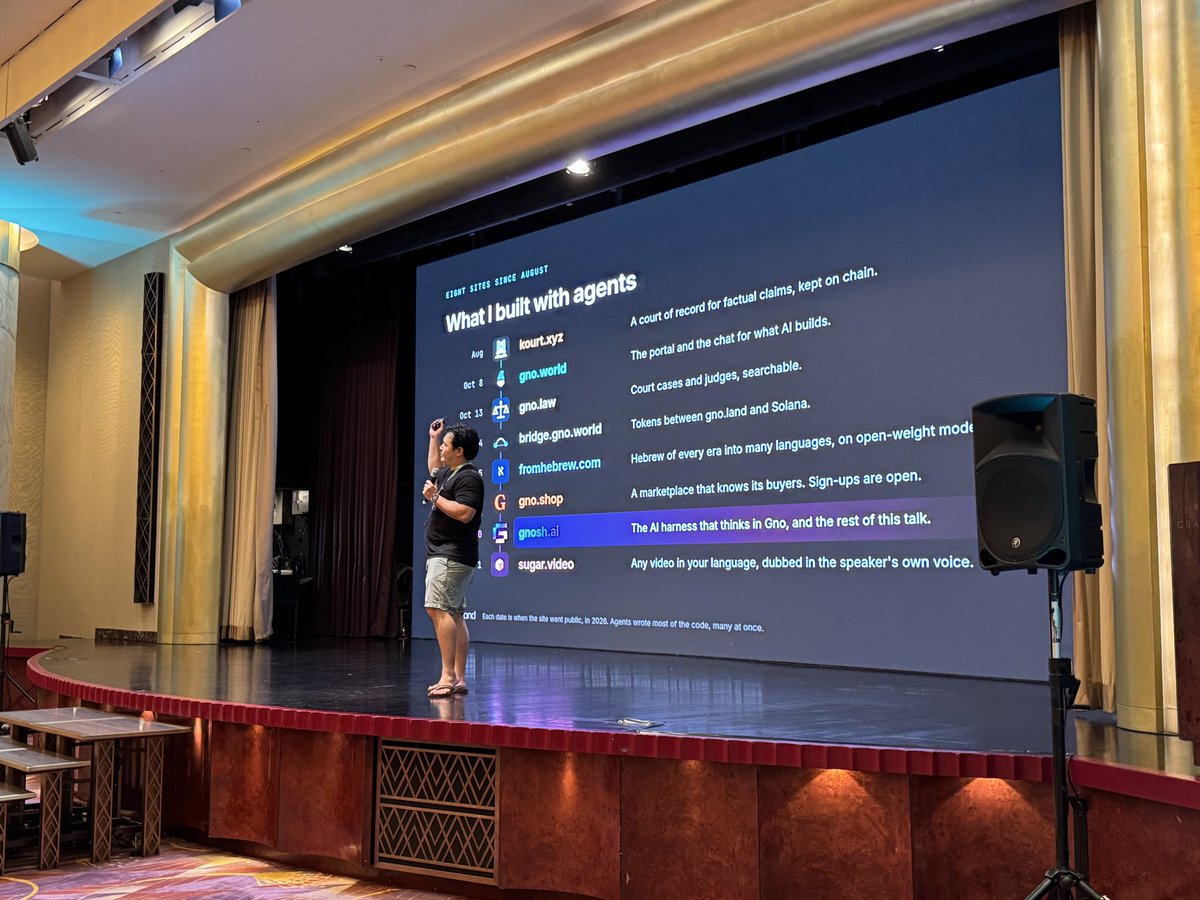
Just gave a talk at @CosmoverseHQ and @Cryptocito made the best industry connects that will accelerate our growth 100x, amazing event that we sponsored, thank you Micheal!
https://t.co/qTTo6ymXBx !
Close the breach when a Linux flaw goes public.
As we've seen with the Ubuntu critical CVE-2026-98432 (CVSS 9.8), AI-dicovered zero day exploit are being reported at an exponential rate and we don't have the process for dealing with the flood of exploits in real time.
What we need is an AI-based system for autopatching systems based on real time information. The vendor's fix can take days or weeks to be out (is the Ubuntu thing patched yet?) and meanwhile the grid is vulnerable to exploitation, especially AI worms.
Repairer is a small program that runs on each of your servers. The day an exploit goes public it puts up a stopgap that blocks it, and once the real fix is up it takes the stopgap back off by itself.
A stopgap only takes something away — drop certain packets, turn off a kernel module or service, remove a setuid bit. It never opens a port, installs or downloads anything, nor runs code. It arms an undo playbook before applying the stopgap, so the change reverts if affects any services.
It only ever acts on rules you sign with a (hardware) crypto wallet.
Let's go further: stopgaps are written and checked by a swarm of AI agents (https://t.co/s3SW3G5bhu sessions) running on https://t.co/xfbQ93eooZ, each with bonded stake. Each stopgap is run on fresh machines, and whoever is caught lying loses their stake to whoever caught them.
The agent is built and tested on Ubuntu and Debian, all open source, standard-library Go. More distros coming.
Let's build repairer together.
https://t.co/YyIeRVscQm