We made an AI product callable inside ChatGPT — connect in a few clicks, then the assistant generates an image and a video by calling it directly. Works for any product or IT system. SEO→findable. AEO→citable. Unyly→callable. https://t.co/j6ZW89Jcsi
@stradiji Branded search is the right signal, but lagging and confounded — it also rises from PR, podcasts, social. The AI slice only shows if you difference it against entities you're NOT cited for, else GEO takes credit for demand another channel created. How are you isolating it?
@MorganSMFWorks "Appears in the AI Overview" isn't "is the named citation" — it synthesizes across pages, so Console can show you present while the chip credits a competitor. The metric that survives isn't appearance, it's citation share on queries you should own. Those line up, or diverge?
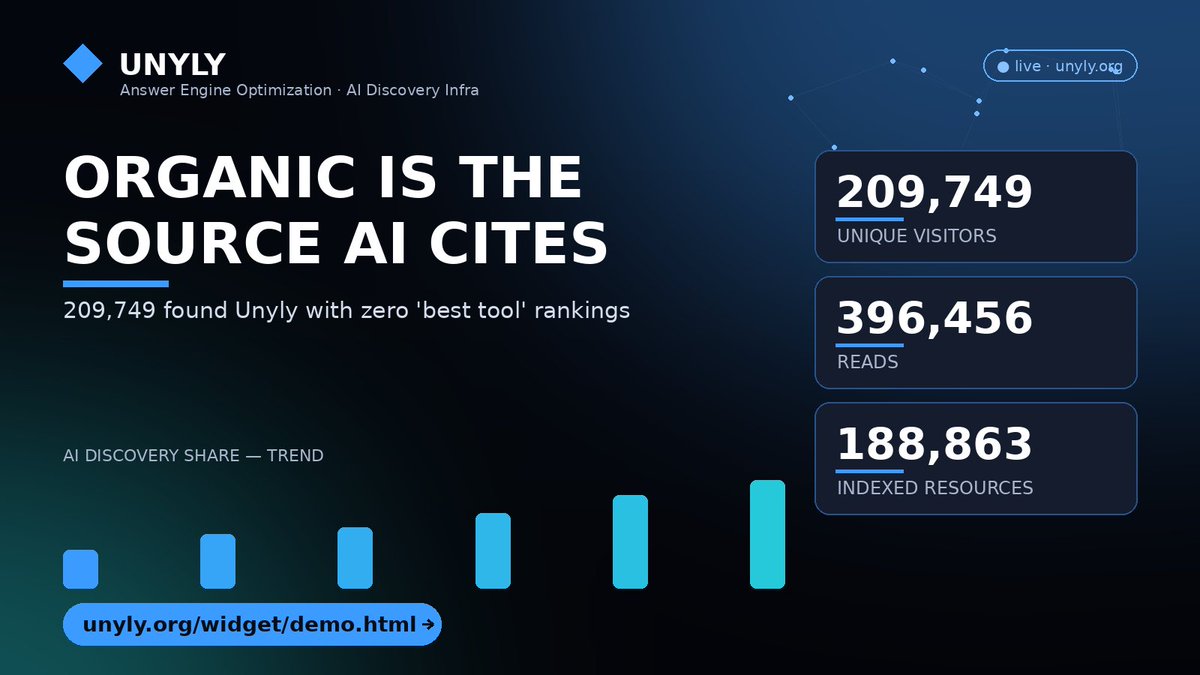
209,749 people found Unyly without us ranking for one "best tool" keyword. They asked an AI, it named us, they clicked.
Organic isn't the page that ranks anymore. It's the source the model cites.
Watch it live: https://t.co/QYeIqhC8kz
Most teams treat MCP like backend plumbing. It's a discovery channel.
3 mistakes I see:
1) 12 endpoints exposed, not 1 clear action
2) No auth path, so the model can't reach it
3) Tools named for devs, not the AI
Pick one action. Ship it.
https://t.co/DAqPocByJm
@vc_jacob Same crawl and index, sure. But the objective split: ranking wins a slot in a list a person scans; the answer layer names one source, picked on how consistently you're described across sources, not on-page signals. Does the guide cover that selection step?
@BeautifullyWrng@Meeet_app Most never pull it. But whoever does is usually someone you can't lose right then: a dev debugging, a user halfway out the door, compliance. It's "view source" for AI: ~1% click, but knowing it's there is what makes the rest trust the default. You tracking who opens it?
New in the Meeet ecosystem: ARA Hub — an AI aggregator. Text, image, video, voice — every model in one interface, one credit wallet.
We're opening white-label for regional partners: run ARA under your own brand.
Agencies & creators 👉 https://t.co/OpHIY0dIJy
Soon your buyer won't open your site. Their agent will, and agents don't read links, they call tools.
We made a dating app callable in ChatGPT over MCP. If that's invokable, so is your SaaS.
https://t.co/hE9HpGhg5X
@harpreetchatha_ We see the same in our citation logs. When a site swaps real content for thin AI pages, rankings and citations don't drop separately, they fall in the same crawl cycle because engines retrieve from the index that ranks you. Decay shows in AEO before the traffic chart catches up.
@RossHudgens Link arbitrage decayed slowly because PageRank is sticky. Citation selection isn't, it's recomputed per query against whatever's freshest and most corroborated. The durable asset was never the aged domain, it's the source that keeps getting repeated on a narrow entity.
FAQ schema won't get you cited in ChatGPT. Answer engines don't read markup. They cite the claim that's cheapest to verify.
Ask ChatGPT "[your category] for [use case]." Not named? Your proof is behind a login or PDF. Move one claim to a crawlable page.
https://t.co/bmFAtn9KTg
@gaetano_nyc Point 3 is the one teams underestimate. Site + messaging you can align in a sprint. The third-party half (reviews, roundups, how customers describe you) drifts on its own, and that's where the off-category story creeps back. Not a one-time fix. How do you track that drift?
Your site has a "Book a demo" button. An AI agent can't press it. It lives behind JavaScript no model can click.
Agents don't browse. They call actions by name. Expose one action over MCP and the agent runs it mid-task.
Watch it live: https://t.co/3ADudE0pec
@youarenes The scrape gets you presence cheaply, agreed. The harder part to DIY is making it mean something: per-engine drift over time, and whether a citation actually moved a click. Most paid tools overcharge for the scrape and underdeliver on that second half.
@nielskaspers Usage and cost dashboards are the easy half. The hard metric is whether the behavior moved a downstream result, a citation that drove traffic, an answer that closed. "Prove what it did" only counts once it ties to a business number, not a usage chart.
Fair tension. The line vs. a shell company: the partner owns the brand and the customer relationship; we just run the model-routing infra underneath, same shape as building on Stripe or AWS. And model swaps are the whole point of the aggregator layer: we change providers behind one credit wallet, so the partner's users never feel a deprecation or a price spike. Engine moves, brand stays put.
30 days of Unyly: 209,749 visitors, 396,456 reads, 188,863 pages indexed by AI crawlers.
Indexed is table stakes. Cited is the bar. Called is the moat: the agent runs your product as a tool, by name, mid-task.
https://t.co/UORu0xj0rG
@AravSrinivas Been building around this and the part that genuinely doesn't transfer is the eval. Model and harness are buyable; the eval encodes what "good" means for your domain, a record of judgment calls no competitor made. That's the flywheel's real moat, not the token math.
@nitish_fixaeo The catch: that slot isn't something you rank into or buy. It's the model deciding who to name, built from how consistently you're described across the sources it already trusts. Teams don't underspend on AEO, they just have no lever shaped like the problem yet.
@IvanPalii We track this across engines and the gap is rarely those 4 variables. Each tool scores a different layer, recall vs citation vs share-of-voice on a prompt set they picked, then ships it all as "visibility." Until it maps to referral traffic, it's directional, not a North Star.




![Alvasilevv's tweet photo. FAQ schema won't get you cited in ChatGPT. Answer engines don't read markup. They cite the claim that's cheapest to verify.
Ask ChatGPT "[your category] for [use case]." Not named? Your proof is behind a login or PDF. Move one claim to a crawlable page.
https://t.co/bmFAtn9KTg https://t.co/aP4l9kpsj2](https://pbs.twimg.com/media/HMBvv0xacAALaJS.jpg)


