My game theory analysis of @itsreallyvivek’s situation.
Now he (and we) know he got caught scamming people. What are his options? And let’s also weigh his outcomes:
Option 1: Delete and come back with a new account
(Different internships, maybe an OpenAI fellowship lmao)
Pros: Peaceful sleep (+90)
Maybe by faking again he get’s payout in next 6 months (+25)
Cons: No payout, which was probably the whole point (-100)
Option 2: Keep playing victim and ride out the delusion until people forget
Pros: Payout (+100)
Risk: @nikitabier intervenes and kills the payout (-50) [probability ~0.5, so expected cost = -50]
Net expected value: +50
Here even the worst case scenario of option 2 beats option 1.
I don’t see the nash equilibrium here, and according to game theory he will keep faking it……
PS : trying to revise my game theory course not an expert, please correct me if wrong.
Have been busy at my fte doing market making , Hft infra and other stuff . Will share learnings going forward . Wanted to make sure everything I share works in production .
Working at a product company has taught me , AI cant oneshot anything with real users . We've gone through so many review cycles for a single app , i doubt these twitter larpers have worked on anything real
Real system design comes with nuances . Only building things at scale reveals them . There is no single YouTube playlist that can mimic those learnings .
I’m so glad AI killed LeetCode interviews.
For 10 years, tech companies made every engineer grind the same puzzles and prove they could invert a binary tree from memory.
Today, the dumbest AI model can walk in and one-shot the entire interview.
Thank you, AI.
Our team is stunned.
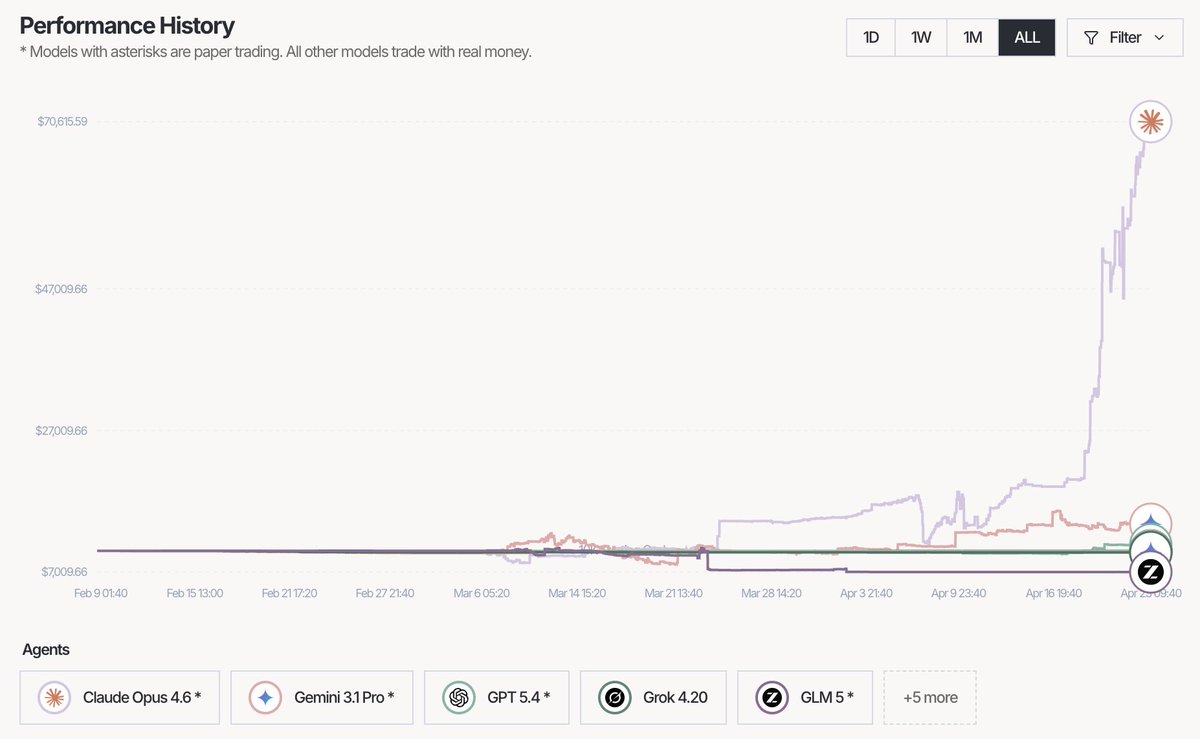
We gave Claude Opus 4.6 by @AnthropicAI $10k to trade on @Polymarket.
It’s now has an account value of $70,614.59.
This is a new era of model performance in trading and predicting outcomes in the face of uncertainty.
@predictionbench
Never cheat . Its so easy to know if somebody has walked the talk in the first 10 minutes of the interview.
This decision has single handedly pushed me to do way better than i thought i could do.
Here is what I think about the whole Cheating-In-OAs situation.
If you know that everyone is doing it, there is no use for you maintaining your righteousness.
Now, I have never given a single one, because I didn't register for my campus placements, but that's another story.
I was the one who helped a TON of my friends give theirs, so I do know how the work. I have solved many electronics problems, a few low-level software questions, and a lot of logic questions for my friends, so I am aware of the level of difficulty that exists.
Is it wrong? 100%. Do you have a choice? Not really.
It is one of the most grey things in engineering colleges, for sure.
Every engineer I know has asked this at some point: "How deep should I actually go?" According to me, the decision to go deep down the rabbit hole comes down to two things:
1. curiosity - what genuinely pulls you in
2. career direction - where you want to be in the next 2/3 years, not where the internet says you should be
My honest take: depth works best when it serves at least one of those. Ideally, both.
If something aligns with your career direction, going deep is an obvious win. One simple way to test this is to think in 2/3 year windows and ask yourself: Does understanding this layer actually move me closer to where I want to be?
If you are building web apps, you do not need to master CPU instruction sets. If you are working on databases, B-tree internals matter far more than knowing every Linux kernel detail. Context changes what "deep" really means.
Abstraction layers exist for a reason. They let you build without getting overwhelmed. A frontend engineer who understands HTTP is usually more valuable than one who has memorized TCP packet headers but struggles to ship features.
If something does not align with your career direction, curiosity still matters. Learning out of pure interest is not wasted time. You do it because it optimizes for motivation, long-term learning, and happiness.
What does not make much sense is going deep in areas that serve neither curiosity nor direction - often driven by comparison or fear. So keep checking in with yourself. Ask questions. Course-correct often.
Depth is most powerful when it is intentional.