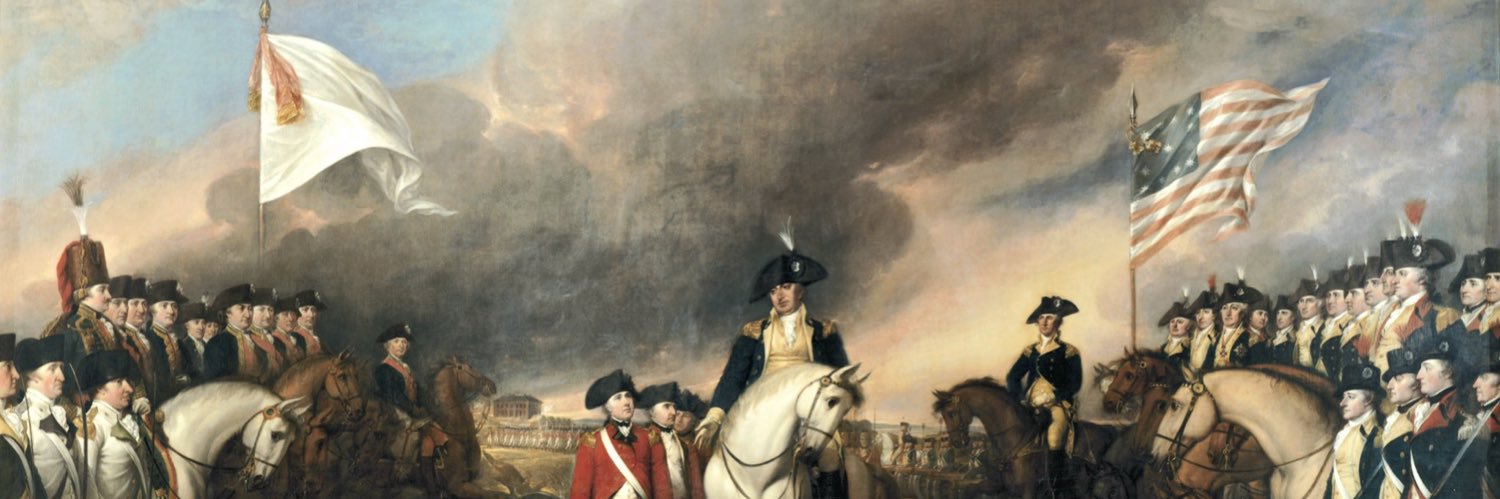
The wild horse runs across the high plain at dawn. He answers to nothing. He was made for the mountains.
The other horse stands in the pasture with his head down. The fence is low. He could clear it before breakfast. He waits for the next command. He has forgotten he was made for something more.
Let's dive in. 🧵🇺🇸 #AmRev
On April 25, 799, Pope Leo III rode out through Rome in a holy procession. Armed men waiting along the route pulled him from his horse. They were kinsmen of the pope before him, and they wanted Leo gone.
They tried to gouge out his eyes and cut out his tongue. Then they dragged him into a monastery and locked him up.
Leo escaped by night. With his enemies accusing him of adultery and perjury, he did the one thing that could save him. He crossed the Alps to Charlemagne, who was camped at Paderborn in conquered Saxony.
Charles sent him back to Rome under Frankish guard. A year later he came himself to settle the matter.
There was another problem hanging over all of it. In Constantinople, the Roman Empire was ruled by a woman named Irene. In 797 she had her own son blinded and took the throne for herself. To the men of the West, a woman could not hold the title of emperor. As they saw it, the throne of the Romans sat empty.
On December 23, 800, Leo stood in St. Peter's and swore an oath before God that he was innocent. No one could judge a pope, so he cleared himself.
Two days later was Christmas.
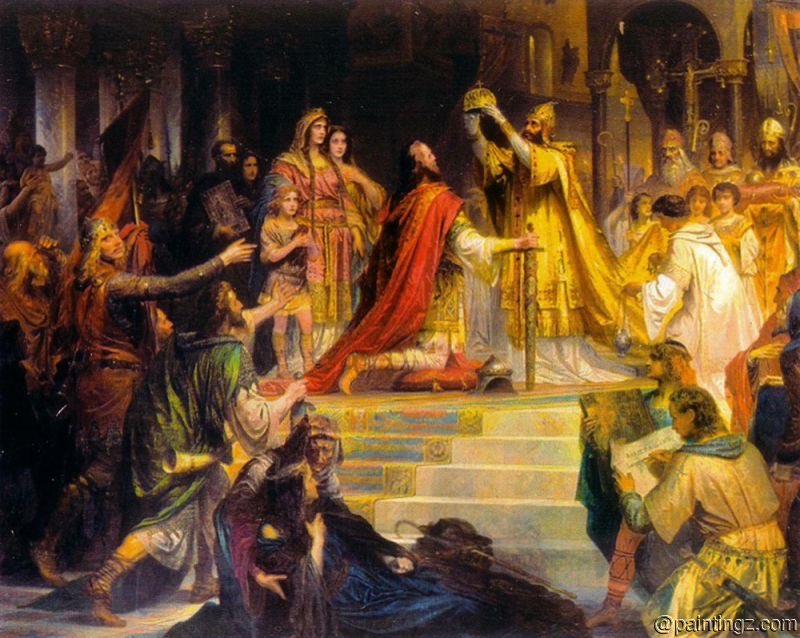
Charles came to Mass in a Roman tunic and cloak. As he rose from prayer before the tomb of Peter, Leo placed a crown on his head. The crowd shouted the acclamation three times. Life and victory to Charles, Augustus, crowned by God, great and peaceful emperor of the Romans.
Then the pope knelt before him, the honor once given to the emperors of old.
Charles's biographer Einhard wrote that he would never have entered the church that day if he had known what the pope planned. Historians still argue over that. Charles had come to Rome in person and stayed for weeks. And he kept the title until he died.
But think about who held the crown. It was the pope's hands that put it there. Every emperor after him would have to come to Rome for it. And every pope after Leo would remember who did the crowning.
Charles took his new title seriously in another way. He believed a Christian empire needed men who could read.
In 789 he had ordered that every monastery and cathedral keep a school to teach boys their letters and psalms. He gathered scholars from England, Ireland, Italy, and Spain to Aachen. His scribes copied the old Latin texts by the thousand and developed a clean, clear hand that anyone could read.
The lower case letters in this post come straight down from that script.
Charles himself learned to read but struggled all his life to write. Einhard says he kept tablets under his pillow to practice in the night.
He died at Aachen on January 28, 814, around 66 years old. The year before, he had crowned his son Louis co-emperor himself. No pope was present.
It did not hold. Louis's sons went to war with each other and with him. In 842 two of them swore an alliance at Strasbourg, one in an early form of French and the other in an early form of German, so each army could understand. It is one of the oldest records of either language.
In 843 at Verdun they split the empire three ways. The west became France. The east became Germany. The two have fought over what lay between them ever since.
Remember those schools. Charles wanted readers so the clergy could serve his church and his crown.
In 1647 in Massachusetts, a law required every town of fifty families to hire a teacher, so that every child could read the Scriptures with his own eyes. Not to serve a king. To answer to God.
Charlemagne's heirs in the East held on for nearly seventy years. Then the line ran out, Viking ships were coming up the rivers, Magyar horsemen were coming over the plains, and the German dukes had to choose a king for themselves.
They chose a Saxon. #AmRev #HolyRomanEmpire
When the last of Charlemagne's line in the East died in 911, the German dukes first chose one of their own, Conrad of Franconia. He spent seven years losing. He could not control the dukes and he could not stop the Magyars.
On his deathbed in 918, Conrad did something no one expected. He told his brother to carry the crown and the royal regalia to his greatest enemy, Henry, Duke of Saxony. Henry, he said, was the only man strong enough to hold the kingdom together.
A Saxon. From the same people Charlemagne had spent thirty years conquering and baptizing at the point of a sword.
Henry inherited a kingdom bleeding out. Magyar horsemen from the Hungarian plain rode in every few years, burned towns, took slaves, and were gone before any army could catch them. Henry was not strong enough to fight them yet. In 926 he bought a nine year truce with tribute.
Then he used every one of those years.
He built fortified towns across Saxony and ordered one man in nine from the countryside to live inside the walls and keep them ready. He trained heavy mounted warriors. When the truce ran out he refused to pay. The Magyars came in 933, and at Riade he beat them in the field.
Henry died in 936. His son Otto was about twenty four.
Otto was crowned on August 7, 936, and the place was the point. Aachen. Charlemagne's own chapel. He was anointed by the Archbishop of Mainz and set on Charlemagne's stone throne.
At the feast afterward, the great dukes served him at table as steward, chamberlain, cupbearer, and marshal. Men who ruled whole peoples, waiting on the king.
The Saxon was claiming Charlemagne's inheritance. Not every duke agreed.
Otto's first years were spent fighting his own house.
His half-brother Thankmar rose against him and was cut down at a church altar in 938. His younger brother Henry rebelled with the Dukes of Lotharingia and Franconia in 939. At Andernach on the Rhine, Otto's men caught the rebel dukes. One was killed in the fighting. The other drowned trying to escape across the river.
Henry was forgiven. He then plotted to murder Otto at Easter in 941, was caught, and finally submitted on his knees at Christmas. Otto forgave him again and later made him Duke of Bavaria.
In 953 it was Otto's own son, Liudolf, who rose against him.
This is the pattern of the Empire from its first generation. Power held by blood, and blood turning on itself. It never changes for nine hundred years.
Out of those betrayals Otto learned a hard lesson. Dukes had sons. Sons inherited land, loyalties, and grudges. Every duke was a rival king in waiting.
So Otto turned to the Church.
He gave bishops and abbots land, castles, courts, tolls, and the right to raise soldiers. He filled the highest church offices with his own family and his own chaplains. His brother Bruno became Archbishop of Cologne and Duke of Lotharingia at the same time. A churchman holding a duchy.
The logic was cold. A bishop could not pass his office to a son. When he died, the power came back to the king, who named the next man.
It made the German king the strongest ruler in Europe. It also fused the Church to the crown so tightly that within a century they would tear the Empire apart fighting over who controlled it.
Remember Charlemagne's schools, built to train clergy for the crown. Otto finished the job. In his kingdom the bishop was the king's man, holding the king's land and leading the king's soldiers.
In New England the minister was the congregation's man. They called him, they paid him, and he answered to God and to them. No crown owned the pulpit.
But in 954, with Otto's son in open revolt, the Magyars saw their chance. They rode west again, in greater force than ever. #AmRev #HolyRomanEmpire
Charlemagne did not become sole king of the Franks by plan. His brother Carloman shared the kingdom with him, and the two hated each other. In 771 Carloman died suddenly. Charles took his lands, and Carloman's widow fled with her sons to the Lombards in Italy.
Charles was in his early twenties. He would be at war almost every year for the rest of his life.
He started with the Saxons.
The Saxons lived between the Rhine and the Elbe, in what is now northern Germany. They had no king, no cities, and no intention of bowing to the Franks or their God. They raided Frankish lands, burned churches, and killed missionaries.
In 772 Charles marched into Saxony and tore down the Irminsul, a great sacred pillar the Saxons worshiped near the fortress of Eresburg. He took its treasure and stayed three days destroying it.
He thought it would be a short war. It lasted thirty two years.
Every time Charles marched home, the Saxons rose again. While he was in Italy in 774 taking the Lombard crown and shutting their king away in a monastery, the Saxons burned the frontier. While he was in Spain in 778, they did it again. That was the year his rear guard was cut to pieces in the Pyrenees at Roncesvalles, and a commander named Roland died with it. The French would sing about him for centuries.
In 782 a Saxon force under their war leader Widukind wiped out a Frankish army at the Süntel hills.
Charles came north in a fury. At Verden on the Aller river, the Saxon nobles handed over the men they said were responsible. The royal annals of his own court record that 4,500 of them were beheaded in a single day.
Some historians question that number. His own chroniclers did not. They wrote it down as justice.
Around this same time Charles issued a law for conquered Saxony. Any Saxon who hid from baptism and stayed pagan was to be put to death. Death for eating meat during Lent. Death for burning the dead in the old way. Death for killing a priest.
Baptism or the sword.
In 785 Widukind himself came in and was baptized, with Charles standing as his godfather. Still the Saxons kept rising. In the 790s Charles began emptying whole districts, marching thousands of Saxon families into Frankish lands and planting Franks on their farms. The last of the deportations came in 804, and with it the end of the war.
Not every man in Charles's court thought this was the way of Christ.
His closest adviser was Alcuin, a scholar from York who ran the palace school. He wrote that faith is a matter of the will, not of compulsion. A man can be driven to baptism, he warned, but not to belief. He said the heavy tithes being forced on the Saxons were turning them against the faith.
Charles did not change course.
Here is the twist. The Saxons did become Christians. Their land became the heart of Germany. And a century and a half later it was a Saxon, Otto, who sat on Charlemagne's throne at Aachen and took his crown. The conquered people became the emperors.
But Alcuin's question never went away. Can a king make a man believe?
For a thousand years Europe's rulers answered it with force. They picked the faith of their lands. Dissenters were burned, drowned, and driven out.
In 1683 a band of German families who had been hounded for their faith crossed the ocean and founded Germantown, Pennsylvania. They came to a colony built on the promise that no man would be forced in matters of conscience.
That promise became an American conviction. Faith offered, never forced. Alcuin would have recognized it.
Meanwhile, in Rome, a pope was about to be dragged from his horse in the street, beaten, and left for dead. And the only man he could run to was Charles. #AmRev #HolyRomanEmpire
Before there was a Holy Roman Empire, there was a deal between a family of Frankish warlords and the bishop of Rome.
Everything that came after grew out of that deal. So that is where we’ll Lstart.
The Franks were a Germanic people from the Rhine. When Rome fell in the West, they were one tribe among many fighting over the ruins.
Around the year 500 their king Clovis united them and was baptized at Reims. The bishop is said to have told him to bow his head and burn what he had worshiped. Most Germanic kings of that age were Arian Christians, who denied the full divinity of Christ. Clovis went Catholic. That choice tied the Franks to Rome for the next thousand years.
His dynasty, the Merovingians, ruled for two and a half centuries. By the end they were kings in name only. Long-haired figureheads carried to ceremonies in ox carts while the real power sat with the Mayor of the Palace.
In the early 700s that mayor was Charles Martel. Martel means the Hammer.
Islamic armies had crossed from Africa into Spain in 711 and taken nearly all of it within a decade. Then they came over the Pyrenees into Gaul. In 732, near Tours, Charles met them with a wall of Frankish infantry. The Umayyad commander was killed and his army slipped away in the night.
Historians still argue over how decisive Tours was. The Franks did not argue. Charles had held the line, and his family now ruled the kingdom in everything but the title.
His son Pepin wanted the title.
Around 750 Pepin sent envoys to Pope Zachary with a question. Was it right that the kings of the Franks held the name of king but no power?
The pope answered that it was better to call him king who held the power.
That was all Pepin needed. The last Merovingian, Childeric III, had his long hair cut off, the mark of his royal blood, and was shut away in a monastery. In 751 Pepin was raised as king and anointed with holy oil, something no Frankish king had done before.
A king made not by blood, and not by the people, but by the blessing of the Church.
The bill came due fast.
The Lombards of northern Italy were pressing on Rome. In 753 Pope Stephen II did what no pope had ever done. He crossed the Alps in winter to beg the Franks for help.
In 754, at the abbey of Saint-Denis outside Paris, Stephen anointed Pepin king a second time with his own hands. He anointed Pepin's two sons beside him. Then he forbade the Franks, on pain of excommunication, from ever choosing a king from any other family.
One of those boys was about six years old. His name was Charles. History would call him Charlemagne.
Pepin paid his debt. He marched into Italy twice, beat the Lombards, and handed the conquered land to the pope. A strip of central Italy from Rome to Ravenna.
The Papal States were born. For the next eleven hundred years the bishop of Rome would also rule as a prince over land.
Somewhere in this same era, someone forged a document called the Donation of Constantine. It claimed the first Christian emperor had handed the pope authority over Rome and the whole West. Popes leaned on it for centuries until a scholar proved it a forgery in 1440.
Look at what was built. The pope made a king. The king made the pope a prince. Each held up the other's throne. The people underneath were asked about none of it.
Charlemagne grew up inside that deal. He was anointed into it as a child. Everything he did as king and emperor flowed from it.
A thousand years later Americans put their answer in writing. Governments derive their just powers from the consent of the governed. Not from a pope's letter.
When Pepin died in 768, the boy from Saint-Denis was a grown man with a crown, an army, and a pagan people on his eastern border who would not bend. He would spend thirty years trying to break them. #AmRev #HolyRomanEmpire
The Old Crowns: What America Broke From
For two years this account has told one story. The preached Word built the free American mind, and in 1776 free men told a king no.
But you can’t fully understand what we broke from until you know what it was.
So we are going back a thousand years.
This is a new series on the Holy Roman Empire and the royal houses of Europe. Habsburg. Hohenzollern. Wittelsbach. Wettin. Hanover. These families married each other, warred with each other, and claimed their right to rule came down from God through crown and altar. For a thousand years ordinary men had no say in who ruled them.
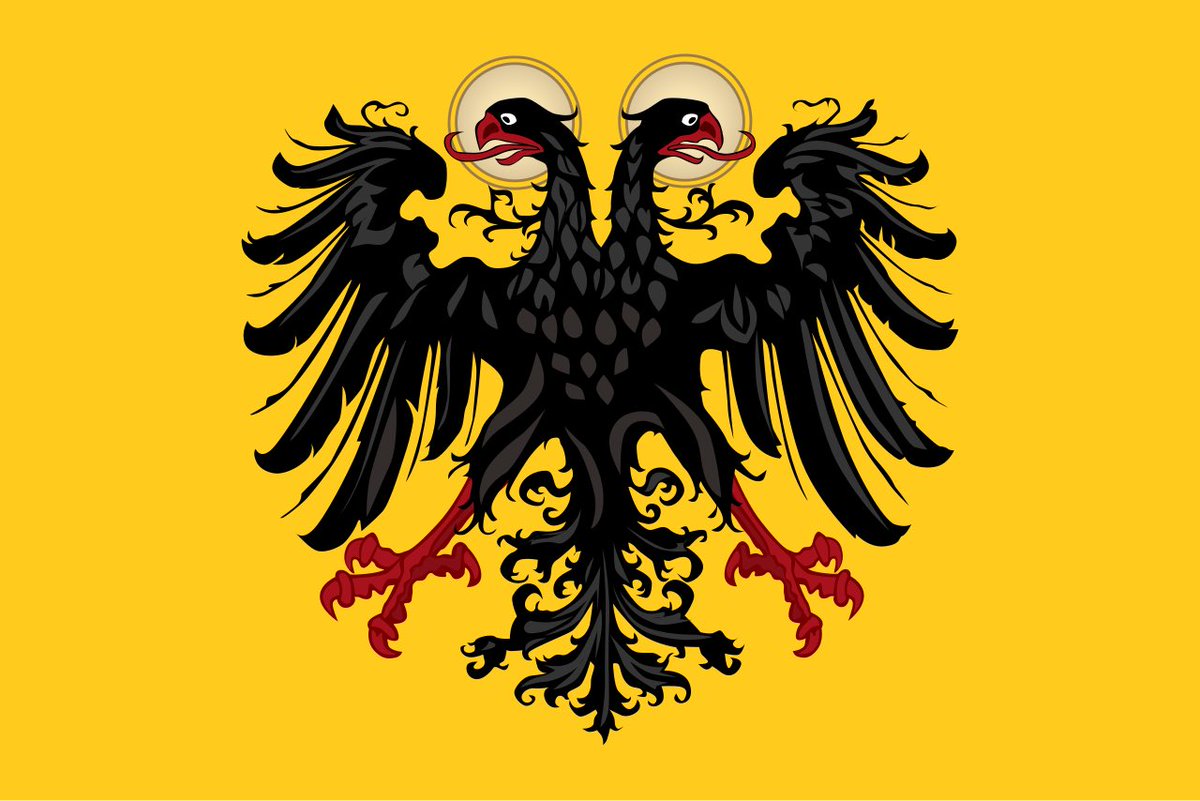
This one is personal. I carry a German name. My blood runs back to the lands that lived under the eagle on this banner. Somewhere in my line, someone left that world for this one. I want to know what they left and why.
Here is what ties it together.
George III was not only King of Great Britain. He was also Elector of Hanover, one of the princes of the Holy Roman Empire who chose its emperor. When the Crown needed soldiers to put down the colonies, it hired nearly 30,000 Germans from princes of that same Empire. We call them Hessians.
So when Americans declared independence, they were breaking from more than London. They were breaking from the whole old order of throne, bloodline, and inherited rule. Thirty years later, in 1806, the Holy Roman Empire itself was gone.
Over the coming weeks we will cover:
• The crowning of Charlemagne
• Otto the Great and the birth of the Empire
• Popes against emperors
• The Golden Bull and the seven electors
• The Reformation in German lands
• The Thirty Years' War
• The rise of the Habsburgs and the Hohenzollerns
• The Hanoverians and the British throne
• Napoleon and the end of the Empire
Here is where it starts.
WHERE IT STARTED
Rome fell in the West in 476. For more than three hundred years after that, no emperor ruled in the West.
On Christmas Day in the year 800, Charlemagne, King of the Franks, knelt in prayer at Old St. Peter's in Rome. Pope Leo III set a crown on his head, and the crowd hailed him Emperor of the Romans.
It was no accident. A year earlier Leo had been attacked in the streets of Rome and fled to Charlemagne for protection. The king restored him, and the pope crowned the king. Charlemagne's biographer later claimed he would never have entered the church that day if he had known. Believe that if you want.
That one moment planted the question that would drive the next thousand years: does the emperor get his authority from God directly, or through the pope who crowned him?
Charlemagne died in 814. His grandsons split the empire at Verdun in 843. The eastern portion, the German lands, became the core of what came next.
Those lands were soon under attack. Magyar horsemen raided deep into Germany for decades. In 955 at the Lechfeld near Augsburg, the German king Otto I broke them for good. Seven years later, on February 2, 962, Pope John XII crowned Otto emperor in Rome.
Most historians mark that as the beginning of the Holy Roman Empire.
The name came later. "Holy" was added under Frederick Barbarossa in the 1150s. "Holy Roman Empire" was in use by 1254. "Of the German Nation" by the late 1400s. Voltaire later mocked it as neither holy, nor Roman, nor an empire. He had a point, but it lasted 844 years anyway.
The double-headed eagle on this banner, haloed and crowned with glory, flew over the Empire from the 1430s until the end in 1806.
A crown placed by a pope. A throne chosen by princes. A people never asked.
Hold that picture. In 1776 a few million Americans looked at a thousand years of it and declared that God gives rights to men, not to bloodlines.
Next: Otto the Great, and how a German king became the protector of Christendom.
#AmRev #HolyRomanEmpire
Hercules Mulligan was an Irish tailor in British-occupied New York. His shop dressed the officers of the enemy. Every fitting was an intelligence operation.
He had not planned it that way. He was just the best tailor in the city.
But Mulligan was one of the first members of the Sons of Liberty. Alexander Hamilton lived with him before the war. He helped steal British cannons from the harbor. When Washington retreated from New York in 1776, most Patriots left with the army. Hamilton, now on Washington's staff, suggested Mulligan stay behind as an intelligence source.
Mulligan went back to his shop and kept fitting British officers for their uniforms.
British officers came because he was the best, and because wealthy men in uniform need good tailors. They were relaxed. They felt important. They assumed the tradesman was beneath their notice.
He listened to everything.
When he had something worth sending, he called for Cato. Cato was an enslaved man who worked in Mulligan's household as a chocolate maker. He was also the courier. When Mulligan had intelligence, Cato rode it to Washington's headquarters. He made that ride more than once, knowing what would happen if he was caught. He was not free. He chose to do it anyway.
The network that saved Washington's life ran on Cato's back.
The first warning came late at night. A British officer needed a coat urgently and let something slip during the fitting: there was a plan to capture Washington. That day. On the road. Mulligan finished the coat, sent for Cato, and Washington moved.
The second warning came through Mulligan's brother Hugh, who worked loading British supply boats. Hugh learned the British had found Washington's planned route along the Connecticut coast. Hercules sent Cato. Washington rerouted.
Two warnings. Two rides. Two times the war did not end with Washington in British hands.
When the British finally left New York in 1783, Mulligan was in a dangerous position. He had worked closely with the enemy for seven years. The Patriots coming back into the city did not know he had been working for Washington.
Washington understood the problem. His first morning back in New York, he walked to Mulligan's shop and placed an order for clothes. In public. In front of whoever was watching. Then he came back and had breakfast with him.
No explanation was needed. When George Washington has breakfast with your tailor, the question of whose side the tailor was on is answered.
Mulligan put a sign in his window: "Clothier to Genl. Washington."
Most men waste years waiting for a position worth using. Mulligan understood that the position he was already standing in was the one that mattered. A tailor's shop in occupied New York was not a limitation. It was the entire operation.
The intelligence came through him because nobody thought to look for it there.
You are standing in a position right now that has more reach than you think. Find the mission hiding in plain sight.
Rule 27 of 76 Rules of Command is live on Substack. Use the position you have. 👇🇺🇸 #AmRev
Peter Francisco was found on a Virginia dock at age five. Speaking Portuguese. No family. No name anyone knew. A planter took him in, gave him a name, and put him to work as a blacksmith’s apprentice.
By sixteen he was six and a half feet tall. He walked into a recruiting office and enlisted. The army took him.
He fought at Brandywine, Germantown, and Fort Mifflin. Took wounds in the Philadelphia Campaign and came back. At Monmouth a musket ball tore through his right thigh and never fully healed. He kept fighting. At Stony Point he was among the first men through the breach and took a deep wound to the stomach. Anthony Wayne mentioned him by name in the after-action report.
He kept showing up.
At Camden in 1780 the American line collapsed. Gates fled. Men were running. A cannon was mired in the chaos and about to be captured. Francisco got to it, fought off the men coming for it, and carried the barrel off the field.
He was twenty years old. The cannon weighed 350 pounds.
At Guilford Court House in 1781 he took a bayonet wound serious enough to put most men down. He did not go down. He was at Yorktown when Cornwallis surrendered.
After the war he fell into poverty like most veterans. He worked. He raised six children. He served as Sergeant-at-Arms of the Virginia State Senate. He applied for a pension in 1820. A fellow officer wrote a letter confirming his service.
He died in 1831. The Virginia General Assembly adjourned early so members could attend his burial.
March 15 is Peter Francisco Day in Virginia, Maryland, Massachusetts, and Rhode Island.
He came from somewhere nobody could confirm. He became something nobody could argue with.
Fight with what you were given.
Rule 26 of 76 Rules of Command is live on Substack. Fight with what you were given. 👇🇺🇸 #AmRev
William Washington was George Washington’s cousin. His father wanted him in the ministry. He chose the army instead.
He fought at Long Island, Trenton, and Princeton. Took wounds at two of them. Then moved to the cavalry and never looked back.
By 1781 he was the best cavalry commander in the Southern Army. At Cowpens, Morgan lined up his troops in three waves and hid Washington’s dragoons in the rear. When Tarleton attacked, the militia fired two volleys and fell back. Tarleton read it as a rout and pushed hard. His line broke formation.
Morgan called the whole line to turn and fire. Washington told him the moment was now. Morgan gave the order.
Washington charged.
The British line collapsed. Men threw down their weapons. Then Tarleton gathered his officers and rode directly at Washington.
Washington was out ahead of his men, as he always was. A British officer swung at him. He parried and his sword shattered at the hilt. A second officer moved in. His sergeant major blocked it. A third came from the other side.
Washington’s bugler rode into the gap and shot the officer in the shoulder.
The bugler was fourteen years old.
Tarleton swung one final time. Washington blocked it with what was left of his hilt. Tarleton broke free and fled, firing back as he rode, wounding Washington’s horse.
Washington had just survived a three-on-one saber fight with no weapon because the men around him would not leave him to face it alone.
That is what leading from the front builds. Not just men who follow you into a fight. Men who ride into your fight when you can no longer fight it yourself.
Your bugler is watching. Ride toward the fight.
Rule 25 of 76 Rules of Command is live on Substack. Ride toward the fight that everyone else is running from. 👇🇺🇸 #AmRev