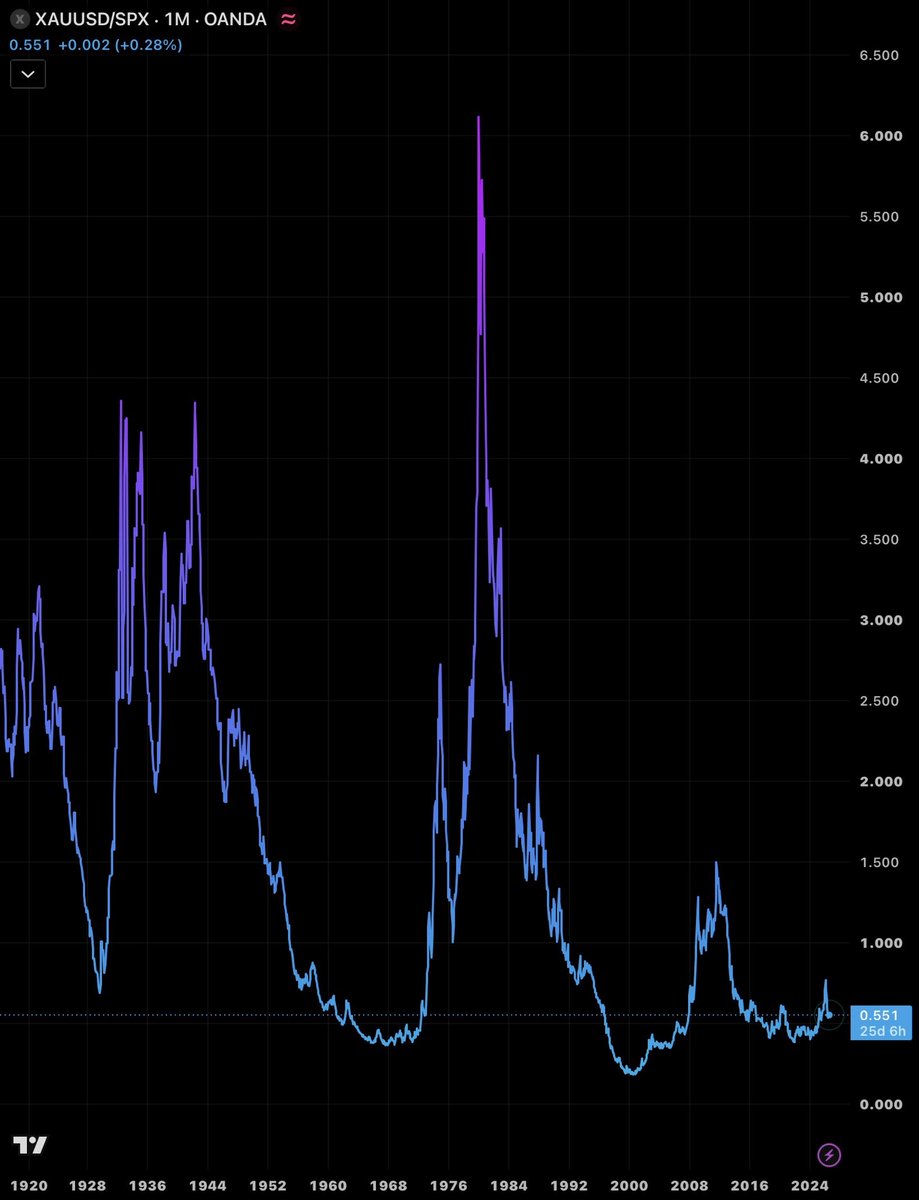
David Einhorn says the hedge fund industry is only about $2.5-3 trillion while mutual funds are more than 10x larger - and as trillions moved from active managers into passive funds, he thinks value investing got effectively wiped out: “the value investing industry... is defeated, so to speak”
this is him explaining why cheap stocks can now stay cheap for years. the investors who used to buy them got redeemed, research teams disappeared, and index flows kept pushing more money toward the biggest and most expensive companies instead
Einhorn says Greenlight had to adapt by going from paying 10–11x earnings for undervalued companies to looking for stocks at 4–5x earnings with 15–20% cash-flow yields and aggressive buybacks - because he can no longer assume another active manager will eventually show up and rerate the stock
full interview below
Today’s market is sending a very unusual message: inflation pressure is rising, but the financial system is not panicking yet.
Oil is higher.
Treasury yields are higher.
The dollar is higher.
Gold and silver are higher.
Yet stocks are basically flat.
Normally, rising oil + rising yields + a stronger dollar should start putting meaningful pressure on risk assets.
But there is one very important detail:
Oil volatility is not rising anywhere near as aggressively as the oil price itself.
That changes the interpretation.
For now, the market is not treating the rise in crude as a disorderly supply shock yet.
It is simply accepting a higher oil price and a higher inflation/risk premium.
So the current sequence looks more like:
Oil and commodities rise → inflation expectations firm → yields stay elevated → dollar remains supported → hard assets continue attracting capital → equities absorb the pressure without breaking.
This is closer to a real-asset/reflation phase than a true systemic stress event.
And the fact that gold and silver are rising despite higher yields and a stronger dollar is particularly important.
It shows that demand for real assets is becoming strong enough to overcome some of their traditional macro headwinds.
But we have to watch the next stage very carefully.
There is a massive difference between:
Oil ↑ while oil volatility stays contained
and
Oil ↑ + oil volatility explodes higher.
The first is a commodity bull move.
The second means the market is beginning to price uncertainty over supply, future prices and inflation itself.
That is when oil can start transmitting volatility into:
Yields → dollar → equities → carry trades → broader financial conditions.
So right now I would not call this a disorder.
I would call it:
Rising real-asset inflation pressure while financial volatility remains contained.
The real warning signal will be when:
Oil ↑
OVX ↑ sharply
Yields ↑
Dollar ↑
VIX ↑
If those start moving together, the character of the market changes completely.
Then oil is no longer simply rising.
Oil becomes the source of systemic stress.
For now, the pressure is building beneath the surface, but the system is still absorbing it.
Dear readers from all over the world - thank you!
This year marks 10th anniversary of “How China Escaped the Poverty Trap.” It couldn’t have scaled walls and traveled without your support & sharing
The book is now FREE to download (link below)
https://t.co/OX87veC0RW
Case in point: Bab-el-Mandeb Strait. Shipping traffic before current fallout was averaging just 21 ships per day—a massive plunge from the pre-war (US-Houthi) baseline of 75 ships per day. Expect elevated geopolitical premiums to persist. #EnergyMarkets#Commodities#Oil#US
⛽️ Gas Station Prices Aren't Coming Down Anytime Soon.
A combination of geopolitical shocks, shifting trade routes, and maxed-out refinery utilization rates are creating a perfect storm for refined products. Here is a breakdown of the current structural bottlenecks: 🧵👇
Two important facts to keep in mind on China’s mercantilism/trade imbalance
1. Mercantilism delivered (contra the consensus) the highest & longest rate of per capita *consumption* growth (7.6% b/w 1978-2024) of any country in post-war history (@ProSyn piece attached)
1/
The widening divergence between copper and silver is warning about something far more dangerous than a normal slowdown.
Copper remains elevated because essential industrial inputs are still constrained and expensive.
Silver, meanwhile, is collapsing under liquidity stress, weakening risk appetite and slowing economic activity.
In a healthy reflation, industrial metals should broadly strengthen together. That is not what we are seeing.
The market is instead signalling:
Economic activity is weakening, but the cost of essential inputs is not falling with it.
That destroys margins from both sides. Companies face weaker demand while energy, metals and other critical inputs remain expensive. Consumers lose purchasing power, corporate profits come under pressure, and central banks cannot easily respond because inflation remains embedded in the supply side.
This is not a conventional recession where collapsing demand quickly kills inflation.
It is a stagflationary squeeze, weakening growth combined with persistent scarcity.
copper will eventually break lower towards as the slowdown spreads.
Until then, this divergence is telling us the system is becoming more fragile, not healthier.