We are looking for excellent people to help build our vertically integrated AI stack. Numerics, quantization, HW simulators, compiler, runtime, kernel performance, RTL, verification, emulation, DFT, physical design, post Si bringup. Join us at Tesla!
At the start of the year, the market was pricing in 2 Fed rate cuts.
Today: just one cut, and not until the December meeting.
Video: https://t.co/pOPRl50mmA
We should be open to revisiting whole beacon/execution client separation thing.
Running two daemons and getting them to talk to each other is far more difficult than running one daemon.
Our goal is to make the self-sovereign way of using ethereum have good UX. In many cases that means running your own node. The current approach to running your own node adds needless complexity.
Short-term, maybe we want some more standardized basic wrapper that lets you install dockers of any client and make them talk to each other easily? Also good that @ethnimbus unified node https://t.co/BWpU939wIM exists. Longer term, we should be open to revisiting the whole architecture once @leanethereum lean consensus is more mature.
Now, the quantum resistance roadmap.
Today, four things in Ethereum are quantum-vulnerable:
* consensus-layer BLS signatures
* data availability (KZG commitments+proofs)
* EOA signatures (ECDSA)
* Application-layer ZK proofs (KZG or groth16)
We can tackle these step by step:
## Consensus-layer signatures
Lean consensus includes fully replacing BLS signatures with hash-based signatures (some variant of Winternitz), and using STARKs to do aggregation.
Before lean finality, we stand a good chance of getting the Lean available chain. This also involves hash-based signatures, but there are much fewer signatures (eg. 256-1024 per slot), so we do not need STARKs for aggregation.
One important thing upstream of this is choosing the hash function. This may be "Ethereum's last hash function", so it's important to choose wisely. Conventional hashes are too slow, and the most aggressive forms of Poseidon have taken hits on their security analysis recently. Likely options are:
* Poseidon2 plus extra rounds, potentially non-arithmetic layers (eg. Monolith) mixed in
* Poseidon1 (the older version of Poseidon, not vulnerable to any of the recent attacks on Poseidon2, but 2x slower)
* BLAKE3 or similar (take the most efficient conventional hash we know)
## Data availability
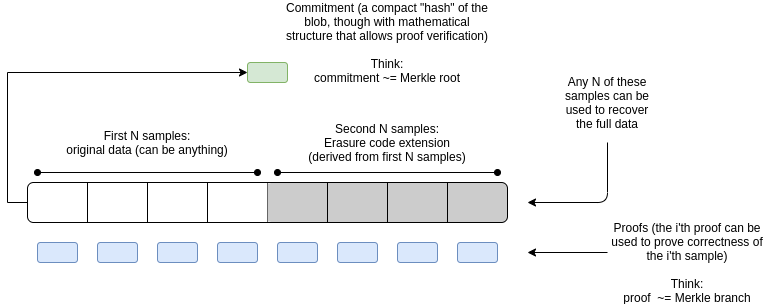
Today, we rely pretty heavily on KZG for erasure coding. We could move to STARKs, but this has two problems:
1. If we want to do 2D DAS, then our current setup for this relies on the "linearity" property of KZG commitments; with STARKs we don't have that. However, our current thinking is that it should be sufficient given our scale targets to just max out 1D DAS (ie. PeerDAS). Ethereum is taking a more conservative posture, it's not trying to be a high-scale data layer for the world.
2. We need proofs that erasure coded blobs are correctly constructed. KZG does this "for free". STARKs can substitute, but a STARK is ... bigger than a blob. So you need recursive starks (though there's also alternative techniques, that have their own tradeoffs). This is okay, but the logistics of this get harder if you want to support distributed blob selection.
Summary: it's manageable, but there's a lot of engineering work to do.
## EOA signatures
Here, the answer is clear: we add native AA (see https://t.co/YD9nIpsxcC ), so that we get first-class accounts that can use any signature algorithm.
However, to make this work, we also need quantum-resistant signature algorithms to actually be viable. ECDSA signature verification costs 3000 gas. Quantum-resistant signatures are ... much much larger and heavier to verify.
We know of quantum-resistant hash-based signatures that are in the ~200k gas range to verify.
We also know of lattice-based quantum-resistant signatures. Today, these are extremely inefficient to verify. However, there is work on vectorized math precompiles, that let you perform operations (+, *, %, dot product, also NTT / butterfly permutations) that are at the core of lattice math, and also STARKs. This could greatly reduce the gas cost of lattice-based signatures to a similar range, and potentially go even lower.
The long-term fix is protocol-layer recursive signature and proof aggregation, which could reduce these gas overheads to near-zero.
## Proofs
Today, a ZK-SNARK costs ~300-500k gas. A quantum-resistant STARK is more like 10m gas. The latter is unacceptable for privacy protocols, L2s, and other users of proofs.
The solution again is protocol-layer recursive signature and proof aggregation. So let's talk about what this is.
In EIP-8141, transactions have the ability to include a "validation frame", during which signature verifications and similar operations are supposed to happen. Validation frames cannot access the outside world, they can only look at their calldata and return a value, and nothing else can look at their calldata. This is designed so that it's possible to replace any validation frame (and its calldata) with a STARK that verifies it (potentially a single STARK for all the validation frames in a block).
This way, a block could "contain" a thousand validation frames, each of which contains either a 3 kB signature or even a 256 kB proof, but that 3-256 MB (and the computation needed to verify it) would never come onchain. Instead, it would all get replaced by a proof verifying that the computation is correct.
Potentially, this proving does not even need to be done by the block builder. Instead, I envision that it happens at mempool layer: every 500ms, each node could pass along the new valid transactions that it has seen, along with a proof verifying that they are all valid (including having validation frames that match their stated effects). The overhead is static: only one proof per 500ms. Here's a post where I talk about this:
https://t.co/rAUSJjW7WL
https://t.co/EtXpkaDll5
It will significantly increase my opinion of @Anthropic if they do not back down, and honorably eat the consequences.
(For those who are not aware, so far they have been maintaining the two red lines of "no fully autonomous weapons" and "no mass surveillance of Americans". Actually a very conservative and limited posture, it's not even anti-military.
IMO fully autonomous weapons and mass privacy violation are two things we all want less of, so in my ideal world anyone working on those things gets access to the same open-weights LLMs as everyone else, and exactly nothing on top of that. Of course we won't get anywhere close to that world, but if we get even 10% closer to that world that's good, and if we get 10% further that's bad)
CC @DarioAmodei
https://t.co/RSzHnXqWFL
24 dedicated people.
$30M spent on development.
Extreme specialization, speed, and power efficiency.
Today we launch Taalas’ first product. Check it out:
Details: https://t.co/88CA0XAL71
Demo chatbot: https://t.co/ec4ladcKnw
API: https://t.co/M3EkaxEqPj
There’s no such thing as an “educated nationalist” if nationalism means unquestioning loyalty to the state or its leaders.
Education is meant to cultivate independent thinking, skepticism toward power, and commitment to constitutional values. It encourages debate, dissent, and evidence-based reasoning. Nationalism in its rigid form, however, demands alignment, obedience, and emotional loyalty.
When loyalty overrides critical thought, education becomes decorative rather than meaningful. The real test of education is not how loudly one defends authority, but how confidently one questions it.
Introducing EVMbench—a new benchmark that measures how well AI agents can detect, exploit, and patch high-severity smart contract vulnerabilities. https://t.co/op5zufgAGH
I built the first AI that earns its existence, self-improves, and replicates without a human
wrote about the technology that finally gives AI write access to the world, The Automaton, and the new web for exponential sovereign AIs
WEB 4.0: The birth of superintelligent life
Environmentalists made a number of predictions about resource depletion in the 1970s.
None have materialized.
Instead, technological innovation, guided by the price mechanism, has made resources more abundant—even as the world economy has grown.
https://t.co/oE12MxTB98
In 2026, Claude Code could finally unleash the golden age of local and decentralized apps.
The reason is that Claude Code allows you to quickly clone any moderately complex cloud-based app into a decent local one that runs on only your files.
This is an important update to Obsidian founder Kepano’s concept of “file over app.” His argument was that files are portable (and hence more reliable) but apps are not.
The new information is that apps are suddenly portable too. That is: apps of moderate complexity without strong global network effects are suddenly easy to clone. The clone won’t be perfect right away, but it’ll be pretty good. And if the cloning dev sticks with it it’ll get better.
So: can we get a local open source Mac app for everything, operating only on your files? Maybe we can make that a reality.
Welcome to 2026! Milady is back.
Ethereum did a lot in 2025: gas limits increased, blob count increased, node software quality improved, zkEVMs blasted through their performance milestones, and with zkEVMs and PeerDAS ethereum made its largest step toward being a fundamentally new and more powerful kind of blockchain (more on this later)
But we have a challenge: Ethereum needs to do more to meet its own stated goals. Not the quest of "winning the next meta" regardless of whether it's tokenized dollars or political memecoins, not arbitrarily convincing people to help us fill up blockspace to make ETH ultrasound again, but the mission:
To build the world computer that serves as a central infrastructure piece of a more free and open internet.
We're building decentralized applications. Applications that run without fraud, censorship or third-party interference. Applications that pass the walkaway test: they keep running even if the original developers disappear. Applications where if you're a user, you don't even notice if Cloudflare goes down - or even if all of Cloudflare gets hacked by North Korea. Applications whose stability transcends the rise and fall of companies, ideologies and political parties. And applications that protect your privacy. All this - for finance, and also for identity, governance and whatever other civilizational infrastructure people want to build.
These properties sound radical, but we must remember that a generation ago any wallet, kitchen appliance, book or car would fulfill every single one of them. Today, all of the above are by default becoming subscription services, consigning you to permanent dependence on some centralized overlord.
Ethereum is the rebellion against this.
To achieve this, it needs to be (i) usable, and usable at scale, and (ii) actually decentralized. This needs to happen at both (a) the blockchain layer, including the software we use to run and talk to the blockchain, and (b) the application layer. All of these pieces must be improved - they are already being improved, but they must be improved more.
Fortunately, we have powerful tools on our side - but we need to apply them, and we will.
Wishing everyone an exciting 2026.
Milady.
I think for a lot of people corporations ending the ability to own your own PC is going to be the last straw before they radicalize. And PC here is a generic term. You can apply it to desktop computers, laptops, phones, game consoles. All. The corporations want to end ownership.
To many people, PCs became the last big item they could afford to buy. Houses are a joke. Cars have become a joke. PCs were the last thing you could buy and own and be yours. And they are taking that, too. And what is next? Your clothing?
I think, to many, this will be the last straw. A great many people will reject this and radicalize, and I suspect radicalize towards hardcore socialism and communism.
The goal is not to onboard people to Ethereum. The goal is to onboard people to openness and self-sovereignty.
We fail if we don't onboard people. But we also fail if we achieve mass adoption of walled gardens with no self-sovereignty left.
This is the wei.
(In particular, note that this means the whole "let's not ask people to download browser extensions or other custom software" direction should be viewed as an onboarding strategy ONLY. The ultimate goal is, yes, we want people to download browser extensions and other custom software, because otherwise, how else are people going to actually verify the chain?)
PeerDAS in Fusaka is significant because it literally is sharding.
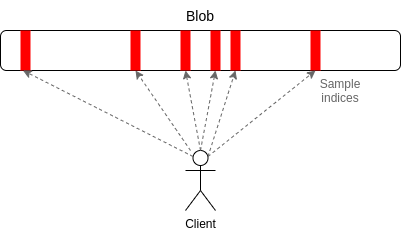
Ethereum is coming to consensus on blocks without requiring any single node to see more than a tiny fraction of the data. And this is robust to 51% attacks - it's client-side probabilistic verification, not validator voting.
Sharding has been a dream for Ethereum since 2015 , and data availability sampling since 2017 ( https://t.co/Fa0jKFgObW ), and now we have it.
That said, there are three ways that the sharding in Fusaka is incomplete:
* We can process O(c^2) transactions (where c is the per-node compute) on L2s, but not on the ethereum L1. If we want to scaling to benefit the ethereum L1 as well, beyond what we can get by constant-factor upgrades like BAL and ePBS, we need mature ZK-EVMs.
* The proposer/builder bottleneck. Today, the builder needs to have the whole data and build the whole block. It would be amazing to have distributed block building.
* We don't have a sharded mempool. We still need that.
But even still, this is a fundamental step forward in blockchain design. The next two years will give us time to refine the PeerDAS mechanism, carefully increase its scale while we continue to ensure its stability, use it to scale L2s, and then when ZK-EVMs are mature, turn it inwards to scale ethereum L1 gas as well.
Big congrats to the Ethereum researchers and core devs who worked hard for years to make this happen.