🇪🇷 For 70 years, Asmara Technical School has equipped Eritrean youth with skills, discipline, and purpose - proof that human development comes first in Eritrea. Our appreciation to the school, its educators, and graduates. Investing in youth is investing in our future. #Eritrea
(By Prof. @AbdiwahabSheik7) ― Ethiopia is facing a three-layered crisis that could tear the country apart.
Number one, 𝐢𝐧𝐭𝐞𝐫𝐧𝐚𝐥 𝐩𝐨𝐰𝐞𝐫 𝐬𝐭𝐫𝐮𝐠𝐠𝐥𝐞, seven armed rebel groups are determined to remove prime minister Dr Abiy Ahmed Ali from power.
Number two, 𝐢𝐧𝐭𝐞𝐫-𝐫𝐞𝐠𝐢𝐨𝐧𝐚𝐥 𝐜𝐨𝐧𝐟𝐥𝐢𝐜𝐭, 𝐃𝐞𝐞𝐩𝐢𝐧𝐠 𝐭𝐞𝐧𝐬𝐢𝐨𝐧 𝐚𝐧𝐝 𝐭𝐞𝐫𝐫𝐢𝐭𝐨𝐫𝐢𝐚𝐥 𝐝𝐢𝐬𝐩𝐮𝐭𝐞𝐬 between Ethiopia's regional states including Oromia and Somali regions are threatening national stability.
Number three, Ethiopia's unnecessary 𝐭𝐞𝐧𝐬𝐢𝐨𝐧 𝐰𝐢𝐭𝐡 𝐭𝐡𝐞𝐢𝐫 𝐧𝐞𝐢𝐠𝐡𝐛𝐨𝐮𝐫𝐬 such as #Sudan, #Egypt, #Eritrea and #Somalia and her ambitions with red sea are adding fuel to an already explosive situation.
But the most dangerous problem is deeper, Ethiopians are increasingly 𝐥𝐨𝐲𝐚𝐥 𝐭𝐨 𝐭𝐡𝐞𝐢𝐫 𝐞𝐭𝐡𝐧𝐢𝐜 𝐢𝐝𝐞𝐧𝐭𝐢𝐭𝐢𝐞𝐬 than to Ethiopian state itself except few elites in Addis Ababa.
Here is the uncomfortable truth: a country cannot survive indefinitely when ethnic allegiance is stronger than national identity.
If #Ethiopia continues down this path, Ethiopia will go into #Yugoslavia way, it just matter of time.
This guy is my favourite clown on X. I beg you, please go to the UN Security Council and present a claim for #Assab based on these arguments. It might finally put you out of your misery. I am even willing to contribute towards your flight to New York.
In #Ethiopia, you have a saying: ኣጥብቆ ጠያቂ፡ የናቱ ሞት ይረዳል! And in the very document you are presenting as your magic evidence, you are telling the world that there was no country called Ethiopia in 1883.
The document refers to Menelik as the King of Shoa! Not Ethiopia, not even #Abyssinia! Do you know why? Because there was no unified country called Ethiopia at the time. There was not even a centralised state governing the Abyssinian feudal territories. Instead, there were regional rulers such as Menelik (King of Shewa), Yohannes (King of Tigray) and Tekle Haymanot (King of Gojjam), each ruling their respective territories, collecting taxes in the form of food and livestock, and fighting among themselves for the coveted title of King of Kings (ንጉሰ ነገስት).
In fact, in 1883, Emperor Yohannes IV was the King of Kings and outranked Menelik, commanding greater territories and military forces. He famously appealed to Queen Victoria of #England to supply him with ammunition to subdue his opponents in Shewa, Gojjam, Wollo, Begemder and elsewhere. This is something subsequent Abyssinian/Ethiopian rulers have continued to do, and Abiy is doing the same today. He is attempting to subdue and rule over #Tigray, #Amhara, #Somalia, #Afar and other regions using #UAE funding and weapons. Some things never change!
In fact, Menelik conspired with the #Egyptians and #Italians to weaken Yohannes and undermine his imperial authority, with the ultimate aim of becoming the undisputed King of Kings of Abyssinia following Yohannes's death in 1889.
Menelik was also seeking ammunition to conquer Oromia, Tigray, Somali territories and the southern hinterlands. At the same time, he was eager to sign treaty after treaty with #Italy, recognising Italian control over #Eritrea and its entire coastline, including #Assab.
Menelik was conquering territories during the same period as the European Scramble for #Africa. He was also entering eagerly into treaties that helped shape the political boundaries of what would become #Eritrea, #Djibouti, #Somalia, #Kenya, #Sudan and the present-day landlocked #Ethiopia.
So, ASRAT BLOG, keep digging! You will uncover skeleton after skeleton, and I suspect many of them are ones you would rather keep buried.
For those who have been arguing including some members of the international community, political analysts and certain delusional #Ethiopians—that the @AbiyAhmedAli administration is seeking nothing more than commercial access to the sea for economic development, the answer is now clear;
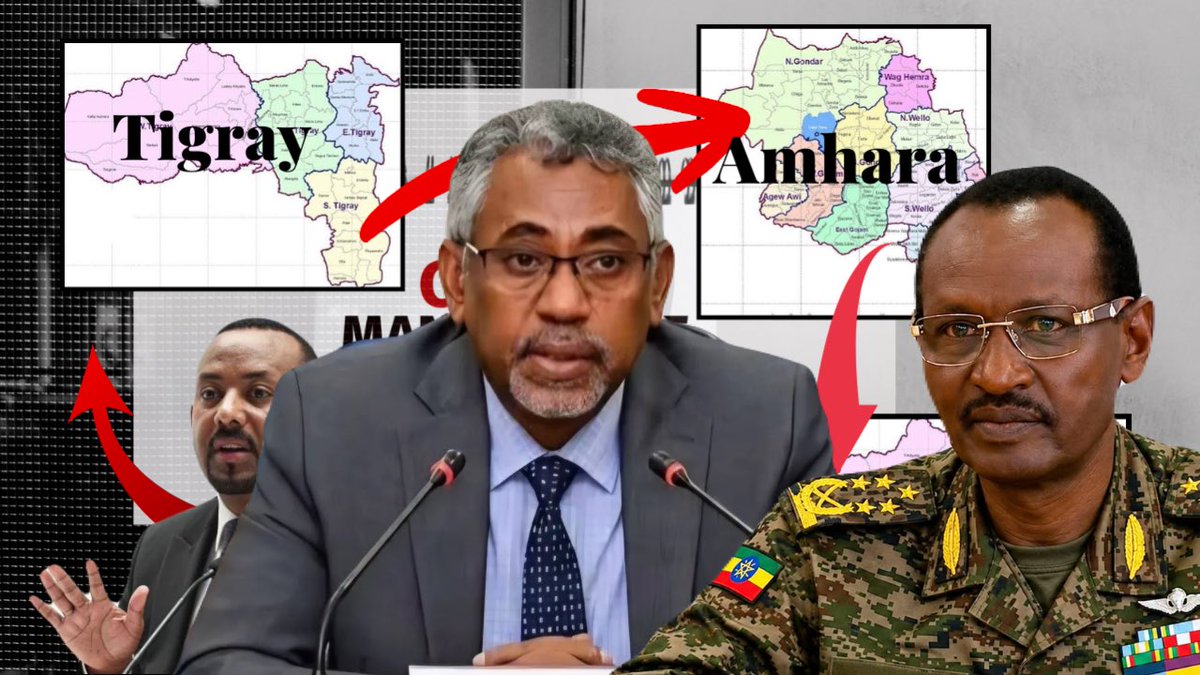
The head of landlocked maritime force Admiral Kindu Gezu’s own remarks expose boldly and unequivocally, a much broader ambition: #Ethiopia wants to become a coastal state, with the sovereign #Eritrean Port of Assab at the centre of its territorial ambitions. Thank you for making the position clear for the international community, Admiral. Your remarks have exposed the fundamental difference between seeking commercial access to a seaport and pursuing another country’s sovereign territory to become a coastal state.
But let there be absolutely no misunderstanding: #Eritrea is not a country whose sovereignty can be challenged through #threats, #intimidation or military aggression. Invading a sovereign nation is not as easy as making declarations or expressing territorial ambitions.
Assab is #Eritrean. Its sovereignty is not negotiable, its borders are not up for grabs, and its territory is not available for seizure.
Any attempt to acquire #Eritrean territory by force would constitute a violation of the #UN Charter and a grave threat to regional peace and security. #Eritrea’s sovereignty and territorial integrity are non-negotiable.
@hagereysala@Maetot2014@MFAEthiopia@StateDept@BBCAfrica@_AfricanUnion@UN@UN_Spokesperson@UNSC_Reports@BashirHashiysf@umutcagrisariii@US_SrAdvisorAF@hadnetkeleta@AmbStesfamariam@EliasAmare@EmbassyEritrea@gdrarr@Yehdavid
Abiy is a novice and incompetent politician who cannot seem to stick to what he said yesterday, let alone stand by what he says today. Worse still, he is hell-bent on dragging Ethiopia down with him to the bottom of the pit.
In October 2023, when he first unveiled his delusional rhetoric about #Ethiopia's supposed “sovereign right” to a seacoast, Abiy cautioned political elites and parties against talking about retaking #Assab. He warned that such discussions would make reconciliation with #Eritrea impossible and could lead to a potentially disastrous war.
Fast-forward to 2026, and the same man has unleashed rhetoric on an industrial scale about retaking Assab, while openly preparing the ground for war and an invasion of Eritrea.
This episode perfectly captures Abiy's political incompetence, inconsistency and instability.
@BBCAfrica@mehdirhasan@zeteo_news@cgtnafrica@Reuters@ReutersAfrica@AJEnglish@CrisisGroup@AfricaProg@_AfricanUnion@antonioguterres@USEmbassyAddis@ChinaEmbEritrea@mfa_russia
A Quiet Victory: Eritrea’s Elimination of Trachoma
ERITREA ― A disease that can lead to irreversible blindness has been eliminated as a public health problem in Eritrea.
WHO has officially validated the achievement.
Eritrea is now the 34th country in the world and the 11th in Africa to reach this milestone, following more than two decades of sustained efforts to combat trachoma through treatment, prevention, hygiene, and improved sanitation.
Behind this achievement are health workers, communities, and years of determination to protect people from a preventable disease.
Progress is not always measured in headlines or grand gestures. Sometimes, it is measured in people who will never lose their sight to a disease that can be prevented.
Today, #Eritrea has every reason to celebrate. 👏
https://t.co/DCVufUUXEl
“For thousands of years,” Abiy Ahmed says of Ethiopia and the Red Sea. Of the past 469 years, Ethiopia held a coast for 39.
We checked the claim against old atlases and the historical record.
The Ottomans took the port of Massawa in 1557 and kept a garrison there for three centuries. A French atlas of 1707 by Guillaume De L’Isle marks it “aux Turcs”.
Egypt took the port in 1865. Italy landed in 1885 and declared the colony of Eritrea in 1890. France signed for Obock in 1862 and created French Somaliland, now Djibouti, in 1896.
Ethiopia had a coastline from 1952, when it was federated with Eritrea, until 1991, and has been landlocked since.
Abiy, speaking on 15 July 2026, called sea access “a question of national existence”.
Verdict on “thousands of years”: false.
#Ethiopia #RedSea #Eritrea #AbiyAhmed #FactCheck
Our Sea, Our Sovereignty: Eritrea Will Not Be Redrawn
by David Yeh
*"... Let us be clear from the first line. Eritrea did not win its legitimate right of decolonization and independence - first denied to it in the 1940's on the altar of overriding external interests - to become again a footnote in someone else’s geopolitical paper. We did not bury our sons, daughters, mothers, fathers, sisters, and brothers, endure thirty years of war, and vote almost unanimously in 1993 to free ourselves, only to be told thirty years later that our coastline is a regional commons; our sovereignty an obstacle; and our stability, a problem to be managed by others".
*"...Eritrea has not exported war. Eritrea has not collapsed. Eritrea has not invited a new foreign base every season to do its fighting for it. Our coastline from Ras Qesar to Ras Dumera, more than 1,000 kilometers of Red Sea shore, has remained secure, sovereign, and open to legitimate commerce. That is not an accident. That is the result of a disciplined state, a disciplined people, and a national policy that refuses to rent our sovereignty to the highest bidder".
*"...Ask any honest observer: where in the Horn do you find free education from primary school to university, free healthcare, no institutionalized ethnic polarization tearing the country apart, no clan warlords, no religious civil war? That is Eritrea. We are grappling with economic challenges because we were destroyed by war and then sanctioned, not because we are ungovernable or resourceless. We are proud because we built schools, hospitals, dams, and roads with our own hands while others built their capitals with foreign loans. To call us 'repressive' is to insult a people who chose discipline over chaos, and unity over ethnic fragmentation that has consumed some of our neighbors".
*"...Real cooperation in the Red Sea cannot be built on threats, on memorandums signed over our heads, where the coastal owner is treated as an obstacle. Real cooperation begins with a simple principle: the Red Sea belongs to the Red Sea states. Its security must be led by its littoral peoples. Its economic benefits must serve its littoral peoples first".
*"...Eritrea is ready for that cooperation. We have always been ready. We will build roads, power lines, and trade corridors with Ethiopia, with Sudan, with Djibouti, with Somalia, with Yemen, with Saudi Arabia. We will sit at any table where we are respected as equals. But we will not sit at a table where our existence is debated as a problem, where our ports are discussed as if they are up for redistribution, and where our sovereignty is treated as a relic of the past".
https://t.co/gP6EAotJ5P
What would it take to turn Eritrea’s mineral resources and human potential into lasting prosperity?
Ruth Negash joins me to discuss her experience at EIT and Bisha Mine, skills development, and self-reliance.
Watch: https://t.co/6R99MubjYj
#Eritrea
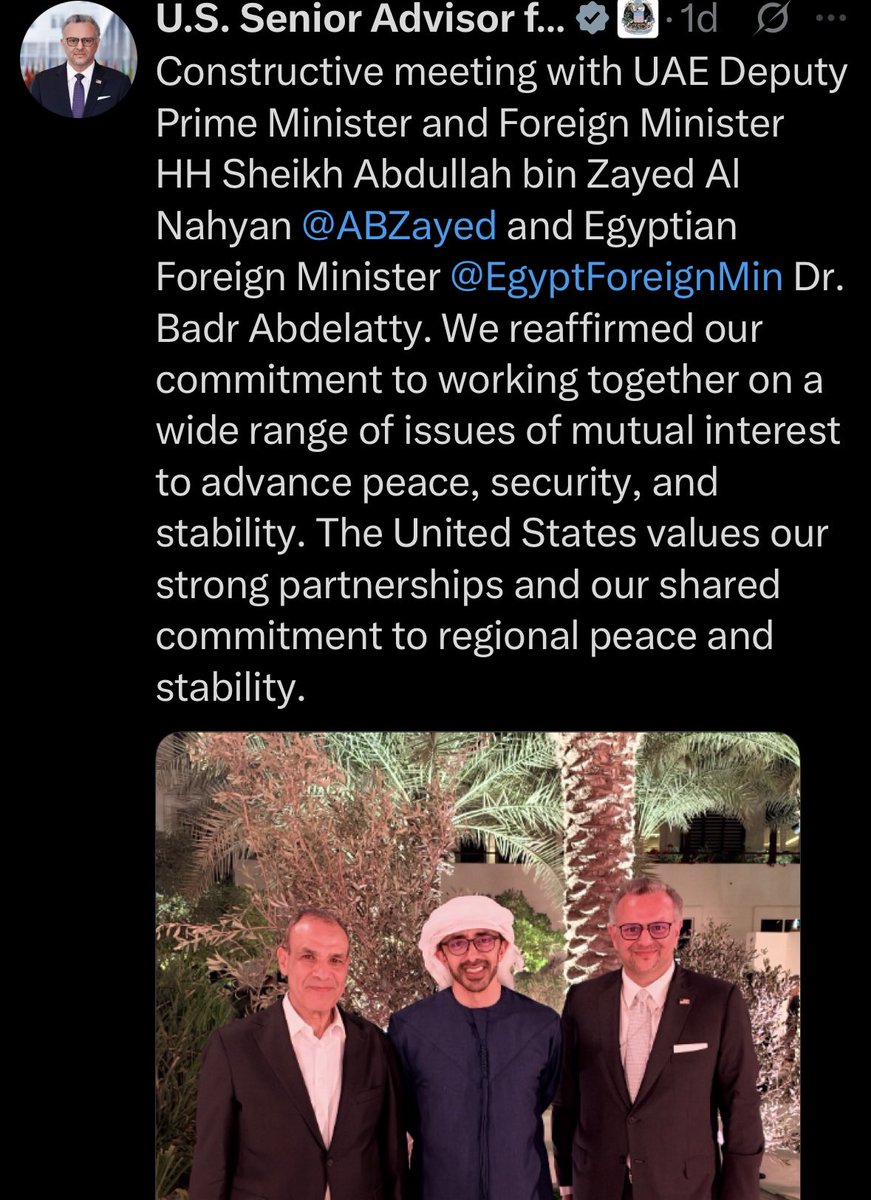
For Addis Ababa, this photo is a diplomatic eviction notice.
The UAE is in Egypt, not Addis Ababa. By coordinating with Egypt and the U.S. on “water security” (Nile) and Red Sea stability, Abu Dhabi is harmonizing with Cairo & Countries in the region. Ethiopia’s patron is negotiating matters central to its very survival, while Addis Ababa remains sidelined.
Washington’s "Red Sea First" consensus is locking in. Following Army Chief Jula’s territorial claims and the Senate's push to halt arms sales, the U.S. is openly aligning with regional powers to box in Abiy's expansionism.
The Alamein bloc now has trilateral backing. Abiy's divide-and-rule diplomacy has backfired. He pushed the UAE into a U.S.–Egyptian & Alamein framework designed to contain him.
He is isolated, with no major broker left to rescue his Red Sea ambitions.
#Ethiopia #UAE #Egypt #US #Alamein #RedSea
ERITREA: ANCIENT AND NEW
A Thursday Reflection
#Eritrea is mourning the passing of His Grace Abune Lucas, Administrator of the Office of the Patriarch, Member of the Holy Synod of the Eritrean Orthodox Tewahdo Church and Archbishop of the Southern Region, Adi-Keih. His passing is a moment of sorrow for the faithful and the wider Eritrean community.
It also draws attention to the enduring place of the Church, its spiritual institutions and their custodians in our country's history. Debre #Libanos, where he was laid to rest, is not simply a burial place. Like Debre Bizen, Debre Sima and other ancient monasteries across Eritrea, it forms part of a much older inheritance of faith, learning, memory and cultural continuity.
There is something profoundly revealing about standing before an ancient monastery in #Eritrea. Perched on a mountain, overlooking valleys and landscapes that have witnessed centuries of human history, these institutions seem almost indifferent to the passage of time. Their stone walls, manuscripts, traditions and accumulated memories speak of generations long gone, yet remain very much present.
I was fortunate enough to visit Debre Libanos some years ago. I remember the mummies discovered there and the arrangements governing access to the main building, where women were not permitted. I was content to remain with the women in the smaller church midway up the ascent, taking in the beautiful scenery and reflecting on the history surrounding us. It is an experience that has stayed with me.
Debre #Bizen, traditionally dated to the fourteenth century, became an important centre of monastic scholarship and manuscript preservation. Debre Libanos, associated with the early Christian monastic tradition of Semenawi Bahri, is linked to an older religious heritage.
Debre #Sima and other ecclesiastical institutions form part of a landscape in which religious, cultural and intellectual life developed over many centuries. Their significance lies not only in their age, but in their endurance. Through changing political authorities, successive administrations, wars and invasions, they have preserved an inheritance that cannot be confined to the chronology of any modern state.
#Eritrea's historical depth is also reflected in its archaeological landscapes, ancient settlements, languages, diverse communities, maritime connections and cultural traditions. Archaeological discoveries at Sembel, in the greater #Asmara area, reveal settled communities dating back to the first millennium BCE.
Further evidence from Adulis, the ancient Red Sea port city where recent excavations have uncovered even earlier traces of human activity, illustrates how these lands were connected to wider African, Arabian and Mediterranean worlds through centuries of trade and cultural exchange. Eritrea's history is not the story of one civilization, religion, community or period. It is a tapestry woven from diverse peoples, cultures, beliefs and experiences.
And then there is #Asmara, Eritrea's beautiful capital, where history, culture and architecture come together in a city unlike any other. Anyone who has walked its streets cannot fail to be struck by its magnificent architecture: elegant façades, imposing public buildings, broad avenues, cinemas, theatres, churches, mosques and carefully planned urban spaces. Different periods, influences and styles have come together to create an extraordinary architectural landscape.
In 2017, UNESCO inscribed Asmara on the World Heritage List as Asmara: A Modernist African City, recognizing its exceptional modernist architecture and urban planning, particularly from the Italian colonial period of the 1930s and 1940s. UNESCO's recognition did not create Asmara's heritage; it acknowledged an exceptional legacy that had endured long before its inscription.
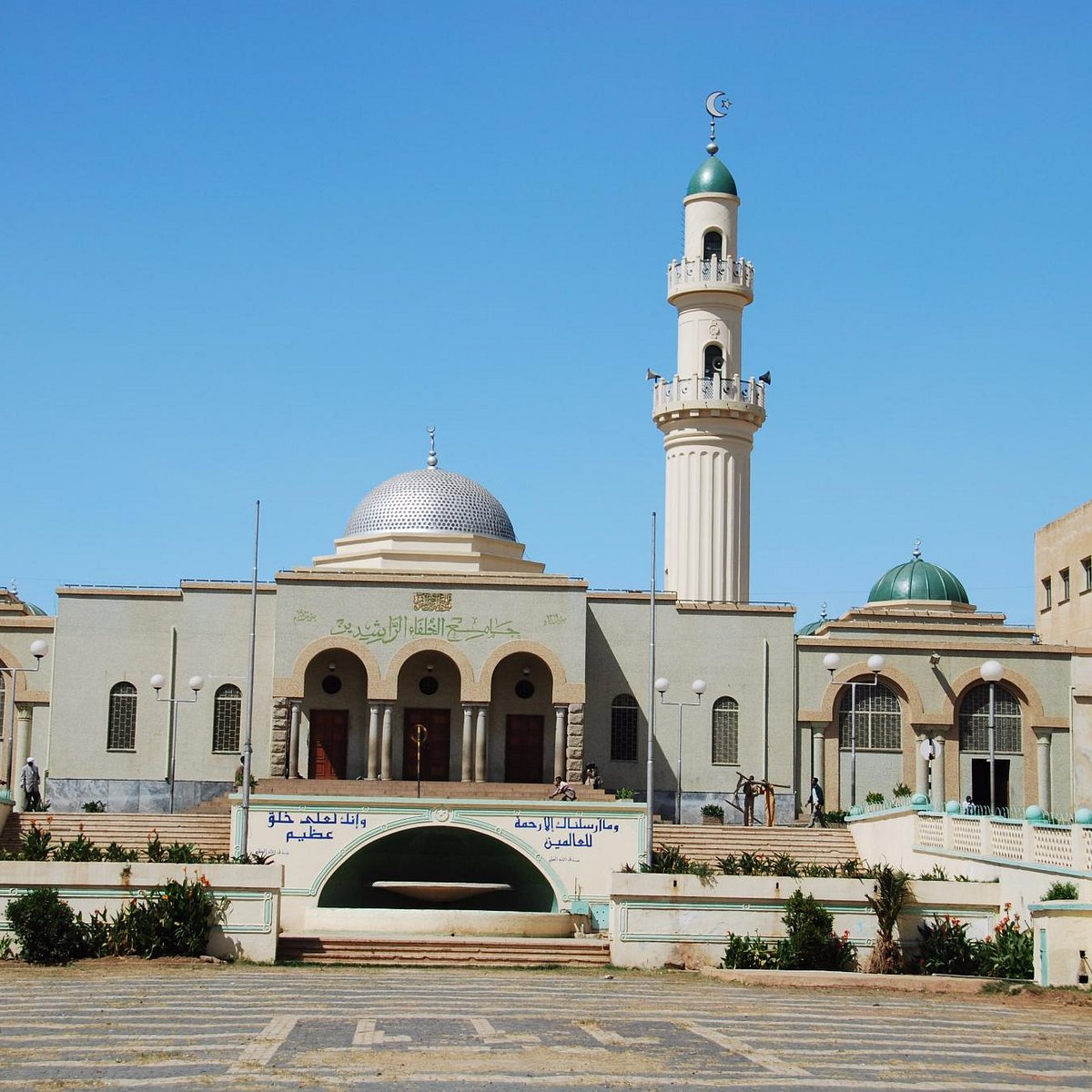
The Cathedral at the centre of Asmara, completed in 1922, is now more than a century old. Its imposing bell tower and Lombard Romanesque character have become defining features of the city's skyline. The Church of Our Lady of the Rosary, the Al Khulafa Al Rashiudin Mosque, the former Fiat Tagliero building, Cinema Impero and countless other structures contribute to Asmara's distinctive architectural identity. But there is something important to remember when admiring these buildings… the buildings predate Eritrea's independence. The people of Asmara and their history predate them.
Before modernist architecture transformed the city, there were already communities, families, neighborhoods, markets, places of worship and established social and cultural life. Asmara was not an empty landscape upon which an architectural experiment was imposed. It was an inhabited place with a history of its own.
The architecture we admire reflects a particular period in the city's development; it does not mark the beginning of Asmara or the history of its people. Colonial architecture can be preserved and appreciated for its historical and artistic value without confusing the legacy of colonial construction with the origins of the city and its inhabitants.
The same distinction applies beyond Asmara. Successive foreign powers that occupied or administered Eritrea constructed buildings, roads, fortifications, military installations, administrative centres and other infrastructure across the country. Some remain visible today and form part of Eritrea's built heritage.
They tell us about the ambitions and priorities of those who built them, but their presence does not make Eritrean history begin with their arrival, nor does it make the history of the country the history of its occupiers. An occupying power may leave its mark on the landscape; it does not thereby become the author of the land's history.
And then there is #Assab. Today, Assab is discussed in terms of strategic geography, maritime access and the economic requirements of landlocked #Ethiopia. Yet, long before it became the subject of contemporary geopolitical calculations or the site of a modern deep-water port, people lived in this region, sustained communities and livelihoods, and maintained their own social and political institutions.
#Assab was not an empty coastline awaiting European discovery. It was home to established Afar communities, including the Ankala, whose old settlement at Assab Saghir and traditional presence across the wider Dankalia coast are documented in historical sources. These communities were part of the wider Afar world, with established connections across the Red Sea and surrounding territories.
#Assab was #Eritrean under the 1952 federal arrangement. Its subsequent annexation by #Ethiopia, following the unilateral termination of the federation in November 1962, must be understood in that historical context. Annexation did not erase the identity of the region or the history of its inhabitants. Assab's strategic importance cannot be separated from its history, and its history cannot be reduced to the interests of those who may wish to use it.
#Assab's history begins with its people, not its port. Its strategic importance, infrastructure development and commercial potential do not alter its historical identity or its place within #Eritrea. A port can be constructed, a harbor modernized and infrastructure developed to transform a town's commercial importance. None of these developments creates the historical existence of the people who live there or establishes sovereignty over the surrounding territory. Building a port, a road or other infrastructure does not confer sovereignty over the land on which it stands. Construction is not a deed to sovereignty.
Eritrea is ancient and new at the same time. Ancient in its peoples, civilizations, cultures and historical roots; new as a modern sovereign state, born of a long struggle for self-determination and internationally recognized in 1993. Independence did not begin the history of the Eritrean people; it opened a new chapter in it. Eritreans did not come into existence with the end of colonial rule, the termination of the federation, liberation in 1991 or the 1993 referendum. These were milestones in the political history of the modern state, not the origins of the people who made it possible.
Long before modern statehood, our forefathers built communities, cultivated the land, worshipped, traded and crossed the seas. The modern Eritrean state emerged through a turbulent history of Italian colonialism, British administration, federation with Ethiopia, its unilateral termination and the annexation of Eritrea in 1962.
The liberation struggle was the assertion of the people's right to determine their own future. 1993 marked the emergence of #Eritrea as an internationally recognized sovereign state, not the creation of the #Eritrean people or their historical identity.
#Eritrean identity is not a recent discovery, our historical presence is not a diplomatic invention, and our sovereignty is not a concession granted by anyone else. Our monasteries, archaeological sites, historic cities and coastal communities bear witness to the depth and diversity of our historical experience. They remind us that while Eritrea is a young sovereign state, the society and people it represents have much older roots.
#Eritreans did not fight for independence to become a people. They fought for independence because they were a people, with a history, an identity and the right to determine their own future. That history continues through their independence and theirsovereign statehood…
#ThrowbackThursday #ThursdayThoughts #Thursdaywisdom
Eritrea’s National Youth Olympic Team returned on Monday, 16 November 2026, after participating in the 2026 Youth Olympic Games and achieving a notable success by winning two medals.
At the World Youth Olympic Games held in Dakar, Senegal, from 31 October to 14 November 2026, the Eritrean Youth Olympic Team won a silver medal in the 800 meters through athlete Gebreab Yonas and a bronze medal in the 1500 meters through athlete Kanari Teklemaryam. In the 3000 meters, athlete Samuel Niguse recorded a strong fourth-place finish.
Well well well…
can @MFAEthiopia deny this? Because the whole world can translate Amharic into English. This time, even PP media propagandists will find it hard to even attempt to deny G/ Kindu Gezu’s open declaration of war against #Eritrea. He stated “Ethiopia is not seeking maritime access. It is seeking a land grab”. He declared his government is seeking to redraw international border which means a land grab inside another sovereign country in Eritrea. Well well well.. after 3 years deceiving the international community, these idiots finally came out of the closet. Thank you G/ Kindu Gezu.
@StateDept@WhiteHouse@EUSR_Weber@EU_Commission@antonioguterres@US_SrAdvisorAF@MFAEgOfficial@mfa_russia@MFA_China@SecRubio@BBCWorld@AJEnglish@dwnews
We condemn war! Yes to #peace, no to war! Oui à la paix, non à la guerre! #NoMoreWar
ሰነፍ, ነዳይ, ፈራሕ, ስሱዕ!! #AbiyAhmed
Lazy = ሰነፍ
Needy/bankrupted = ነዳይ
Cowardly = ፈራሕ
Greedy =ስሱዕ
#HornOfAfrica#PeaceForTheHorn#Geneva #EritreasSovereigntyisNotNegotiable #EritreaPrevails #Eritrea #Ethiopia #Somalia #Sudan
Video of peace demonstration in Geneva, 13 November 2026.
In Mekelle, z Field Marshall claimed Dogali, Gundet & Adulis are part of Tigray,& in doing so he gave away the game: if all of #Eritrea is imagined as #Ethiopia , then any Eritrean at home can be called an invader. PP propaganda equals Disinformation.
👇👉
https://t.co/BhF4vlPxjJ
More than 5 million displaced civilians, 5 states at war with their own government, more than 10 very organized militants operating inside the country. 2 million people died of ethnic conflict in just 5 years. The government in power now is at war for 8 straight years. A country that is at conflict with all of its neighbors. What more can we say about #Ethiopia? It’s a failed country.
@MFAEthiopia
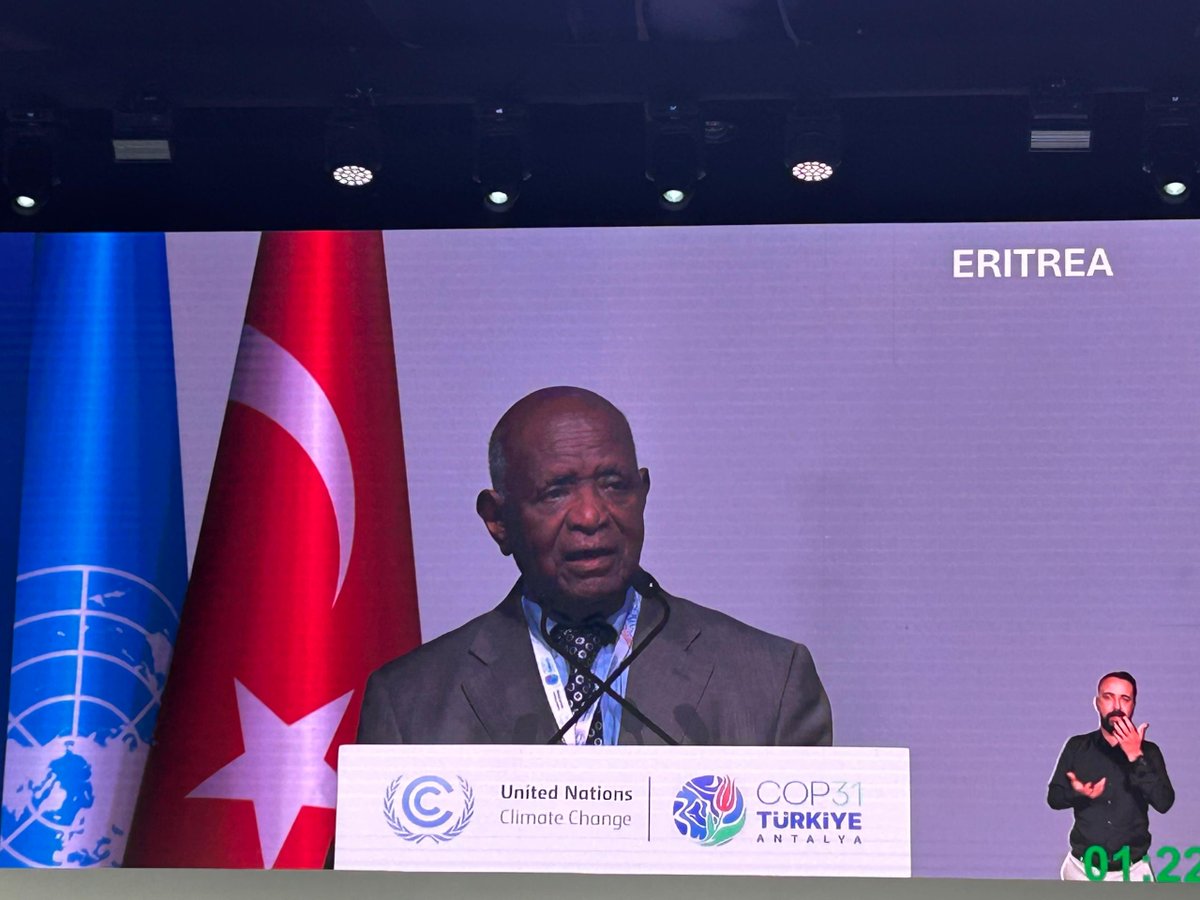
#Eritrea's Delegation Statement – Mr. Tesfai G. Sebhatu, Minister of Land, Water and Environment – At COP 31, Antalya, Turkiye, 9-20 November 2026
*"...In a bid to cope with the changing climate, my country has embarked on adaptation strategy. Under this non-optional strategy, programs that involve intensive nature-based solutions have been underway towards enhancing resilience of communities.... Soil and water conservation, including construction of medium and micro-dams, (more than 800 built), development of potable water supply systems equipped with solar pumps in rural communities, expansion of marine and terrestrial protected areas and planting trees are some of our success stories worth mentioning".
*"...In compliance with requirements under the Convention and subsequent decisions passed in COPs, Eritrea has submitted its 3rd Generation of NDC that declares its ambitious climate action commitment".
*"...My delegation reiterates Eritrea’s unflinching commitment to UNFCCC. Its fundamental tenets make it an important platform around which all parties ought to rally to save planet Earth from the lurking climate menace. Indeed, the Convention as such is undoubtedly one of the great achievements of our generation. The hard work exerted in all COPs is indeed notable".
*"...In the event and for the sake of the hundreds of millions who are already suffering from climate related plight; and, for the sake of future generations; my delegation urges all parties, and particularly the parties whose input can make a difference, to raise their commitment in order to make COP 31 in Antalya an event where dialogue translates into action".
https://t.co/e7sT5yQeW9
Mengistu and Abiy: The Red Terror (ቀይ ሽብር)
Mengistu Haile Mariam—the Butcher—was interviewed during the latter stages of his 17-year rule over #Ethiopia and confronted with the charge that he had killed 12,000 people to seize power.
He dismissed the accusation as outrageous and absurd. He claimed it was not in his nature to kill even an insect, let alone a human being. He insisted that he had never ordered a single person to be killed and said the allegation offended his sense of humanity. To him, it was unimaginable. He said all that while acting like a shy teenager fiddling with his face.
By the final days of his rule in 1991, after the Soviet Union had abandoned him, Mengistu was being quietly assisted by #Israel. He could not believe that the #USSR would desert him, even in his last hour. Still defiant, he claimed that #Ethiopia could purchase weapons from anyone willing to sell them.
Mengistu famously sold the Felashas (aka #Ethiopian #Jews) to Israel code named Operation Solomon (1991): A massive, 36-hour airlift that flew over 14,000 #Ethiopian Jews from #AddisAbaba as the Mengistu regime was collapsing and he received millions of dollars and military assistant.
Yet his remarks about the war with #Eritrea are eerily reminiscent of the rhetoric heard today from Abiy Ahmed Ali. When Mengistu was asked how long he was prepared to send young #Ethiopians to #Eritrea to be killed or maimed, he replied that he did not want to send anyone and that #Ethiopia had not started the war. He argued that the regime had inherited the national identity of its forefathers and therefore had no alternative but to defend it.
No leader, he insisted, had the mandate to allow an independent state to be carved out. Whatever the sacrifice, he said, He was prepared to pay it—even if the war lasted one hundred years.
Just weeks after making that declaration, Mengistu packed his bags and boarded a plane under the pretense of visiting a city inside Ethiopia. Mid-flight, he ordered the pilot to divert to #Kenya. From there, he fled to #Zimbabwe, where he has lived in exile ever since.
After sacrificing hundreds of thousands of lives and devastating the economies and futures of both #Ethiopia and #Eritrea, the man who boasted of fighting for a century ran away when the moment of reckoning arrived.
In #Eritrea, even after more than three and a half decades since the end of Mengistu Haile Mariam’s regime, the mere mention of his name still sends shivers down spines—evoking gnashing teeth and deep-seated hatred rooted in memories of #Ethiopian soldiers, mass bloodletting, and the arbitrary and summary executions that were ubiquitous during that era what Mengistu himself called the Red Terror.
Today, when Abiy Ahmed speaks about invading Eritrea, there is a powerful sense of déjà vu. Abiy Ahmed bears troubling similarities to Mengistu Haile Mariam—in his language, in his tone, and in his boasts—except now the death toll is counted in the millions, and the scale of economic destruction is far, far greater.
@BBCAfrica@BBCWorld@ReutersAfrica@Reuters@TheEconomist@trtafrika@UNSC_Reports@antonioguterres@_AfricanUnion@thesiriusreport@AfricaProg@cgtnafrica@MFAEthiopia@US_SrAdvisorAF@StateDept@USEmbassyAddis@SecRubio@EUSR_Weber@eu_eeas
Held a meeting with Ambassador Melanie Higgins, Senior Advisor for #Africa at the US Mission (@USUN), to exchange views on #Eritrea|s priorities and engagement at the @UN, as well as broader issues relating to #Eritrea–#US bilateral relations.
Highlighted the importance of a more nuanced, balanced, and coherent #US policy towards #Eritrea, one that takes into consideration the country's objective challenges, historical experience, and legitimate national interests. While efforts to recalibrate bilateral relations are welcome, a meaningful reassessment would benefit from a clear understanding of the historical circumstances and policy choices that have shaped the relationship.
Underscored the importance of the longstanding people-to-people ties between the two countries. The thousands of #Eritrean Americans who contribute to American society across various fields, including service in the US military, represent an important foundation upon which stronger bilateral relations can be built. These connections make a compelling case for a relationship with #Eritrea that is constructive, forward-looking, and reflective of the close human links between the two countries.
Also expressed concern over the continued reliance on allegations and reports whose evidentiary basis and methodology merit closer scrutiny, as well as the repeated inclusion of Eritrea on various US designation lists. Such measures have had a lasting impact on #Eritrea's international standing and public perception, while doing little to create an enabling environment for improved relations. A genuine policy review should therefore include a careful reassessment of these measures and their broader implications.
Emphasized that a more productive bilateral relationship must be grounded in mutual respect, including respect for #Eritrea's laws, institutions, sovereignty, and the principle of non-interference in its internal affairs. Building the necessary confidence will require addressing existing differences with mutual understanding and recognizing the broader opportunities for cooperation that remain largely unexplored.
Developments in #Ethiopia and their implications for regional peace and stability also featured in the exchange. Expressed concern over efforts to externalize domestic political and security challenges, particularly through rhetoric and actions with potential regional ramifications.
While acknowledging recent US efforts to encourage de-escalation and avert further deterioration in the situation arising from the course pursued by #Ethiopia’s leadership, underscored the importance of principled and consistent international engagement.
Also emphasized that developments must be addressed on the basis of facts, international law, and established principles, rather than expediency or accommodation, as a consistent approach is essential to preventing further escalation and safeguarding regional peace and stability. A clear-eyed approach is essential to preventing further escalation and safeguarding regional stability.
Ultimately, stronger #Eritrea–#US relations would serve the interests of both countries. Advancing this objective requires candid dialogue, mutual respect, a better appreciation of each other's perspectives, and a willingness to move beyond entrenched assumptions.
We agreed to remain engaged and maintain dialogue on the issues discussed, with a view to fostering greater understanding, identifying opportunities for a more constructive bilateral relationship, and pursuing cooperation within the multilateral system in areas where #Eritrea’s and the US’ positions and interests converge.