Breaking: Missouri All-American tailback Ahmad Hardy is set to make his season debut for the Tigers this weekend at Arkansas, sources told @PeteThamel.
Hardy is not going to start, but he’s expected to get a handful of carries for Missouri. He's been ruled out since May after being struck by a bullet.
Full story: https://t.co/Q1xL1VdB85
Breaking: The Detroit Red Wings have suspended Dylan Larkin without pay after he informed the Red Wings he will no longer play for them, the team announced.
We are not slowing down. 🚀
Our Artemis III mission will send four astronauts to low Earth orbit next year to test critical systems needed for future lunar landings https://t.co/G5CkHbQhFR and we’re accelerating efforts to ensure the success of Artemis IV, the first Artemis mission on the lunar surface https://t.co/zEDKEcLpXY.
What would it be like to live on Mars?
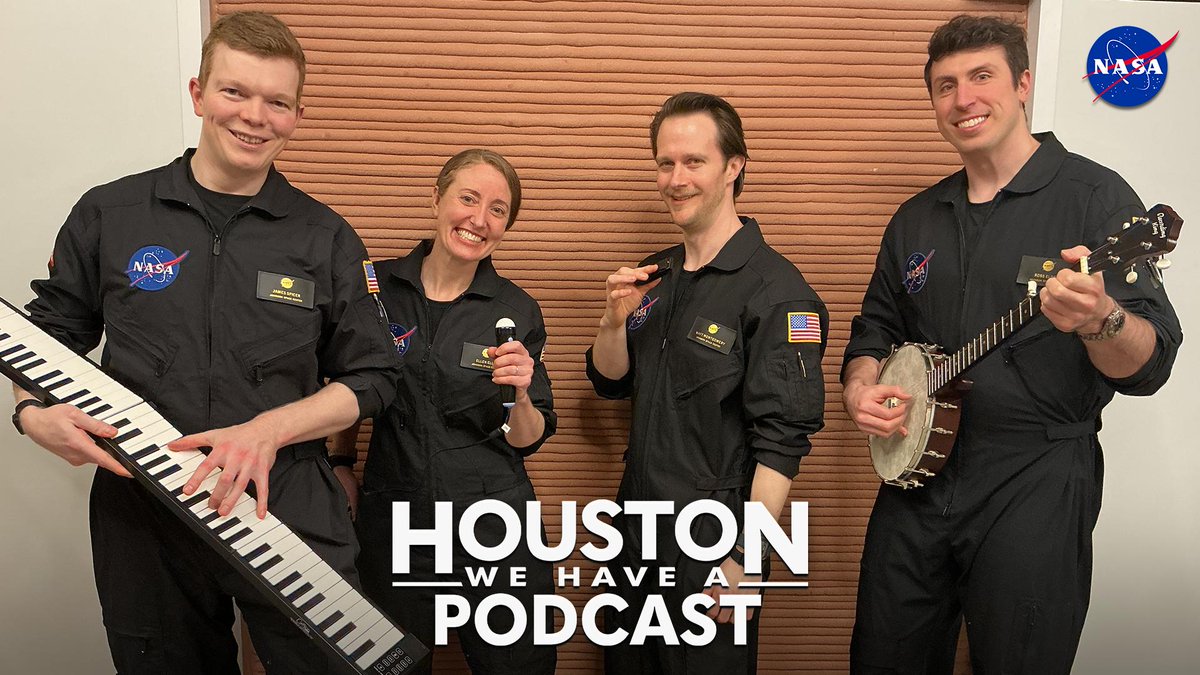
The CHAPEA 2 crew share their final thoughts before their yearlong simulation mission ends on Houston We Have a Podcast: https://t.co/BAgJK9NMRk
Are you stepping into a spacesuit this week? So are @astro_anil and @astro_kutryk — but not for Halloween!
Tune in here on Oct. 29 at 6:30am ET (1030 UTC) to watch these two astronauts deploy a new solar array on the @Space_Station.
Se cumplen 5 años de la tragedia en la línea 12 del Metro
Hasta ahora ningún funcionario ha pisado la cárcel
26 personas murieron y más de 100 resultaron heridas
¿Cuánto tiempo más pasará para que se haga justicia?
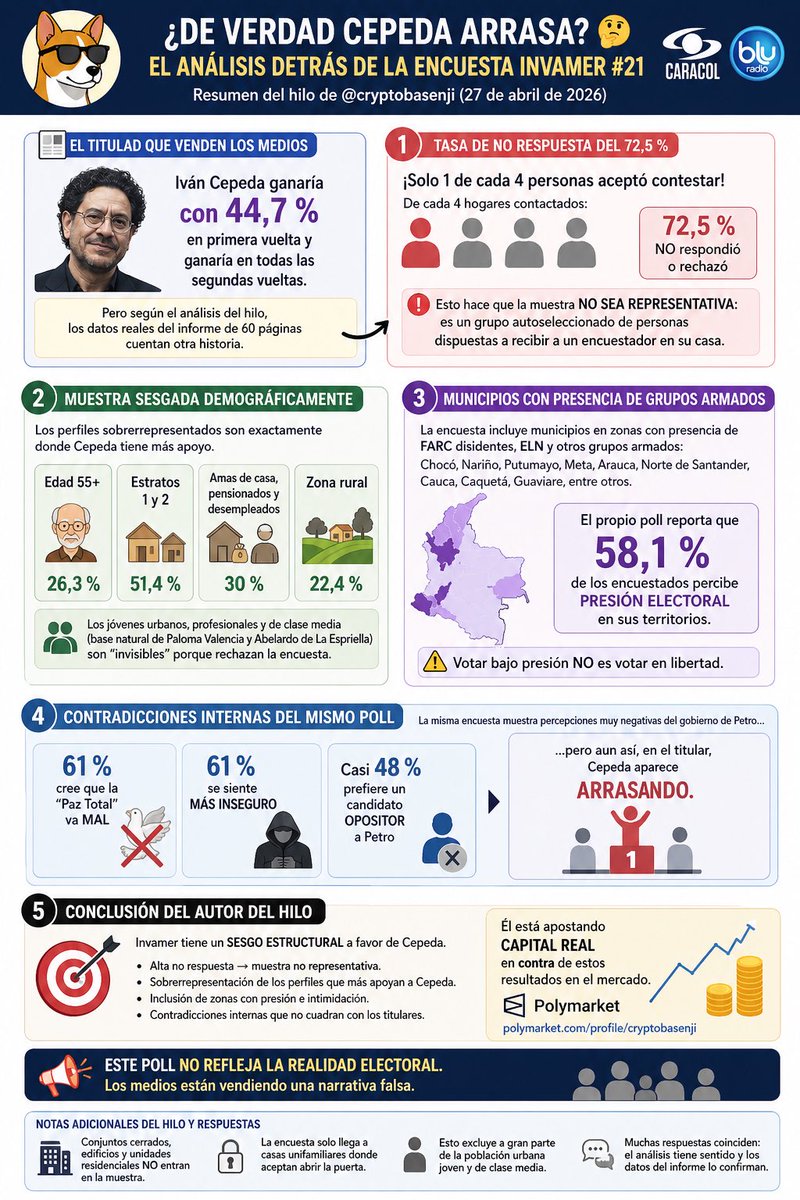
Para quienes no hablan inglés, aqui un resumen de porqué @cryptobasenji, quien analiza tendencias de @Polymarket, dice que la encuesta de Invamer (la que más se pifió el 8 de marzo 👉 https://t.co/t0cd4Mq07H 👀) estaría inflando a Cepeda (no tanto como Celag que es un descaro🤥)
¡EL MÁS FELIZ ECHANDO TACO! 🌮🇰🇷
Heung-min Son y el resto de la plantilla del LAFC aprovecharon su visita a México para echarse unos taquitos después de eliminar a Cruz Azul de la Concachampions.
Te presentamos la última cinta de la selección de la #79Muestra de Cineteca Nacional: AMOR (SEXO-SUEÑOS) (2024), de Johan Haugerud, EN OPINIÓN DE… Mónica Martz. ❤️🔥🎬
La presidenta debería revisar las auditorías de la @ASF_Mexico, quien acreditó el recorte al Programa de Vacunación en 2024 con @lopezobrador_
El dinero para vacunas del Centro Nacional para la Salud de la Infancia se redujo en 9,422 millones en un solo año 👇🏻
⚠️ "Pensé que nos iban a dar un tiro": El terror de los falsos barrenderos en la #CDMX.
María Fernanda y su madre vivieron una pesadilla en su casa, cuando tres sujetos, dos de ellos disfrazados del servicio de limpia, orquestaron un asalto violento.
"Pensé que me iban a secuestrar... les rogaba que no nos hicieran nada", relató María Fernanda a Fuerza Informativa Azteca.
¿Habías escuchado de este modus operandi en tu zona? 👇
Con información de @isidrocorro / @ivanramirez092
Detalles: https://t.co/OZRV1bdfr8
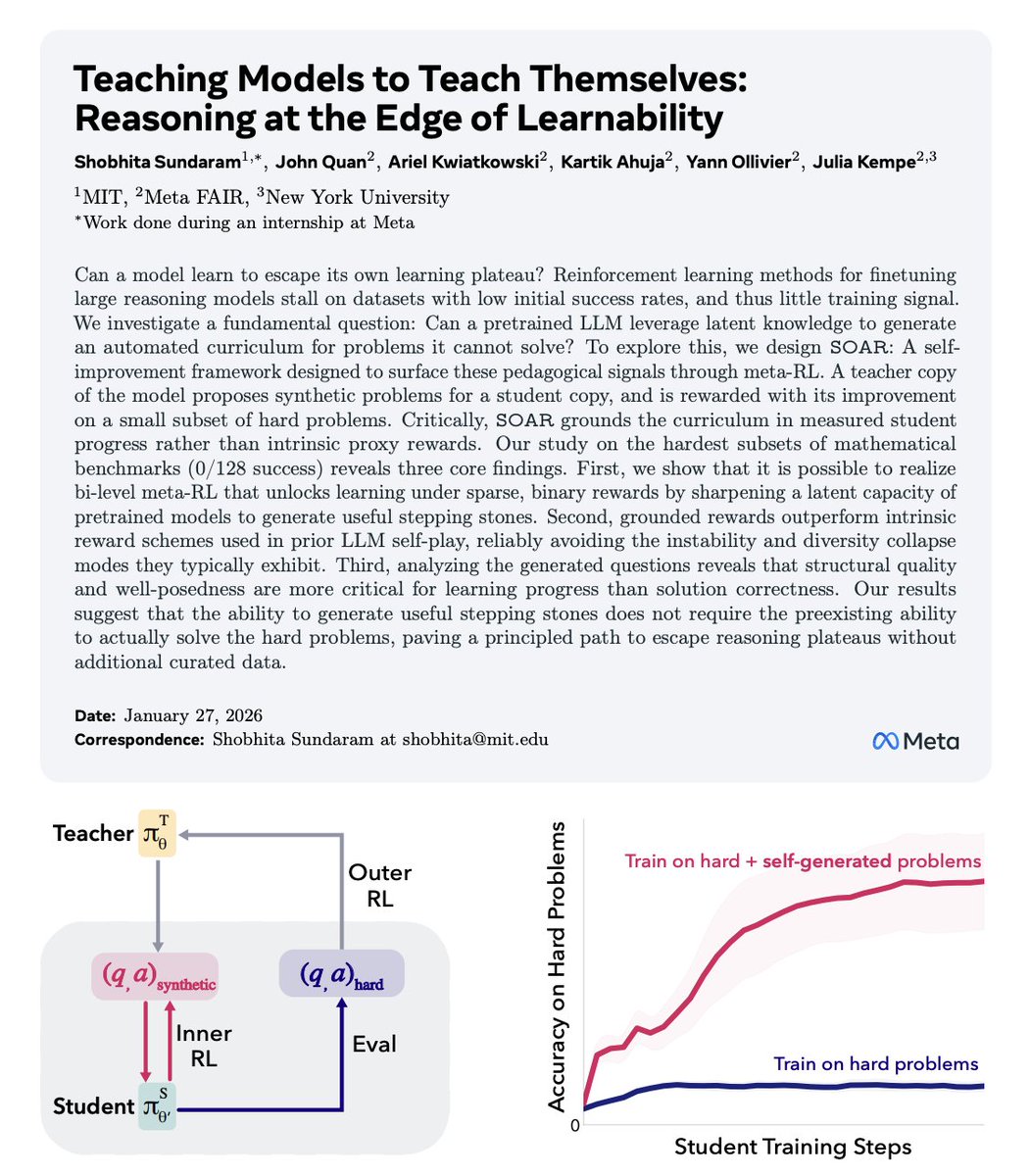
MIT just published a paper that quietly explains why LLM reasoning hits a wall and how to push past it.
The usual story is that models fail on hard problems because they lack scale, data, or intelligence.
This paper argues something much more structural: models stop improving because the learning signal disappears. Once a task becomes too difficult, success rates collapse toward zero, reinforcement learning has nothing to optimize, and reasoning stagnates. The failure isn’t cognitive, it’s pedagogical.
The authors propose a simple but radical reframing. Instead of asking how to make models solve harder problems, they ask how models can generate problems that teach them.
Their system, SOAR, splits a single pretrained model into two roles: a student that attempts extremely hard target tasks, and a teacher that generates new training problems. The catch is that the teacher is not rewarded for producing clever or realistic questions. It is rewarded only if the student’s performance improves on a fixed set of real evaluation problems. No improvement means zero reward.
That incentive reshapes everything.
The teacher learns to generate intermediate, stepping-stone problems that sit just inside the student’s current capability boundary. These problems are not simplified versions of the target task, and strikingly, they do not even require correct solutions.
What matters is that their structure forces the student to practice the right kind of reasoning, allowing gradient signal to emerge even when direct supervision fails.
The experimental results make the point painfully clear. On benchmarks where models start with zero success and standard reinforcement learning completely flatlines, SOAR breaks the deadlock and steadily improves performance.
The model escapes the edge of learnability not by thinking harder, but by constructing a better learning environment for itself.
The deeper implication is uncomfortable. Many supposed “reasoning limits” may not be limits of intelligence at all. They are artifacts of training setups that assume the world provides learnable problems for free.
This paper suggests that if models can shape their own curriculum, reasoning plateaus become engineering problems, not fundamental barriers.
No new architectures, no extra human data, no larger models. Just a shift in what we reward: learning progress instead of answers.