@Ryan_Daigler They can do both (truth or lie) in one sentence, even if being opposite to one another. Truth to make those who _know_ trust them more and lie to confuse everybody and make themselves feel superior. What ever benefits them the most. It doesn't matter to them at all.
SOMEONE WHO HAS BEEN NARCISSISTICALLY ABUSED WILL OFTEN...
1. OVERTHINK EVERYTHING — because they've been trained to anticipate criticism and coriflict.
2. DOUBT THEIR OWN MEMORY - years of gaslighting make them question what's real.
3. STRUGGLE TO TRUST COMPLIMENTS - kind words feel suspicious, not sincere.
4. APOLOGIZE FOR EXISTING - they've been made to believe their needs are burdens.
5. SCAN PEOPLE'S MOODS CONSTANTLY - survival once depended on reading danger in silence.
6. FREEZE WHEN CONFRONTED - their nervous system still remembers emotional attacks.
7. DOWNPLAY THEIR PAIN - they're used to having their suffering minimized.
8. AVOID ATTENTION OR PRAISE - because it once triggered jealousy or punishment.
9. STAY OVERLY LOYAL - even to those who mistreat them, because betrayal feels worse than abuse.
10. SECOND-GUESS THEIR DECISIONS - the narcissist's control trained them to seek permission for everything.
11. FEEL GUILTY FOR SAYING "NO" - setting boundaries feels like rebellion.
12. EXPERIENCE EMOTIONAL FLASHBACKS - a tone, look, or phrase can send them right back to the trauma.
13. CRAVE PEACE BUT FEAR IT - calm feels unfamiliar after years of chaos.
It’s the inconsistencies with a narcissist that fuck you up. Jekyll and Hyde. Kind then cruel. Not knowing which version you’ll get.
The inconsistencies keep you hooked. The narcissist wants you to believe it’s you who brings out their bad side.
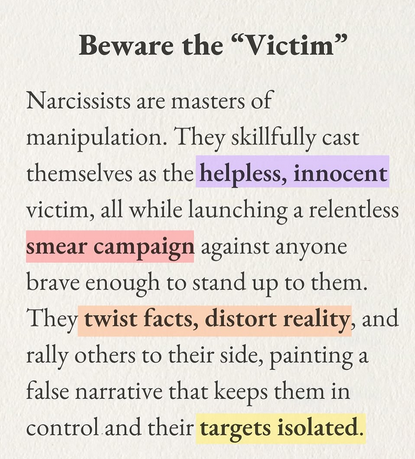
One of the most abusive things the sociopathic narcissist will do is to play the victim role while making their actual victim look like the perpetrator of the abuse. It’s a double attack.
This is a form of “Crazy making” performed by the sickest and most toxic people.
A narcissist's mask slips when:
Money is involved.
They are angry.
You disagree with them.
They don’t get their way.
Underneath is the person you're really dealing with.
The narcissist can only understand your behavior through their own mentality.
They don’t have access to a genuinely other perspective. Everything gets filtered through what they would mean if they did what you did.
When you set a boundary, they read it as aggression — because that’s what their boundaries are.
When you go quiet, they read it as punishment — because that’s what their silence is.
When you pull away, they read it as a power move — because that’s what their distance is.
It’s not just projection. It’s a failure of imagination so complete that they can’t conceive of motivations they don’t personally possess.
Genuine hurt looks like manipulation to them.
Authentic self-protection looks like retaliation.
Honesty looks like an attack.
The irony is that this makes them confidently wrong about you.
They don’t wonder if they’ve misread you. They KNOW you and what you’re doing. And what “you’re doing” is exactly what they would be doing in your place.
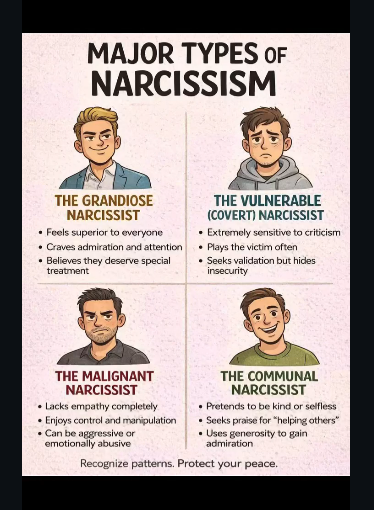
Covert narcissists attack their victims by casually overdramatizing everything they can to make their victim look unhinged or in need of help while simultaneously feigning a moral high ground by acting “concerned for them”. This mob triangulation abuse tactic creates a false narrative about the victim causing stress and anxiety. Also referred to as “crazy making”. This is the epitome of covert malignant narcissism.
Malignant narcissists are vandals. But they don’t vandalize property — they vandalize people.
When they encounter someone with genuine value — real heart, real integrity, real character — they feel threatened by it. That kind of authentic goodness exposes what they are by contrast. And they can’t tolerate that.
So they do what vandals do. They deface it. They trash it. They mark it up until it looks like something that deserves to be discarded.
That’s the smear campaign. That’s all it is. It’s not a conflict. It’s not a dispute. It’s a vandal spotting something of value and defacing it — because genuine value offends them, and destroying it is the only way they know how to respond to feeling inferior.
So they take it away from everyone.
The person they target didn’t do anything wrong. They were just too good to leave alone.
One of the cruelest and most insidious layers of narcissistic abuse is the weaponization of your trauma response as proof of your “instability,” rather than as evidence of what was done to you.
When you experience severe trauma from prolonged psychological or narcissistic abuse—when it leads to CPTSD, a mental collapse, a nervous breakdown, or even hospitalization—your abusers will use that.
They will try to freeze you in that state, forever.
They will point to your trauma response and say, “See? That’s who they are.”
Not what happened to you—but you. As if the very injuries they inflicted prove you were broken all along.
They won’t offer compassion or understanding. They won’t take responsibility.
Instead, they’ll exploit it as a reason to discredit anything you say from now on.
To them, your pain is useful. Your collapse is ammunition to use against you.
And that’s what makes recovery so hard. Because not only do we have to heal from the abuse—we have to push back against the story they’re still trying to write about us.
They want to make your trauma your identity, so they can walk away clean.
But you are not their story.
You are not your trauma.
Your trauma defines what they did to you, and that’s what they’re terrified of people figuring out.
Narcissistic abuse survivors are often accused of “living in the past.” What’s actually happening is something more precise: they are living in an unresolved logic problem. The abuse created a set of propositions that contradict each other—people who claimed to love them treated them with contempt; their accurate perceptions were called delusions; their pain was reframed as manipulation. The mind cannot simply move on from contradiction. It circles back because it’s trying to resolve something that was structurally designed to be irresolvable. The gaslighting wasn’t incidental to the abuse. It was the abuse. And healing isn’t a matter of “letting go.” It’s a matter of finally being allowed to trust your own conclusions.
The classic Captain Jack Sparrow debut scene: both hilarious and completely cool, and it basically defined the 'mischievous but maximum charisma' style for the entire Pirates of the Caribbean series afterward.
Many people are so impressed by this one scene alone that Johnny Depp left a lasting impression!