“In such numbers, these satellites could affect astronomical observation of the sky from every country"
#starlink#starmind#spacex
https://t.co/v5EU8HbqgF
The distance is not really that significant, as 1 light day is a human defined distance, simply based on how long our particular planet takes to revolve.
What's more significant is that it's still operating after 50 years of time.
After it's initial launch and gravity assists, it would have continued on to this distance of 25.9 billion miles, wether it was operating or not and it's distance will continue to increase.
@WalkerAmerica It's not a fisheye or wide angle lens that's causing the curve. It is a curve!
The lens may just be exaggerating it a bit....
https://t.co/uTjteTIEfu
@satofishi From 400km your seeing the local horizon from that height. Just as if you look around you from top of a tall building, or from a high mountain, or an aircraft. You need to be a few thousand km from Earth to see the Full spherical globe.
Ctedit: R Ball, 1896
Great shot of Pic Du Midi observatory taken from low Earth orbit by Pleiades Earth Observation satellite.
The cable car up to top is not for anyone with a fear of heights!
Pic du Midi: where Airbus satellites meet the peaks 🛰️🏔️
At 2,913 meters above sea level, the Pic du Midi de Bigorre in southwest France is more than just a mountain peak. It has long been famous for its role in observing the depths of space from its high-altitude vantage point.
For over a century, this iconic summit has served as a major astronomical observatory where scientists and stargazers have looked skyward to unlock the mysteries of the universe. It stands as a symbol of human curiosity and our eternal quest to understand the cosmos.
Today, we offer a different perspective. 👀
While the observatory looks toward space, our Pléiades Neo satellites look back at the Earth. 🌍
Captured by Airbus Pléiades Neo satellites from an altitude of 620 km and enhanced with HD15 processing, this image was acquired while the satellite was above Algeria. It reveals the rugged textures and breathtaking scale of the Pic du Midi in remarkable detail. 🛰️📸
Look closely, and you can even distinguish the coronagraph dome with its shutters open for observation, offering a glimpse into the astronomical research conducted at the summit.
High-definition observation, from a whole new angle.
Explore the full-resolution imagery in our Image Gallery: https://t.co/giNG5mMMt9
#Airbus #Geospatial #PleiadesNeo #SatelliteImagery #EarthObservation
Voyager & Light-Day
Voyager 1 will soon reach one Light-Day from Earth about 16 billion miles.
Yes, but a light day is a purely human-defined measurement of distance, based on our planets rotation period.
On any other planet, with different rotation period, 1 Light-Day would be a different physical length!
The fact reached 1 Light-Day is irrelevant, it's of no actual positional or location consequence at all.
Just state it's 25.9 billion km in SI units! 😄
@cottonblonde Yes, it's still transmitting data. It will take around 24hrs at moment, but that time will increase, just as it been doing since left Earth.
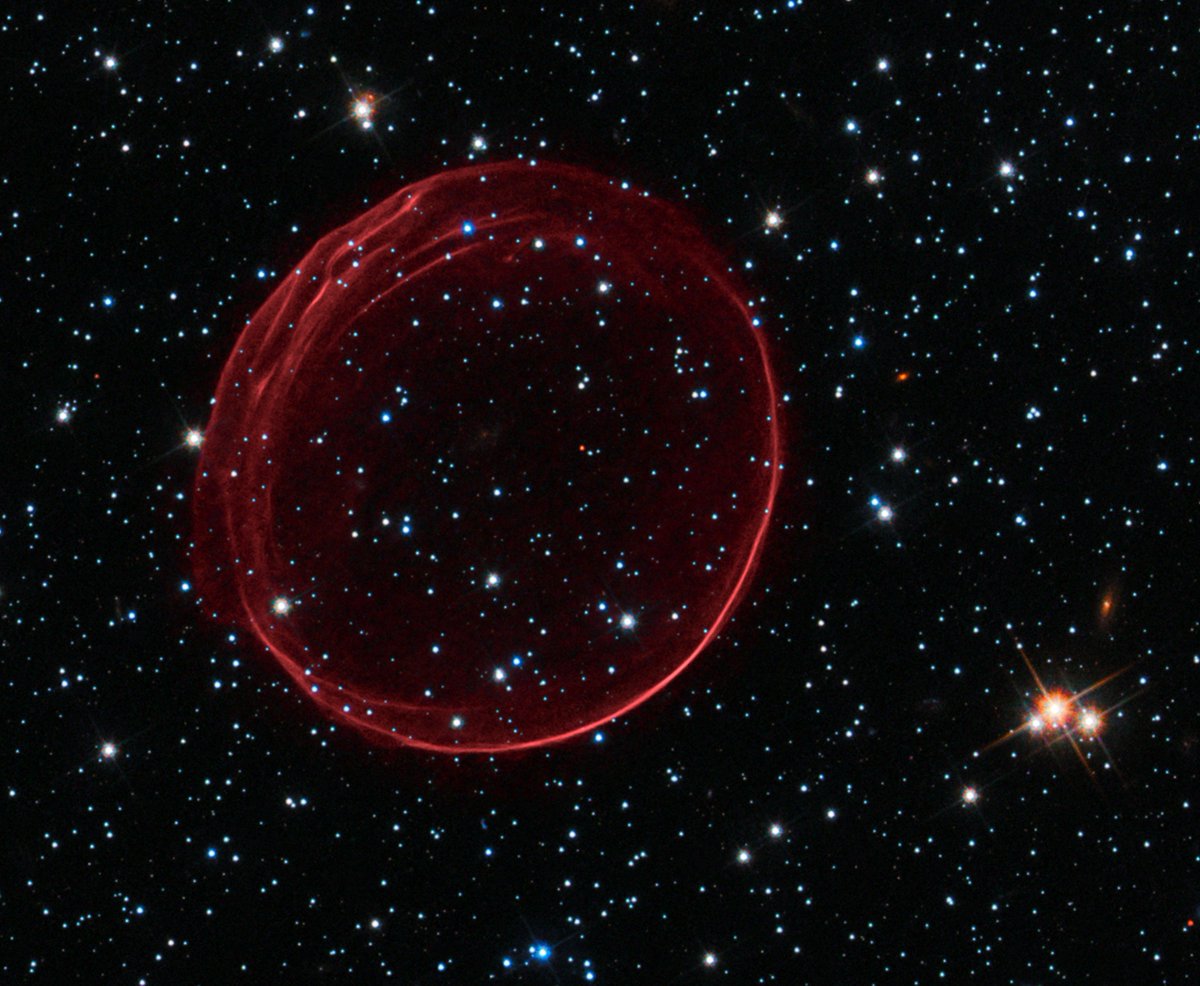
A Blob.
Supernova remnent SNR 059 in the Large Magellanic Cloud.
The "bubble" is 23 light-years across and is expanding at 5,000 Kps
Image:
NASA, ESA, Hubble Heritage Team (STScI/AURA); Acknowledgment: J. Hughes (Rutgers Univ.)