ΜΥΣΤΡΑΣ - Ανακαινισμενο Παλάτι των Ηγεμόνων
Η Αίθουσα του Θρόνου.
Η εμνπευσμένη απο ζωγραφική του Φωτη Κόντογλου, περιβολή του Αυτοκράτορα Κων. Παλαιολόγου.
Η εμπνευσμενη απο βυζαντ. τοιχογραφια περιβολή της Ελ. Δραγάση.
Artifacts pulled from the sunken depths of Thonis-Heracleion in Egypt challenge what we accept about ancient Mediterranean history. This massive port city built in the 12th century BC holds Greek ceramics that somehow survived massive tsunamis and deep soil liquefaction without a single crack..
If you are wondering why today's Turks have Greek DNA, here is the answer. This land for thousands of years has constantly shown us its Greek heritage. New discovery of an amazing statue of the goddess Athena.
A monastery suspended between sky and sea… in a place few will ever see. ⛪
This is Mount Athos known in Greek as Agio Oros (the Holy Mountain) in Halkidiki. ⛰️
Access is limited, and only men are permitted to enter. Which makes moments like this beautifully captured by ironsav13 (IG) all the more rare.
📍 At the Monastery of Simonopetra
#discovergreece #mountathos #halkidiki
The Ptolemaic Kingdom, founded by Ptolemy I Soter after the empire of Alexander the Great, was the richest Hellenistic state.
From Alexandria it dominated the eastern Mediterranean, blending Greek and Egyptian traditions until decline and growing control by the Roman Republic.
:A Grecian Odyssey, Seen from 250 Miles Above From the serene vantage point of orbit, the cradle of Western civilization unfolds like a living myth carved into the Earth itself.Below lies the rugged Greek mainland, stretching southward into the sun-drenched Peloponnese, where ancient heroes once walked. Further still, the legendary island of Crete anchors the scene, birthplace of gods and kings. The Aegean Sea glimmers with countless islands scattered like jewels across sapphire waters — a labyrinth of myth and memory.The coastlines are impossibly intricate, fringed and lacy, as if the gods themselves traced delicate fingers along the shore. From 250 miles up, the geography that shaped democracy, philosophy, and epic poetry reveals its breathtaking secrets in a single glance.These are the same waters that carried Odysseus home, that whispered secrets to Socrates, and that still call to sailors and dreamers across the ages.Simply breathtaking. Timeless.
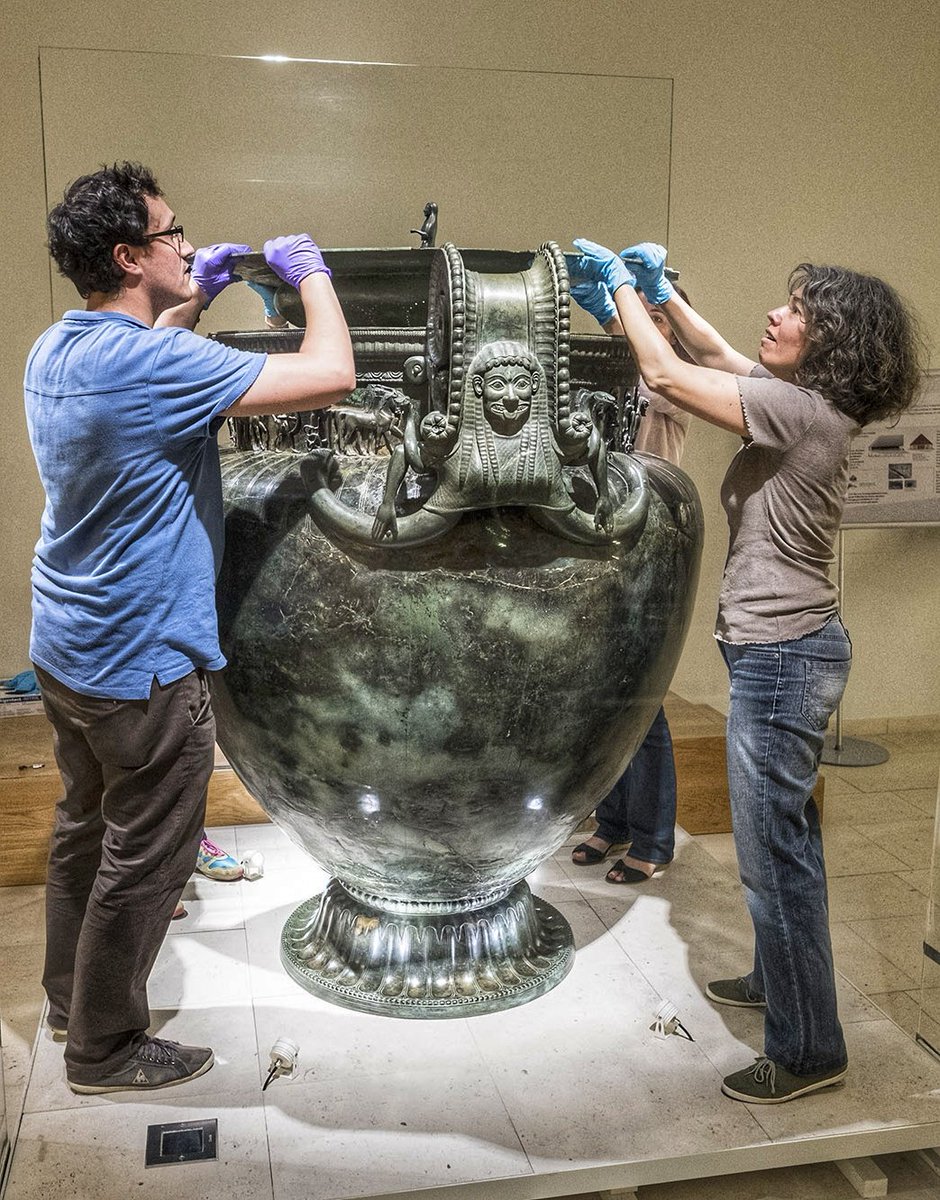
The Vix Krater, a 6th century BC Greek bronze vessel imported to the Celts. Discovered in Bourgogne/France in the tomb of the “Lady of Vix,” a Celtic princess. It remains the largest known metal vessel of Western antiquity.
Musée du Pays Châtillonnais
MINOAN HIGHWAY IS FOUND IN SOUTHERN CRETE - GREECE :
Archeological excavations on Crete have uncovered a major highway that is presumed to have connected the 15th Century BC, Minoan city of Phaistos with its southern seaport of Kommos.
A Toronto University professor, Joseph W. Shaw, who i s directing an excavation of Kommos by the American School of Classical Studies in Athens, sa id that the limestone-paved road is ''a dramatic discovery whi ch underlines the southern seaport's strategic importance fo r the Minoan empire.''
Next to the ancient road are the remains of what Dr. Shaw believes was a ''sort of customhouse, a public building where the Minoan sea captains would meet.'' He said that the standing wall of this building is constructed of ''enormous blocks, among the largest ever used in Minoan construction.''
Dr. Shaw said the ancient Kommos port, which is near the renowned caves of Matala, about five miles south of Phaistos, served the seafaring Minoan empire as a point of entry and trade with North Africa and ancient Egypt.
The well-worn road, according to Dr. Shaw, is nearly ten feet wide and large enough for four people to walk abreast. He said it separated the wealthy central district of Kommos from the common houses and then continued inland toward Phaistos. Evans Predicted Road Existed
Sir Arthur Evans, the archeologist who discovered the Palace of Knossos, home of the legendary King Minos and the Minotaur, predicted as long ago as 1924 that a town existed on the site of Kommos.
Sir Arthur, who also believed that a great road existed, presumed that the thoroughfare connected Kommos and Knossos, from the southern to the northern shores of the island.
While Dr. Shaw has only uncovered the beginning of the road, he said he believed that the avenue continues as far as Phaistos. In the excavation work this summer, no evidence has been found that it continues as far as Knossos.
''At this point the Kommos excavations have revealed so much information that we must spend one year analyzing it,'' Dr. Shaw said. ''When we resume the digging in 1983, we hope to uncover the downtown area of Kommos.''
The Minoan civilization, which flourished in Crete during the Bronze Age, was abruptly destroyed by what historians believe was a series of earthquakes about 1450 BC.
#archaeohistories
In Gaziantep Province, Türkiye 🇹🇷, archaeologists have uncovered a breathtaking collection of 2200 year-old mosaics in the ruins of the ancient Greek city of Zeugma. Dating back to 3rd-2nd Centuries BC, these masterpieces offer a vivid glimpse into the art, culture, and daily life of the Hellenistic period. Once strategically located on the Euphrates River, Zeugma thrived as a wealthy trade hub, blending Greek, Persian, and later Roman influences.
The mosaics, crafted from thousands of tiny colored stones and tiles, depict a rich variety of subjects from mythological figures and legendary heroes like Heracles, Achilles, and Alexander the Great to scenes of nature and daily life. Their lifelike quality and intricate detail showcase the exceptional skill of ancient artisans and highlight the city’s deep Hellenistic roots. These artworks once adorned the floors of lavish homes, temples, and public spaces, reflecting the opulence of Zeugma’s elite society.
Though parts of Zeugma were submerged in the early 2000s due to the construction of the Birecik Dam, ongoing excavations continue to reveal treasures that preserve the city’s legacy. The discovery of these mosaics not only enriches our understanding of ancient Greek artistry but also tells the story of cultural exchange across civilizations, ensuring that Zeugma’s grandeur endures for generations to come.
#drthehistories
Mel Gibson Walks Mount Athos, the Holy Mountain in #Greece : A Devout Christian’s Pilgrimage to Orthodoxy’s Stronghold. "I have never felt a connection to God anywhere like I did here."