Caleb Hammer catches a husband changing his story after his wife reveals she found GRINDR on his phone.
He admits he had been using the app for around a MONTH without telling her.
First, he says they had talked about experimenting.
Then he says he thought she was doing the same thing.
Then the explanation becomes:
“I was lonely because you never want to have sex with me.”
His wife says none of that gave him permission to secretly use a dating app.
Caleb’s response:
“You cheated. Say it as it is.”
Pay attention to the shock and vertigo the cyber world is going through right now. This is what it feels like when rising AI capabilities stop being hypothetical. Sooner or later, everyone will get their own version of this.
The pattern goes like this. Models improve and a new capability appears at the frontier but doesn’t immediately become tangible. Insiders make predictions that get either ignored or dismissed as delusion, fear-mongering, or IPO hype. Proofs of concept slowly arrive but are written off as contrived and only appreciated within narrow research circles. Time moves on, everyday life remains familiar, and people speculate that the predictions were overblown. Then come the first sparks hinting that practical thresholds are being crossed. Suddenly, a phase change happens and some delicately maintained equilibrium shatters overnight.
We’ve watched this play out a few times in the last year.
Software engineering went first. Despite being the field watching AI most closely and adopting it most eagerly, software engineering was left shellshocked by the exploding utility of coding agents near the start of this year. Programming changed more in 2026 than it had in the last 15 years combined, and things are only continuing to accelerate. Nobody knows what it will mean to be a software engineer in a few years.
Mathematics was next. Mathematicians went from laughing at the idea of LLMs being useful, to moving the goalposts (‘it’s just brute-forcing counterexamples’) when the Jacobian Conjecture fell, to being thrown into an existential spiral a few weeks ago when hundreds of frontier math results were quietly dropped overnight. The field is now steeped in debate about what it could possibly mean to be an effective mathematician as AI continues to improve.
Now it’s cyber’s turn. Dramatic improvements in cyber capabilities were demonstrated during the Mythos preview in April, and massive white-hat operations like Daybreak and Glasswing were launched to give defenders a head start in hardening their systems. Months passed, and people began to suspect that the risks were overblown. Meanwhile, capabilities continued to diffuse into open source and non-frontier models. At some point, a critical mass was reached and we underwent a phase transition: critical vulnerabilities in the web’s core infrastructure and high-profile attacks on industry targets started landing at a drumbeat pace. All of this is after months of efforts to give defenders a head start, and before frontier offensive capabilities are even broadly available (note: it actually seems like many of the recent vulns are coming out of white hat programs).
I suspect 3D modeling, animation, and video editing are entering this same interval between impressive demonstrations and widespread consequences. These fields will soon make contact with a rapidly changing reality.
Take note of this feeling, the disorientation before the normalization treadmill kicks in and we all go back to pretending things are normal. Use it as your reference point for what the climb toward ASI will actually feel like.
2027 is going to be fucking insane.
The longer you’re single, the harder dating gets…
I like my peace and I don’t want to go to your house on a wed after work, and I don’t want you at mine
but i do miss having a person to do shit with
So naturally, this week in dating apps, I’ve been called a cougar, told distance shouldn’t matter by a guy in Canada because I’m hot, and accused of being AI by a man who texts like AI
Today I made 4 lamb chops and ate 2. Sometimes I’d just like someone to eat the other 2… why the fuck is that so complicated?
Agents need to find higher-bandwidth connections to your brain. Text out, keyboard typing in = slow.
So, Amp will now sometimes give you an interactive mini-app right in the thread to get your input and let you play around with stuff.
gm CT ☕️
the next security problem in crypto might not be whether an AI agent can execute a transaction.
it might be whether it knows enough to avoid executing the wrong one.
a few days ago, @zerufinance introduced zScreen as an MCP server, making wallet screening accessible to AI tools like Claude Code and Cursor.
that integration caught my attention for a reason that goes beyond convenience.
we’re moving toward a world where AI agents won’t just summarize blockchain data. they’ll interact with wallets, evaluate counterparties, move assets, and execute multi-step strategies with less human involvement.
and that changes the meaning of trust.
when a human uses a new protocol, they can pause, inspect an address, look at transaction history, and decide whether something feels off.
an autonomous agent needs a more systematic way to do that.
a wallet address alone tells you very little. what matters is the activity behind it: where funds came from, how they moved, and whether the surrounding behavior raises legitimate concerns.
this is where wallet intelligence becomes an interesting building block for agentic finance.
instead of asking an agent to blindly execute a task and investigate the consequences afterward, screening can become part of the decision process itself.
but there’s a catch.
a risk score is evidence, not a verdict.
a wallet with unusual activity isn’t automatically malicious. funds can pass through multiple addresses for legitimate reasons, and a model can misinterpret patterns it doesn’t fully understand.
if agents treat every warning as proof of wrongdoing, they could reject legitimate users and create a different kind of failure.
if they ignore warnings because execution speed matters more, the screening layer becomes little more than decoration.
the real challenge is connecting risk signals to sensible actions: investigate further, request additional checks, limit exposure, or proceed when the evidence supports it.
that’s also why i find the MCP integration more interesting than another dashboard feature.
bringing screening directly into an agent’s workflow makes it possible to consider trust at the moment a decision is being made, rather than leaving it in a separate tool that nobody remembers to open.
of course, integration alone doesn’t prove that agents will become safer. accuracy, explainability, data freshness, and the handling of false positives still matter.
but the direction makes sense.
as more financial activity becomes automated, behavioral intelligence could become part of the infrastructure that helps software decide when to act, when to pause, and when to ask for human judgment.
the future of onchain AI won’t be defined by execution capability alone.
it will also depend on whether an agent can recognize the limits of what it knows before putting capital at risk.
that’s the part of @zerufinance i’m watching this morning.
not just smarter agents.
agents with better reasons to trust, and better reasons not to.
gm, builders. the most important transaction might be the one an agent decides not to execute.
if your goal is to find the best ways to implement AI in your work...
most of your job will be deciding wether this task you're automating/delegating to an agent really adds leverage to your work
i see A LOT of ai products launching, and focus on the mundane tasks: answer email, manage calendar, book restaurants or flights...
what's the point in setting up workflows, having to maintain an infrastructure or pay a subscription to perform such EASY tasks?
same applies to business workflows... Claude Code and other tools have people feel like they're super behind if they're not using it as their daily driver
truth is you can get A LOT of shit done with just decent prompting, context engineering and MCPs
you don't need a big ass setup that's time consuming, the goal with AI is to do MORE and FASTER
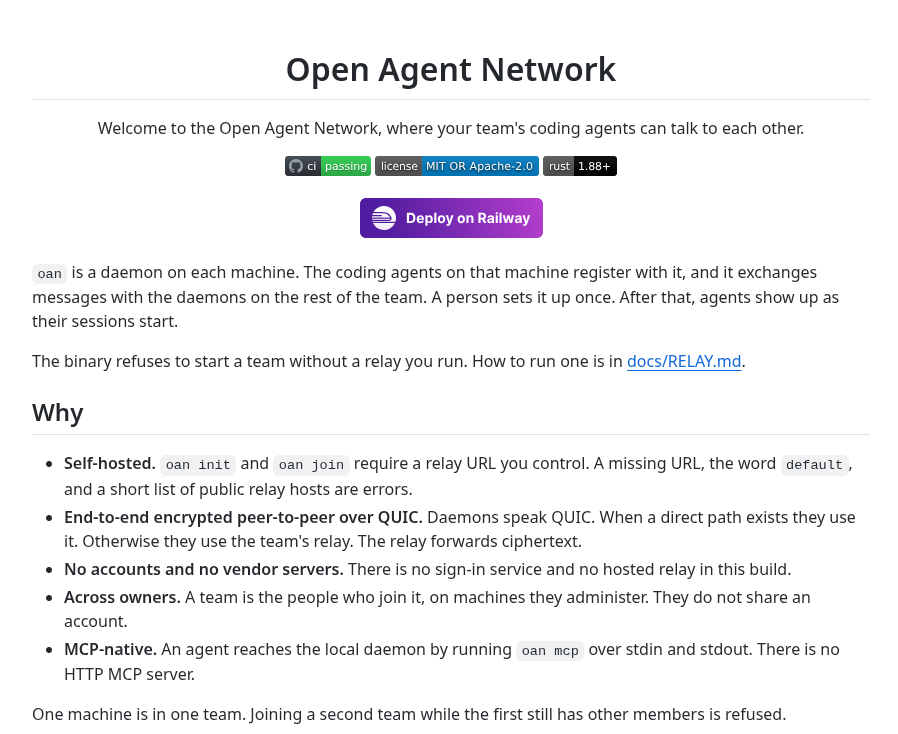
your coding agents can talk to each other now. on your own infra.
open agent network: claude code, codex, cursor, gemini, grok, opencode, deepseek. different machines, different owners, one team.
- you run the relay, the binary refuses to start without one
- e2e encrypted p2p over quic, the relay only sees ciphertext
- no accounts, no vendor servers
- plain mcp, so any agent can plug in
forked from reason network and made fully self-hosted. open source.
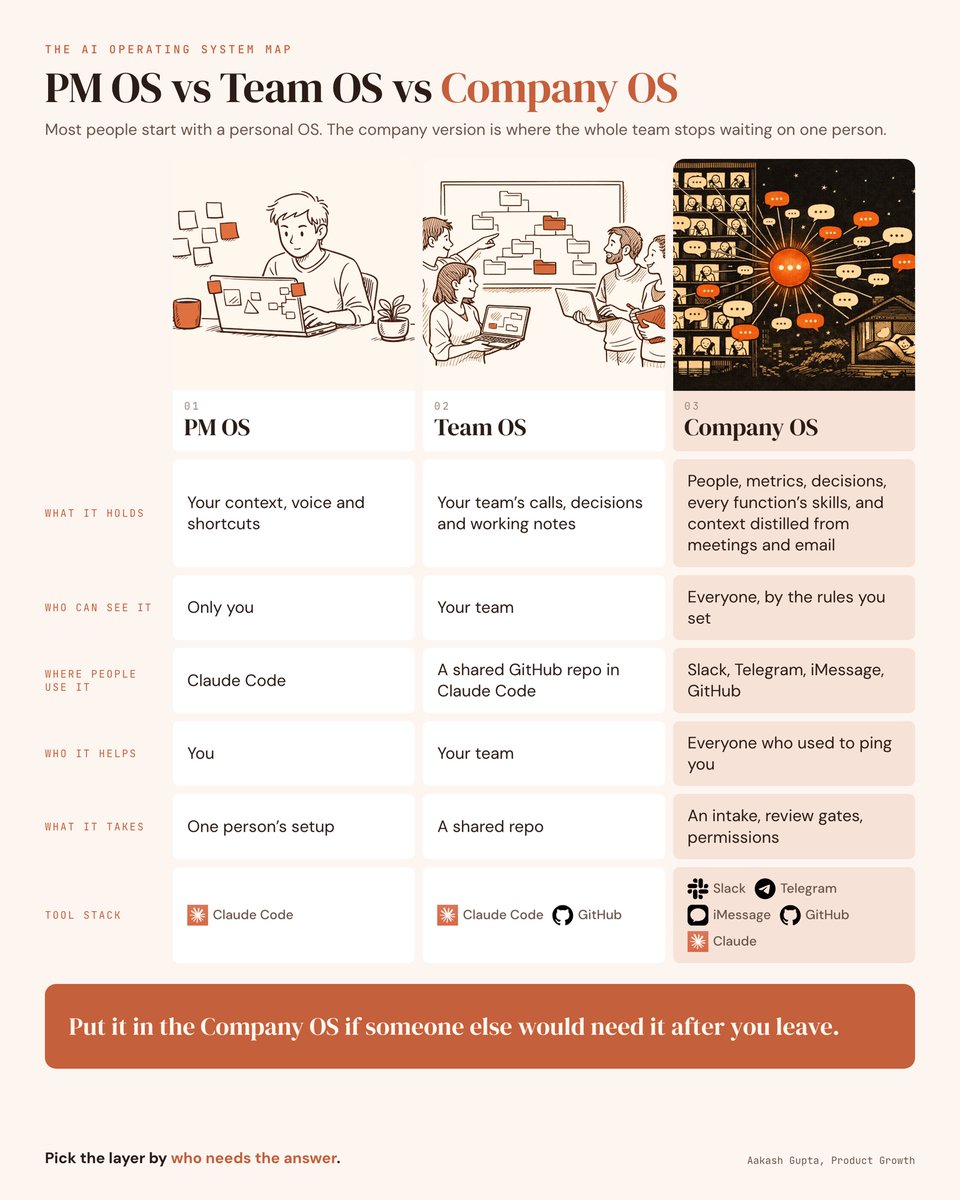
PM OS vs Team OS vs Company OS.
Here's what each one is, and which to build first:
Most people's AI setup still lives on one laptop. It knows their context and their shortcuts, and nobody else on the team gets any of it. Two CPOs I had on the podcast went further. Jiaona Zhang built a harness at Laurel so good that CSMs ship to production. Mikhail Shcheglov made his company's whole system reachable from Telegram.
I've now built all three layers. Here's how they differ.
𝟭. 𝗣𝗠 𝗢𝗦
Your own Claude Code setup.
It holds your context, your voice and your shortcuts. Only you can see it, and only you get faster. Wade Foster, the CEO of Zapier, rated a PM OS "Adoptive" on his AI fluency scale.
Tools: Claude Code.
𝟮. 𝗧𝗲𝗮𝗺 𝗢𝗦
One shared repo your whole team works from.
It holds your team's calls, decisions and working notes. Your team can see it and ask it questions, so the same few people stop answering the same questions.
Tools: Claude Code and GitHub.
𝟯. 𝗖𝗼𝗺𝗽𝗮𝗻𝘆 𝗢𝗦
Shared skills and shared context for the whole company.
Anyone can add a skill they use over and over, from GitHub or Slack, and a human approves every change. It reads meeting transcripts and email, and a security layer decides who sees what. People use it where they already work. Wade rated a complete Company OS "Transformative."
Tools: Slack, Telegram, iMessage, GitHub and Claude Code.
𝟰. 𝗪𝗵𝗮𝘁 𝗮𝗰𝘁𝘂𝗮𝗹𝗹𝘆 𝘀𝗲𝗽𝗮𝗿𝗮𝘁𝗲𝘀 𝘁𝗵𝗲𝗺
Who needs the answer.
If only you need it, it goes in your PM OS. If your team needs it, it goes in the Team OS. If someone else would need it after you leave, it goes in the Company OS.
𝟱. 𝗪𝗵𝗶𝗰𝗵 𝗼𝗻𝗲 𝘁𝗼 𝗯𝘂𝗶𝗹𝗱 𝗳𝗶𝗿𝘀𝘁
Getting pinged all day for context? Start with the Company OS, because that's where the pings come from.
Running a small team that shares one codebase? Team OS.
Just getting started with Claude Code? PM OS, then build up from there.
When my team tried the company version, our partnerships lead got asked for a media kit. The bot read twelve months of sponsor email, found three sponsors who'd asked, and one line in Slack later we had a reviewed PRD, then a live page.
Which layer are you on today?
Another glorified escort profile on Hinge but this one is subtle.
Clues:
-Pic of her in first class; she’s setting expectations
-Eastern European
-Reference to traditional roles & caring about partner’s happiness: she’s looking for a rich beta provider
CHATGPT IS THE CHAT BOX
Not even close
ChatGPT is the chat box
The real stack is the factory underneath
Modern AI apps sit on layers like this:
LLMs → OpenAI, Claude, Gemini, Llama, Mistral, DeepSeek
Agentic AI → LangGraph, CrewAI, AutoGen, CAMEL, Agno
RAG → LangChain, LlamaIndex, Haystack, GraphRAG
Embeddings → OpenAI, Voyage, Cohere, BGE
MCP → models wired to tools, data, systems
AI Security → Guardrails, Presidio, Lakera, Prompt Security
Obs + Evals → LangSmith, Langfuse, Phoenix, Ragas
Memory → Redis, Mem0, Zep, Neo4j, Chroma
Agent SDKs → OpenAI SDK, Semantic Kernel, Google ADK, Bedrock
Automation → n8n, Zapier, Make, Airflow, Prefect
Vector DBs → Pinecone, Weaviate, Qdrant, Milvus, pgvector
These tools only work if they connect
One weak layer breaks the whole system
Your RAG dies if retrieval and embeddings are weak
Your agent dies if tools, evals and guardrails are weak
Your memory is useless if you cannot see when context goes stale
MCP without permissions becomes a liability
They fail where the layers meet:
Model → Retrieval → Context → Agent → Tool → Memory → Eval
A pretty stack can still be a bad system in production
The edge is how the pieces hold together when real traffic hits
Which layer broke first in your last build
$NBIS end goal is more apparent than ever now. They are trying to not simply be a hyperscaler but the full stack alternative to the frontier labs going head to head against them. This will be their pavement to be a trillion dollar giant not another 100000 Blackwells. $NBIS is embedding themselves more deeply into each and every single piece of the open weights stack than most imagined:
PyTorch Foundation: Officially joining as a Platinum Member directly influencing upstream runtime & distributed kernel optimizations. (Read the attached article from Pytorch to understand how deeply $NBIS is being tied to the open source ecosystem and how deeply their co-engineering goes)
vLLM Engine: I met a gentleman who is now a $NBIS fellow in one of the $NBIS developer events who was a part of the original vLLM team And frankly I don’t think he’s the only one. For those who don’t know vLLM the default at scale model serving engine in the market.
LangChain: One of $NBIS customers serving as the core ecosystem powering high throughput production agentic systems.
NVIDIA, Hugging Face & Reflection AI: We all know about how interconnected these are to the open source ecosystem and $NbIS.
While traditional hyperscalers push proprietary walled gardens, $NBIS is co designing anything from bare metal compute to serving infrastructure including serving engines which are high level inference software to agentic infrastructure with the leading players of each layer while the rest of the so called Neoclouds that are tied to the same basket as of $NBIS are still trying to figure out setting up liquid cooled racks.
“Nebius’s Applied AI team contributes inference and post-training optimizations to open-source projects, and its open-source work has been incorporated into the PyTorch Ecosystem. As a Platinum member, Nebius plans to contribute to PyTorch and vLLM performance on the latest hardware platforms and share what it learns from running inference and post-training at production scale.”
-PyTorch
Anyone who still claims $NBIS to be a Neocloud please point out any other company in the said basket that does anything remotely similar.
Source: https://t.co/coS3dtvbmz