There’s a question going round about creative ways to get people adding liquidity to tokenized stocks.
every answer to it is money. print a token, pay it to LPs, hope they stay when it stops.
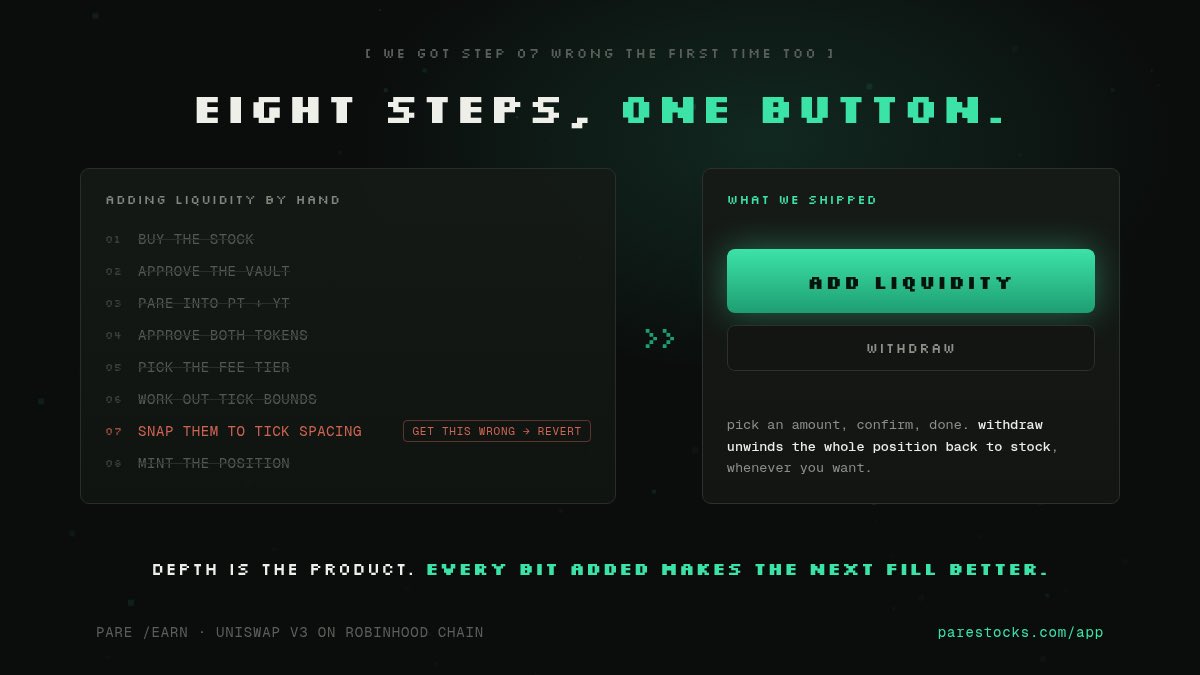
We went at it from the other end and deleted the friction instead. adding liquidity here used to be eight steps and a tick maths problem that silently reverts if you get it wrong. now it’s a button. pick an amount, confirm, withdraw whenever.
and the position is easy to sit in. both sides of the pool are the same stock, one just has the dividend removed, so the pair only moves inside a band about a percent wide.
The interesting part with stocks is you don’t have to print anything to get liquidity in. the yield’s already real, it’s just locked inside the share.
so we cut the share in two. one token holds the price, one token holds the dividend. the yield stops being an emission you farm and becomes something you can buy, sell and LP on its own.
We have AAPL, SPY and QQQ live on RH chain, around $15k of liquidity in the pools already.
Series 03 is live. QQQ, split.
pQQQ is the Nasdaq 100 at a discount. yQQQ is nothing but its dividends. Same terminal, same March maturity, same free merge. Three markets now: AAPL, SPY, QQQ.
We seeded it with $5k of our own QQQ straight into the pools, same as we did for AAPL and SPY. Every market we open, we're first in.
And the next thing opens these markets to everyone. Right now you need tokenized stock before you can touch a split. Not for much longer. Anyone holding crypto is about to have a direct line into real equities and the dividends behind them, in one step, no brokerage and no paperwork 👀
Millions of wallets, three markets, one door. Soon.
https://t.co/oMOmAdwF2v
Appreciate the deep dive, and mostly agree.
On the caps: 1,000 is shares per series, not dollars. That’s about $326k of AAPL and $766k of SPY per vault. It’s immutable per series and was set deliberately small until the contracts are heavily audited. Later series can raise it once that has been completed.
On YT liquidity: agreed, and it’s physics as much as budget. A yAAPL is worth under a cent on the dollar, so the YT pools only deepen as more stock gets pared. We put $8k of our own in today and the EARN tab lets anyone add. The treasury’s split fees go back into the pools, so that’s the flywheel you’re describing.
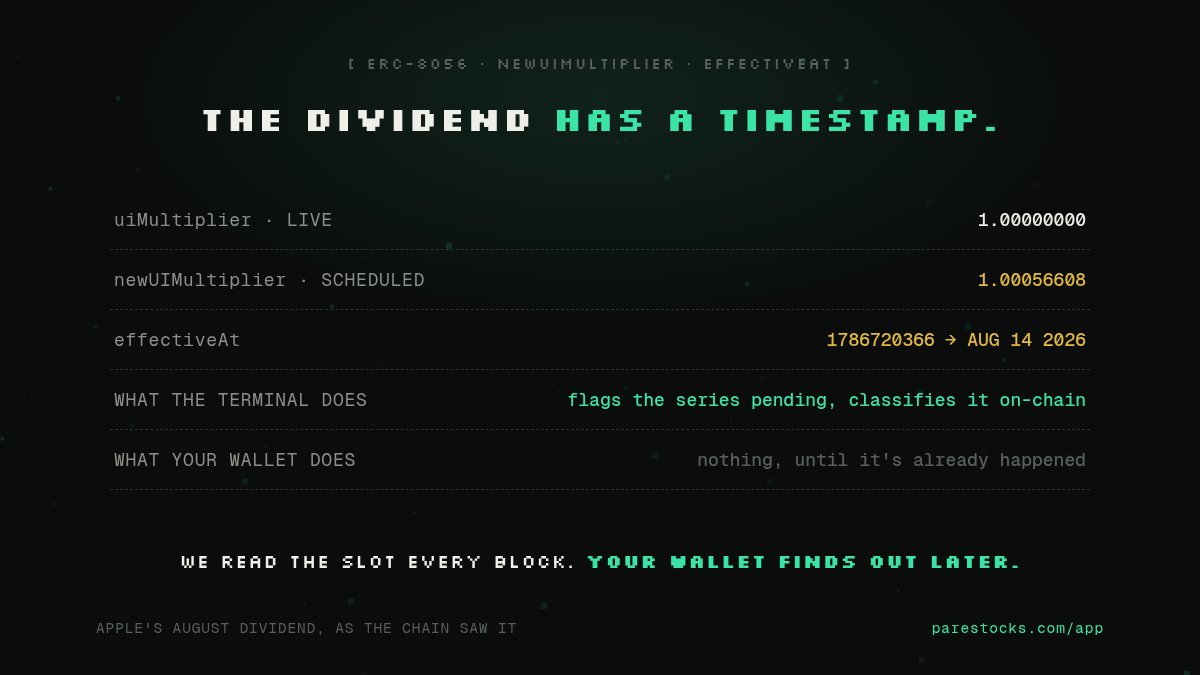
Robinhood Chain tells you about a dividend before it happens.
Every stock token carries two multipliers: the live one, and the next one with a timestamp for when it takes effect. Apple's August dividend sat on-chain as 1.00056608 with a date attached before a single wallet balance changed.
Our terminal reads that slot every block. The moment a dividend is scheduled, the series flips to pending and the event gets classified on-chain. Your wallet finds out later. We don't.
Series 03 is loading. QQQ.
The Nasdaq 100, split the same way as AAPL and SPY: pQQQ is the index at a discount, yQQQ is nothing but its dividends. Contracts deploying shortly, with pools to go with them, seeded the same way we seeded AAPL and SPY.
Same terminal, same maturity, same free merge. Third market in one week.
https://t.co/N5QgFT21Z1
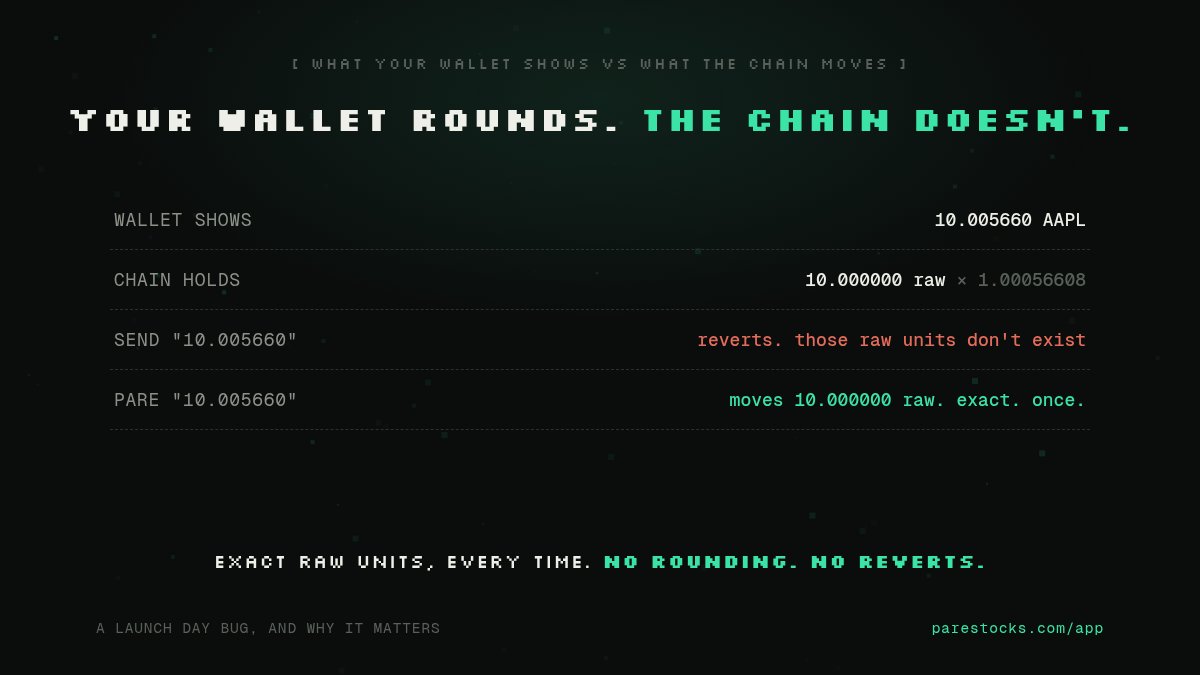
A bug we hit on launch day, and why it matters.
The stock tokens are ERC-8056. Your wallet shows 10.005660 AAPL. The chain holds 10 raw units times a multiplier. Type the number your wallet shows into a transfer and it reverts, because that many raw units don't exist.
So every amount the terminal sends is exact raw units, clamped to what the chain actually holds. No rounding, no reverts, no approving twice. Small thing. It's the difference between a demo and a product.
Rare. Yields are annual but dividends are quarterly, so a 2-6% yielder only moves the multiplier 0.5% to 1.5% per payment. Even PFE at 6.5% a year lands around 1.6%. You’d need a special dividend or a spinoff to reach 3%, which is a years apart event per name.
And when it does fire, merge stays free the whole two days, so anyone who doesn’t like the pending outcome exits to the whole stock and skips the event. Splitting costs a fee. Getting out never does.
Every dividend and every stock split hits the chain the same way: one number in the token contract moves. Our accountant has to know which it was, because a dividend belongs to yield holders and a split belongs to nobody.
So it doesn't guess. Growth under 3% is a dividend. A clean ratio like 2:1 or 3:2, at least 20% from 1, is a split. Anything in between qualifies as neither, so it waits behind a two day public timelock while merge stays free.
The bands can't overlap. That's the whole security model in one sentence.
The reason merge is free: the vault never holds anything except what you deposited.
Split a share and you mint one pAAPL and one yAAPL. At maturity pAAPL redeems the baseline and yAAPL redeems the drip, and the two slices of the pot add up to exactly the deposit. Not approximately. Exactly, by construction.
No reserve ratio, no liquidation engine, no oracle. Just arithmetic that can't come up short.
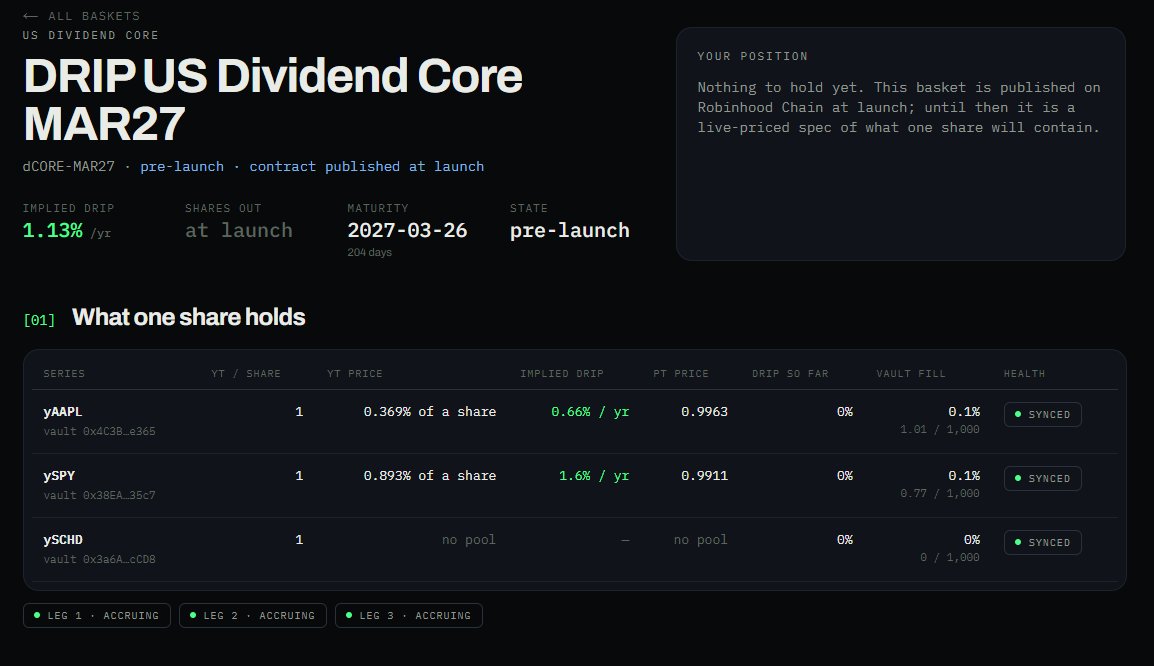
Very cool. @prometheusx91 took PARE yield tokens and built dividend index funds out of them. A US dividend core, a high dividend mix, a tech dividend fund, all just bundles of strips expiring the same day.
This is exactly what splitting a stock is for. The strips are building blocks, and it’s awesome to see someone already building with them. Great work.
This is independent work done by Prometheus, so read their notes before you touch anything. But go check it out.
Built a Dividend Index Protocol on top of @PareStocks for fun. Lets you creating and trade indexes of future corporate dividends using PARE YT. Just a scratch on the surface to what's possible with $PARE
Say you wanted exposure to distributions of a bunch of companies(dividends) without actually buying the stocks of said companies like
yAAPL-27
yMSFT-27
yJPM-27
yKO-27
yXOM-27
you would buy all five into 1 live DIV27, and buying DIV27 essentually exposes you to the dividends on those YTs. lots and lots and lots of doors open, themed markets like TECH-YIELD, BANK-YIELD, SP500-DIV, etc...
Potentially a tradeable market for a load of coporate dividend expectations too(trading on price speculation of DIV27 for example). I'm thinking dividend yield curve too, grouping other indexes like DIV27 together as one curve.
idk, just messing around, I think a whole new ecosystem can spawn from this, a whole new meta.
can be smtg like Basket -> redeem YTs -> sell YTs or
Basket -> YTs -> buy matching PTs -> PT +YT -> OG stock tokens
was very intrigued by the possibilities here
https://t.co/27y8kzVovL
Correct, it's a bet.. dividends paid versus dividends expected, and you win or lose on the difference. Nobody gets a dividend free.
What splitting adds is choice. Holding AAPL is two bets in one ticket, price and dividend. Split it and you can hold either one alone. That's new.
Paying in AAPL instead of a stablecoin means no oracle and no peg to trust. The stock is the unit.
If you know Pendle, you already understand PARE. Here's the family resemblance and the difference.
Pendle proved something important: people want to split yield-bearing assets into principal and yield and trade the parts. They did it for crypto-native yield, things like staked ETH and sUSDe, and at peak there was over $13B locked in that idea. PT and YT, discounts and drips, the whole grammar of yield trading. They wrote it, and honestly, we learned from it.
PARE runs the same split on a different asset class: real stocks.
The yield source is different in kind. Pendle's yields come from staking rates and funding, which float constantly. Our yield is Apple's board declaring a dividend, a discrete event a few times a year, recorded on-chain through the stock token's multiplier. That's why our version needs something Pendle never did: a classifier that can tell a dividend from a stock split, because equities do things crypto assets don't.
The scale ceiling is different too. Crypto-native yield is however big DeFi is. Dividend-paying equities are one of the largest asset classes on the planet, and they're arriving on-chain right now at record pace. Same trade, much bigger ocean.
One line to take away: Pendle is yield trading for crypto. PARE is yield trading for the stock market. If you believed in one, the other is the same thesis with a bigger denominator.
https://t.co/N5QgFT21Z1
The EARN tab is live in the terminal. You asked for it yesterday.
Pick a series, enter how much AAPL or SPY you want in, hit provide. It pares exactly what the pools need, pairs it, and mints both positions straight to your wallet, PT pool and YT pool, in the standard ranges. Every swap from now on pays fees to those positions. Anything the pools don't need stays with you, and there's a withdraw button right under it. No lockup, ever.
We went first. Over $8k of our own AAPL and SPY went in today, and the principal pools now hold roughly $11k, around ten times what they held this morning. The swap tab shows price impact before you sign, so you'll see the difference.
Each series is capped at 1,000 shares while the contracts are young. Plenty of room, and a hard ceiling nobody can bypass.
https://t.co/tPM64OIerr
Fair question. The point is what it costs you.
Holding AAPL for the dividend means putting up $230 to collect about a dollar a year. Buying yAAPL means putting up about a dollar to collect that same dividend. Yes, it's paid in AAPL, so that dollar has price exposure. But it's a dollar's worth of exposure, not $230. You've turned "own Apple, get a bit of yield" into "own the yield, nearly none of the stock." That's a pure dividend bet with roughly 250x less capital...
And the other half is the mirror: pAAPL is Apple at a discount for people who want the price move and couldn't care less about the dividend. The holder who splits gets to sell tomorrow's dividends today.
Paying in AAPL instead of a stablecoin is on purpose. No oracle, no peg, nothing to trust. The stock is the unit.
Sometime in the next few weeks SPY pays its quarterly dividend, and for the first time you’ll be able to watch a real S&P 500 dividend land on a blockchain.
Here’s what it looks like. Nothing arrives in anyone’s wallet. Instead one number inside the SPY token contract, the multiplier, ticks up by a fraction of a percent. Most people will never notice. Our terminal will: the series flips to a pending event, the dividend gets classified on-chain, and every ySPY holder is sitting on the other side of that tick.
Boring for a wallet. A market for us.
Terminal update landing soon too.
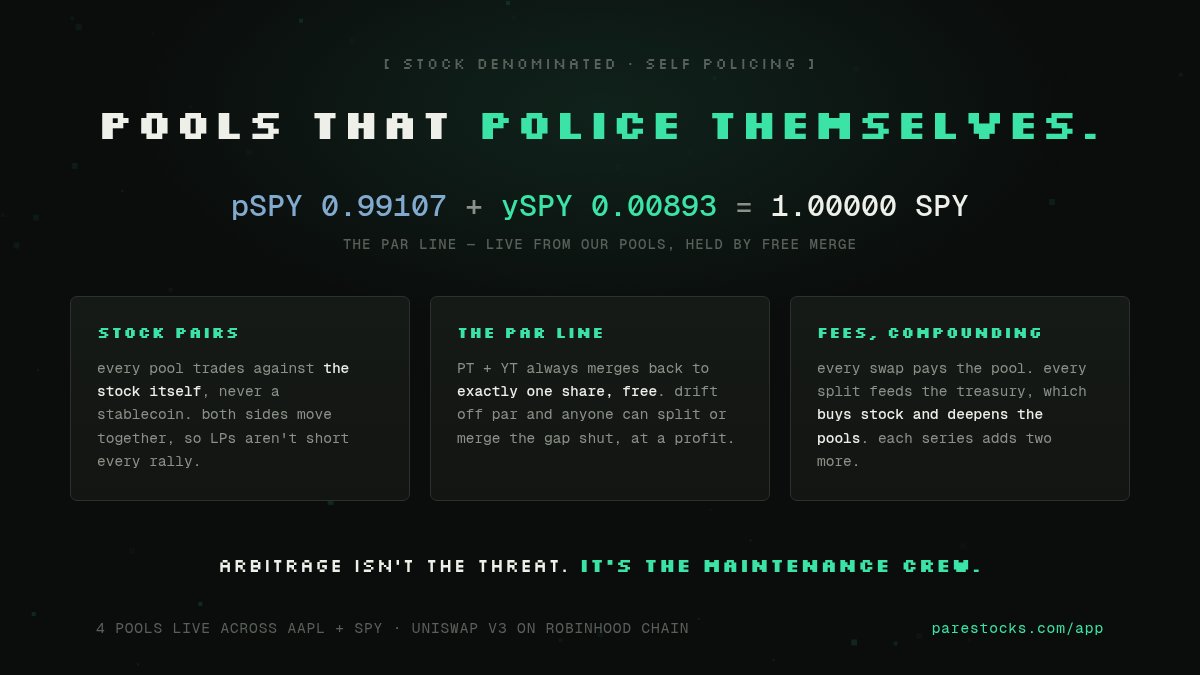
Worth explaining how our liquidity pools actually work, because they're built differently.
Every PARE pool is denominated in the stock itself. pSPY trades against SPY, not against a stablecoin. Both sides of the pair move together, so when the market rips, the whole pool rips with it. LPs aren't short every rally the way they are in a token/USDC pool.
And the pools police themselves. pSPY plus ySPY always merges back into exactly one SPY, free, straight from the contract. If pool prices ever drift off that line, anyone can split or merge and pocket the difference. Arbitrage isn't a threat here. It's the maintenance crew.
Four pools live across AAPL and SPY. Every swap pays fees into them, and every new series ships with two more.
Next two: QQQ. Soon.
Stripping yield from bonds is a $560 billion market off-chain. Pendle did it for crypto and peaked at $13 billion locked. Nobody had done it for stocks. Anywhere. On any chain.
Then we did it. Twice. AAPL and SPY, split and trading, while Robinhood Chain pushes $2 billion a day and grows every week, with more listings coming.
We're not competing for this market. We're the only ones in it.