Dario's essay points towards the right path forward. The details need working through, but the direction is correct for meeting this critical moment.
This is also why we recently put out our proposal for an industry-wide standards body for frontier AI. https://t.co/Mm1hmcaSmH
Physics-based weather models still beat AI when it matters most. Not on average. On the most extreme days.
This is the opposite of what we've been hearing...
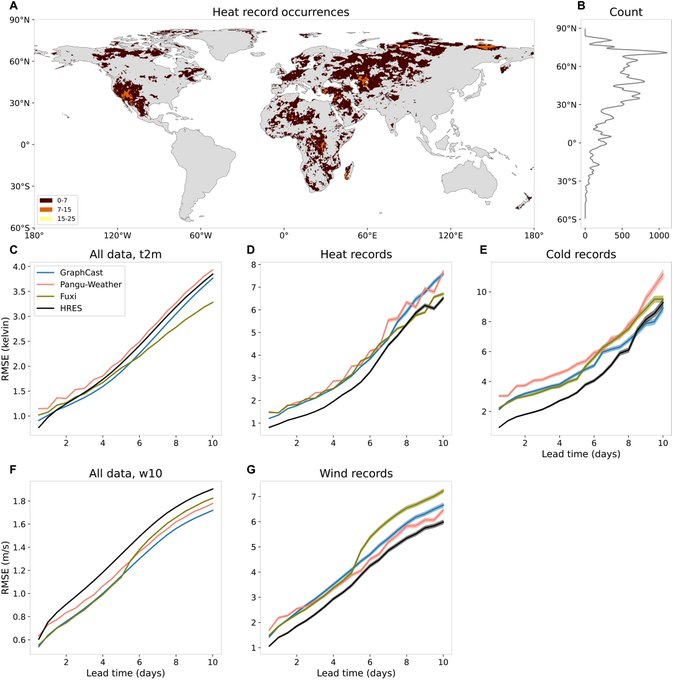
A new paper in Science Advances ran every major AI weather model: GraphCast, Pangu-Weather, Fuxi, against ECMWF's HRES across 162,751 record-breaking heat events, 32,991 cold records, and 53,345 wind records in 2020.
On average conditions, the AI models win. GraphCast, Fuxi, and the rest outperform HRES on standard temperature and wind benchmarks across most lead times. This matches what every prior benchmark study has shown. AI weather forecasting is genuinely impressive.
Then the researchers asked a different question. What happens when the event is unprecedented? Not extreme. Not the 95th percentile. Actually beyond anything in the training data.
HRES won every single category. Heat records. Cold records. Wind records. Nearly every lead time. The performance gap was largest at short lead times, where AI models should have the most information and the least uncertainty.
The bias pattern is pretty massive. The AI models systematically underestimated how extreme the events were. The bigger the record exceedance, the larger the underprediction. The researchers describe it as an implicit 'soft cap': the models behave as if they can't forecast values much beyond the most extreme thing in their training data. The bias grows almost linearly with how far the event exceeded the record. HRES showed no such pattern.
This isn't a fluke. The same result held in 2018 and 2020, which had opposite ENSO conditions. It held across the tropics, subtropics, mid-latitudes, and high latitudes. It held for all three variables. It held when the researchers ran an alternative evaluation specifically designed to avoid the forecaster's dilemma.
The mechanism is pretty straightforward. AI weather models are trained on ERA5 reanalysis data from 1979 to 2017. They learn to interpolate between historical weather patterns. When a new initial condition arrives, they find the nearest analogues in training and produce something in between. Record-breaking events, by definition, have no close analogues. The model has never seen anything quite like this, so it regresses toward the most extreme things it has.
Physics-based models like HRES don't work this way. They solve partial differential equations describing atmospheric dynamics. They don't need a historical analogue for a 48°C heatwave in Siberia. The physics doesn't care whether it's happened before.
The authors are careful about what this means. AI models remain faster, cheaper, and competitive on average conditions. Probabilistic AI forecasting is developing rapidly. Data augmentation with simulated extreme events and hybrid physics-AI architectures are plausible paths forward. This isn't a verdict on AI weather forecasting broadly.
But the policy implication is quite important. The events where AI models fail hardest are exactly the events where accurate forecasting matters most. Record-shattering heat. Unprecedented wind storms. The scenarios that overwhelm emergency response, strain infrastructure, and kill people because no one expected them to be that bad.
The authors wrote it plainly: it remains vital to fund and run physics-based NWP and AI weather models in parallel. I find it an unusually direct recommendation in a methods paper.
Climate change means record-breaking events are becoming more frequent, not less. The training distribution is shifting. AI models trained on 1979 to 2017 data will see more and more out-of-distribution events as the climate diverges from that baseline. The extrapolation problem the researchers identified isn't going away. It's getting harder.
The models that can't forecast records are being asked to forecast a world that's setting them constantly.
Link to full paper: https://t.co/vZ7IV8d5EE
🇮🇹 Il primo del posto a vincere a Monza in 60 anni.
È il vostro momento, fan italiani 😍
🇬🇧 The first local to win at Monza in 60 years.
Your moment, Italian fans 😍
Un territorio que se degrada mientras seguimos mirando hacia otro lado
La Comisión Europea acaba de poner cifras a una realidad que ya no admite excusas: la degradación del territorio y la desertificación avanzan y amenazan seriamente el futuro de nuestros ecosistemas.
El último informe del Centro Común de Investigación (JRC) de la Comisión Europea revela que el 53 % del territorio español se encuentra actualmente bajo condiciones de desertificación, el porcentaje más elevado de toda la Unión Europea. Y el problema no termina ahí: más de un millón de kilómetros cuadrados de territorio europeo presentan un riesgo elevado de desertificación en los escenarios futuros analizados.
No estamos hablando simplemente de una cuestión climática. La degradación del suelo es también consecuencia de cómo utilizamos el territorio: pérdida de cubierta vegetal, transformación de los ecosistemas, incendios, erosión, sobreexplotación y modelos de gestión que durante demasiado tiempo han tratado el suelo como un recurso infinito.
Pero el suelo no es infinito. Los bosques tampoco. El agua tampoco.
Cuando degradamos un ecosistema, perdemos mucho más que paisaje. Perdemos biodiversidad, capacidad de retener agua, fertilidad, carbono y resiliencia frente a sequías, incendios y fenómenos extremos.
Y aquí aparece una contradicción que resulta difícil de ignorar: mientras la ciencia europea advierte del deterioro del territorio, seguimos permitiendo políticas que favorecen la simplificación de los ecosistemas, la pérdida de biodiversidad y la transformación de nuestros montes en territorios cada vez más vulnerables.
La respuesta no puede ser seguir parcheando las consecuencias.
Necesitamos restaurar ecosistemas, proteger los suelos, recuperar bosques autóctonos, reducir la fragmentación del territorio y apostar por una gestión basada en la evidencia científica.
Porque cuando un suelo se degrada, recuperar lo perdido puede llevar décadas o incluso siglos.
Y cuando desaparece una especie, una comunidad ecológica o un ecosistema, no existe ninguna subvención ni ningún decreto capaz de devolverlo tal y como era.
La advertencia está sobre la mesa.
Ahora falta lo más difícil: que quienes toman las decisiones estén a la altura del problema.
Proteger el territorio no es una opción ideológica. Es una cuestión de supervivencia.
Fuente: Centro Común de Investigación (JRC) – Comisión Europea, Towards a better characterisation of land degradation and desertification in the European Union.
https://t.co/zG6xn3G8uc
E se gli scienziati si sbagliassero? Se tra 50 anni scoprissimo che avevano ragione i negazionisti del clima? Avremmo protetto la Terra, difeso la salute umana, salvato specie animali, reso l'aria di nuovo respirabile, ripulito i fiumi dai veleni...e tutto questo per niente?
🌡Limiting global warming to 1.5°C has been the world's North Star for climate action. A critical benchmark against which policies are set and progress is measured.
So, what happens if we breach it?
We break it down➡️ https://t.co/97dAY9oWi4
✅ Relevant, flexible by design, and with clear added value!
The evaluation of the EU Nitrates Directive shows that it is fit for purpose while also identifying opportunities to simplify its implementation.
Learn more 👉 https://t.co/EmM8CXXX9M
#ZeroPollution
Nobel Prize winning economist Kenneth Arrow wrote about "learning by doing" decades ago. He knew that productivity and expertise improve through experience.
The messy, repetitive works is often where you learn the patterns that eventually become judgment. Knowledge can be taught, but judgement is built through lived experience.
The first draft you rewrite. The customer call you listen to. The bug you fix and fix again. The factory floor you walk.
Small decisions you make every day teach you judgement. And, judgement is the thing everyone wants from senior people in the workplace. If we automate away every entry-level task without replacing the learning loop, we are removing a part of the process that creates experts.
The goal should be to use AI to accelerate learning, remove friction, and give people better tools to build expertise faster.
https://t.co/MpFZzCk1An
Thanks @Fortune & @tbove4 for sharing this story. Link in the comments.
Il a changé la façon dont on pense les paysages. Presque personne ne connaît son nom.
J'ai appris avec tristesse la disparition de Dominique Soltner.
Ce nom ne vous dit peut-être rien, mais ses travaux ont transformé la compréhension des paysages agricoles.
UN FIL 1/8
La pretesa di Trump di ricevere il Nobel per la pace non è più ridicola di quella di Vance di insegnare al papa la dottrina della guerra giusta. Non ditemi quindi che è un problema di personalità. È l'hybris di un intero gruppo dirigente che ha perso il senso dei propri limiti
11 miliardi per smantellare le vecchie centrali, lavori fermi al 32% dopo 20 anni e Deposito scorie stimato al 2041. Prima di nuovi reattori, il nodo è il passato. È il bagno di realtà che Arera porta in Parlamento. L’analisi di Simone Collini qui 🔗 https://t.co/Y4kHOwt2Xx
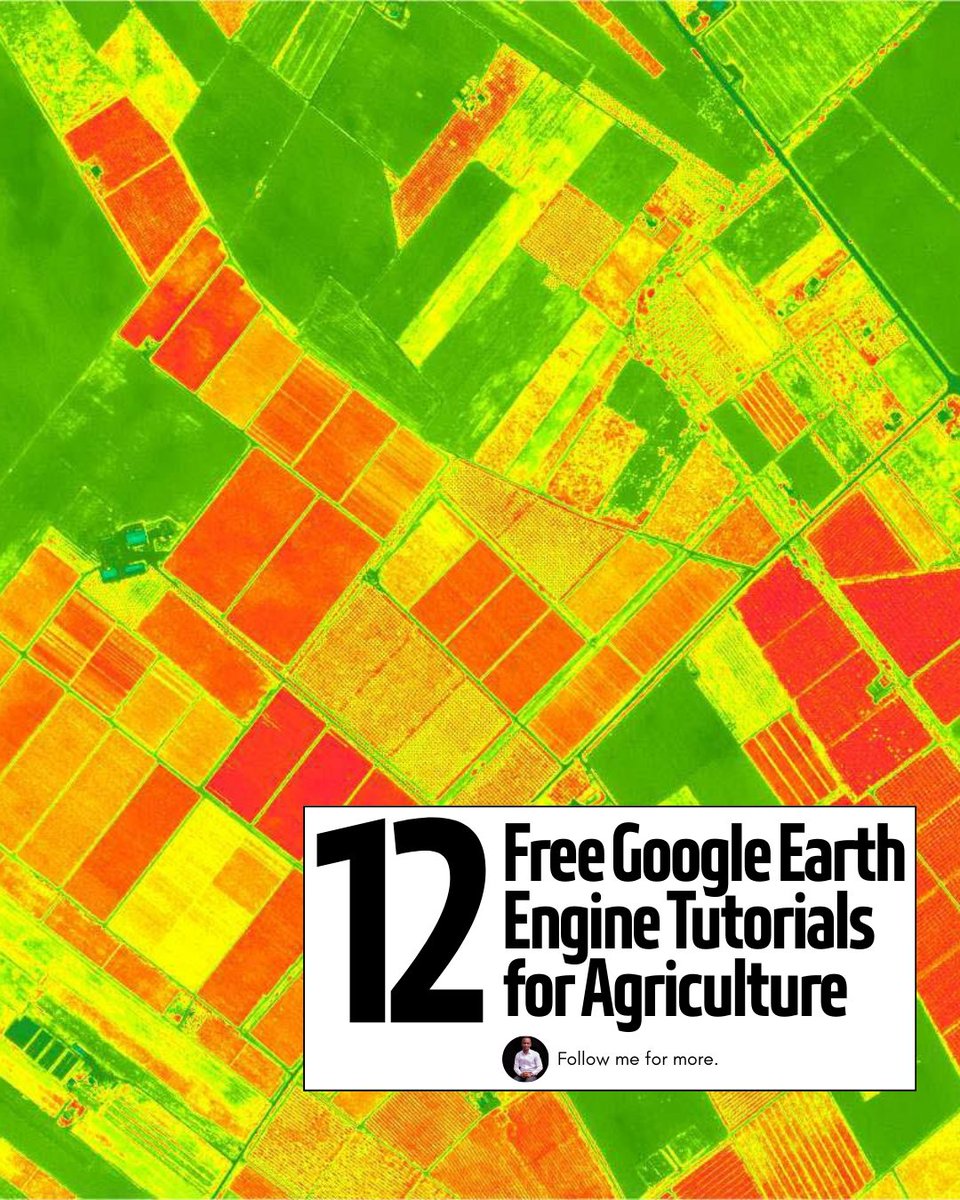
Create Stunning Time-Series Satellite Images in Seconds!
The GEE Data Catalogs Plugin v0.5 for QGIS is now available and it's a powerful upgrade. You can now create time-series satellite imagery with just a few clicks using a simple interface. The new version also supports direct downloads to your computer, making the workflow faster and more efficient.
Key Features:
- Access over 80 petabytes of satellite and geospatial datasets from Google Earth Engine
- Generate animated time-series imagery effortlessly
- Export results directly from QGIS to your local machine
Useful Links:
QGIS Plugin Page: https://t.co/o4wrN44uZr
GitHub Repository: https://t.co/NB4shvrL7b
Video Tutorial: https://t.co/I3UxXTvapi
#QGIS #geospatial #EarthEngine #Python #datascience #satellite