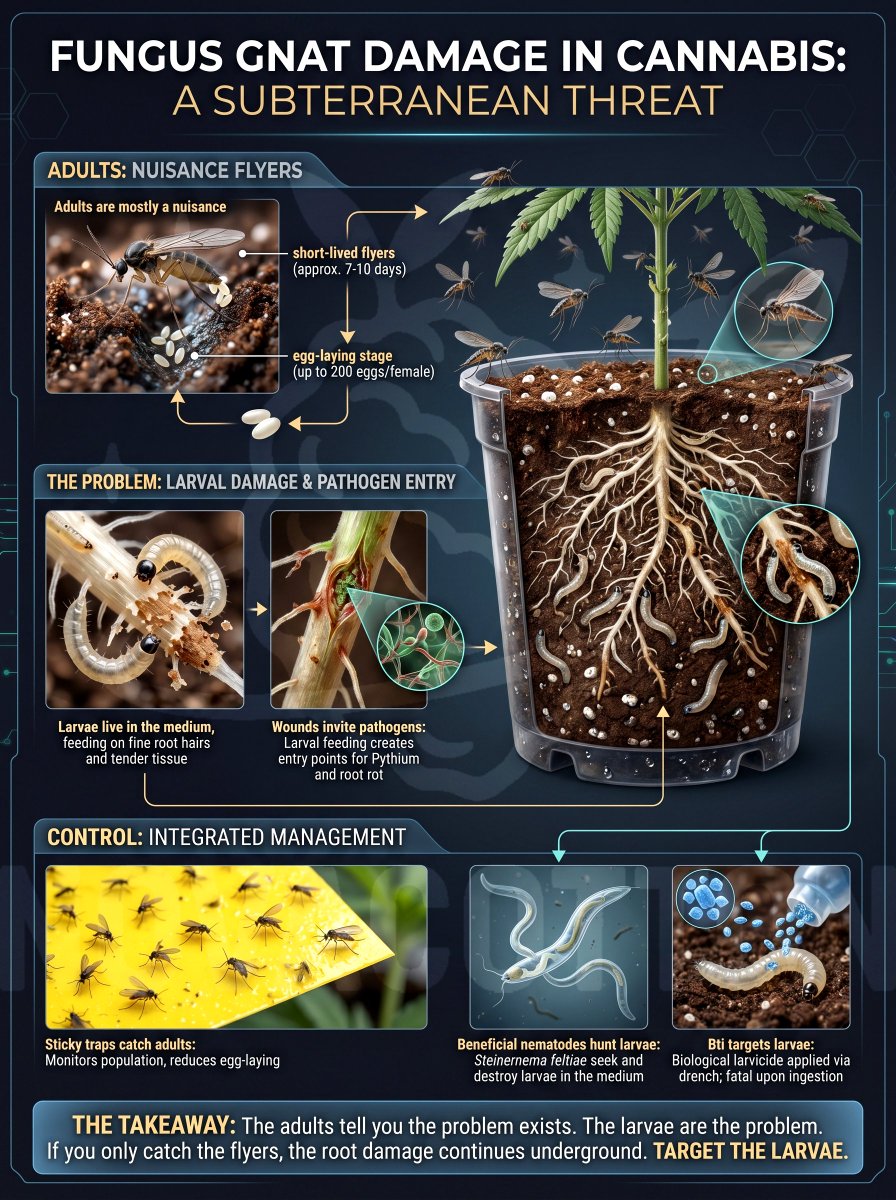
Adult fungus gnats may be a nuisance, but the larvae are the ones truly wreaking havoc O_o bet you didn't know that, did you? While most growers are preoccupied with the pests they can see, they often overlook the hidden threat devouring their root systems. O_O
Adult fungus gnats (Bradysia species) are weak fliers that only live about a week. They don’t even feed on your plants. Their only real job is making more gnats.
In the upper inch of damp soil or coco, females deposit between 100 and 300 eggs. Honestly, I can't imagine living in a reality where creatures like these are actually huge...
The larvae go through four instar stages over roughly two weeks. They primarily eat organic matter and fungal mycelium… but here’s what most people miss :(
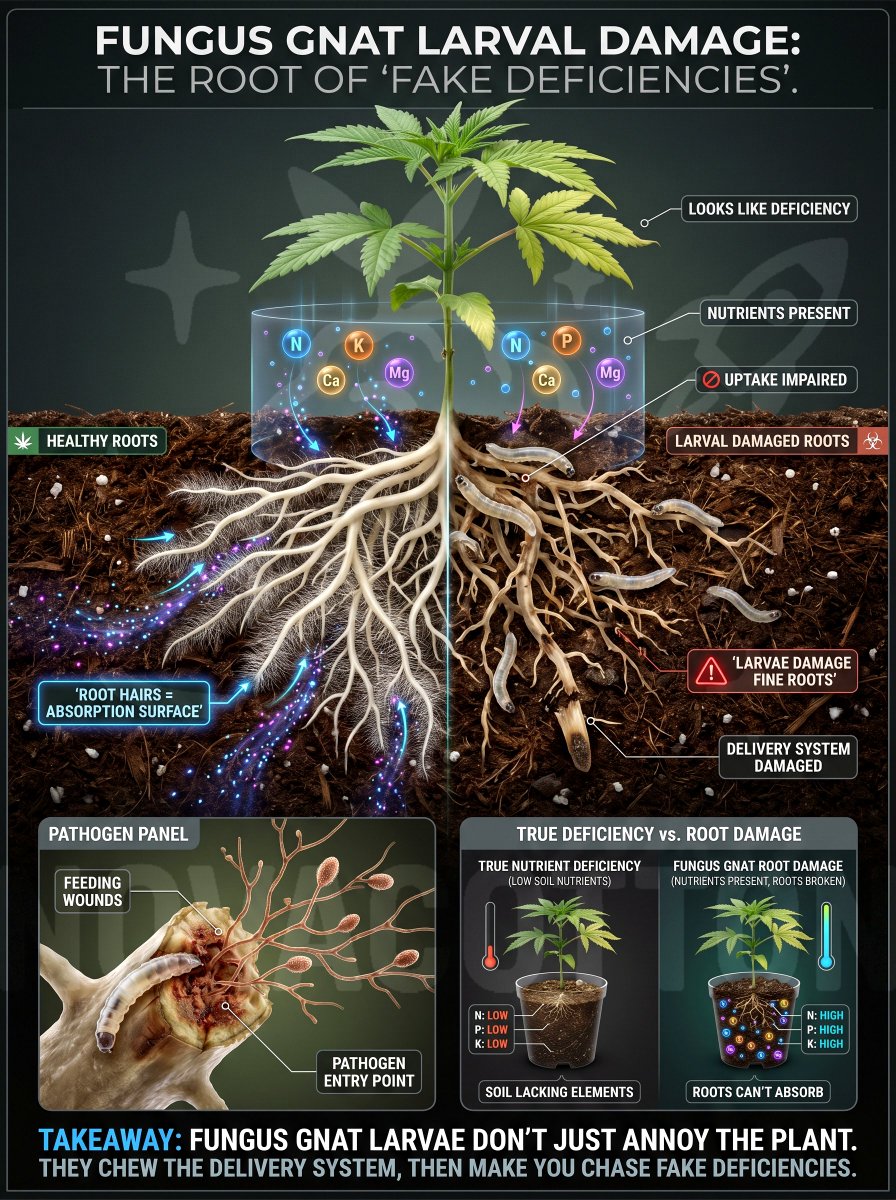
When food is limited, they also chew on root hairs and tender root tissue. This silently destroys the plant’s ability to absorb water and nutrients. The result? Vague, stubborn deficiency symptoms and slow growth that won’t fix no matter how much you feed 😔 because the delivery system itself is damaged.
Even worse, the tiny wounds they create give Pythium and other root pathogens easy entry points.
So those yellow sticky traps you’ve been using for two weeks while watching adults fly around?
They only catch the adults.
The adults aren’t the problem.
The real fix targets the larvae in the root zone!
Beneficial nematodes (specifically Steinernema feltiae) : microscopic worms that actively hunt larvae, enter their bodies, and release symbiotic bacteria that kill them within 24–48 hours. WOOOO :D
Bacillus thuringiensis var. israelensis (Bti) : produces proteins that are toxic only when the larvae ingest them. Completely safe for plants, beneficials, and mammals.
Sticky traps manage the flyers. yes
Nematodes and Bti go after the real villains where they actually live O_o in the medium.
Treat the root zone, not just the air.
That’s where the damage is happening.
Success lies in addressing the source of the infestation! You have the knowledge to defeat this foe! Godspeed!
Keep on Growing O_O
Most people treat coffee like it’s harmless and cannabis like it’s deadly.
But the overdose reality is backwards.
Caffeine has documented direct overdose deaths, especially from pure or highly concentrated products.
Cannabis is not harmless — high THC and edibles can cause serious reactions — but fatal overdose from cannabis alone is considered unlikely by official U.S. sources.
So why is one sold at every gas station…
while the other still carries decades of fear?
Thoughts?
Here's what we have for you today!
44-year study showed Cannabis users showed LESS brain ageing/decline!
Cannabis users show ZERO lasting brain deficits in memory/executive function!
Vitamin D + CBD team up to CRUSH liver cancer cells!
Stay tuned! 😎
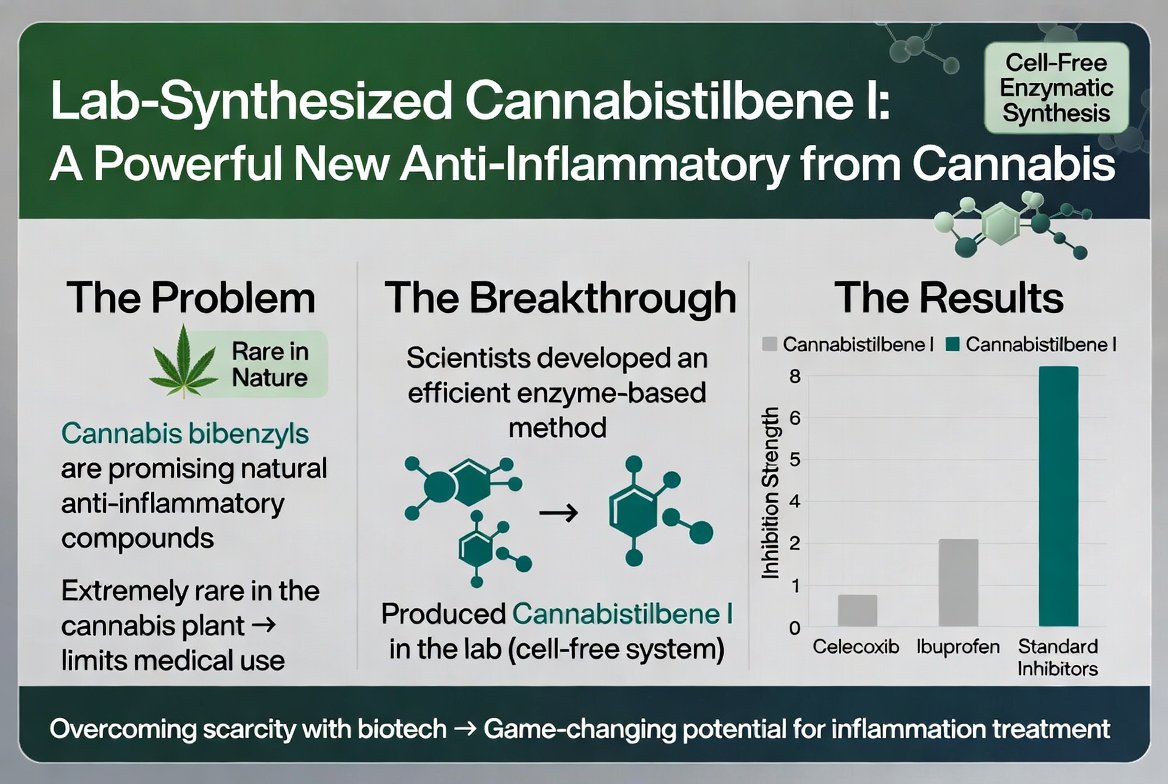
Scientists just synthesized Cannabistilbene I — a rare Cannabis sativa molecule that powerfully blocks TWO key inflammation pathways!
Cannabis bibenzyls are promising natural anti-inflammatory compounds, but they are extremely rare in the plant, limiting their medical use.
Scientists developed an efficient enzyme-based method to produce cannabistilbene I (a key bibenzyl) in the lab.
Cannabistilbene I strongly blocks two major inflammation enzymes — more effectively than leading commercial drugs.
https://t.co/zNK1lDdin9
Hemp is emerging as a sustainable solution for water purification, primarily functioning as a highly effective natural biosorbent.
Its fibrous structure binds heavy metals and organic pollutants directly to its surface, making it an eco-friendly alternative to conventional materials like activated carbon.
Hemp filters water including removal of
heavy metals. Functional groups in hemp fibers (such as carboxyl and hydroxyl) draw positively charged metal ions out of the water. Laboratory studies show that hemp biomass, specifically hemp hulls, can successfully reduce lead by 100%, iron by 97%, and zinc by 95%.
Because hemp is a hyperaccumulator, it can be planted in contaminated wetlands or used in floating ecosystems to actively clean polluted waterways.
Researchers are finding that hemp-based biosorbents perform similarly to conventional carbon filters at a lower cost.
Receipts:
https://t.co/H5MyeQEtUq
https://t.co/YfCnV74i0u
https://t.co/StWVsdCnsq
https://t.co/0EQxJPNTqG
https://t.co/vFMGp8myIZ
https://t.co/b511im65nV