I just got back from SF and I FEEL INSPIRED.
I spent 5 days with frontier AI model teams, AI startup founders, and 3 billionaires.
My takeaways:
1. I had lunch with 3 billionaires. All of them are buying SaaS companies and rebuilding them agent-first. They were deeply inspired by Bending Spoons and Ryan Cohen's eBay deal. Buy the company, cut the headcount, rebuild the tech, add agents, add features, make more valuable experience, raise prices.
2. The frontier model companies are hungry for usage data from the field. They can see API calls and token counts. They can't see the actual workflows. If you're deep in a niche using these models in ways the model companies haven't seen, that understanding is incredibly valuable. Usage intelligence is the new alpha.
3. Consumer AI is massively underbuilt. Every billboard in SF is either B2B inference infrastructure or vertical agent companies. The entire city is optimized for enterprise. Meanwhile you have companies like Cal AI doing $50M ARR in 18 months as a consumer app. I met with a cool few teams doing consumer AI (@paulscherer / @ekuyda)
4. MCP came up in literally every conversation. The companies exposing their product as MCP endpoints are getting pulled into deals they never pitched for. The ones that aren't are becoming invisible to agents. This is the new SEO. If agents can't find you, you don't exist. Building products for agents is the new zeitgeist in general.
5. Not uncommon for hot seed rounds to be $25-50 million valuations. I saw a Series A at $450 million
6. If I had a dollar every time someone mentioned "forward-deployed engineer" this trip I could have funded a seed round. It's the hottest role in SF right now. The person who sits between the agent and the customer, making sure everything actually works.
7. The mood around open source shifted. A year ago it felt like open source was chasing the frontier models. Now founders are telling me Gemma and DeepSeek are good enough for 80% of what they need at a fraction of the cost. The "which model do you use" conversation is being replaced by "which model for which task." Model loyalty kinda feels dead.
8. Voice agents came up more than I expected. Multiple founders told me voice is the interface for the next billion users. The billion people who will never type a prompt will absolutely talk to one.
9. The Obsidian community in SF is weirdly intense. Multiple founders showed me their vaults unprompted. Like showing someone your home gym. It's a flex now. The quality of your knowledge base (second brain?) is becoming a status symbol among builders.
10. Maybe it was just the people I met but the age of the founders is shifting. I met more founders over 40 this trip than any trip before and more founders under age 21 than ever before. Founders getting older and younger at the same time.
11. I spoke to a lot of fast-growing startups, VCs and frontier models who are hiring content creators right now.
12. The restaurant scene in SF is actually better than it's been in years. Founders are going out more. Alcohol is out, not surprisingly.
13. SF doesn't feel like the only place anymore. We all have access to the same frontier models. We all read the same X feed. A founder in NYC or Lagos is calling the same APIs as a founder in SoMa. So in the past it felt like SF was always lightyears ahead, doesn't feel that way anymore. It's okay not to live in SF and have BIG DREAMS.
14. The coworking spaces in SF are half empty but the coffee shops are packed. People want to be around people. I had a few startup ideas here....
15. Walking around the Mission I noticed something: the street-level businesses, the taquerias, the barbershops, the laundromats, none of them use any AI at all.
16. I heard the phrase "agent debt" for the first time. Like technical debt but for agents. When you hack together an agent workflow fast and never clean it up, the system prompts conflict, the memory gets polluted, the tools overlap. 6 months later the agent is doing weird things and nobody knows why lol.
17. Met a few people who carry two phones now. One for personal. One that's basically an agent terminal running Telegram or iMessage connections to their agent fleet.
It's always amazing to get that dose of inspiration in SF. I FEEL INSPIRED.
But I'm so happy to be back home, locked in and building.
We're 12-18 months into a shift that will take 15 years to play out. The urgency in every conversation was real.
What an incredible time to be building.
@mcuban Ok so basically, the ultimate race of this decade is whether the AI Native can figure out distribution before the Big Incumbent can figure out agility. Right now, the AI Natives are moving way too fast for the incumbents to react.
karpathy just broke the internet with something called auto research
it’s basically an ai research agent that runs experiments for you 24/7
you give it a goal like
“make this model better”
“find a higher converting landing page”
“lower customer acquisition cost”
then it runs a loop:
1) plan an experiment
2) edit the code or config
3) run a short test on a gpu
4) read the metrics
5) keep the winner
6) try again
over and over
while you sleep
by the morning you wake up to the best version
actual tested improvements
think of it like a robot research intern that runs hundreds of experiments and only keeps the winners
this is link to his repo https://t.co/hm9aFyXQZS for your to mess around with it
in the latest episode of @startupideaspod
i break down:
• what auto research actually is
• how it works step by step
• 10 business ideas you can build with it
• how to install it and start using it
this one is saucy
because tools like this change how startups get built
watch
Still haven’t gotten around to pampering my OpenClaw agents to do everything for me yet, but here’s a reminder of what “software on demand” really feels like today.
Needed to edit slides generated by NotebookLM (awesome tool btw) and export the PDF to PNG. Acrobat locks that behind a “Pro” paywall; subscription expired. Instead of re-upping for one checkbox feature, I asked Claude Code to spin up a tiny converter.
Three minutes later I had a local web app that did exactly what I needed and took me about the same time it would’ve taken to reactivate Adobe.
Agents may be trendier, but small self-service automation still feels pretty damn good.
For millennia, jocks ran everything.
The nerds finally take over.
And what do they do?
Develop AI that wipes out their own coding/math/analysis moats.
Creating a social premium on interpersonal skills.
The irony.
In his latest chat with Joe Rogan, @elonmusk painted a picture of a future where AI anticipates and generates everything we consume.
Like his other predictions, there's a good chance something 50% similar happens in a 2-3x longer timeframe (10-15 years).
But if that seems too Sci-Fi, what I believe is inevitable is a fundamental shift in how we not only consume but produce and disseminate knowledge.
Many top minds believe we're still a decade from true creative AI; the kind that can produce a new idea without seeing an example first. If that's true, the burden of creativity remains on us. To keep our edge, we must leverage what GenAI can do now, and that means cutting our outdated practices.
The first unlock happens when we can truly trust the AI's results. This will start with full traceability, allowing us to double-check the outputs. That baseline will improve quickly.
The next, bigger step is to abandon the "document" as the primary format for knowledge.
That's when the real potential is unleashed. It's when we stop wasting human AND compute resources authoring PDFs that are mainly read by other LLMs, which in turn produce more PDFs for humans to superficially audit.
My prediction? Within Elon's timeframe, a good portion of knowledge will be stored in structured, verifiable memories. Our questions and needs will determine the interpretation of core facts contributed by others.
We'll just lay out the facts. Our "assistants" will handle the rest.
#FutureOfAI #KnowledgeGraphs #ClaimGraphs #Deepentix #GenerativeAI #DeepTech
https://t.co/wGlbbJVsHJ
I stole this idea and now use it with every single employee.
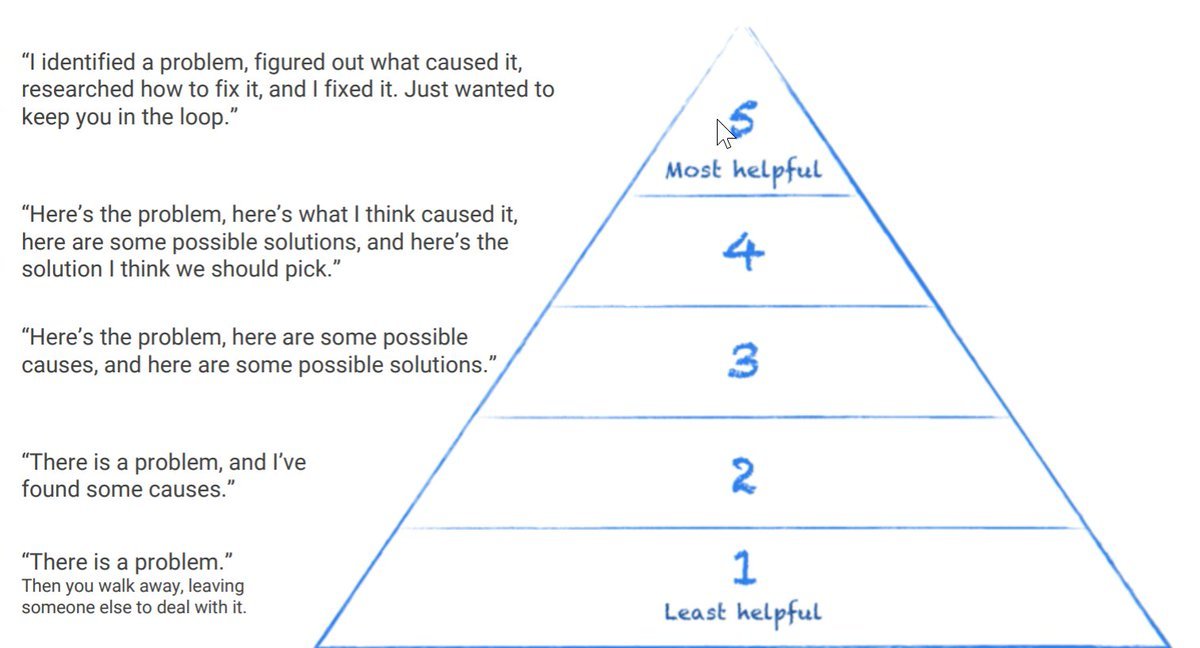
It’s the best illustration I’ve seen of teaching someone to be high agency.
It says there are 5 levels of work:
Level 1: “There is a problem.”
Level 2: “There is a problem, and I’ve found some causes.”
Level 3: “Here’s the problem, here are some possible causes, and here are some possible solutions.”
Level 4: “Here’s the problem, here’s what I think caused it, here are some possible solutions, and here’s the one I think we should pick.”
Level 5: “I identified a problem, figured out what caused it, researched how to fix it, and I fixed it. Just wanted to keep you in the loop.”
Using this framework, here’s what I say to every new employee…
You will live at Level 4 from Day 1 and as we build trust you will rise to Level 5.
Being high agency doesn’t just mean tackling problems in this way. It means your entire way of working should be oriented to being a Level 4+ employee.
Plz feel free to steal it as well.
And ty @stephsmithio for the framework!
There is a significant need for "last mile" agencies.
Advancements in coding assistants are impressive, but a substantial gap remains between AI-generated code and production-ready applications.
Until this gap closes, AI coding assistants enhance developer productivity but do not empower non-technical entrepreneurs to confidently create sophisticated software independently.
You can now obtain a detailed software architecture plan with over 30 artifacts and a deployment guide from a single prompt using Claude's latest coding model. However, debugging and ensuring it works require genuine expertise.
As a father of young kids and a big advocate for using GenAI in life, business, health, and career, I am always keeping an eye out for its potential negative effects on my children's development. I'm going to share my observations, both negative and positive, on various aspects of AI in parenting every now and then.
The case of generating songs using text-to-music tools:
Preamble: I am a fan of Suno for this task. Their V4 definitely is closing in on human-level voice quality. Lately we've been generating songs about my kids' favorite toys. I must say, It's still a bit weird for me that what we are singing along with is generated by AI and not a human. I catch myself signing to the song, but then feel awkward about it.
My worry: Our first child, a first grader, loves singing. She also loves making up her own silly songs and having a blast with them. I was worried if they get used to having on-demand songs "created" for them, would it limit their creativity and demotivate them for making up songs themselves?
My observation: I seem to have been wrong. She keeps singing a couple of Suno's songs about her plush toys, and extends them to her other favorite toys. It seems the fact that she is now able to hear a "professionally" created song about a subject that is personal to her, she dares to do the same herself.
Now it's time to start worrying about something else... :)
AI startups are booming, but marketing & sales are the real battleground.
GenAI helps with content, but execution still needs human expertise.
With intense price competition, traditional agency fees are tough for early-stage startups.
I'd partner with marketing pros offering success-based/profit-share models, not hourly/project rates.
Christmas keeps giving for AI enthusiasts!
Just when OpenAI unveiled their Canvas feature to the public, making me consider a switch from Gemini back to ChatGPT, Gemini counters with their Deep Research feature, with direct export to Google Docs. It hasn't been even a month since a team from Stanford introduced their Wikipedia-style research tool.
The amount of innovation and parallel development in GenAI solutions right now is mind-blowing. Users are the clear winners. However, for AI entrepreneurs, the competition feels like daily obliteration.
I'd still focus on niche target groups with a distinct value proposition to make my mark in this battleground.
I’m the CEO of a $100 million business.
But the first 10 years of my career:
• Rejected by Google (2x)
• Fired by FB after 9 months
• Built 10+ startups that didn’t work out
Here are 18 pieces of brutally honest career advice (I wish I knew earlier):
🚀 #AhaSend is now live on #ProductHunt! 🎉 Deliver your emails to the inbox with our Pay-as-You-Go transactional #EmailAPIs. Our mission: To make transactional emails faster, easier & more affordable for everyone. Check us out and leave your feedback! ➡️ https://t.co/YQLIeq54MH
1st time founder: "I got a great idea for a startup so bought the domain and already started building everything to handle scale."
2nd time founder: "I got great feedback from customers about how to solve their problems so started building an MVP."