My salute to the Indian pilot Captain Smit Machchhar for his extraordinary bravery.
Despite being stabbed and seriously injured, he fought back, resisted, opened the cockpit door, and enabled passengers and crew to overpower the attacker — preventing a catastrophic mid-air disaster.
He saved the lives of 174 people, including Israeli citizens and other nationals.
I wish Captain Machchhar a speedy and full recovery.
He is a true hero.
Indian defence procurement is sometimes a joke beyond rescue. An order for a measly *59* Zorawar light tanks, developed by L&T & DRDO to address an urgent need in Ladakh, has now been split, with this tiny order split into an Mk1 & Mk1A types. https://t.co/dFkc3WrRtA
🔴L&T provided Product in world fasting speed. Order 18, QR changed
🔴Bharat Forge provided Garuda 105 with all tests completed. Order 0
🔴QRSAM all tests succeeded, Order 0
🔴Solar Industries, Bhargavastra ready, Order 0
🔴WHaP ready by TASL , Order 0
It seems the reply of Indian Industry is want @adgpi@DefenceMinIndia to provide orders than lectures at seminars.
Everyone frames our coal story as a climate problem. There's a quieter industrial angle nobody talks about. We're putting 37,500 crore into coal gasification, turning domestic coal into syngas, then ammonia, then urea. The real point is the fertiliser feedstock. Urea today leans on imported LNG, and every gas price spike abroad lands straight on the farm subsidy bill. We paid double the market rate for urea during the last energy shock. Coal we have a billion tonnes of. Whether it's the cleanest route is a fair argument. But swapping an import you can't control for a resource you're sitting on is a logic older than the climate debate.
This is the interesting part about Amul milk at Costco in the US.
Amul is not shipping milk from India to America. Amul partnered with Michigan Milk Producers Association (MMPA), a 100+ year-old American dairy cooperative.
American farmers provide the milk.
MMPA brings the local dairy infrastructure.
Amul brings its technology, formulation and brand.
And the finished Amul Gold 6% milk is now sitting in Costco refrigerators. 🇮🇳🤝🇺🇸 That’s a pretty smart way to take an Indian food brand global.
Make it locally. Brand it globally.
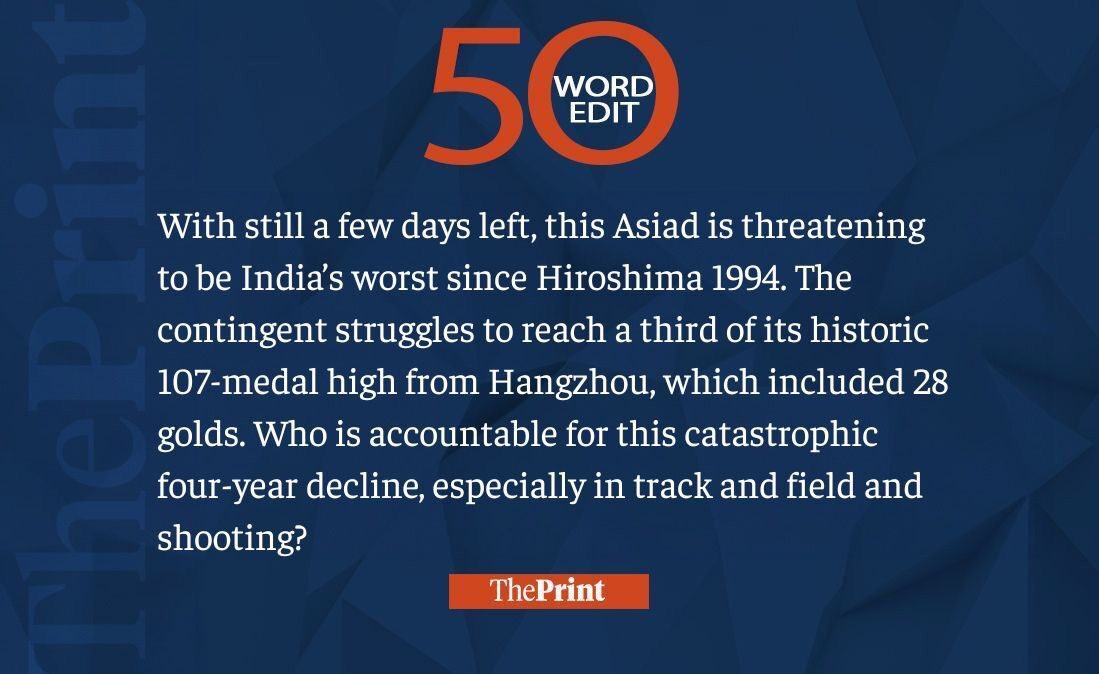
Asian Games 2026 should force Indian sports to ask some uncomfortable questions.
Shooting, badminton, athletics were among the disciplines where we expected India to compete strongly. Yet the performances so far have raised serious concerns, especially when compared with what we achieved in 2022.
Shooting alone brought us 22 medals in 2022, including 7 Gold. Badminton delivered 3 medals, athletics 29 and equestrian 2. Four years later, instead of seeing the progress we were promised, we are seeing worrying signs of regression in some of our key disciplines.
This is not about blaming athletes. They deserve our support. But who takes responsibility for the system behind them?
Four years is a long time in sport. Where did the preparation go wrong? Are selections, fitness, coaching, support staff and high-performance programmes actually delivering?
And the biggest question of all: where is the accountability for the money being spent on Indian sport?
We cannot keep celebrating funding, infrastructure and big promises while avoiding hard questions when performances go backwards.
@Media_SAI@BAI_Media@afiindia
The athletes deserve better. Indian sports deserves answers.
#AsianGames2026 #IndianSports
The government has quietly told 112 factory power plants to stop being factories for a while and start feeding the grid. Vedanta, Tata Steel, JSW, Hindalco, Reliance, even the refineries. Anyone with a captive plant above 50MW now runs flat out through December and reports its coal stock to Delhi every week.
The trigger is El Nino. Around 40% of coal plants are sitting on critically low fuel, and demand hasn't cooled the way the calendar promised.
What catches me is the law they reached for. Section 11 of the Electricity Act was almost never invoked before 2022. This is the second time in four years. A clause written for genuine emergencies is quietly becoming a seasonal tool.
That tells you two things. The grid margin is thinner than the capacity charts suggest, because you don't conscript private plants when you have slack. And captive generation, which everyone files as a company's private backup, is now part of the national reserve in all but name. We built it as insurance for one factory and it has ended up as insurance for the whole system.
The capacity total looks comfortable. The fact that we keep reaching for an emergency clause says the story is the buffer, not the number on the chart.
Cashless health insurance is legally sanctioned house arrest.
The doctor officially discharges you at 9 AM. You are fully recovered, your bags are packed and your family is ready to take you home.
Then the hospital administration steps in: "Sir, the insurance TPA approval is pending. Please remain seated in your room until we receive the final payment."
You then spend the next 8 to 12 hours held hostage in a ₹15,000-a-day hospital room.
You are no longer a patient but you are collateral. The hospital doesn't trust the insurance company to actually pay, the insurer is deliberately stalling to find a typo in your medical history to reject the claim and you are stuck in the middle of a corporate standoff.
We live in a country where UPI settles transactions in 300 milliseconds and automated trading algorithms move crores in a microsecond.
The system is designed to exhaust you. They want you so frustrated and desperate to go home that the next time you get sick, you just pay the cash upfront and file for a reimbursement which they will conveniently reject 45 days later citing "insufficient documentation."
If my policy is active and the hospital is in-network, the final discharge should be an instant and automated API settlement. Man I paid insurance company for this service.
Until we force insurers to adopt automated clearing, stop calling it a cashless facility.
Call it what it actually is: an extortion racket with a waiting room.
India the Perennial Soft State
The decision to let American covert operative Matthew VanDyke and six Ukrainian drone specialists quietly leave India is more than an isolated legal reversal. It belongs to a long and uncomfortable tradition in which New Delhi invokes its tough criminal laws and then retreats when geopolitical pressure builds up.
VanDyke, a veteran of covert wars in the Middle East and Ukraine, was arrested in March alongside six military-trained Ukrainian partners. According to Indian court filings, the group belonged to a larger international network that smuggled drones into India before routing them onward to Myanmar. The National Investigation Agency initially invoked the Unlawful Activities (Prevention) Act, India’s premier anti-terrorism statute.
Then came the dramatic climbdown. After U.S. Secretary of State Marco Rubio personally raised VanDyke’s detention with New Delhi, the NIA dropped the UAPA charges. VanDyke and all six Ukrainians have now been released on bail and permitted to return home.
The episode recalls a familiar pattern. From the Bhopal gas disaster and the Purulia arms-drop affair to the Enrica Lexie Italian-marines case and Ottavio Quattrocchi’s escape in the Bofors scandal, India has repeatedly seen high-profile criminal proceedings against foreign nationals or entities diluted, abandoned or rendered inconsequential under diplomatic or strategic pressure.
Different cases, different Indian governments, but the same question endures: What makes India such a soft state that it so often fails to enforce accountability when powerful foreign interests are involved?
If the Gandhi's were not in the Congress leadership, India, BJP, Modi-Shah, political opposition will all be in a better place; We should discuss OPENLY & without malice or prejudice. There is NO precedent for such a long rule by a single family anywhere or anytime in the world.
McDonald's is spending 8.5 billion dollars to find out why families stopped coming.
I can save them the 8.5 billion.
They took out the playground.
The plan, announced Wednesday at investor day. Better food, faster service, new equipment, AI tools, hospitality training, and a bigger push into chicken and beverages. They call it Next. The goal, they say, is making customers feel more comfortable.
Wall Street loved it so much the stock fell 5 percent to its lowest since 2022.
Over five years McDonald's shares are down 3 percent. Burger King's parent is up 14. The owner of Taco Bell and KFC is up 13.
This is not a hamburger problem. This is a McDonald's problem.
So let us talk about who used to eat there.
Parents. That was the whole business. Parents at 5:40 on a Tuesday with three kids in the back and nothing thawed at home.
You did not go for the burger. You went because your kids could run screaming through a plastic tube for 40 minutes while you sat with a coffee and experienced silence.
That was the product. The food was the cover charge.
The first PlayPlace opened in 1971 in Birmingham, Alabama, and for fifty years it did one job. It made small children demand to go to McDonald's.
Then 2020 arrived, every play area in the country closed, and a great many never came back. The equipment came out during a remodeling program named Experience of the Future.
The Experience of the Future turned out to be a touchscreen.
Their own chief executive said he did not know if ball pits were in their future.
Sir, you were not selling ball pits. You were selling forty minutes.
So now there is no counter, no playground, and no reason for a seven year old to want to go. A screen, a window, and a bag.
And for that we pay prices that require a moment of reflection in the parking lot.
For thin, overcooked, oddly uniform pucks that taste like a memory of beef.
I did not love them because they were good. I loved them because I was eight and there was a slide.
And have you seen the new buildings.
The old ones were unmistakable. Red roof, yellow arches, legible from a highway at 70 to a child who could not yet read.
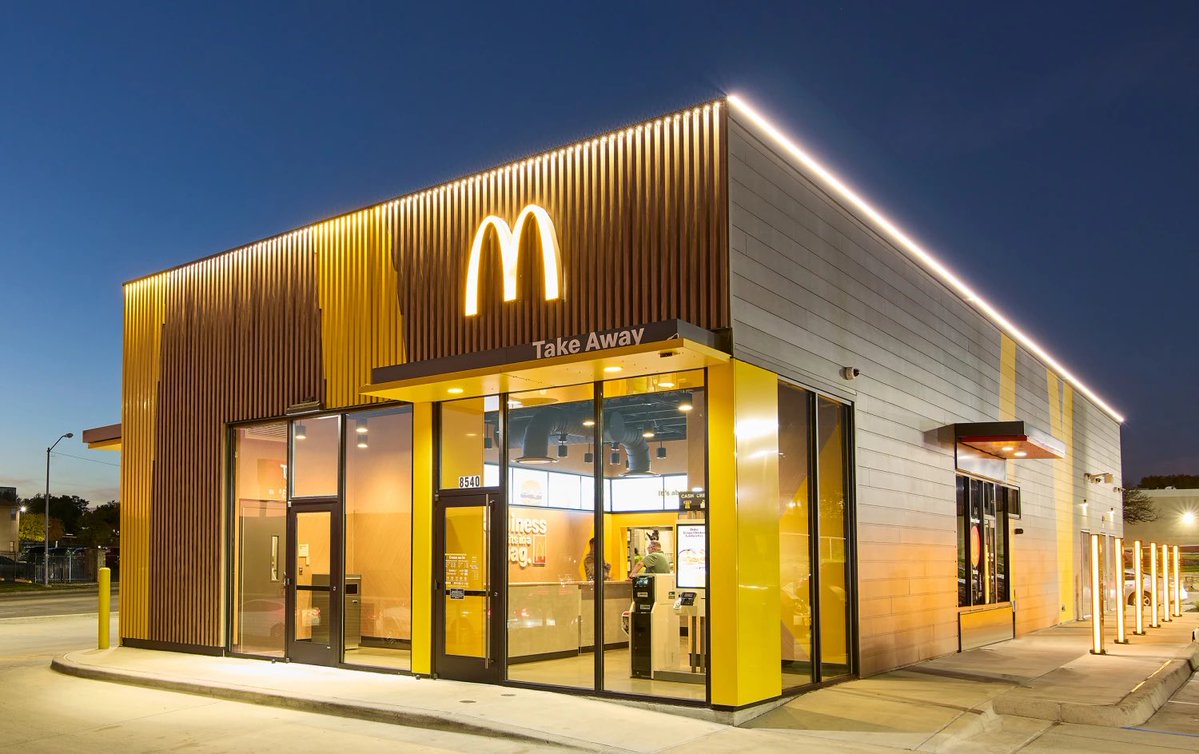
The new ones are a flat gray box with a small logo and a drive through wrapped around it. A regional claims office with a fryer.
They removed the color, the characters, the counter, and the playground, and then hired consultants to find out why it no longer feels like anywhere.
Which is why, when I have to eat fast food, I go to Chick-fil-A.
Not for the politics. For the competence.
They have led the customer satisfaction index for fast food eleven years running, and average 8.5 million dollars per location against McDonald's 4 million.
More than double, while closed on Sundays. Fifty two days a year with the lights off, and still double.
A seventeen year old hands you a bag and says my pleasure and means it about 70 percent, which is 70 percent more than a touchscreen has managed.
McDonald's is spending 8.5 billion on hospitality training.
Chick-fil-A earns 8.5 million per restaurant by just having some.
So here is my consulting proposal, free of charge, on behalf of mothers everywhere.
Put the playgrounds back.
Not a nostalgia campaign. Not a retro cup. The structure. Tubes, slides, a door the kids cannot open from the inside, and a bench where a tired woman can sit.
And understand what you are buying, because it is not lunch.
A six year old does not know your food is bad. He has no basis for comparison and no functioning palate. He thinks the burger is incredible because he is standing in a castle made of tubes.
That is the window. That is the only window you get.
You catch them before the taste buds arrive, and thirty years later they drive past your sign, feel something they cannot explain, and pull in anyway.
That is not a menu strategy. That is imprinting, and you shut it down in 2020 to save on cleaning.
Eight and a half billion dollars for AI tools and hospitality training.
Or a slide.
🦋
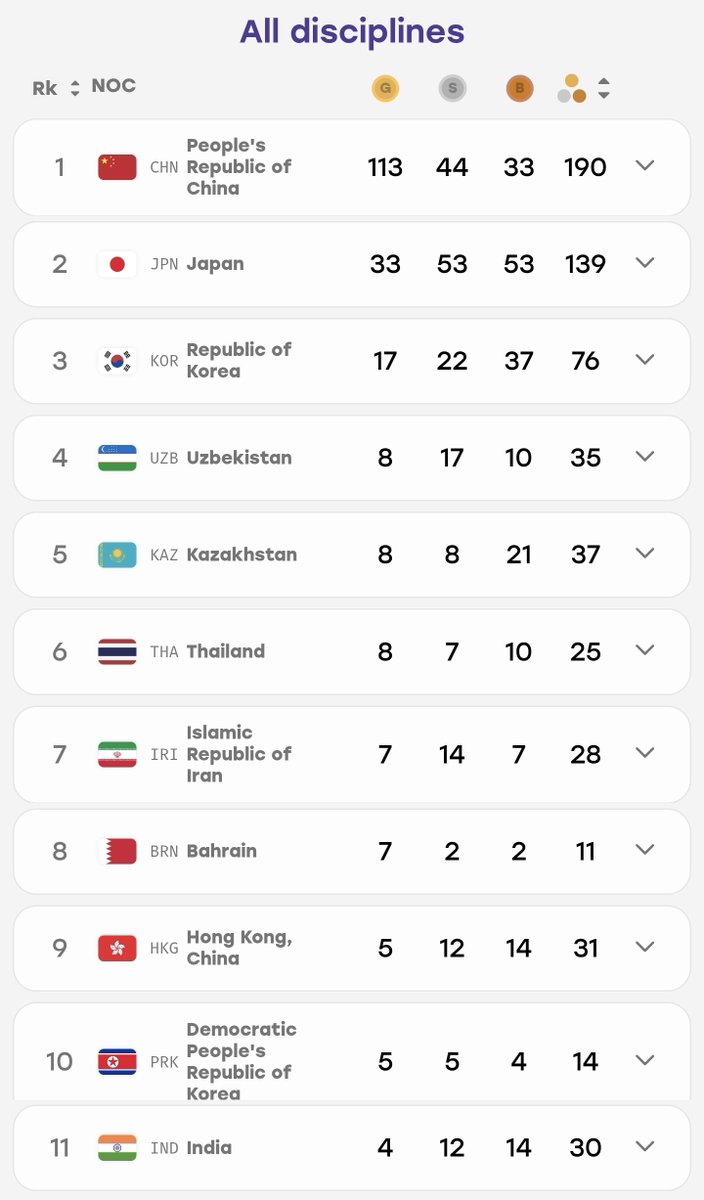
India is having a shocker of an Asian Games.
Shooters have severely underperformed and there are big question marks over the trials process. Many failed to make the finals even at an Asian level.
Last minute team changes in the rowing competition where athletes were threatened that their "future would be ruined" if they didn't comply. They've been called "anti national" for questioning the decisions.
Varun Sanyal didn't have coaches or support staff with him (was alone for his weight cut and deemed medically unfit after fainting in the sauna). But 250 'officials' are part of the contingent. Sports people or babus on Japan vacation with families?
Many athletes are on record that they found out just 2-3 weeks prior that they would be participating in the Asian Games. They simply didn't have enough time to prepare for the competition to their best ability. How can athletes win medals when they haven't prepared as well as their competition?
India is going to fall massively short of its 2022 tally of 106 with 28 gold medals.
Japan has messed up the organization of the Games, and that has hogged all the attention. But don't take your eyes away from the disaster that the Indian Olympic Association has inflicted on the atheletes and India's chances of a strong performance.
This story was narrated to us when we visited ISB for a training course. Rajat Gupta and his team has almost finalized the location for setting up the ISB when they heard this statement from Balasaheb. They developed cold feet and that's when the then AP CM (and now), Chandrababu Naidu stepped in.
He sent the state government aircraft to pick up Rajat Gupta and his team. He took them to site and asked them to set up the business school. Rajat Gupta had his conditions - complete autonomy, no reservations, no quotas etc. Chandrababu Naidu agreed to all of them under one condition - it should be a world class business school. And that's how we have the ISB. #ISB #vision
This is arguably one of the worst organised games for sure. Today the host broadcast crew tell me at Badminton that they had seen my venue travel video a tad late!
They landed up at city hall and had the same nightmare!
Read this piece by @sharmisthagoop2 for perspective.
Is Nagoya organisationally the worst Asian Games in recent memory? The organisational deficiencies have had journalists comparing these Games unfavourably with Hangzhou, Tokyo and Paris
#AsianGames@sharmisthagoop2 ✍️
https://t.co/3o2HziPCQT