जौनपुर में RTO कार्यालय के बाहर वाहन मालिक का अनोखा विरोध का अंदाज।
रजिस्ट्रेशन के नाम पर 50 हजार रुपये सुविधा शुल्क मांगने का आरोप लगाते हुए वाहन मालिक ने कार्यालय के बाहर पांच डंपर खड़े कर दिए।
वाहन मालिक और ठेकेदार विनय सिंह झगडू ने आरोप लगाया कि बाबू गणेश दत्त मिश्रा द्वारा प्रति गाड़ी रकम की मांग की जा रही थी।
विरोध में पांचों डंपर सड़क पर खड़े कर दिए गए, जिसके कारण सारा जाम लग गया।
मामला सामने आने के बाद RTO कार्यालय में हड़कंप मच गया।
PM @narendramodi Sir the cross subsidy paid by students in 50% general not govt quota should stop. Why should middle class students pay for medical education through their nose to subside the govt quota? Govt should pay the full cost of medical education for govt quota students this will cut fees for general seats by at least 50%. We need fairness in education.
Govt pays almost 90% of cost of medical education in govt colleges, why not in others too for govt quota. This burden on general seats middle class families is outrageous. Please intervene . We are promoting greater inequality due to this. Medical education cannot be preserve of parents who can pay 1cr + as fees. @mansukhmandviya@NITIAayog@sanjeevsanyal@AmitShah@nsitharaman@republic@ARanganathan72@TimesNow@RShivshankar@rahulroushan@sardesairajdeep@PMOIndia@IndiaToday
पहले देश में reforms की बात करने वाले घोषणा तो कर देते थे, लेकिन बाद में भूल जाते थे।
हमने reforms को लेकर एक clear roadmap बनाया। इस roadmap की प्रमुख दिशा रही है, Governance level के reforms!
इसके लिए आज 21वीं सदी के भारत में हम सिर्फ regulations नहीं बदल रहे हैं, हम regulations की पूरी Philosophy बदल रहे हैं।
पहले regulations की अप्रोच थी — "Prohibited unless permitted."
हम इस approach को बदलकर "Permitted unless prohibited" की तरफ ले जा रहे हैं।
- पीएम @narendramodi
For the first time ever, clean energy capacity in India has taken the top spot. That’s a 12x expansion over 25 years.
Everyone’s talking about the environmental side of this shift, & that is big, of course, but I think the real story here is grid sovereignty.
Scaling renewables at this pace moves energy away from being a volatile, imported commodity & turns it into a domestic advantage.
When 1.4 billion people pivot their base energy capacity toward clean power, it completely redefines energy security.
Huge milestone for India’s power landscape, & an even bigger blueprint for the rest of the world.
Can you guess what this number is: 43 crore?
That is 430 million. Not vaccine doses. Not Aadhaar cards. Not UPI txns this time.
That is the number of free doctor consultations delivered by a govt telemedicine platform most urban Indians have never even heard of.
It is called eSanjeevani.....
And it might be the most quietly massive digital health system on the planet, bigger, by consultation volume, than any telemedicine platform any country has ever built, public / private.
Look at how fast this scaled, most people assume govt tech moves at govt speed.
This one did not....
- 2019: platform rolled out, mostly experimental.
- Mid-2020: crossed 3 million consultations, right as COVID lockdowns hit and OPDs across the country shut their doors.
- Within a couple more years: past 120 million.
- By January 2025: past 250 million.
- By November 2025: 430 million.
That is not linear growth. That is a curve that bent hard upward because a health worker sitting in a primary health centre in rural Chhattisgarh, with zero specialists for a 100 KMs, suddenly had a video line straight to a doctor at a district hospital.
How it actually works and why the model is smart:
- It runs on a hub & spoke system. 131,000+ rural health centres (the "spokes") connect to ~17,000 hospital hubs.
- A nurse / health worker at a village level centre does the first line consultation and if it needs a specialist, they do not send the patient on a bus ride to the nearest city. They connect them, live, on video, right there.
- And this is not a niche pilot anymore, 93%+ of all usage runs through this doctor to doctor model, meaning it has become genuine day to day rural healthcare infrastructure, not a COVID-era stopgap.
A few more fascinating data points for people mostly doubting any govt run schemes:
- 57% of beneficiaries are women, the demographic that has historically had the hardest time physically travelling to a city hospital for a routine consultation.
- 12% are senior citizens. This is reaching exactly the population that private telemedicine apps, built for smartphone literate urban users with credit cards, were never going to reach.
1 of the largest single interventions in healthcare access in human history, built quietly, by an Indian govt lab (C-DAC), running almost invisibly in the background of "Digital India" headlines that usually go to UPI and Aadhaar instead.
Bharat is rising. 🙏🙏
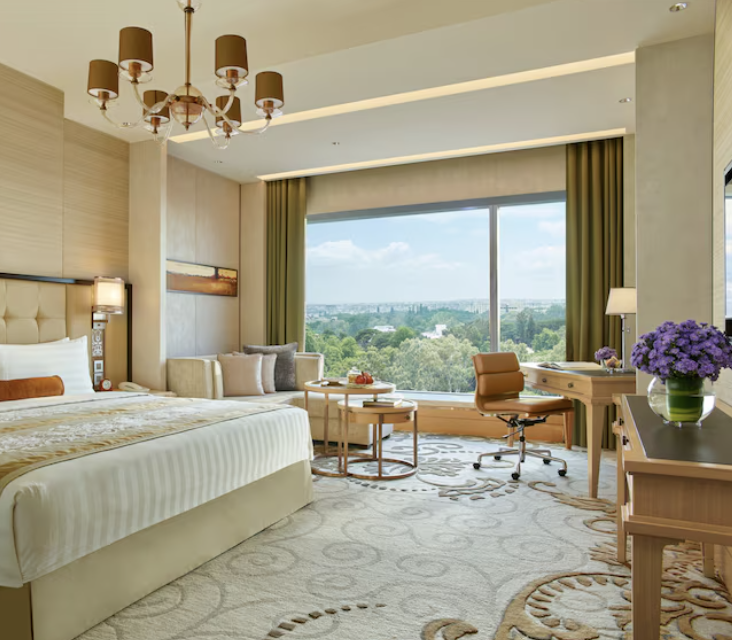
Shangri-La Bangalore will no longer be under the management of Shangri La hotels and resorts. From 1st Sept 2026 it will be managed by Alekhya property developments and will be known as ARTEZIA
We remain so obsessed with cricket we risk overlooking the hockey equation.
India’s 5-3 in Amstelveen completes a decade of complete hockey domination over Pakistan. Undefeated, with 21 games won and two draws.
A better way to understand this is the total goals scored for and against in these 23 games.
India scored 92 against Pakistan’s 33. We’ve seen many tennis score wins, 7-1 in FIH Pro League, 10-2 in Hangzhou (2023) Asian Games, 6-1 and 7-1 in FIH World League, London (2017).
And of course the 5-3 at Amstelveen.
Delhi Govt makes Biometric Attendance compulsory after a surprise check by CM found staff/bureaucrats missing during working hours.
But then; the devices start malfunctioning. Why?
Because someone is throwing water at them!
The lengths people will go to game the system.
The question is- do you need guarantees for 60% of the population?
Karnataka is the richest state in India with the highest per capita income!
Our poverty ratio as per @NITIAayog is very low! Nobody is against guarantees but guarantees for 60% of the population? We need this for the really poor! Do such a large number of women in our cities need guarantees? Do a very large no of households in our cities need 200 units of free power? Do all women in Karnataka need free transport? @lkatheeq we have 60%+ guest faculty in govt colleges whereas we need better HE for our youth. How can they get high quality jobs with low quality HE? What has govt done to promote creation of more jobs? TN is attracting more manufacturing. This is the real issue.
For last 3 years the revenue deficit is ~ 20000 cr a year. Government is borrowing to pay guarantees. Capex has not gone up much over last 3 years. We need an introspection about the future, as you have tried to do . Having KPK recommend increased taxes on citizens is not the answer. We are becoming a high cost state. I hope KPK does not recommend more taxes. That will be a disaster.
In our cities hardly 60% of property taxes is collected! When will govt become more efficient instead of borrowing more?
@DKShivakumar@CMofKarnataka
Scenes from the Shivajinagar footpaths today.
Weeks after the GBA's footpath clearance drive evicted street vendors and encroachment in Bengaluru, many are mushrooming back once again.
Most people know the story of 1947: the 565 princely states, Sardar Patel, and the unification of India. But buried deep inside diplomatic archives lies an incredible, reallife geopolitical quirk:
For 7 full years (1954-61), a sovereign, self-governing enclave existed right inside India, ruled not by the Union Government, but by a local administration that answered to no foreign power.
This was the story of Free Dadra and Nagar Haveli.....
In 1947, when British India gained independence, Portugal’s dictator António de Oliveira Salazar refused to negotiate the handover of Portuguese India (Goa, Daman, Diu, Dadra, and Nagar Haveli).
Dadra and Nagar Haveli were tiny landlocked enclaves completely surrounded by the Indian state of Bombay (today’s Gujarat and Maharashtra). Jawaharlal Nehru wanted to avoid open military conflict with a NATO member, creating a tense stalemate.
In July-August 1954, local nationalists and volunteers including the Azad Gomantak Dal, the United Front of Goans, and RSS activists such as Raja Wakankar and Nana Kajrekar executed a swift, low profile operation.
Without official Indian Army involvement, they overran the Portuguese police posts, disarmed the garrison, lowered the Portuguese flag, and raised the Indian Tricolour.
On 2 August 1954, Dadra and Nagar Haveli were declared free.....
Once liberated, a delicate legal problem arose. Portugal took India to the International Court of Justice (ICJ) at The Hague, claiming a right of passage through Indian territory to reclaim the enclaves.
If India formally annexed the territory while the case was pending, it risked international complications. So the local leadership created a de facto independent administration, the Varishta Panchayat of Free Dadra and Nagar Haveli.
For 7 years this body governed the enclave: collecting revenue, issuing orders, and running day to day affairs while remaining completely enclosed within Indian borders.
Indian civil servants quietly assisted, but the territory remained legally distinct.
By 1960 the ICJ had ruled that Portugal possessed a limited right of passage for civilians and goods, but not for armed forces or weapons. With the legal path clearer, India moved.
In June 1961 the Varishta Panchayat voted to join India. On 11 August 1961, Gujarat-cadre IAS officer K.G. Badlani who had been serving as Administrator was formally appointed Prime Minister of Free Dadra and Nagar Haveli for a single day....
As head of the independent territory, he signed the Instrument of Accession with PM Nehru.
That same day, Parliament passed the Constitution (Tenth Amendment) Act, 1961, integrating Dadra and Nagar Haveli into the Union of India as a Union Territory.
For 7 years an independent pocket of land existed inside India, governed by its own local body and shielded by careful diplomacy. And for 1 extraordinary day, an IAS officer stood as Prime Minister of that free territory just long enough to hand it over to the Republic of India.
It remains one of the quietest, cleverest, and most elegant manoeuvres in the story of India’s territorial unification, a masterclass in patience, legal precision, and quiet resolve.
I salute Inspector Santosh Vaijnath Kendre of the Maharashtra Police’s Special Protection Unit for showing heroic courage in saving Sukhbir Singh Badal ji’s life during the attack in Nanded.
Santosh, you stood like a human shield between Sukhbir ji and the attacker, putting your own life at risk to protect his. In doing so, you reminded us of what it truly means to wear the uniform — to put duty before self and courage before fear.
The Badal family bows to you with deepest gratitude. Your bravery will never be forgotten. May Waheguru bless you with a speedy recovery.
Also, a special mention for the doctors and the entire staff at the Yashosai Hospital for their relentless service in comforting us 🙏
Department of Expenditure had issued a clear and unequivocal advisory on how consultancies are to be awarded government contracts. In particular, it states that qualification criteria for government contracts should be commensurate to the project. Till now it was common for eligibility to be restricted through unnecessarily high turnover and payroll requirements that could only be met by a tiny club. This levels the playing field for Indian consultancies and new entrants.
#BREAKING
Bengaluru could soon charge up to Rs 25,000 a year to park on residential roads
Residential permits: Rs 15,000 for small cars, Rs 20,000 for sedans, Rs 25,000 for SUVs
On-street parking: Rs 40 to Rs 80/hour for cars, Rs 20 to Rs 40/hour for two-wheelers
The draft policy was issued on August 11. The public has 30 days to submit objections
In 2008, the travel story was Europeans flying to New York to shop. The euro hit $1.55, the dollar was weak, and Manhattan felt like an outlet mall to anyone paid in euros. 18 years later the Wall Street Journal is writing about the unstoppable American tourist, and Portugal grew American visitors 5x in a decade.
The whole boom is one chart wearing a vacation outfit.
In 2008, the EU economy was 131% the size of the US economy. Today it's 71%. Europe went from a third bigger than America to a third smaller in the span of one iPhone.
Per person it gets worse. EU GDP per capita was 76% of America's in 2008. By 2023 it was 50%. Half. The average American now out-earns the average European by more than the average European earns.
In 2000, France was as rich as the 36th richest US state. By 2021 it had fallen below Arkansas. Germany dropped to Oklahoma. Italy sits below Mississippi, the state Americans use as the punchline for poor.
A software engineer in Lisbon earns €35,000 to €40,000. The same engineer in New York clears $170,000. Same job, same laptop. He books a month in Portugal, eats out every night, and his bank account grows.
If the trend holds, by 2035 the US-Europe income gap equals the gap between Japan and Ecuador today.
Europeans flew west in 2008 because of a currency blip. Americans fly east in 2026 because an entire continent's paycheck stopped growing for a generation. Only one of those trips ends.
Karnataka has prohibited manufacture, storage, distribution, transport & sale of gutkha and pan masala containing tobacco and/or nicotine across the state for one year.
The ban also covers products sold separately but marketed/distributed in a manner that facilitates mixing by consumers.