Regret the tone of my post on data centers yesterday.
What I should have said:
There were reasonable concerns about data centers 18ish months ago: water, taxes, jobs, electricity prices, the environment and what they would do to small towns. Well-structured data center projects have largely addressed these concerns today and we should be celebrating this.
On balance, data centers are awesome for America in every way.
On water: U.S. data centers use a fraction of what golf courses use. A lot of the numbers from 18 months ago were off by over 1000x. Newer data centers use closed-loop systems or recycled water. Should be required by every town approving a data center project.
On taxes: looking only at sales-tax exemptions, as Ronan Farrow did, is the wrong way to evaluate this. Data centers pay significant property taxes. Loudoun County, which is the wealthiest county in America, now collects on the order of $1 billion a year from data centers. In Quincy, WA, data centers are more than half the property-tax roll. Over time, property taxes can go to zero while government spending increases in these towns.
On jobs: this has been unambiguously awesome for blue collar Americans. Demand for electricians, plumbers, welders, HVAC techs, and contractors has gone vertical, and it is not a one-time construction job. These buildings get upgraded and expanded over time. That is why the building trades are fighting for them, and why some unions are now treating opposition to data centers as a reason not to endorse politicians.
On power: the original fear was that households would pay for the incremental electricity demand in the form of higher prices. That is why the ratepayer-protection deals and the new large-load tariffs exist. The right structure is: the data center brings or pays for new generation and signs a contract long enough that existing customers are protected. Where that is happening, utilities are cutting or freezing residential rates and saying so on the record. Where it is not, people are right to object. Electricity prices are going down *today* in a number of large states because of data centers.
On the environment: data centers overwhelming use natural gas today, which is the cleanest power source outside of nuclear, solar and wind. And the companies that are building the data centers are committed to carbon neutrality such that an equivalent amount of solar will likely be built. Maybe more importantly, the data centers need batteries to function effectively and these batteries can also sell energy back into the grid (which recently prevented blackouts in Texas). Over time, data centers will run on solar plus batteries.
On the towns: Poverty in Quincy, WA fell from 29% to 6%. Data center taxes paid for a new high school, a hospital, a library, police and fire stations. This is happening in many left for dead former mill and farm towns that had no other bidder for the land.
Data centers are actually reindustrializing parts of America and creating the kind of working-class jobs both parties have spent decades claiming to support. That should not be a partisan issue. Data centers can and should be awesome for America and they increasingly, overwhelmingly are. Supporting the outsourcing of data centers to China will likely age just as well as support for the outsourcing of high quality, blue collar manufacturing jobs to China has aged.
When the facts change, I change my mind. I hope that reasonable people who had good faith reasons to oppose data centers at least consider updating their beliefs given the change in the facts over the last 18 months. This really matters for America.
I will say I also think the idea of making data centers beautiful is a good one that has yet to be implemented. Data centers should be just as beautiful as Grand Central Station. We can learn a lot from the railroad buildout. Neoclassical revival ftw.
Might write up open-weight AI tomorrow as this is equally essential to America.
$IREN: Performance Target for CEO RSU Compensation - Calling All Retail
I support @neel_epochal's call that we need to attach a performance target for each of @danroberts0101's and Will's 9.1m share compensation package.
I believe in $IREN hitting $150, shouldn't Dan and Will? If Dan and Will do what they claim, then $150 is a nothing burger. Even by 2027 when their first tranche vests. Can Dan and Will please consider adding a $150 stock price target as a performance metric for their RSU compensation package? This will instill confidence in retail that has supported them for years.
I am a small retailer with 37.2k shares. I can confirm @neel_epochal has 703k shares. There are significant retail whales with one person at 3m+ common shares. Can we get @leopoldasch whose fund owns 11m shares to support this?
Poll in quoted post since X didn't let me attach poll to long post.
June 5, 2026 Scrapes:
Between my wife and I we made the following scrapes today. We have a small cash position ~2-3% of our portfolios that we use to do short term trades.
IREN
Using position cash, I sold to open Cash Secured Puts for $IREN $55 expiry 9/18 for ~$13 premium.
Possible outcomes are:
1. Most like IREN will bounce and I will close at $7-8 for $500/$600 for each $5.5k used to secure the PUT. 10% profit in ~1-2 weeks.
2. Not my choice of trade but I can wait until 9/18 and if IREN is above $55, I collect 23% profit in 3.5 months. I'd rather do 1 and then look to use spare cash conduct another scrape trade on IREN or OUST.
3. If macro tanks or some market calamity reason, I spare cash buys IREN for effectively $42.
I have two batches of $IREN $54 CSP expiring today and next Friday. This is effectively my cash position so if I get assigned I will just roll into tight CC for good premium.
I target $53 mid term support for my CSP targets, sometimes selling $54. If IREN is too high to sell CSP, I sell OUST CSP which I do have some open right now.
ORCL
Closed batch of $320 9/18 ORCL CCs. We had previously closed batch of $350 9/18 ORCL CCs earlier this week. My wife opened these beginning of week and was able to play the huge premium swing this week on 50% of her entire ORCL position.
I truly cannot understand why there is so much argument between $IREN and $NBIS clan.
I used to be an $IREN shareholder, I exited as I wasn't comfortable with some things. I still think they can execute. I'm not a fan of every person on their board, but it is what it is. I still swing trade $IREN and who knows maybe I return depending on how the risks I identified develop.
On the other side, it is completely fine to congratulate $NBIS on their execution. Some $IREN bulls are so obsessed into turning every positive of $NBIS into something bad, and if we look for months now that was complete bs.
Also, a few $NBIS bulls are doing the same (I'm pretty sure IREN clan knows exactly who that is lol). Criticising $IREN for the same moves $NBIS is doing.
It's not a zero sum game. Both companies can do well long term. It doesn't have to be one or the other. I truly want you both to succeed. Not being in any of these names, I think I can provide an unbiased opinion based on fintwit sentiment.
Please brothers, stop arguing all the time. If someone shares a bear take on your company, take it as a friendly tip to verify your bull case.
Your time is too precious to waste it on online arguments, but that's just me.
Much love y'all.
$NVDA isn't just a "partner" of $IREN, they are a CUSTOMER!
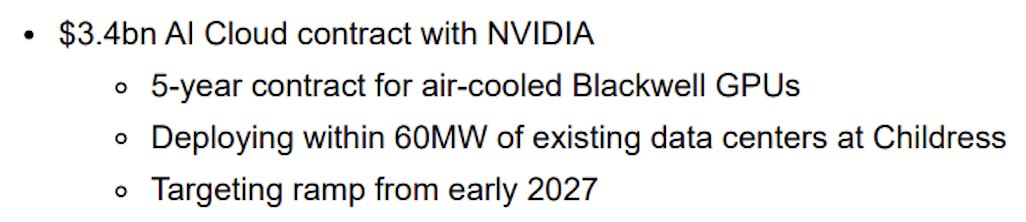
They just signed a 5-year, $3.4b contract with $NVDA to deploy 60 MW of air-cooled Blackwell capacity at the company's Childress (TX) campus.
HOLY SHIT. This is an insane turn of events... 🤯
Overnight, $IREN traded almost AUD $10 billion in a single session on the NASDAQ - more than the entire @ASX's on-market daily turnover of AUD $7.5 billion.
I'll be honest. That number is humbling. But it also stings a little.
Because two and a half years ago, we were told we weren't welcome on the ASX.
The rejection was disappointing - not just for what it meant for us as a company, but for what it said about Australia's willingness to back next-generation technology at scale. We believed then, as we do now, that the future of digital infrastructure and compute deserved a place in Australian capital markets. Apparently, the feeling wasn't mutual.
But we never gave up on Australia.
We have continued to try and do business here. We have several large-scale data centre development sites across the country, and our commitment to building world-class, renewable-powered infrastructure on Australian soil has never wavered.
Australia has everything it needs to be a global leader in AI infrastructure - the land, the renewable energy, the engineering talent.
The permitting and regulatory process remains our biggest challenge - and I won't pretend otherwise. It is slow, complex, and at times deeply frustrating for a business operating at the speed that AI demands.
What it needs now is the regulatory and policy environment to not miss out on this opportunity.
But we are working through it, and when we get to the other side, we are ready to accelerate.