We bring unbiased clarity to chaotic markets by delivering sleek financial analysis. Plus, we drop insightful market commentary to keep you well-informed.
We’re excited to introduce our new Global Stock Screener, the most powerful and intelligent screener ever built.
Find global stocks using natural language.
Quickly discover stocks using over 550 metrics and 8,000 filters, all simplified for precision and ease.
$KOSPI - Pullback to 40wk ma, time to buy?
"South Korea plans to inject 20 trillion won ($13.9 billion) into its sovereign wealth fund for strategic investments in AI, data centers and infrastructure, expanding its mandate to include domestic assets for the first time" - BBG
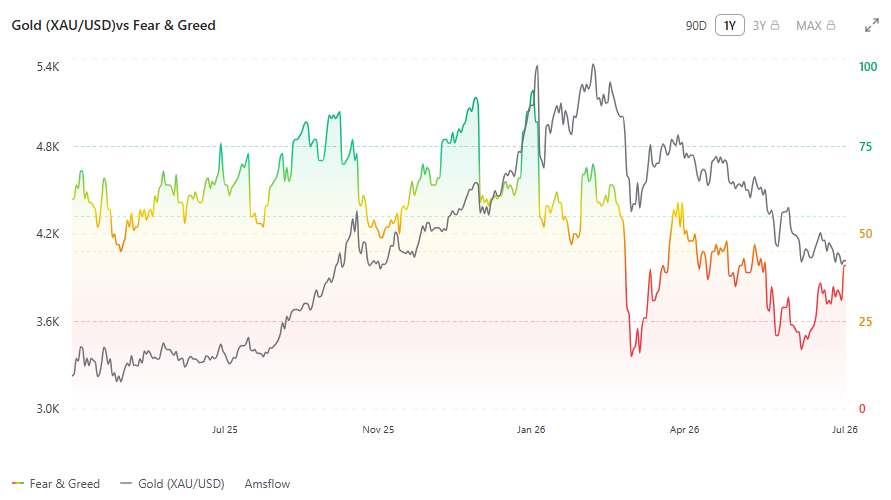
Złoto spadło prawie 30% od szczytu. Indeks strachu dla złota przestał obsuwać się niżej. Czy to dobry czas na zakupy?
Gdy końcem 2025 złoto wchodziło na nowe maksima, cena przebijała $5,000, każdy chciał mieć złoto. Pojawiło się dużo osób, które uznały ten rynek za niedowartościowany.
Teraz, gdy cena jest prawie 30% niższa, hype zniknął.
Zobacz co się działo z indeksem chciwości i strachu na szczycie. Gdy złoto przebijało po raz pierwszy barierę $5,000 (styczeń), chciwość była ogromna. Ale już za drugim razem (luty), poziom chciwości był znacznie mniejszy. 'Wszyscy' siedzieli załadowani w złoto i czekali na dalsze wzrosty.
Teraz sytuacja jest odwrotna. Spadki w lutym i marcu 2026 były jak kubeł zimnej wody na rozpalonych inwestorów. W marcu ekstremalny strach. Złoto spada, choć 'nikt' się tego nie spodziewał. W lipcu złoto jest jeszcze niżej, inwestorzy nadal się boją - ale już nie tak mocno jak wcześniej. Pomimo nowych minimów, podaż przygasa.
Czy mniejszy strach na złocie, pomimo nowych minimów, zapowiada ruch w górę?
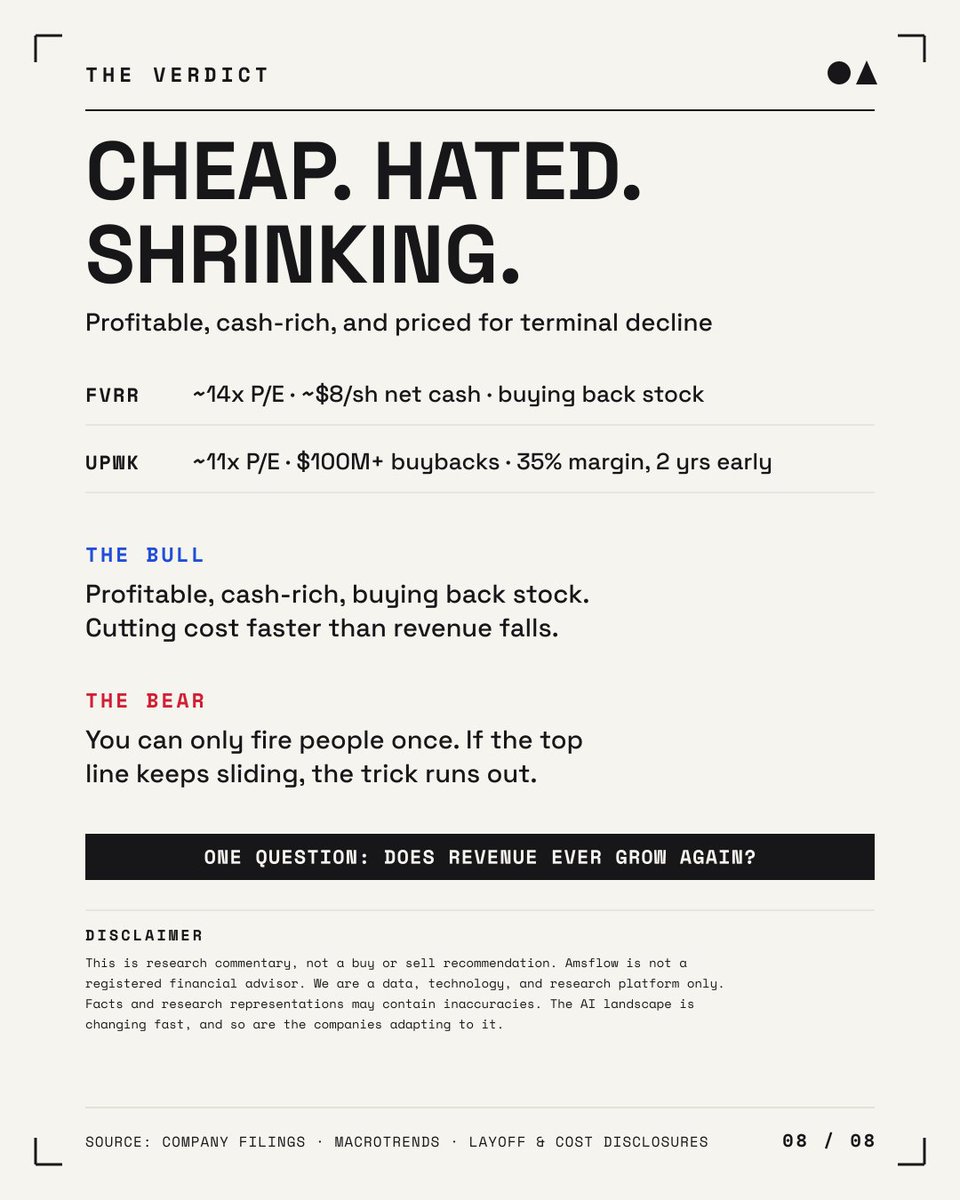
So where does it land? No spin.
Bull: profitable, cash-rich, buying back stock, 11-14x, cutting cost faster than revenue falls.
Bear: you can only fire people once. If revenue keeps sliding, the trick runs out.
Both true. The whole debate reduces to one question: does the top line ever grow again?
Right now, it isn't.
Two companies the market says AI killed.
Fiverr $FVRR and Upwork $UPWK have lost ~$18 billion in value since 2021. Around 90% of what they were worth.
But their profits went UP.
Here's what actually happened, in numbers.
Here's the irony that makes this the cleanest AI case study on the market.
AI is eating their low end: translation, logos, simple code, blog posts, all done in ChatGPT and Claude now.
AI is also their only growth: Fiverr's demand for Claude Code specialists is up 938% in six months.
Upwork's AI-work volume is up 40%.
The threat and the lifeline are the same thing.
We ranked 15 software categories by two numbers nobody puts side by side: your odds of ever reaching profitability, and how much of the outcome is pure luck.
The spread is brutal. Consumer social sits at 5% odds and 95% luck, one postmortem dataset alone counts 134 dead social startups and $4.1B burned trying to crack network effects. Vertical SaaS sits at the other end with 75% odds and 15% luck, and the market knows it: public vertical SaaS trades at 11x gross profit vs 5x for horizontal. Investors pay double for a dollar of predictable profit.
The strangest row is edtech. Low luck AND low odds. Every other category is at least gambling. Edtech is the only one that fails predictably. Full methodology and sources on the sheet.
The catch is the one that always haunts memory: this is the most cyclical business in tech.
Micron is now a roughly $1.35 trillion company near an all-time high, on margins that went from 39% to 85% in a single year.
Those $100B in customer agreements are take-or-pay, so customers can still walk if demand softens. New fab supply from Micron, SK Hynix and Samsung lands around 2028. Incredible quarter, but the cycle still exists.
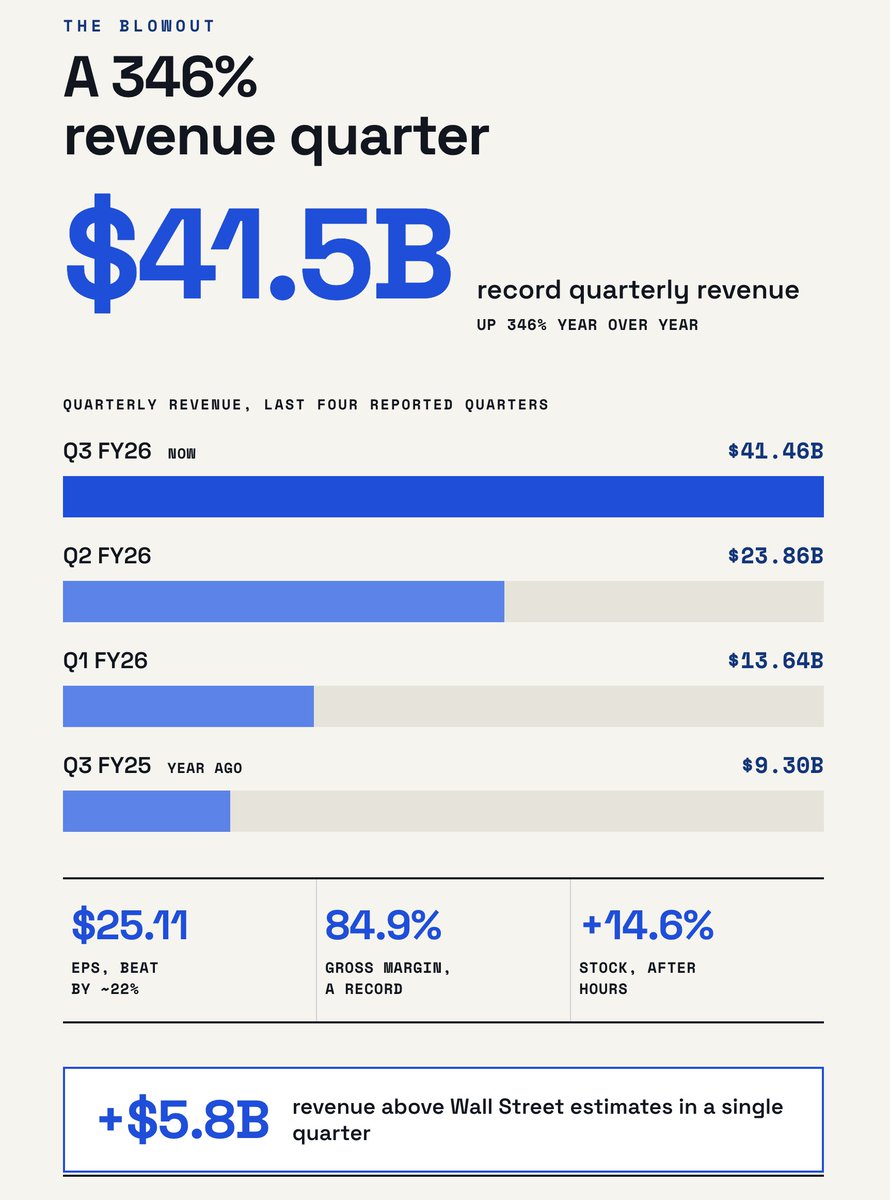
Micron just reported, and it is one of the most absurd earnings beats you will ever see. $MU did $41.5B in revenue last quarter, up 346% from a year ago.
EPS came in at $25.11 versus $20.49 expected. Gross margin hit a record 84.9%. The stock jumped about 15% after hours toward an all-time high.
Why is this happening? AI created a memory shortage with no quick fix. Data center was $25B of the quarter, about 60% of all revenue, now an annual run rate above $100B.
Demand keeps outrunning supply, and Micron expects conditions to stay tight beyond 2027. Customers are even prepaying.
Micron has signed $100B of take-or-pay supply agreements, with $18B in cash deposits already down.